
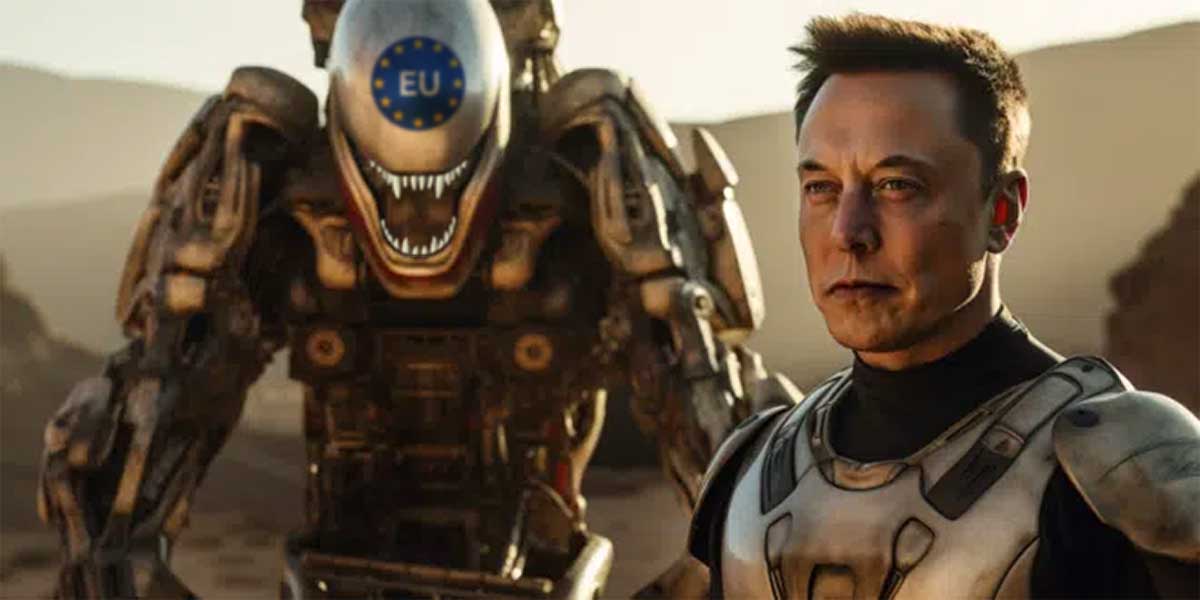
The latest salvo in the ongoing battle between Elon Musk and the EU came from the X owner himself. He revealed that in the run-up to the European elections, X declined to participate, but all other major platforms accepted the deal.
Thomas Fazi, 20 JULY 2024
Translated from unherd.com (after a reader tip)
The EU's war on freedom of expression
Elon Musk cannot win this battle
Musk's revelation came shortly after Thierry Breton, the EU's censorship czar, the preliminary findings of the Commission announced that X's new “blue check” verification system violated the DSA. Since anyone can now sign up and achieve “verified status” – unlike Musk, when the platform arbitrarily decided who was worthy of the coveted blue checkmark – this, he says, undermines users' ability to make informed decisions about an account's authenticity.
The Commission also accused She urged the company to address such breaches or face a fine of up to 6% of total global annual revenue, which was about $3.4 billion in 2023. Non-compliance may result in X being banned from operating in the EU altogether.
The Commission's reasoning is that it is all about “transparency” and protecting users from deception and disinformation. But the truth, as Musk suggests, is that this is actually about the EU's desire – and the DSA's ultimate goal – to secretly control the online narrative. So much for transparency.
This mission to censor is backed by Mike Benz, a former Trump official and cybersecurity expert who claims that “giving researchers access to X's public data” is not as benign as it sounds. In fact, it's a cover for the EU's attempt to “use the DSA to force X to restaff the censorship team that was fired when Elon took over.” Elon fired the team because, like, the Twitter Files revealed, their sole purpose was to respond to government requests for censorship. Hence Benz's claim that these “researchers” are actually “political agents.” Musk repostte Benz's one-word analysis commented – “Exactly” – adding that if the EU takes enforcement action against X, he will take them to court.
The language and accusations are not new. The ground rules for this battle were laid when Musk took over Twitter and tweeted “the bird has been freed.” Breton replied immediately: “In Europe the bird will fly according to our rules,” with a reference to the DSA, which was officially signed into law that same month.
Although Musk initially promised to “respect future European regulations,” the honeymoon did not last long. In May 2023 he withdrew from the EU Code of Practice on Disinformation, which was initially voluntary, but subsequently in fact was made legally binding under the DSA. This led to an investigation in December into whether the platform violated the DSA in areas such as “risk management, content moderation, dark patterns, ad transparency and data access for researchers.” Last week it was concluded that this was indeed the case, hence the latest showdown.
It's hard to see how Musk can win this battle. Especially when you consider that his pro-free speech has not only pitted him against the EU, but also against a number of other governments around the world. Musk has “takedown” requests challenged in Brazil, India, Australia and Turkey and has even challenged some of these requests in national courts. In almost all cases, however, the platform has responded to governments' requests. From one report Last year it even turned out that X under Musk had approved more than 80% of government censorship requests.
“It's hard to see how Musk can win this battle.”
So even as Musk publicly challenges the EU, he deletes posts – as many X users have regretted – for non-compliance with the DSA. For example, on October 10, days after the Hamas attack, Breton issued a warning to Musk over alleged “disinformation”; X responded by immediately remove or flag tens of thousands of pieces of content.
However, accusing Musk of hypocrisy would be missing the point. Complying with these requests is often the only way the company can continue to operate — and at least Musk, unlike the other major platform owners, has made online censorship public. The publication of the groundbreaking Twitter Files revealed the shocking level of collusion between the US government and social media companies.
But more importantly, Despite censorship, remains the only platform where information can flow relatively freely. In fact, it remains the greatest threat to the establishment's desire for complete control over information – which is why it is being tackled so harshly. But one man, no matter how rich or powerful, cannot be expected to single-handedly take on some of the most powerful governments in the world – let alone the European Union, the world's most influential supranational institution.
There is another factor to take into account. The global assault on freedom of expression is not just the whim of unhinged, power-hungry politicians and bureaucrats. It is a systemic problem related to the structural decline of liberal democratic institutions, especially in the West. As our societies degenerate into de facto oligarchies controlled by increasingly delegitimized political-economic elites, manipulating public opinion – not only through propaganda through traditional mass media channels, but also increasingly through monitoring and micromanaging the public conversation taking place on social media platforms – is increasingly seen as a necessity to keep the status quo safe from the threat to democracy. This is further exacerbated by the increasing militarization of the geopolitical context, which requires an even more compliant population given the political and economic consequences.
It's no coincidence that it censorship-industrial complex began to emerge in the second half of the 2010s. This was a time when the West was rocked by an unprecedented “populist” reaction against globalization and the neoliberal order – Trump, Brexit, the Yellow Vests and the rise of Eurosceptic parties and movements across Europe.
It was also the moment when the path of future confrontation with Russia was laid in Ukraine – and when NATO began developing the hybrid or cognitive warfare doctrine, which conceptualizes the management of Western public opinion as an integral part of warfare. As Jens Stoltenberg, the former Secretary General of NATO, put it in 2019 expressed: “NATO must remain prepared for both conventional and hybrid threats: from tanks to tweets.”
If we expect to watch Musk fight for us, we have already lost.
The Covid-19 pandemic, which saw massive online censorship applied for the first time, bought Western elites some time. But not for long. Today, a “populist” backlash is sweeping the West again: Right-wing populist parties are emerging across Europe and Trump is on track to win the next US elections. Meanwhile, escalating tensions in Ukraine have exploded into a not-so-proxy war between NATO and Russia. From the perspective of Western elites, all this calls for a doubling down on the censorship regime, with one big difference: online censorship used to take place behind closed doors, outside the law and in a context of plausible deniability on behalf of governments; today it is institutionalized and constitutionalized through instruments such as Digital Services.
Elites conveniently justify their censorship in two ways: by continually expanding the scope of “hate speech” to include almost everything; and, even more ominously, by labeling critical opinions, especially on foreign policy and geopolitical matters, as “disinformation” or examples of foreign interference. It is no coincidence that the very first DSA-rapport of the European Commission was entirely focused on the issue of “Russian disinformation”. Tellingly, the report places “Kremlin-backed accounts” – potentially any account critical of NATO – almost on the same level as accounts linked or associated with the Russian state.
This deliberate blurring of the lines between illegal and harmful speech, and between critical opinion and foreign propaganda, is central to the censorship regime, because it allows EU elites to determine what hundreds of millions of Europeans can and cannot say and read online. It's state-sanctioned censorship, plain and simple. And it should come as no surprise that the biggest threat to freedom of expression today comes from the EU: after all, the bloc's entire institutional architecture is designed to restrict democracy by transferring power to unpredictable elites who are largely isolated from the people. In turn, the top-down imposition of unpopular policies on the people of Europe inevitably leads to resistance, which then requires the suppression of free speech to counter the resistance. It's a vicious feedback loop.
This kind of mass censorship should really be seen as the last line of defense of a desperate oligarchy – and no one sums up this oligarchy better than Breton himself, a former businessman and military and intelligence contractor turned technocrat-in-chief. If this were a movie, you couldn't imagine a better choice than him as the arch-enemy of the populist rabble-rouser Musk. But it's not a movie. This is a battle that will determine the future of democracy for years to come. And if we expect Musk to fight for the rest of us, we've already lost.
Thomas Faziis a columnist and translator atUnStove. His latest book isThe Covid Consensus, co-written with Toby Green.
 battleforeurope

X is one of the few places where both sides of the polarization “meet” (name calling often). They (from the DSA'84) are apparently afraid of losing sheep.
How do we keep “public” opinion on track? Both come from the same pot, keep people “stupid, ignorant”. Musk was the first private institution to make an agreement in 2017 with the “government” to launch satellites (60,000) around the Earth. The number is now 40+ thousand and is increasing more slowly to reach the number mentioned above. He was/is the first “private” organization that “got” the green light to launch satellites. This gave the “public” the idea that he was in favor of open communication on the internet without censorship/control. However, everything that was discussed on X was saved. He played on/with X, the “opponent”, but was just another pawn to keep an eye on everything.