


Summary
The widely held consensus on the importance of regaining trust in government should not result in an attempt to change citizens' perceptions rather than introspection and change within the government itself. Only special attention to a transparent government can improve the relationship with the citizens.
Recent affairs and crises have exposed the government's lack of transparency about its actions and decisions. This lack of openness is at odds with the promises of parties such as VVD and D66, which emphasize transparency and reliability in their election manifestos. In reality, the government makes major mistakes and tries to cover them up or not actively remember them, leading to a loss of trust and a democratic imbalance.
A thorough evaluation of the corona policy, in contrast to the expected regaining of citizens' trust, will justify the need for more distrust of the government. This distrust is desirable. It is an essential part of a healthy democracy, in which the government must be critically monitored and controlled. It is precisely a lack of distrust that has contributed to government missteps, with the media playing an important role in maintaining this lack of critical attitude.
Reforms within the government and the media are necessary to create a healthier balance of power and more transparency. A true democracy depends on a critical, vigilant and, above all, informed citizenry.
Politieke partijen, de ombudsman, NPO, landelijke dagbladen: iedereen is het met elkaar eens over één onderwerp en dat is... nee, niet "bestaanszekerheid" maar: "terugwinnen van het vertrouwen in de overheid". Dat geeft aan dat de prioriteit ligt bij het veranderen van de houding van de burger. Het handelen van de overheid is vooral instrumenteel, om die verandering teweeg te brengen.
That is not a confidence-inspiring approach. You would expect introspection: what did we do wrong, how can we structurally correct it? How can we guarantee transparency and thus show that we are becoming a little more reliable again because we are making adjustments thanks to criticism from outside?
This is not necessary for the media. They consider system criticism 'extreme right' and 'anti-democratic'. They support the incumbent parties and they prefer to keep the troublemakers at bay. According to them, the problem lies on the side of the disobedient citizen who refuses to trust the government.
Say what you do
"Ik zeg wat ik denk en doe wat ik zeg" zei Pim Fortuijn. We zijn inmiddels aangeland bij een overheid die niet zegt wat ze doet, dat is een paar stappen verder. Als je vraagt wat ze gedaan hebben en waarom, dan zwijgen ze in alle talen, terwijl dat het enige is wat telt: transparantie. Als je weet wat er gebeurd is en waarom, kun je beoordelen of ze hebben gezegd wat ze dachten en gedaan wat ze zeiden. Zelfs Woo-verzoeken worden genegeerd of gesaboteerd.
Do cabinet trendsetters VVD and D66 say what they do?
VVD writes in its election program: "De overheid moet dienstbaar, betrouwbaar en transparant zijn. De Tweede Kamer moet zijn controlerende taak goed kunnen uitvoeren en zich richten op het controleren van de regering." It's literally there. There has to be so much. If you weigh this statement against the behaviour of the Rutte cabinet, you can only conclude that message and reality are far apart in the VVD. The VVD is clearly not acting on its word. Where is the reliability factor?
From the party program of D'66: "Als mensen niet worden beschermd tegen willekeur en misbruik van de macht faalt de rechtsstaat [...] De basis moet op orde zijn: goede dienstverlening, transparante verantwoording en begrijpelijke communicatie." How does good service match with draconian policy, how transparent is it to keep policy processes at bay with underlying data and models, and do they perhaps mean by understandable communication that it should be clear that someone's position is at risk if they think they know something better (or even: they really know much better) than government officials? Does establishing behind-the-scenes censorship on social media and job insecurity in the event of criticism perhaps fall under 'understandable communication'? No trace of introspection there either. They write that they have learned from the benefits affair, but the past period has shown that nothing at all has been learned from the benefits affair. All important corona cards are still kept close to the chest, despite WOB requests.
In other words, the government is making big mistakes, covering them up, thereby forfeiting trust and then believes that the perception of the public needs to be adjusted. The regency disdain splashes off: if we play the masses, it will be all right again. They count on their most important pillars: Volkskrant, NRC, Op1.
Anyone who trusts a government that behaves in this way is not a democrat. A democratic government exists by the grace of opposing forces. That whole dynamic has been sidelined. We have repeatedly seen how cabinet members turned away when the opposition had the floor - and how the Speaker of the House let that happen. A power-hungry majority kept everything in check with a mutual compromise of principles.
Maybe they all want to, but they simply can't withstand the forces of power.
The Fourth Wave plays controlled opposition
Trouw published a sympathetic opinion piece by Stan Baggen and Peter van der Vlis, lawyers. The two main pillars of their argument: "Een publieke evaluatie [van het coronabeleid] kan vertrouwen terugwinnen" and "Een gebrek aan vertrouwen erodeert de democratie".
A thorough evaluation will do the opposite: it will force us to face the facts that democracy no longer works and that this is precisely because of a lack of distrust of government policy and the suppression of that distrust.

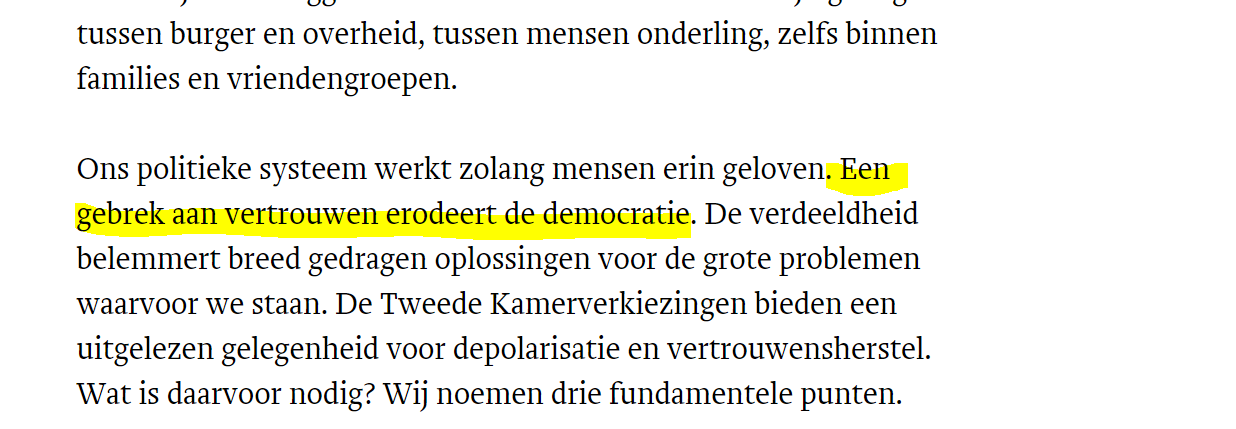
Two excerpts from the plea of Baggen and van der Vlis in Trouw
"Een publieke evaluatie kan vertrouwen in de overheid terugwinnen."
Baggen/van der Vlis in Trouw
'Regaining trust' is a nice constructive thought, but one that does not sufficiently demonstrate the realization that, unlike entrusting power, holding on to power is intrinsically evil. Power is like priority: you have to get it, not take it. Exercising power over others is limiting the sovereignty of those others. This means interfering with individual freedoms and (human) rights. Centralization of power is at odds with self-determination. This applies at an individual level but also on a larger scale: for example, the EU curtails the sovereignty of member countries. Government representatives are inclined to sign the cross, because that offers more security from a career perspective. Interests are intertwined there and it goes without saying that centralized interests outweigh local interests many times over.
'Regaining trust' is a nice constructive thought, but one that does not sufficiently demonstrate the realization that, unlike entrusting power, holding on to power is intrinsically evil. Power is like priority: you have to get it, not take it. Exercising power over others is limiting the sovereignty of those others. This means interfering with individual freedoms and (human) rights. Centralization of power is at odds with self-determination. This applies at an individual level but also on a larger scale: for example, the EU curtails the sovereignty of member countries. Government representatives are inclined to sign the cross, because that offers more security from a career perspective. Interests are intertwined there and it goes without saying that centralized interests carry much more weight.
A public evaluation will become a justification for a more suspicious attitude.
Trust in The System or in the officials?
'Regaining trust' is based on the somewhat naive belief that not only the officials within such power systems need to be trusted again, but also the system within which power-hungry career hunters could do their thing. Checks and balances bleken rituele dansjes. Toch worden we weer gemaand om te geloven dat degenen die nu onjuiste beweringen doen om hun gezicht redden, in een nieuwe periode ineens wél de krachten kunnen weerstaan van Het Systeem. Let wel: Het Systeem waar zij zelf aan bouwen en dat hen een positie biedt. Politici noemen al die posities samen zelfs een "Huis". Daar gaan ze de fundamenten heus niet onder wegspoelen. We moeten hen op hun blauwe ogen geloven dat ze vanaf de volgende kabinetsperiode integer en transparant zullen handelen binnen een zelfcorrigerend systeem, ook als ze de zaak volkomen in het honderd laten lopen en er vele levens met hun fouten zijn gemoeid. Als ze nu dan maar maar sorry zeggen. Zand erover...
It's unfortunate, but that's not how it works.
It has become apparent whether people have acquired, stolen or inherited power: you should always distrust them. Those in power shrug their shoulders about, for example, a missing €5.1 billion. Without blinking an eye, they simply communicate on television that that is not true. Such an action at least sows doubt, because we trust politicians, right? It is also polarizing: proponents see their confidence confirmed ('the minister says so himself!'), opponents are strengthened in their skepticism.
They brush aside tens of thousands of unexplained deaths after vaccination, lives are destroyed - and it is not the first affair in which unscrupulous action is taken and facts are withheld or distorted.
Why should that trust be restored? It is precisely misplaced trust that allowed all these mistakes. The gullibility knew no bounds. The citizen should have been helped in this by the media, but what happened there requires an evaluation in itself. See also Tijs van den Brink, who calls TV virus chef Ab Osterhaus 'one of the best virologists there is'. The collective blindness is truly unimaginable.
With a thorough evaluation of the corona policy, policymakers are not only sticking their own necks in the noose. It will also be exposed that The System offers no protection against fatal blunders and the subsequent covering up of them for years, despite the fact that the stain in which they are rubbed is getting bigger and bigger. Anyone who is under the delusion that officials are going to poison the well from which they feed has too little life experience.
Where the belief that our political system will protect us from disastrous missteps next time comes from is nowhere explained. The mechanism behind 'more trust' is therefore not clear.
A different system design doesn't solve that either. The current design may not even be that bad. A constitutional court could be an improvement, but in the countries around us it has not been of much use either.
It is unavoidable that wrong turns are sometimes taken in terms of policy and the policy elite holds the collective umbrella even more tightly when it storms. That's where things go wrong. They tamper with the transparency that should be inherent to The System, and with social and scientific rules and principles, making something like 'accountability' nothing more than a show, a ritual puppet show. That is precisely why distrust is the only remedy. If you want to make it sound more positive, you can also call it 'control' or 'critical monitoring'.
What does an evaluation bring about?
The corona period has been an unprecedented stress test that has brought a lot to light, but only for those who want to see it. An in-depth public evaluation will also confirm for those who do not yet see it that way, that a government never deserves trust, even with formally built-in control mechanisms. The cross-border policy that The System has produced during that stress test has been too damaging, its cover-up too shameful. A proper evaluation by the government is therefore impossible, simply because it would jeopardize the interests of the State. The State could declare itself incompetent and de facto wipe out all accumulated authority and that is not in the interest of the State, however justified it might be. (Also note that the interest of the State has become a different interest than the interest of the population.)
Minister Kuipers beriep zich dan ook op het Staatsbelang toen hem werd gevraagd waarom bepaalde data en afwegingen niet vrij beschikbaar waren. Het is een geloofwaardigere reden dan het eerdere "om privacyredenen". Als die informatie namelijk duidelijk maakt dat je de boel belazert met Het Systeem als dekmantel, dan is het in Staatsbelang als je jezelf als centrum van dat belang ziet. Weer een cruciale denkfout.
Een evaluatie zal aantonen dat Het Systeem 'De Staat' monstrueuze fouten niet heeft kunnen voorkomen, of die nu voortkwamen uit incompetentie of uit goede bedoelingen. Dat wordt achteraf verbloemd door pijnpunten te ontwijken en te vergoelijken, zie bijvoorbeeld de OVV-rapporten en de laatste "internationale audit", waarvan Fritsander Lahr verslag deed, te Read on maurice.nl. The whitewashing slogan has become predictable. They are manifestations of a larger, underlying problem, namely that numbers, facts and science no longer matter when it comes to legendary state failure. Those facts then have to disappear, removed, gaslit and smokescreened.
The pile of evidence for that failure is getting higher daily. Those who do not accept this pile as evidence could at least debunk the underlying hypotheses. Publishing the data that has been kept secret until now should be enough. But instead, the criticism is hushed up, ridiculed or even punished and the data remains in the government vault.
But do they think that trust needs to be restored!?
If there is one place that should be distrusted by definition, it is the place where power is concentrated. This includes the controlling mechanisms, in the form of institutions that are paid by power to judge independently. (I would say: give it a try, independently and critically judging the person who pays your salary.). Control is not experienced as a snooping aid, but as an annoying obstruction. Substantive criticism that should result in grateful corrections is dismissed as disinformation. Anything to save face. And the whole body, by and by.
The most important thing about tribunals is their entertainment value
A harsh public evaluation is an option, but one with consequences for any perpetrators of violations of standards and the law. If this is organized internationally, it is called a 'tribunal', a word with unpleasant associations. Such an evaluation will at most single out a few scapegoats who can be ritually sacrificed, while 90% of those responsible get away with it. Not only cabinet members and other leaders, but I am mainly referring to the adherent journalists, politicians, civil servants and academia. And yet it is precisely they who let those few victimized poor slobs have their way and even encouraged even more disproportionate policies or even more desirable 'science'.
The media have provided support, which in turn has allowed politicians to draw the moral jokers. We still remember the one-two punch between Paulusma and Kuipers, the inciting Kuiken, the Thinktankers and their trolls whispered by the Ministry of Health, Welfare and Sport/RIVM/NCTV, a legion of silent academics, professors and doctors, prize-winning collaborators, lustily twittering newsreels, corrupt government advisors and so on. If you put it that way, there is no saving it.
Responsibility or guilt?
From the policy top to the living room, all 'non-wappies' are partly responsible for the health terror of recent years.
Does that mean they are really guilty? No, they only lacked a healthy distrust of the government. Neither the newspapers nor the major state broadcasters gave any reason to do so. They don't know any better, that's not how their character structure works. That is not possible, because then you usually do not get very far in the often government-subsidized life of, for example, the education factories (600,000 employees), the health industry (1.4 million) or the media conglomerate (a much smaller group with decisive scope). It will be no different for the municipal and national employees (approx. 1 million). Approximately 30% of the workforce works in the public sector, paid for by public money. No one likes to bite the hand that feeds.
Governments are a necessary problem and do not deserve trust. This is emphatically NOT about the individuals such as politicians and civil servants who often do their work with integrity: it is about The System of Power that infects everyone who comes into contact with it. If you are immune to it, you will be worked out. That's a self-cleaning principle. See Omtzigt, whose divestment failed, FvD which, according to many, should be eliminated, and of course Arib. Unheard Netherlands doesn't parrot enough either: get rid of it.
"Een gebrek aan vertrouwen erodeert de democratie."
Baggen/van der Vlis in Trouw
That was the second important quote. After all, leadership is needed in order not to fall into normless anarchy. Group agreements must be monitored and collectively revised when the group gives cause to do so. That requires, for example, control and enforcement, accepted by those who are led. They agree with each other to listen to that guidance. That does indeed require a form of trust. That has to be lived up to. Therefore, it is necessary to be able to verify at any time that your own trust is still justified and that the agreed rules are being followed.
It is now clear that the opposite is just as true: A lack of distrust erodeert de democratie. Elk machtssysteem neigt naar verabsolutisering en dat hoort ook zo: machthebbers moeten met overtuiging werken. Dat betekent dat er continu gewaakt moet worden en dat waken is een taak van de bevolking en haar vertegenwoordiging. Die zou op haar achterste benen moeten staan bij de eerste signalen van haperende transparantie. Maar de overheid verzwijgt, verdraait, verbloemt, doet stiekem, houdt geheim, is vergeetachtig - en de bevolking trapt er in omdat de media het niet laten zien. "Ze staan er toch maar" hoor je dan.
A government can only be trusted if it is watched with suspicion and can correct itself when asked.
Do the media offer no hope at all? After all, they have the task of forcing transparency with their 'reporting'. Without transparency there is no control - and therefore trust is impossible. Unfortunately, the media also appear to have been incorporated into The System, for example through extra funds during busy times (see corona), lucrative government campaigns (see corona) and privileges/firsts/scoops/exclusive access (see corona). Their task has become policy support, or propaganda. Would a transparency institute help or would it, like a judge or an ombudsman, let the state interest prevail again when it really matters?
I'm afraid it will require digging a bit deeper than 'evaluating'.


Do I understand correctly that this article was published in Trouw? It's that they completely failed during the corona crises, otherwise I would even consider a subscription. But I'm afraid it's too late for them too: the mainstream media is completely "MacDonaldst". Everywhere you get the same unhealthy bite-sized chunks without crack or taste. It is absolutely not allowed to deviate from the head office for the preparation of this fast food, otherwise you will be out immediately. Fun for the masses perhaps, also nice and safe. You know what you're getting and you don't have to think about it at all. Nowadays, for healthy food with depth, you have to go elsewhere, such as here, for example.
No, this piece was not in Trouw. That was another piece, which argued for more trust.
I thought it was so strange that there was such an article in Trouw, perhaps the worst newspaper in the Netherlands.
So where does this excellent piece come from, Anton? It describes very well the how and what (but not yet the why) of that miserable period, and evokes in me even more strongly the desire to arrive at real tribunals. In which: the role of big tech, big pharma, the WEF, the WHO, the EU, etc will be exposed, and how their servants (read: from van Dissel to Rutte and von der Leijen, via de Jonge et al.). Kudos for publishing this, keep this good work going!
This excellent piece is another original by virusvaria.nl 🙂
Share it! Would be nice if more people read it.
I am deeply impressed. And I'm going to share it as much as I can. I would like to pay tribute to this analysis. I have serious doubts about my vote, and this is a good guideline. Thanks.
A healthy distrust. That is what I wish for everyone who has to do with the government, whether it is the local government, the national government, the EU or the UN.
Because no matter how you look at it, many institutions have become so calcified and opaque that corruption can occur very easily. It starts small but gets worse and worse. In my opinion, it is not for nothing that publications with the title 'Treason' have been appearing lately, a serious form of accusation, but anyone who really analyses the developments can understand this qualification. The slogan 'working on trust in the government' that I hear from some politicians in the context of the forthcoming elections therefore comes across as extremely weak. There's a lot more to it. In any case, it does not give me much confidence with regard to the election next Wednesday. I am going to vote, but I understand very well people who do not do so for understandable reasons.
The government regains trust by getting AUTHORITY granted to it by its citizens.
That authority went completely through the sewer when they started their idiotic authoritarian behavior and threats: "neighborhood by neighborhood, door by door, arm by poor." That only radiated a power mentality without an ounce of authority, all the more so since, even then, there were sufficient signs of a highly questionable game of pro-vaccination against premature treatment, possibly prophylactic.
So: distrust until some trust seems justified
Good of you to quote that sentence!
Also very questionable: that they are able to claim that they never said it (and also that many people have already forgotten: "Did they really say it like that?"). That is the culture of lies, in addition to the squandering of language and concepts, that we are dealing with. Newspeak.
Goede mensen die zich niet bezig houden met Algemene Zaken krijgen slechte mensen, die hun regeren. (Plato)