


Vandaag verscheen het rapport "De zonnige beeldvorming van de Eurobarometer", van Maurice de Hond en mijzelf. De Eurobarometer is sinds 1974 de publieke opiniepeilstok van de EU. Zo'n politiek onderwerp hoort strikt genomen niet op virusvaria thuis, ook niet als ik eraan heb meegeschreven. Toch heeft het alles te maken met de kernthema's van deze blogsite: dubieuze data, het beïnvloeden van de publieke opinie, de rol van de media, het ontbreken van kritische journalistiek, instrumentele wetenschap, kortom het op allerlei manieren doordrukken van dingen die de meeste mensen helemaal niet willen of die ze helemaal niet would would like if they were more well-informed.
I have to think back to my exams Persuasive Argumentation. The word Neurocommunication was not yet a science at that time. We did talk about it in the advertising hidden persuaders and so on. For me, Corona has exposed how things work in our modern democracy: an illusion of reality is created, which serves as a context for what individuals perceive. In a democracy it is not actually the intention that voting behavior is pre-cooked and that is the effect that deviating reports can have.
The report in 5 bullet points
The Eurobarometer measures the public opinion of Europeans about the EU every six months. Analysis of the latest reports shows a systematically overly rosy picture of public opinion in the Netherlands. This reporting influences policy making and public perception. Recognition and adjustment of these methodological flaws is necessary. Important points:
- Methodological shortcomings: The Eurobarometer overestimates the share of higher educated (60% vs. 37% according to CBS) and left-wing voters (43% left vs. 25% right), while Peil.nl and the National Voter Survey show that most Dutch people position themselves on the right. This leads to a more positive image of the EU, because higher educated and left-wing voters are more likely to be pro-EU.
- Non-response bias: The face-to-face nature of the Eurobarometer (with long interviews of approximately 45 minutes) is an important factor for this selective participation. Analysis of the sample shows that people with a critical attitude towards the EU were less inclined to make this time investment.
- Comparison with Peil.nl: The Eurobarometer reports much more positive results than Peil.nl on identical questions. For example: 85% of Dutch people would see EU membership as beneficial according to Eurobarometer, compared to 63% according to Peil.nl. Only 14% are negative about the EU according to Eurobarometer, while Peil.nl measures 34%.
- Structural problem: The distortions are not new and also occur in other countries, such as Sweden and Finland, where an over-representation of highly educated and left-wing voters is also observed. This problem has been present in the Netherlands since 2016, without the research design having been adjusted.
- Verian's response: The research agency Verian, which carries out the Eurobarometer, does not acknowledge the problems and emphasizes the consistency of the research design.
The report is download here and at the footnotes1Downloadlink rapport 2English: https://virusvaria.nl/wp-content/uploads/2025/08/The-Eurobarometers-sunny-outlook.pdf
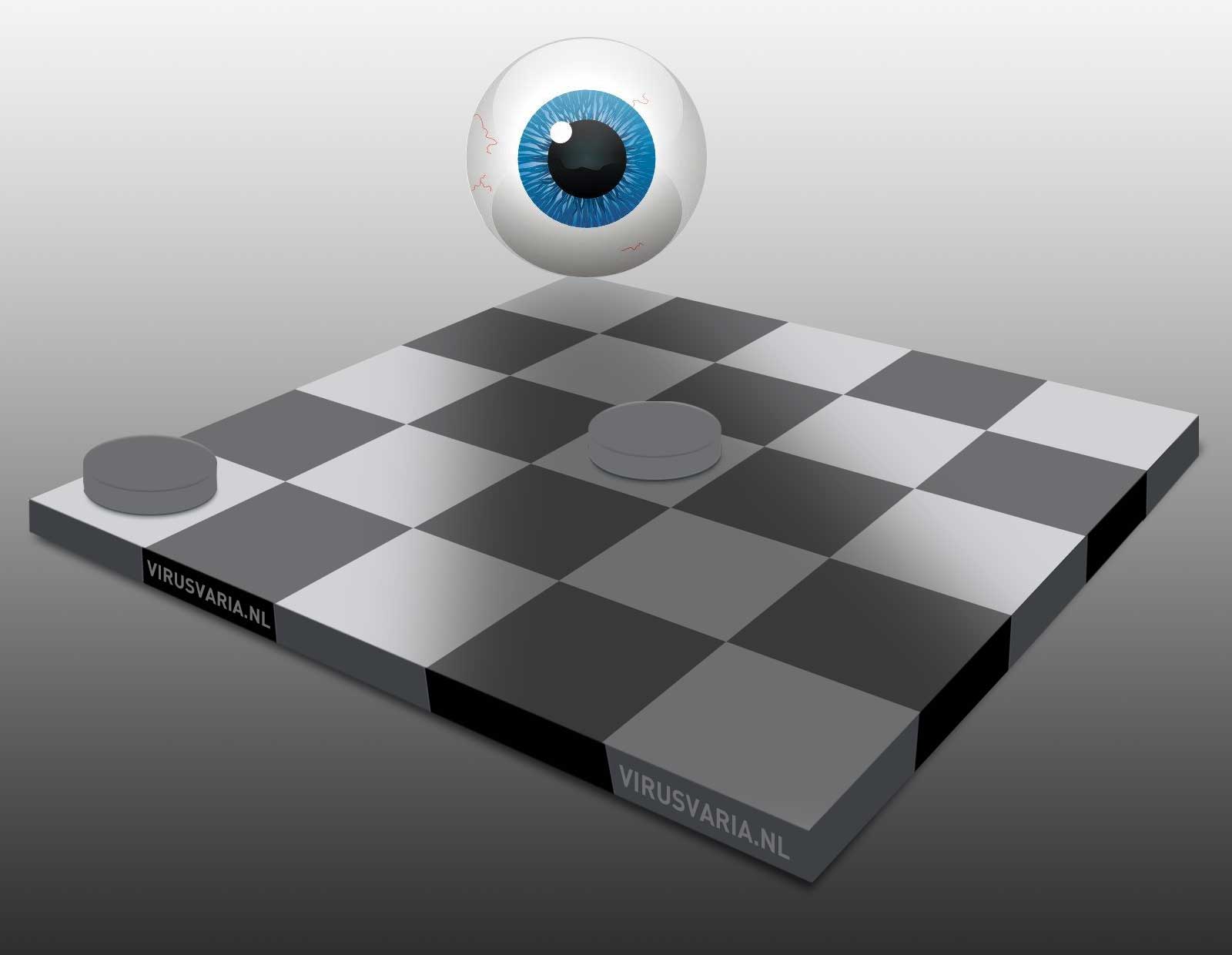
Let me repeat this picture from an earlier article. Move your mouse over the illustration. The moving stone does not change its hue. The two checkers on the board also have the same shade.
The context determines whether you judge the color as light or dark.
The bookcase: mirror or context?
"Toon mij uw boekenkast en ik zeg u wie u bent." A well-known saying that the bookcase reflects who we are. But is that correct? The reverse is just as important: the bookcase not only reflects the personality, but the personality is also shaped by the information in those books. And that entire bookcase is only a tiny fraction of the information bombardment with which we are bombarded day in and day out, while reading the newspaper, and thanks to our 'earphones' also while walking the dog, cycling, doing the dishes, eating chips, in short, consciously or unconsciously listening to the radio and watching TV. We absorb information with every newscast, every interview, every turn of phrase, every word choice. And all of this determines which books we buy or which programs we watch, and how we vote. A self-reinforcing spiral, in principle not much different from what happens on social media.
We must realize that everything that happens outside our direct perception reaches us through television, radio, social media, newspapers, books. Sometimes we know something from hearsay, but that is usually what someone has read or seen on TV or on X. Reports and studies also mainly come to us through these indirect channels. That edited information shapes our worldview. Our reference context is the information landscape that the media offers us. Our worldview is a virtual reality. Incidents in our personal lives are only anecdotal and what really happens is reported at the NPO and is published in the newspaper, where you can check whether what you experienced is true.
So it is two-way traffic: that information shapes our interests and that interest in turn triggers us to look up certain related information. But which one?
While the masses mainly appreciate affirmative voices, you would think that scientists and journalists would be looking for falsification. Maybe that worked well for a long time. I used to think so, but I may have missed a lot that corona has exposed: our administrators increasingly understand how society can be made. Support for policy is more important than room for criticism. Those in power therefore use their power to create or increase that support and to minimize opposition (see also the increasing scandals surrounding government subsidies to NGOs and media giants and in that context let us also think of Hugo's missing billions).
This creates a real danger that journalism and science, just like NGOs, instrumental become: government-paid, large-scale influencers. As a result, if the results of a government study are satisfactory, no critical eye will pass over them. We have already seen this happen in corona-related research and now the Eurobarometer also appears to be reporting wishful thinking.
From measuring to making: 'scientific' research as a policy instrument
The Eurobarometer survey is presented as an objective scientific poll. The research results support the expansion of mandate, policy and powers. Media take it over without question, citizens hear what they ultimately think about it. Administrators and judges also obtain information about areas in which they have less insight, via the 'quality' media. And they copy it again from Reuters and AP News. Two random examples:
- Reuters (May 2025): Confidence in the European Union is at its highest level since 2007, according to an opinion poll
A Eurobarometer survey showed that confidence in the EU has risen to its highest level since 2007, with 52% of Europeans who express confidence. Among young people (15–24 years) this was even 59%. The popularity of the euro rose to 74% support within the EU, and 81% support a joint EU security policy. - This3Reuters: https://www.reuters.com/world/trust-european-union-highest-since-2007-poll-shows-2025-05-28 was presented without any critical methodological reflection.
- AP News (april 2024): Survey shows: security and defense are important issues for citizens
Reporting on Eurobarometer results for the European Parliament elections: defense and security are the biggest concerns, along with economics and health. - The article4AP News: https://apnews.com/article/8c83c494c0f0a6b32ab81e27bf6669d0 mentions 26411 face-to-face interviews but does not care about representativeness. Could this investigation have been the democratic impetus for asking for a higher defense budget?
Fundamentele kritiek op zulke rapportages wordt al gauw afgeserveerd als "wantrouwen in de wetenschap" of als "anti-institutioneel" - een term die steeds vaker wordt geframed als synoniem voor rechts-extremisme. En dat terwijl 'anti-institutionalisme' (systeemkritiek) ooit een kernwaarde was van wetenschappelijke en journalistieke tradities: macht bevragen, dogma’s onderuithalen, consensus betwijfelen. Kritiek zit nu in de verdachte hoek, terwijl wetenschap in toenemende mate wordt ingezet om draagvlak te scheppen en niet meer alleen om waarheid te zoeken. Dus juist nu is er behoefte aan tegengeluid.
As soon as science becomes instrumental for policy communication, the distinction between polling and propaganda disappears. What is called 'research result' is in reality 'programming'. What appears to be 'reporting' is intended as 'nudging'.
Public opinion as a product of information provision
What people think, feel and believe about something like the EU - or about corona, climate, Russia, migration, disinformation, security - is largely determined by their information landscape. The bookcase doesn't just reflect who they are; they also became who they are through their information consumption. OK, also the bookcase, but much more because of the media. This includes reports from CBS, models from RIVM and the Eurobarometer, climate reports, migration benefits and studies on positive side effects of vaccines in pregnant women, just to refer to the previous blog post. It's all: framing, massaging the mind so that it starts thinking in the right direction.
What is missing is transparency, versatile perspectives, substantive debate and respect for those who think differently. These once seemed to be core tasks of the journalistic media. Away. There is nothing left for us but to listen obediently to Aunt Ursula.
Footnotes
- 1
- 2
- 3
- 4

So we are not talking about a barometer but an instrument for manipulation and influence.
And that works because the memory of the average citizen is not good.
To illustrate, the seat gain in polls by Henri Bontebal of the CDA.
https://www.ninefornews.nl/cda-leider-bontenbal-maakte-mensen-met-bijwerkingen-belachelijk-en-had-graag-meegedaan-aan-geweld-bij-coronaprotesten/
This Christian would have liked to participate in violence during corona protests!
Unbelievable and it is clear to me that we (here and my family) are not crazy, which is nice to know. I do see small cracks in my environment. Especially in the field of "climate", unfortunately you see the messages shifting from heat to extremes such as torrential rain and landslides, etc. How long will people continue to pay for all this, perhaps that is the solution or will they hand over to the government despite the fact that it ultimately does not yield them any profit during corona times?
A clear case of 'manufacturing consent'
Nothing new under the sun. Kept out of the picture for Dutch readers for a long time. But we also tried to keep it inaccessible for those who read English. Now available for our bookcases. See below.
https://www.dewereldmorgen.be/artikel/2025/02/25/chomskys-manufacturing-consent-bijbel-van-elke-kritische-journalist-werd-eindelijk-vertaald/
Great article, thank you! It is indeed nothing new under the sun, but it seems as if it is being done more and more shamelessly and no longer just by journalists.
Valuable observations
Immediately ordered 'Manufacturing Consent' by Noam Chomski.
Maurice with this news also at the New World.
What I think also plays a role in this propaganda (I cannot imagine that this is also a mistake) is that dissidents, people who think differently, and critics of power are larger in number than we are led to believe (14% of the Netherlands is said to be anti-Europe). I think this is also conscious, 'atomizing' people, giving them the feeling that they are alone. This will undoubtedly also have happened to the communist totalitarian regimes. I think it is becoming increasingly difficult for the technocracy to keep the lid on the pot. There are now so many free media in which people can express themselves that it is becoming impossible to maintain censorship (he wrote hopefully).
The technocrats are desperately trying to censor the 'disinformation', but that seems to be becoming increasingly difficult.
It's great that you noticed this and looked for explanations.
By the way, it is not necessarily for or anti Europe. That is a nonsensical contradiction. Agreeing on trade agreements, agreements on the same plugs and rail gauge, are all fine and logical, but Aunt Ursula making deals with Uncle Donald like a good schoolgirl goes way too far. And she has no mandate whatsoever (see substack by Arno Wellens https://substack.com/inbox/post/170129338).
Not to mention scary Rutte. The current EU is an undemocratic monstrosity, and people are fed up with that.
What I don't understand at all is that the current view is that Donald Trump is a terrible man?
But in the meantime, the Netherlands has started paying 500 million to order weapons from the USA that will then be delivered to Ukraine. This will mean that, for example, the discussion about AOW taxation and further interventions in the social system are inevitable.
As Rutte already announced, we have it way too good (?) and we must realize that Russia is very dangerous??
I no longer wonder where the real danger comes from because it is in our midst and very influential, unfortunately.
Fortunately, we still have Amalia, who, as a military working student (proest), can apparently be used to further mature minds. Because oh oh, what sense does it make to wage war?
https://www.ninefornews.nl/nsc-stelt-kamervragen-over-omstreden-softwaresysteem-palantir-opeens-kritisch-worden-vlak-voor-de-verkiezingen/
Winning souls because we are so easily influenced, of course.