


In response to questions from science journalist Maarten Keulemans in a comment on an earlier article1Comment met Questions from Maarten Keulemans I have summarized everything below. That is difficult because the power does not lie in making statements but in the substantiation. With such a complex subject, it is difficult to summarize in a few sentences. Still, just an attempt.
Maarten refers in his comment to a substack article “I wrote a letter to Virusvaria”2Substack Maarten: letter to Virusvaria in which he answers various other commenters and also raises more general questions. He also refers to some of his articles in the Volkskrant, which I will leave aside for now.
Let me first say that I really appreciate that Maarten puts time into this. Apparently he sees that people are not just shouting things here from tinfoil hats. I do not respond to personal accusations or straw men, nor do I intervene in the exchanges of ideas between him and other commenters.
Let's cut to the chase.
Five questions
- What exactly are the many, thorough, peer-reviewed, published studies that determine that there is no significant vaccine-related death or disease burden doing wrong? Likethis,thisofthis?
Coincidentally, I have already looked at all three studies. To save reading time, below are summaries of my 'reviews' because I do not want to limit myself to link dumping.
About the French study (JAMA Network Open)
https://jamanetwork.com/journals/jamanetworkopen/fullarticle/2842305
Main criticism: Maurice de Hond's article https://www.maurice.nl/2025/12/09/fransonderzoek-covid-19-vaccinaties/
Additional discussed here https://virusvaria.nl/franse-studie-minder-sterfte-en-meer-zelfdoding-onder-gevaccineerden/
- The problem of 'Residual Confounding' and misclassification Maurice de Hond wijst op een sluitende illustratie hiervan: in de gepubliceerde tabel scoren gevaccineerden zelfs op verkeersongelukken 26% lager - een resultaat dat per definitie geen vaccin-effect kan zijn en dat het hele onderzoek ontmaskert als meting van populatie-eigenschappen, niet van interventie-effect.\
Dat dit een methodologische fout is blijkt ook uit de andere cijfers. In een sensitiviteitsanalyse verwijderen onderzoekers de "COVID-19 sterfgevallen" en vinden tóch een significante risicoreductie (wHR 0,76 oftewel 24% afname!) voor "niet-COVID sterfgevallen". Dat wijst, samen met nog meer onwaarschijnlijkheden, op ernstige methodologische tekortkomingen.
First, there is the Healthy User Bias: People for whom the end of life is in sight end up in the unvaccinated group. The official story of HVE is different: people who choose to be vaccinated are often healthier across the board, have a higher socio-economic status and better access to care. If the statistical correction for these variables is insufficient, you are in fact measuring the health status of the group, not the effect of the intervention. But the former selection factor carries much, much more weight.
In addition, there is the diagnostic bias: als artsen in de kliniek minder geneigd zijn om COVID-19 als doodsoorzaak te noteren bij gevaccineerde patiënten, worden die sterfgevallen als "niet-COVID" (bijv. hartfalen) geboekt. Dit verlaagt de wHR kunstmatig. - The lack of a mechanistic explanation Er is geen solide mechanische basis voor een vaccinatie die op magische wijze de sterfte door alle andere oorzaken (zoals trauma of hart- en vaatziekten) in exact dezelfde mate zou moeten beïnvloeden als de doelziekte zelf. Wanneer onderzoekers beweren dat een effect "equivalent" is aan de hoofdanalyse terwijl de biologische logica ontbreekt, wordt de wetenschappelijke methode ingezet als institutionele retoriek om een narratief van universele effectiviteit te versterken in plaats van een causaal mechanisme bloot te leggen.
- Waarom de term "equivalent" problematisch is De term "equivalent" wordt hier gebruikt om de lezer te sussen. Vanuit een kritisch perspectief is de meest logische conclusie niet dat de interventie "superieur" is, maar dat de data gecontamineerd is door bias. Het feit dat men dit "niet getoonde resultaat" (results not shown) als valide argument gebruikt, is een klassieke techniek om kritische vragen over de werkelijke bron van de risicoreductie te omzeilen. In een transparant veld zouden we de discussie moeten openen over de vraag of de geobserveerde "bescherming" niet simpelweg een weerspiegeling is van de selectie van een fittere populatie.
About the Italian study (Vaccines)
https://pmc.ncbi.nlm.nih.gov/articles/PMC9861956
Previously covered in https://virusvaria.nl/een-statistische-drogreden-ongevaccineerde-oversterfte-in-italie-en-bij-nivel/ (Nivel followed a similar methodology, therefore collected in one article at the time).
- De "HVE-buik" en de startdatum In effectiveness research, the first phase after an intervention is the most critical. The fact that the lines diverge sharply from day zero and then almost parallel is contrary to what you expect from an active biological intervention. This suggests that the groups were already fundamentally unequal at the start: the healthy (vaccinated) versus the vulnerable (unvaccinated). This has a huge effect on the research results. If there is no point in vaccinating 10% of people with a placebo because they are too weak or have no months left to live, the placebo already has an effectiveness of 83%. This is easier to predict for people who are close to the end. Hence the deep dip immediately after vaccination. (The HVE-calculator show that.)
- De "Hartinfarct-kwestie" Als we de cijfers van 0,25% tot 0,38% voor myocardial infarction in de 1- en 2-dosisgroepen serieus moeten nemen zijn die schokkend hoog: 0,33% is 1 op de 300(!). Dat is 2 tot 3 maal dat van de ongevaccineerden. Mensen die na de eerste of tweede dosis een hartinfarct kregen, zullen geen derde hebben genomen. De groep die de derde dosis wel haalde, was een "survivor population". Door mensen met 3+ doses te vergelijken met de hele ongevaccineerde groep, maskeer je de schade die bij de eerste doses is ontstaan.
- De paradox van de "Niet-geïnfecteerden" It is crucial that the mortality among uninfected people (2.18%) is so much higher than among people who have been infected (1.11%). More than 1% difference, almost twice as much mortality from all causes - only due to 'naïve' infection? This is a classic outcome that calls into question the entire logic of vaccination policy. After all, the infection leads to much less mortality than that more than 1% (rather in the order of 0.1% to 0.15%3Ioannidis 2020: https://pmc.ncbi.nlm.nih.gov/articles/PMC7947934/, 4Ioannidis 2022: https://pmc.ncbi.nlm.nih.gov/articles/PMC9613797/).
About the UMC Utrecht study
https://www.umcutrecht.nl/nieuws/geen-oversterfte-door-covid-19-vaccinaties
Previously covered in https://virusvaria.nl/weer-een-hve-studie-nu-door-het-umc/ and on Baker/Walk/Master at Researchgate.
- Het "Healthy Vaccinee Effect" als blinde vlek De kern van het probleem is dat de onderzoekers de selectie-dynamiek negeren. Als een vaccin pas na 14 dagen "effectief" wordt geacht, hoe kan er dan in de eerste zeven dagen al een reductie van bijna 70% in sterfte worden gemeten? De enige logische verklaring is dat de groep die in de eerste week na de prik overlijdt, simpelweg niet in de gevaccineerde categorie terechtkomt. Daarbovenop komt nog dat de "gezonde" populatie die de prik haalt, vooraf is gefilterd: aan degenen die op korte termijn zouden sterven, is geen prik gegeven. Het kleine aantal overledenen (want uit de kleine groep ongevaccineerden) wordt enorm opgeblazen.
- The SCCS method as a smokescreen The researchers use the Self-Controlled Case Series (SCCS) to rule out inter-individual differences, but they forget that the intra-individual condition changes drastically over time. If a person's health status at the end of their life (just before death) is not comparable to that of months before, the entire comparison is a statistical artifact.
- Data pollution The research relies on imperfect data sets. Infections are only registered if one ends up in hospital, which leads to an overrepresentation of sick people in the 'positive test' group. In the Netherlands we also have data pollution due to misregistration of deaths shortly after vaccination. In addition, the CIMS (COVID Vaccination Information and Monitoring System) is notorious for its inadequate links. A study that relies on this without addressing the underlying data pollution is building on a shaky foundation.
- Institutional confirmation bias Wanneer academici die hun reputatie in de strijd hebben gegooid ten bate van het pro-vaccinatiebeleid en het onderzoek doen naar de veiligheid van datzelfde beleid, dan is er per definitie sprake van een belangenconflict. De conclusie dat de resultaten dienen om het "vertrouwen in de veiligheid te versterken" is geen wetenschappelijke doelstelling, maar een PR-doelstelling. Het onderzoek is een schoolvoorbeeld van statistische misleiding waarbij een selectieproces wordt verpakt als wetenschappelijke effectiviteit.
- "LikeJohn Ioannidis showed, excess mortality per country correlates with the socio-economic differences in that country, and not with how many vaccines were given. Why not?"
- The study in question calculates a well-known fact: higher mortality ALWAYS correlates with lower socio-economic status, increased mortality (so) too, which is a percentage of the already increased mortality, so more in an absolute sense - and probably also a stronger increase in a relative sense. The one in question study says nothing about correlation with vaccination rate – otherwise please point it out. The word “vaccine” appears once. That is the passage in which Slovakia, Slovenia and Poland are mentioned, among others, as countries where high mortality decreased remarkably quickly. That's it.
Ioannidis heeft zelf in een vervolgstudie over 2020-2024 zijn uitspraken van de 2020-2023-studie flink bijgesteld: "De COVID-19-vaccinaties hadden weliswaar een aanzienlijk positief effect op de wereldwijde sterftecijfers in de periode 2020-2024, maar dit effect bleef grotendeels beperkt tot een minderheid van de oudere bevolkingsgroep."5Update Ioannidis:https://www.medrxiv.org/content/10.1101/2024.11.03.24316673v2 Only beneficial for a small part of the older population group. Says the scientist you quote.
I was just reminded (during my informal peer review process) that Ronald Meester and Bram Bakker also had some criticism of that follow-up study, but that is all taking it too far.6Review op Ioannidis, by Master/Bakker
Then take a study that compares mortality and vaccination rates, corrects for factors such as policy stringency (measures), demographic and socio-economic factors (average age, poverty risk, care needs, trust in institutions, etc.) and finds that "Hogere vaccinatiepercentages correleerden met grotere stijgingen van de oversterfte en met kleinere dalingen van het aantal COVID-19-sterfgevallen".7Kuhbandnder en Reitzner: extensive summary In which Dutch newspaper could we read about that German research...? Every journalist longs for a real 'scoop', as you have often stated. No one bit here. If I may ask a question in return: Why not?
- If vaccines cause massive health damage, which ones? And why do we not see it structurally in the regular statistics on cancer and cardiovascular disease in all countries where the vaccines have been widely deployed?
- You ask what health damage. This may be related to the immune problems that you also mentioned, where I suspect you meant: as a result of Covid, not the vaccines (why not?), just like blood disorders, neurological disorders, absences (accidental falls), heart and organ failure... Autopsies provide clues to this and I will shortly return to the mechanisms.
Edward Dowd has frightening insurance statistics. It is not visible in the Dutch figures, no one can explain it and that is precisely why it should be investigated. His point: if the excess mortality is not due to the injections, and not to all the other explanations that have now been dismissed, then there is another, global factor that is hitting simultaneously in all countries with a high vaccination rate, and causing millions of additional deaths and disabilities - an explanation that invariably remains unanswered by the established order. So again it cannot be 'hardly' proven by refusing access. A signal that is ignored, also by the media.
Cancer is now starting to emerge in America8SEER US data, see below. The aging argument no longer works, nor does population growth, so now it is thrown at lifestyle or climate. After all, it can't be the vaccines...


Translation: The overall number of cancer cases in people under 50 has INCREASED by 6.4% between 2021 and 2023 amid the mass administration of mRNA vaccines.
- BRAIN TUMORS: +19.5%
- COLON/RECTUM CANCER: +19.4%
- SMALL INTESTINAL CANCER: +15.5%
- OVARIAN CANCER: +12.8%
- STOMACH CANCER: +7.3%
- BREAST CANCER: +3.6%
in de Nederlandse cijfers is het niet te zien. Ik kan dat niet uitleggen, niemand tot nog toe. Dat vraagt om onderzoek. Bij ons was de afgelopen jaren wel de categorie "Overig" een van de fikse stijgers. We wachten maar weer op de data van 2025.
There are all kinds of signals, which are then passed on by concerned citizens because decisive data is withheld by the parties that collected that data themselves. That feeds the idea that there are things that cannot tolerate the light of day. If you are not aware of this withholding: if you click open the footnote after this sentence you can get an impression of how that went in the UK - and if you click through that article also in NL with the Deltavax case of the Biomedical Court of Audit.9Article about the English DeltavaxImportant update in The Telegraph. Hello Keulemans? If there really is what it appears to be behind it, then the benefits affair is a joke. Quite a scoop, if you ask me.
Lareb Hotels
Why would supervisory authorities such as the Lareb, which even found the rare side effect myocarditis (incidence: approximately 20-40 in 1 million), not find such a side effect?
I don't really know where to start because someone could write a trilogy about this.
- The myocarditis signal came from Israeli data and was confirmed with data from other countries, including the Netherlands. Lareb found nothing at all. Furthermore, it is not Lareb's job to confirm whether or not something is a side effect. They simply need to collect thoroughly and report deviations transparently. Nothing came of either.
- Kijk naar AstraZeneca. Lareb fungeerde als signaaldemper. Door elk signaal te objectiveren, te nuanceren en te vertragen met bureaucratische termen als "nader onderzoek vereist" of "geen significant causaal verband," hebben zij de politiek de tijd en de ruimte gegeven om het vaccinatiebeleid voort te zetten, zelfs toen de signalen voor iedereen met ogen in de kop al overduidelijk waren. We liepen bepaald niet voorop toen er een "tijdelijke stop" van AZ werd afgekondigd met als reden "dat er gewoon andere vaccins waren die beter werkten" (dixit H. de Jonge).10Article about it stop taking AstraZeneca
- They also followed along at the blood clots11Article about the connection between thrombosis and corona vaccines (March 2021). Research into that phenomenon boomed in 2021.12See graph search on pubmed
- Lareb suppressed alarm signals because they would not benefit the willingness to vaccinate.13Example Lareb op X van Leon1969
- The advice of the vaccine manufacturer, the RIVM and the Health Council was not to inject pregnant women. Lareb thought it would be interesting to monitor this.
- Lareb received 8 times as many reports as estimated. They did not sound the alarm - yes: that they lacked capacity, that was actually their only problem. And with serious reports it was “yes, we don't know yet whether it is causal”.
- In fact, every death after vaccination must be reported. That was the contractual obligation when entering into an EUA vaccine. Lareb was fine with the fact that this did not happen at all.14Article about the registration deficit at Lareb
That is documented. Those are facts.
Then your question 'why'...? I could see that as a trap. I can't see into other people's heads so now you're asking me to speculate. OK, that's what I'll do - after all, I'm not writing a scientific piece here; I strive for substantiated activism. I appeal to logic and common sense, so I can't get any further than a plausible story.
So 'why'. For many reasons. Especially because the chief boss of Lareb, the Minister of Health, Welfare and Sport, was not looking for that. That was again because of Covid the Dutch massive deaud would fall, just like the Chinese in that promotional video from the pharmaceutical company: this is how you walk down the street feeling exhausted, that's how you fall over lifeless. Typical Covid... we feared then - and all science editors with us.
Images that appeared in China in the first days after the outbreak of Covid-19.


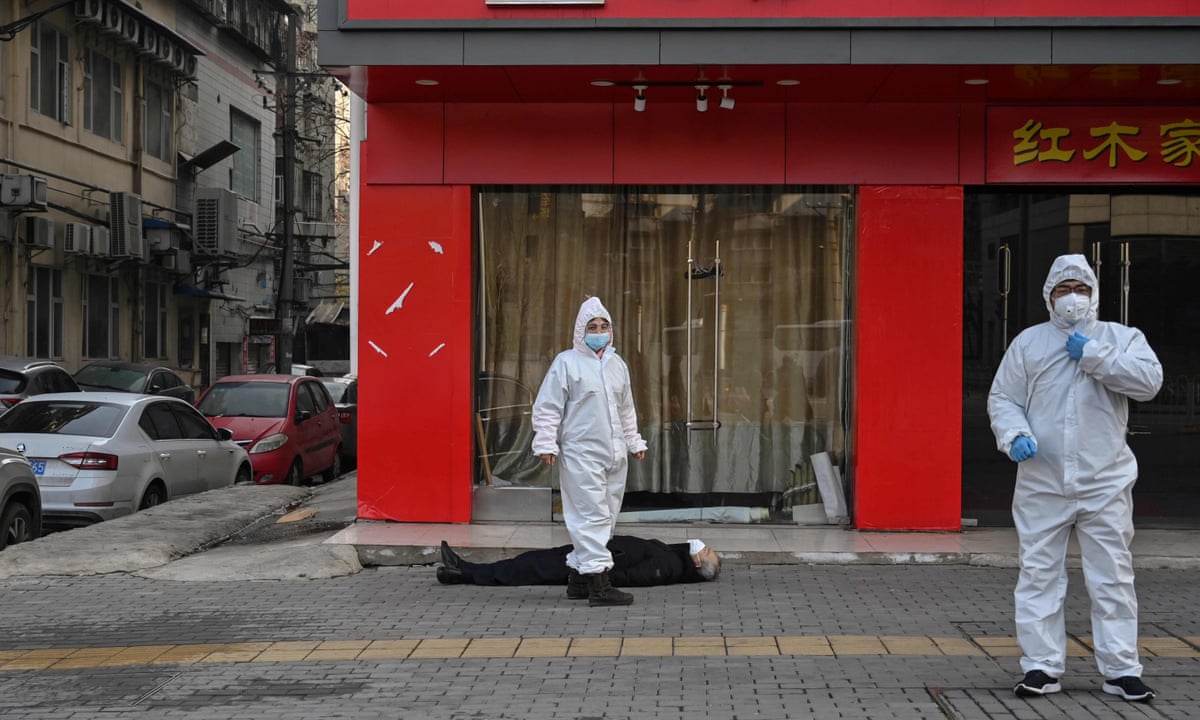

Lareb's official task is to independently identify 'adverse events', whether they are vaccine side effects or not. However, Agnes Kant, in her capacity as director of the Lareb (the Dutch side effects centre), took part in the Vaccination Alliance established by the Ministry of Health, Welfare and Sport. The objective of the Vaccination Alliance was to actively increase vaccination readiness and combat so-called 'disinformation'. And that was all information that was at the expense of vaccination willingness. Agnes Kant had no problem with that.
Wanneer de directeur van een orgaan dat bedoeld is om veiligheid te bewaken, tegelijkertijd deel uitmaakt van een orgaan dat tot doel heeft een medische interventie te promoten, is de onafhankelijkheid per definitie gecompromitteerd. Het "wegnemen van onrust over bijwerkingen" - een werksessie die nota bene door het Lareb werd begeleid binnen die alliantie - staat haaks op een neutrale analyse van risico's. Elk waarschuwingssignaal zou ten koste gaan van de -daar istie weer- vaccinatiebereidheid. En vaccins waren nou eenmaal veilig, dat wist iedereen, dus het was eigenlijk alleen maar hinderlijk, dat melden.
See the WOO documents Cees van den Bos and the aforementioned @Leon1969 on And this while an irreversible injection was rolled out under emergency conditions, including extremely strict monitoring. The emergency conditions were simply not met – and Lareb knew that, assuming they were at all aware. It didn't matter to them.
So don't touch me with Lareb. They functioned as the pharmaceutical companies' customer service.
Media
- Why should well-informed journalists like myself, with countless sources and confidential and personal connections to scientists, never hear about the horrific abuse that is apparently being kept under wraps here? Why is this not discussed at conferences and symposia?
Well introduced... yes, because you do not consider anything that does not fit within the safe narrative as serious information. Because you dismiss dissident scientists as wimps. This is also evident when you write to Bonne “Shall we agree that without that peer review we will simply assume that the scientific literature (in the larger journals such as NEJM, JAMA, etc.) is leading?”
An ecosystem (and then eco of economy) has been built up around pharmaceuticals. Other medicines are only given to patients, but vaccines cover the global market of healthy and less healthy people. So not just a select group of rheumatism or heart patients, no: everyone. The entire world population. The forces released by such interests are too easily underestimated.
Ik vertel dit als inleiding op je vraag "Waarom het daar niet over gaat op congressen en symposia". Wie denk je dat die congressen en symposia organiseert en sponsort!? Wie betaalt de hotelovernachtinkjes in (sub)tropische oorden? Je doet me een beetje denken aan Frank de Rooy. Die dacht werkelijk dat hij zijn docu bij de NPO zou kunnen onderbrengen. Die snapt ook nog niet helemaal hoe het werkt. De fimcrew en de editors die aan de docu hebben gewerkt begrijpen het beter; die kennen de cultuur binnen de NPO. Die waren niet aanwezig bij de première -wat misschien begrijpelijk is- maar ze wilden hun naam ook niet in de aftiteling.
Silenced explanations
The next point:
“But what you keep hiding away is that there have long been explanations for that higher mortality. I have written about it often.”
You name it “Immune deficit: the recurring 'normal' infectious diseases hit harder."
You naturally link a dysregulated immune system to Covid. It can also be caused by the injections, such as the IgG4 switch. This is evident from research: the more vaccinations, the more often people get sick, suffer from long-lasting colds and worse.15Search PubMed for IgG4 switch vaccination mRNA
Then you name “The corona measures: for example, dementia patients have deteriorated more rapidly because their regular routine was disrupted.”
Dear Maarten, that was 6 years ago. We are now talking about current persistent excess mortality that has already exceeded ten thousand in the past two years alone (2024 and 2025). So incidents from 2020 and 2021... really?
“Delayed treatments: all kinds of knee, hip and cataract operations were suspended. And what did you see next? More deaths from falls.”
So because knee operations 6 years ago were postponed for six months to a year, people are now falling more often? Please explain that. I could have imagined something like that with a peak in '21 or '22. But also think about blood clots in the brain, small absences, balance problems, how about that? In addition, deferred care can only represent a small part. See an earlier article about that16Article Deferred care and excess mortality Also a long stretch. Below is a summary by Claude (not complete but then it becomes long):
Delayed care and excess mortality - virusvaria.nl
The article investigates whether delayed care is an important explanation for the continued excess mortality in the Netherlands after 2021. The central thesis is: the claim is widely repeated but never quantified.
Core of the argument:
Theunissen tests the deferred care thesis against four categories — missed operations, cancer diagnoses, heart problems and screening — and concludes that none of them can explain a substantial contribution to structural excess mortality. Planned operations (cataract, hip, knee) hardly result in mortality. The most life-threatening cancers are palliative and can hardly be treated in a life-saving manner. Cardiac interventions such as angioplasty result in at most a few thousand missed cases, compared to tens of thousands of unexplained deaths.
Strongest methodological argument:
International comparison. Countries without significant healthcare infarction — Germany, Australia, New Zealand — show comparable or even higher excess mortality. This undermines deferred care as a primary driver.
Additional observations:
Excess mortality is decreasing now that the health care crisis is structurally worsening - which reverses the causality. Cancer diagnoses rose sharply after 2021, which he links to vaccination mechanisms, not temporarily postponed appointments.
Tone and positioning:
The piece is analytical but not neutral — Theunissen suggests institutional self-protection as an explanation for the lack of transparency about vaccination dates and government policy.
So much for Claude.17Summary door Claude
And then you play your trump: "En de ALLERBELANGRIJKSTE: d) leefstijl."
Bij dit allerbelangrijkste argument mis ik wel een beetje de peer reviewed studies en de collegiale toets. Ook de "correlatie is geen causatie" claim ontbreekt. Dat is een nogal asymmetrische manier van bewijsacceptatie. Nu zegt n=1 anekdotiek me sowieso niet zo heel veel. Jij bent zwaarder geworden door meer thuiswerken. Nou, sinds ik thuiswerk wandel ik vaker en langer met de honden en ga tussendoor weleens een boodschapje doen. Ik zit ook niet tussen hoestende collega's.
The working population certainly does not die 5% or 10% more often because they do not have to drive or cycle to work every day. By the way, that also saves on traffic accidents – if we start to reason that way.
You conclude with “It would really help if you took this seriously.”
Of which, with many links to old documents, which show that I have seriously discussed it before, sometimes years ago, and which I can imagine that you have missed. After all: not published in an authoritative journal. Often read along and against by peers - but yes, my peers, what good is that...
P.S.: The above is in any case a starting point that is limited to the points you mentioned. One thing in advance: well-founded criticism of this is welcome. Evidence to the contrary is not welcome. After all, I know them; these were precisely the reason for the aforementioned evaluation and opinion articles. To introduce the original positions as an argument is a fallacy (petitio principii or circularity). I have now gone along with that. Repeating those positions again is tantamount to admitting that there is no response to the criticism.
Footnotes
- 1Comment met Questions from Maarten Keulemans
- 2Substack Maarten: letter to Virusvaria
- 3Ioannidis 2020: https://pmc.ncbi.nlm.nih.gov/articles/PMC7947934/,
- 4Ioannidis 2022: https://pmc.ncbi.nlm.nih.gov/articles/PMC9613797/
- 5Update Ioannidis:https://www.medrxiv.org/content/10.1101/2024.11.03.24316673v2
- 6Review op Ioannidis, by Master/Bakker
- 7Kuhbandnder en Reitzner: extensive summary
- 8SEER US data, see below
- 9Article about the English DeltavaxImportant update in The Telegraph. Hello Keulemans?
- 10Article about it stop taking AstraZeneca
- 11Article about the connection between thrombosis and corona vaccines (March 2021)
- 12See graph search on pubmed
- 13Example Lareb op X van Leon1969
- 14
- 15Search PubMed for IgG4 switch vaccination mRNA
- 16
- 17Summary door Claude

Good piece again (of course) Just the following about the comment that Lareb is paid by the 'pharmaceuticals'. In 2020, this organization subsidized Lareb with exactly the same amount that they receive annually from the government. Lareb also receives an annual subsidy from the government. In fact, Public Health pays everything to keep Lareb running and the pharmaceutical industry has 'purchased' influence from Lareb through government subsidies.
Who do you mean by “This organization”? Link lost perhaps?
MEB
To be clear: The MEB receives annually from the pharmaceutical industry a multiple of the amount (for other tasks) that they 'donate' to Lareb. See the CBG and Lareb annual reports.
Ah, it takes effort, but €57 million of the €67 million is “third party turnover” and is apparently (but that is unclear from the annual accounts, only the 2023 one can be found last...) inspection or something similar. of medicines on behalf of pharmaceutical companies.
In itself it is not wrong that they pay for their own inspections, but it does raise the question of how independent such an institute is if so much income is critically dependent on these types of assignments...
Although, they apparently also receive “annual allowances”. What is that based on? ” due to € 0.6 million lower revenues from procedures and annual fees (third-party turnover).” you will be shown something about the differences, but how big are those compensations and what do they stand for? Completely unclear. They probably like to keep that a bit vague...
But that is of course completely unacceptable for an agency of the Ministry of Health, Welfare and Sport.
Unfortunately, this is commonplace among institutions and companies.
Strange that you can no longer find the other annual reports.
Yes, the older one, but not the one from after 2023. That's bizarre, right? It is now almost May 2026…. Annual accounts for 2024 have long been legally required and one for 2025 is usually also required by statute...
And so little detail….
It was the fear, stupid 🙂
Anton, I admire your thorough, patient response.
Gradually the realization that we are really dealing with overstefts no longer seems to be a point of discussion.
However, I am afraid that, just like with the MH17 disaster, the focus of investigation has/will be shifted too much to the handling (Schoof was assigned to the HM 17, with the compliments (and reward?) of Rutte afterwards, and cleverly focused exclusively on investigating the handling, so that the possible culpable release of airspace by... was kept out of the picture).
The view of a possible cause that can be prevented in the future is therefore lost from view.
Discussion is thus narrowed to positive or negative effects of 'vaccines', lockdowns, etc. While in my opinion the damage had already been done, namely:
Setting up a huge fear campaign (for a virus: “It is certain that it will come soon, we just don't know when!!”).
The major negative effects on the immune system of a population when the concrete announcement is made, and the national measures taken to illustrate the seriousness, are forgotten.
I think the virologists also panicked. At first it was thought that it was a slightly contagious but deadly Sars cov1-like virus, but then it turned out to be quite contagious with all the PCR tests. Well, the initially reassuring narrative also changed at the RIVM. After all, it was a SEVERE Acute Respiratory virus. Reports and studies showing that this was not too bad and that it was actually a M(mild)ars cov virus were ignored.
The RIVM used an IFR in their models that was far from the truth and (I suspect) made curves with their models that predicted tsunamis of hospital occupancy.
Fear was cultivated by the government (for data research, seepeil.nl). The fact that the actual curves always ended up at the bottom or even occasionally below it was attributed to the measures taken because of the predictions. Well.
It was well known that vaccines did not work against respiratory infections. Confidence in possible vaccines was therefore low.
Fortunately, the vaccine industry was prepared to use the bag of tricks developed over the years to conjure up a (RELATIVE) effectiveness of 95% against cold symptoms.
The fairy tale that there was a cure for respiratory diseases was born. The highly inflamed fear could finally be combated.
And yes, hospital admissions decreased (you had received the shot and had flu-like symptoms, so it worked and you were finally protected).
The stress decreased, blood pressure decreased, sleep recovered, you were allowed to eat out again, go out again and visit friends and family. In short, the immune system recovered thanks to a placebo effect.
Naturally, this was attributed to the effectiveness of the vaccine.
Unfortunately, the long term of the 'vaccines' has not been properly researched, but that was a concern later. In the short term, people also died from it, but if 1 in 1000 died, the GP did not even notice this with around 3000 patients.
Back to the cause: the Anxiety Pandemic. Is the risk of recurrence reduced? No, with pandemic preparedness institutions, fear is kept alive. But luckily we have the amazing mRNA that can be developed quickly and safely to protect us. Easily crosses the blood-brain barrier (which is already porous in 10% of people with dementia, I just read in an interesting Volkskrant article) and can also do its beneficial work there.
Cheers. This will be an interesting discussion. Right, Maarten?
Excellent article in terms of content based on facts and logic.
It's a shame about the few ad-hominums that have crept in; given the content, that would not have been necessary at all.
But.
A believer is (almost?) never converted by facts and logic...
I'm curious about a response from Maarten.
Agree. It is no longer about facts and logic. There are so many factors involved that you can always open another drawer with counter arguments. It starts with recognizing that you are part of a bubble (or collective) that does not take differing opinions seriously. Be open to the idea that there may be valid other opinions.
Maarten himself believes that he is not part of a collective but that he practices neutral scientific journalism. Anything that falls outside these standards is a conspiracy theory. That's what it comes down to every time. Based on this basic attitude, he will always shoot back with counterarguments to prove that the opponent is wrong.
Those photos are brilliant, by the way. Those people are so neat.
Sorry, I'm jumping off track here
….A believer is almost never converted by facts and logic…..
I think it's not so much about the facts as about hard data. It is the explanation (opinion of the interpreter) of that data, the extrapolations, the omission or emphasis of nuances, which reinforces the 'faith'.
The funny thing is that people come up with the same data, but a completely different explanation. And then it really comes down to faith. Do you believe the messenger and blindly accept what he says?
And in my opinion that is the whole 'battle' at the moment. Don't be so naive and do some research yourself. And that is what most who track virus variants have in common. Researchers themselves.
The point is usually that facts (data are also facts in this respect as far as I'm concerned) are denied (blood clots, side effect shortly after the vaccines, data that was registered too late, etc.) and that often simply illogic reigns supreme (UMC, Nivel research, for example), in order to continue to believe in one's own right. That's what I mean.
Facts and logic simply do not convince someone who “believes”. This applies to religions, but unfortunately also to ideologies. If you believe in wind turbines, you deny facts and logic that show, according to objective standards, that wind turbines are completely inefficient compared to, for example, coal-fired power stations, except in places where cables or other power sources are very expensive and/or there is a lot of wind.
Very occasionally it is possible to draw different conclusions from certain data. But if that is the case, there is generally there is still a reasonable debate to be had about it.
The Nivel research is a nice illustration.
+ Facts/raw data: no discussion.
+ Logic: raw data contains bias due to HVE and delayed registration
+ Interpretation conclusion:
– illogical: vaccines are effective and have no side effects
– logical: the data conclusively proves the HVE + possible registration effects.
So conclusions cannot be drawn. Based on an estimate of the HVE on basis
From the data it can even be concluded that the vaccines are harmful.
But an estimate is always dangerous and therefore not hard evidence.
And unfortunately, this also applies to people who believed in lock downs, access passes, vaccines and drops in 2020 and 2021. They continue to believe, despite a world of facts/data and contrary evidence.
Hi Jan, the posts that I/we have been typing on for some time are from the site, but I have reposted the conversation because it was quite interesting and it also ties in with this post:
Jan, this is a well-intentioned post to bring us closer together. However, at this stage of the conversation, the discussion can also be conducted without these fallacies.
You just have to remember that we have been working on a very wide range of topics surrounding Covid-19 every day for about 6 years and have written a lot about it. It is no coincidence that we have already discussed the research that Maarten reports on.
The studies that Maarten cites are all studies in which the methodology used deviates from what you would expect in an objective study and is designed in such a way that in practice it seems to move towards a certain conclusion. We clearly show this in this piece, but the studies are nevertheless still used without restraint to substantiate the same message. Moreover, these are exactly the studies that very well-known virologists showed off to show how well the interventions had worked.
Maarten mainly consults the experts of the OMT for his documents, while there are also experts who have no direct interests in this covid-19 file and therefore arrive at different assessments. The choice to always use the same circle of experts is therefore striking for someone who pretends to operate independently journalistically. Then systematically copying this and publishing it in the newspaper can hardly be seen as critical journalistic assessment.
Moreover, I did not only see this pattern in which specific studies are selected, a fixed group of experts are consulted and this is then widely disseminated in the media. These biased studies also received disproportionate attention in other European countries.
Perhaps you can imagine that after years of fruitless conversations and clashes with “the experts”, relations have grown to such an extent that here and there a little bit of relief is sometimes added to the text, if I may say so. 😊
But let's narrow it down a bit, if that's okay with you. You are also working on something similar to the standard mortality used in the Mortality Monitor. It is of course very difficult to present a complete picture and analyze individual age groups. As you have done in your PDF, it certainly has great value.
However, your ideas regarding mortality prognosis also deviate from how CBS and RIVM currently do this, and are more in line with the methodology of the Mortality Monitor. If you develop this further and arrive at a comparable general baseline as we describe in the paper, do you dare to take the position that there is something wrong with the current representations of CBS and RIVM?
This way we can focus the discussion a bit. In the comments, Maarten also indicated that he found a different methodology than those of the RIVM and CBS interesting.
Answer from Jan:
“The studies that Maarten cites are all studies in which the methodology used deviates from what you would expect in an objective study and is designed in such a way that in practice it seems to move towards a certain conclusion.”
This is not entirely correct. Maarten bases his findings on many studies that are simply done that way in the medical world. And it is known that physicians (including epidemiologists, who have at least followed a serious statistics course), in general are unable to conduct serious statistical scientific research. In general, the virologists have 0 knowledge of statistics. This should also be known to Maarten, but in general he gives: not much evidence of it. But sometimes it does. So therefore there is certainly some hope for a serious debate.
The criticism of the selection of experts is 100% justified. Tunnel thinking lurks in every forum. Even with Virusvaria……
Of course I understand the “relief” out of frustration. But I hope you also recognize: it does not help to agree or convince.
Attn. the excess mortality: in my last contribution, based on the input from Herman and Anton, I have come to the conclusion that their "norm mortality" is a worst case scenario (based on an almost linear continuous sharp decline in mortality figures from 2011 - 2019), and that the representations of RIVM (and to a slightly lesser extent of CBS) describe a best case scenario (whereby at RIVM even measured mortality of the last 5 years is "simply" the new standard is). So it will most likely be somewhere in between. So I really believe that both CBS, and certainly RIVM, present matters far too positively with regard to excess mortality; that is unrealistically positive. Even the actuarial association, which has direct financial interests in a correct representation of the future, had to recognize that the prediction that excess mortality would completely disappear from 2023 was incorrect. As far as I'm concerned, that says enough about the value of the statements by CBS and RIVM.
Although the AG, in its role, does not feel the need to sound the alarm regarding the phenomenon of excess mortality (the Ministry of Health, Welfare and Sport should do that!), they have repeatedly stated loudly and clearly that the (constantly adjusted) forecasts of CBS were also too optimistic. That is evident evidence from the mainstream that there was excess mortality. And from the fact that the AG states that mortality will only be “on track” again in a number of years, you can deduce that they implicitly indicate that there will still be excess mortality for a number of years.
The exact measure for excess mortality is of course very arbitrary after a number of years. How quickly will the effectiveness of healthcare continue to increase? How quickly will people's lifestyles improve/deteriorate?
Response to Jan:
Thanks Jan, I also have other arguments that could show that the excess mortality model will not accurately reflect the future. I will stay away from speculation about why the expected mortality may be too high in the forecasts, but I find it difficult to follow the idea that people will continue to grow older under current living conditions. We are more likely to have it too good than too bad: lifestyle diseases are increasing and that puts pressure on maximum life expectancy. The increasing pressure from the government on healthcare also plays a role in this.
A linear curve is therefore quite optimistic. At the same time, you should not forget that a model is not fundamentally intended to predict exactly, but to establish an average baseline of the health of a population within a certain period, and see how this compares to the future.
I would like to come back to this briefly. You say: Maarten bases himself on a lot of research that is simply done that way in the medical world. And it is known that physicians (including epidemiologists, who have at least followed a serious statistics course), in general are unable to conduct serious statistical scientific research. In general, the virologists have 0 knowledge of statistics.
I think this goes to the heart of the debate. You're not the first to say this. At the same time, in studies where there is a possible conflict of interest, you often see that the results are in favor of a vaccine, medicine or intervention. This raises the question to what extent the chosen methodology and interpretation of results play a role. So the people who set up the study can't count on that bad.
I agree with you that many politicians and also many citizens have more interest in language than in statistics. That makes this debate complex: many people have difficulty assessing the underlying calculations and therefore rely on experts. At the same time, this makes it extra important to take a critical look at who is at the calculation table and what assumptions are made. In that respect, I do not naturally have confidence when the same small circle of experts (such as Marion Koopmans and colleagues) dominates these analyses.
Like you, I hope for a serious and open debate, in which the broader public also gains better insight into what is going on substantively through the regular media. If only because of the exchange of arguments and the visible doubt that exists around this subject on this website.
Response from Jan:
Jillis, I largely agree with you.
A new point is conflict of interest. That is also something that has been a thorn in the side of some doctors for at least 50 years (as long as I read Medical Contact approximately every week). The professional associations (including the KNMG) have always had an ambivalent attitude towards this. I suspect because they were partly sponsored by pharmaceutical companies.
But influencing is virtually ineradicable, despite the ban on advertising for medicines, the ban on string requirements, etc. Many accredited further training courses are still organized by pharmaceutical companies. Many doctors, necessarily, participate in drug research. And it is also known that many pharmaceutical companies have been fined in recent decades for tampering with research results. The standard trick is: many small study populations (large ones are too expensive) where studies with negative or non-positive results are immediately discarded. In particular, the concealment of unwelcome investigations has often been a reason for fines. This also plays a role in mRNA. And because the MEB is also largely financed by the pharmaceutical companies, their independent role is also very questionable.
All known for years and often widely discussed in the MSM.
But strangely enough, this knowledge regarding the development of the Corona vaccine seems to have suddenly been forgotten within the same often quite critical MSM.
That's suspicious. But it may also be that the journalists in the MSM were also so proud of the medical state that they so quickly freed humanity from the Lock down thanks to the vaccine. All harmful side effects did not materialize for a while and were therefore put aside.
The road to hell is paved with good intentions...
Ha yes indeed, the road to hell is certainly paved with good intentions... I also understand that people are proud of what has been achieved medically and that this has cost a lot of investment and that it also has to be recovered. All very logical.
I hope you agree with me that this goes a lot further than a white lie. Once again, I believe that people should be objectively informed about what is going on and should not be controlled by the media. I now even think that it no longer matters at all what you will write about the topic surrounding corona. People have something in their heads and it doesn't go away on its own. And many people don't care at all. They have no power over it anyway, so we just let it happen. This is exactly the attitude that has caused things to escalate in many areas.
Maarten has no choice but to contradict all healthy realistic evidence with his “solidly recognized sources”. After all, his bosses are part of the propaganda in favor of pharmaceuticals and big money. Maarten makes a small contribution by asking these questions in the hope of being able to poke holes in them and undermine the truth and common sense. To think that Maarten can be “converted” is naive. He is a convinced follower of the devil and has long since sold his soul in order to be saved. Maarten is not stupid and has known for a long time that he is employed by a group of people who consider the world population too large. In fact, he thinks he may serve a good purpose and save the world, just like the politicians in The Hague who want to help our country to damnation at all costs for the greater good and are blind to the greater good because a damned Netherlands has no effect at all on the rest of the world, while a healthy Netherlands could have that in a positive way.
To supplement Edward Dowd's conclusion. There is another, global factor that has occurred simultaneously in all countries with a high vaccination rate and is still present. Namely the large-scale rollout of 5G. It is doubtful whether that factor in itself caused the millions of additional deaths and disabilities. But it cannot be ruled out that 5G radiation, possibly in combination with deteriorated immune systems, will still have negative health effects. This too will never be properly investigated. It shouldn't even be suggested. There is also 'so-called' scientific consensus on this. Doubt is by definition disinformation.
I do not claim that 5G is dangerous, but I do claim that the label "scientific consensus" is blocking scientific discovery in more and more areas.
“…I could write a trilogy about it…” 🤣🤣🤣
I think it is admirable how you and Jilles have answered Maarten Keulemans' Gish Gallop* point by point.
* The Gish gallop is a rhetorical debate technique in which someone overwhelms an opponent with an enormous amount of weak arguments, half-truths and inaccuracies at too high a pace. The aim is not to convince the content, but to cause the opponent to stumble due to the impossibility of responding to all points.
I have not found the ad homini that Jan is talking about in the above text. Maybe I missed it... The way I read it, I think you spared Maarten. As it should be. It was too easy to chastise Maarten above the line for his words that he has been throwing at us here (for months in a row now).
Maarten Keulemans is of course not going to respond here anymore. I mean, what should he say? -Anton, you're right? No, strategically there is nothing left but to remain silent. I wouldn't be surprised if we don't hear anything from Maarten Keulemans here below the line. It is just like with Covid, where you, with all your well-intentions, tried to convince people that it was… different, you received cognitive dissonance (anger, suspicion, scorn, swearing) in return and when you were done with that cognitive dissonance and pointed out the facts to people point by point using logical reasoning… they suddenly were no longer interested in the whole Covid discussion. That's how things go. Maarten would have to be a very special person if he did not behave in the same way as the majority of humanity who, when they are reminded of their faith (in something or whatever), cannot be that way again, that eh... an adjustment of their faith is too much to ask. Cees says the same above about Maarten's behavior, but short and sweet. I also wanted to say it in my own words.
Anyway... the big problem of people who want to propose something in the form of a position or a job, one thing; as a science journalist or scientist, doctor, is that they lose their individuality. What I appreciate about Maarten is when he says that he needs to repair his roof or (as he once told me in a private discussion) that he finds my will to send so wonderful. It is those human comments in which I recognize the person of Maarten Keulemans. I also recognize the person of Keulemans in the outpouring that he (as a science journalist for the Volkskrant) honestly regards himself as a glorified stockist, who places the daily scientific news (which comes from the truck) as beautifully as possible within the sections of his newspaper. Unfortunately, you will not find that outpouring in the written version of the Volkskrant. With '30 years of experience' (which Maarten Keulemans says he has in the newspaper), I fear that you will start to believe that you are not a person, but the profession that you practice day in and day out and that adheres to certain 'professional' standards. That (the human being who transforms himself from person to thing) is tragic, but also very human.
I saw (and then I stop) that Sonja Barend recently passed away. Touted as the greatest talk show host the Netherlands has ever known, and in all honesty: that's how I saw her, and that's how she saw herself (she even had some talk show award named after her). So not a person Sonja Barend, but the thing Sonja Barend. Was she really as brilliant as a…brilliant (which is a thing)? -Yesterday I rewatched an episode of Sonja, from 1983 (I was 5 years old at the time.) I was allowed to watch Sonja at that time, I believed it all (I also believed in Sinterklaas in 1983) and it was my way of delaying being sent to bed. I was always allowed to see current events. My parents thought that was important for their upbringing and so on, and Sonja was the news in our home (just as Maarten Keulemans is the science in many people's homes). What did I see? Actors who pretended with duping delight as if they had ended up in some special situation, alternated with terribly vain people who thought it was important that they were put in the news (and which people have completely forgotten in 2026), that was the news in 1983 with Sonja. In short, it was the Sinterklaas news for adults! And no one from the adult audience who saw it, not even Sonja saw it, I think she believed it herself. Although… (and I'll stop there), I read on Wikipedia that she was married for years to that entertainment man who was entertainment, Ralph Inbar! I didn't see that combination coming, but afterwards: it fits perfectly. Just banana splits. That man, Ralph Inbar, went to a cardiologist at the age of 65. That cardiologist probably thought (because that's how specialists all think) that it was his profession and that he could get his science from a scientific magazine/truck like Albert Heijn shelf fillers fill the shelves with what comes out of the truck. Two weeks later, Ralph Inbar was dead.
The lesson I draw from that: be careful about reifying yourself into a profession. Be careful of people who see things in themselves as if they had a profession.
Now I'll stop for the Sunday sermon! -The weather is way too nice for that!
Thanks again Willem. It's nice that you call that "ad homini" because I also read it again: I didn't see it either. It is personal here and there, but that is different from an ad hominem argument. A common confusion is that a substantiated criticism of a person is called “ad hominem”. But the ad hominem fallacy is something different: a substantiation that you do not accept because it comes from a specific person.
Perhaps Jan means the former.
I really hope that a public debate with Maarten can start here at the right level: that of facts, logic and real science... That would be a big gain.
And hopefully that will be a first important step so that the two camps finally come together...
Or that it is revealed that there is a difference in worldview at a fundamental ethical, moral, and epistemological level.
But I expect that when it comes to abortion, euthanasia and immigration; but I certainly do not expect that with regard to the operation of the Corona policy, vaccines, etc.
Only with regard to the very first lock-down can the ethical principle rule of rescue vs. utilitarianism somewhat hinders agreement between camps.
But that doesn't even apply to the later lock downs... There was no longer any rationale for that. I think even Maarten Keulemans (already) agrees with that….
I would like to respond immediately to this rancid suggestion.
>the outpouring that he (as a science journalist for the Volkskrant) honestly regards himself as a glorified stockist, who places the daily scientific news (which comes from the truck) as beautifully as possible within the sections of his newspaper.
Rancid, because it suggests that science journalists are some kind of communicators or something who are rather passively busy presenting the news as 'beautifully' as possible.
That is far from the truth, and it makes me furious, because Willem secretly delivers the poisonous message: the media are stupid, controllable and passive providers of 'the narrative', as conspiracy theorists like to call it.
Journalism is an ACTIVE process, in consultation with our readers: I spend the vast majority of time selecting news (with the guiding question: 'what should or want our readers to know to understand the world?'), critically questioning researchers and informing myself as widely as possible, based on the principle: have I covered all sides of the matter?
Just for fun, read this piece about a completely different medical subject (Alzheimer's) that I wrote together with a colleague last week:
https://www.volkskrant.nl/cs-bc5c878e/
This is preceded by DAYS of interviews, background conversations, reading, talking to each other, visiting conferences, and thinking about what exactly the 'news' is.
I couldn't agree more. This doesn't help a debate about facts and logic.
At the same time, the “amount of research work” is not a hard indication or proof of the final quality of an article. Here too, it ultimately comes down to logic and facts (and empiricism).
Too bad I can't read that VK article directly….
Can we now talk about virus variants again, please? Imagine that we all describe our jobs (what we are or were paid for) here. That is what Maarten keeps doing here and about which he himself is very contradictory (that is where the box filler comparison comes from). Most of us have been doing the covid tragedy for years for free or for a tiny non-cost-covering fee through donations and all FOR SOMEONE ELSE! Criticism of each other is the stupidest thing I have ever read here and all because someone is looking at me. I would really like to get back to the content because too many people are still dying and this autumn there will be injections again, even for people under the age of 70 who work/interact with vulnerable people (such as my seriously ill family member who received several injections under pressure from the employer).
What is so disgusting about quoting a statement that you apparently made yourself, Maarten? – Something with a context, or something?
Hello Hendrik, Willem just indicated that that was not such a happy move. I don't think we should pick at that thread any further. Not now and not here. We have bigger fish to fry right now.
Unfortunate move by whom? From Anton, or from you, Maarten? Your evasive response strikes me as rather childish, just like using a statement you made yourself is disgusting. You apparently once called yourself a stockpiler, and if you referred to it in a friendly and polite manner, you apparently got your ass kicked; that shows - according to my highly personal taste, of course - a lack of humor and self-mockery, signs of stupidity, unworthy of a scientific editor of a 'quality newspaper'.
Hendrik, I once wrote as a salutation in an email to Willem in December 2020:
>Ha Willem!
Sorry that I was radio silent for a while, busy with the lockdown and our end-of-year specials (yes, making such a newspaper is like filling boxes sometimes ;-))
Not knowing that Willem would ignore the smiley, take it out of context and one day throw this at me: 'aha, that Keulemans sees himself as nothing more than a stockist'.
As you can see for yourself: that's not right.
My comment meant that *at that moment* I was busy with our end-of-year specials - media usually produce annual reviews in advance, because we are also people who sometimes celebrate Christmas with our families. I hope that clarifies it somewhat. Agree with Anton: come on. Bigger fish to fry.
Excuse me, Maarten: I now see that I responded to Anton's 'bigger fish', thinking that it was a clincher on your part. Nevertheless, I think 'throwing at one's feet' in this case is highly exaggerated. If I understand correctly, Willem used this stock filling to spin a speculative story about how things might go in editorial offices and among editors, nothing more, not to mention that stock filling is not an honorable profession after all. In short, I don't think it's all very malicious.
I had not yet read Maarten's response to this comment. Mea culpa: When the weather is nice and it's vacation time, I try to keep my screen time to a minimum. That makes me want to miss something on the web...
What Anton was referring to (an apology to Maarten from me in a subsequent thread) was not an apology from me to Maarten regarding this piece of commentary, but from a piece of commentary in another thread where I compare Keulemans with the elderly top tennis player Ivan Lendl. I thought I played the man a bit too much there. Not so much because I compared the scientist Maarten Keulemans with an elderly top tennis player (this comparison is not nice, but it is correct), but because I compared him with Ivan Lendl. Lendl was the most uncharismatic tennis player ever, and no: I can call Maarten many things: Maarten is nice, in crisis, wonderful…. a stock filler, but I don't find him uncharismatic.
That Maarten blames me here for not quoting him correctly (something from an email from 2020 from which I retrieve something without using quote brackets), well: it was six years ago, and I haven't had that email for a long time (the email comes from my LUMC time where I had to leave all my emails with my employer in 2021 and which I did neatly). And no, I didn't apologize for misquoting Maarten (for something I didn't even put between quotation marks!)
I think the meaning between what Maarten told me in 2020 and what I remembered from it… are very close to each other. You could even say that I understood Maarten better than what he wrote to me at the time (and understood himself). That's called reading comprehension, something you had to learn in primary school: "The writer says this, but what does he mean?"
The comment that Maarten Keulemans is a journalist who behaves like a stock clerk for Albert Heijn, who places the products that come off the truck every day as nicely as possible within the shelves/frames of the Volkskrant, is a comment that I have been feeding back to Maarten for years in private correspondence with him without him taking note of it.
There is a lot more in that correspondence, and I asked Maarten if he would mind if I (or he) publish that entire correspondence (not just an email from six years ago), but EVERYTHING that was written between me and him, to give the reader an impression of how Maarten has now been concealing the following fact for years in a row: that is that in 2020 life-threatening diagnoses (such as pulmonary embolism) were systematically missed when diagnosed in at least the LUMC. of serious Covid and which scientific journalist Maarten Keulemans is 'too busy' to read, interpret and publish on the front page of VK!
Thanks, interesting, and very good to have the conversation like this!
For the readers: I have other activities, but I will come back to it.
Dear Maarten,
I look forward to your answer.
And hope that you can and will see through Anton's ad homini (gave me some vicarious shame, although I have rarely seen the content & logic of Anton's argument correctly contradicted).[this was based on a misreading by AI – ed.]And I sincerely hope that you will nevertheless produce a logical answer based on facts.
It could be a good start to a public debate based on facts and logic, which has been missing for 6 years.
I also look forward to your response with interest, Maarten. Good to see that a discussion is indeed possible. The jobs you and all of us have ever had don't matter. This is about something that is very important and which cannot wait another day.
Het is inmiddels bijna 3 maanden later. Nog steeds geen antwoord. Ik documenteer dit op deze plaats omdat ik het anders wat al te makkelijk vind voor MK om, itt zijn belofte, niet op bovenstaand terug te komen, want ach ‘niemand zat er op te wachten, en ik. heb. het. zo. druk. met. werk.’ excuus.’ Wanneer komt Maarten Keulemans met een antwoord op het stuk van Anton? Belofte maakt schuld.
Je hebt helemaal gelijk, niet netjes van me, en ik ben nog steeds van plan te reageren – het was weer een beetje bij me weggezakt.
Nice summary of answers to all of Maarten's questions. I suspect that there will be no counter reaction, but a barrage of new questions. I've noticed this a lot lately. Then you come up with some kind of refutation, and instead of being addressed, a new series of comments follows.
This kills the debate every time.
Enough is enough Bonne, I hope you are wrong because this again takes a lot of time and I secretly have the confidence that Maarten will dare to put a more provocative objective piece in the newspaper. Even if only for more readers.
Anton also writes something about the causes of death. Until 2024, the cause of death is Cardiovascular Disease, together with Other, the largest percentage sources of excess mortality. 2025 is not yet known.
In Cardiovascular Diseases, it APPEARS not to be too bad because the absolute numbers are not increasing, but the baseline there is sharply decreasing and has been below the absolute numbers since 2021. And if the baseline decreases but the absolute numbers do not, excess mortality increases. CBS could also see this itself, but it looks away.
The fact that the Other category is also rising faster than expected is also a good thing in that respect. Because that increase is mainly due to unreceived death certificates from doctors. An unknown cause of death does not necessarily mean death from cardiovascular disease. Keep in mind that if these unknown causes were known, hundreds more deaths could occur from cardiovascular diseases.
It's actually very simple. I have an idea that people who eat salty liquorice live shorter. And I research this in about 2,500 people aged 20-100 who all eat salty licorice. 1250 people do not eat salty liquorice, 1250 do. The majority of people who do eat salty liquorice are on average 60+. The average age of non-salty licorice eaters is slightly lower. Of course, more people from the group that eat salty liquorice will die. Replace salty licorice for unvaccinated and tada... Perhaps a far too simple comparison, but this is how bias can certainly arise! And then I haven't even mentioned underlying diseases, which could possibly be linked to salty licorice, but which are just as likely to occur in people who do not eat it (but do eat chips or something similar that contains a lot of salt).
In general, correction can be made for age and that does happen. But there are so many factors at play that it becomes very complex to find out exactly. You need microdata for that, and even then it is not a cakewalk. But the broad outlines are there and they have provided sufficient signal (for years) to justify large-scale research.
Totally agree. I have simplified it a little bit for the laymen among us who can no longer see the forest for the trees. These are certainly complicated investigations and it absolutely warrants a large-scale and, above all, independent investigation. Without bias! With a neutral approach, no pre-established position.