

The aerosol debacle seemed to be over, but the Outbreak Management Team still hasn't quite got the message (Maurice de Hond wrote about it yesterday). Mocht je nu denken "dat verhaal ken ik onderhand wel" maar je kent het poker experiment niet, lees dan toch even door, het is amusant en goed na te vertellen. Aanleiding om dit te schrijven was ook iets wat ik steeds vaker hoor: "virussen bestaan niet" en "besmetting tussen mensen is onmogelijk": het zou allemaal een grote scam zijn en nog nooit bewezen - terwijl ik toch tientallen stukken heb gezien waarin besmetting wel degelijk is aangetoond. Zo las ik eind 2020 een zeer tot mijn verbeelding sprekend onderzoek dat overtuigend aantoont dat besmetting van respiratoire virussen wel degelijk via de lucht plaatsvindt. Het leek mij toen mosterd na de maaltijd maar kennelijk is nog niet iedereen klaar met eten. Het bewuste experiment werd gedaan in 1987 en is later op allerlei manieren, onder meer met dierproeven, bevestigd. de lucht kwam als dominante besmettingsroute naar voren bij de verspreiding van respiratoire virussen. Tegen het heersende virologische paradigma in. Aerosolen dus.
The study begins with a detailed account of decades of futile attempts to demonstrate that airborne transmission was possible. However, according to Elliot et al., these attempts were always based on experiments that did not provide the right conditions for reliable transmission. Until then, it was generally believed that 5 to 15 minutes in the vicinity of a sick person should be sufficient to cause infection. That had to change, they wrote:
It seems possible that the absence of rhinovirus transmission in previous aerosol-only experiments was due to insufficient intensity, duration of exposure, or both.
Elliot C. Dick, Lance C. Jennings, Katby A. Mink, Catherine D. Wartgow and Stanley L. Inhorn, Department of Preventive Medicine, University of Wisconsin Medical School, Madison, Wisconsin
In dit experiment hadden de onderzoekers dus een andere hypothese: de tijdsduur moest langer zijn. Zoals we zullen zien was dat een grote stap in de goede richting. Vervolgens wordt uitgebreid aandacht besteed aan de strenge maatregelen die werden genomen om besmetting buiten het experiment om te voorkomen. Lunches werden gescheiden genuttigd, voorwerpen werden gedesinfecteerd. Aan alles lijkt te zijn gedacht en de voorzorgen worden gedetailleerd gerapporteerd. En waren zelfs "proef-ontvangers" die uitsluitend op strategische plekken aanwezig waren (bij het omkleden bijvoorbeeld, iedereen moest in chirurgische steriele pakken) om te controleren of daar echt geen besmettingen plaats konden vinden.
Maar hoe hou je mensen lange tijd met elkaar aan de gang, terwijl ze ook nog af en toe (besmette) voorwerpen aan elkaar moeten doorgeven? Het antwoord is even simpel als briljant: kaartspelletjes met besmette kaarten en fiches.
The experiment consisted of poker tournaments, with the field of participants consisting of donors and recipients. Three days before the tournament date, the donors were infected with spray and drops administered into the nose, and again the following day. (It is unfortunate that they did not measure the difference between the two methods, although this was done later in other studies: the nasal doses had to be many times higher than the sprayed doses to achieve the same effect.)
The participants with the most severe colds were selected and seated at poker tables with susceptible subjects, who were tested negative before each session. Donors who were on the mend and whose cold symptoms were subsiding were immediately replaced by sicker poker players.
The participants played poker for 12 hours at a time according to a strict rotation schedule, so that everyone spent time at a table with everyone else. And that happened three times, with a steady supply of new donors whenever necessary.
Poker was played in three settings.
Setting 1: Fomites only
In two strictly separated rooms, cards were played for 12 hours. In the first room, eight poker players with bad colds were encouraged not to be shy about smearing the cards and chips. In the other, separate room, 12 negatively tested recipients played with cards and chips that were brought in fresh from the donor room every hour. To give you an idea: the cards were sometimes too sticky to shuffle. The recipients were urged to touch their faces and noses at least every 15 minutes because they seemed to be doing so less than usual, which is not surprising given the apparent dirt on their hands.
Result: None of the 12 test subjects caught a cold from the intensive indirect contamination of snot and saliva via objects.
Setting 2: Fomites and aerosols
This was actually a normal setting. There were no special measures or restrictions, which meant that all forms of infection were possible. The items were not handled very hygienically, giving fomite infection a real chance.
Result: 12 of the 18 recipients caught a cold when they were indirectly infected via objects and breathed in and out the same air as the donors.
Setting 3: Aerosols only
Donors and recipients who tested negative were simply placed in the same room. To prevent any form of contact with the recipients' faces, the recipients were equipped with a large plastic collar (exp. A) or arm braces (exp. B) to prevent them from touching their faces with their hands. If they experienced itching in their nose, they were assisted by one of the negatively tested assistants. The entire setting was designed to allow only airborne transmission.
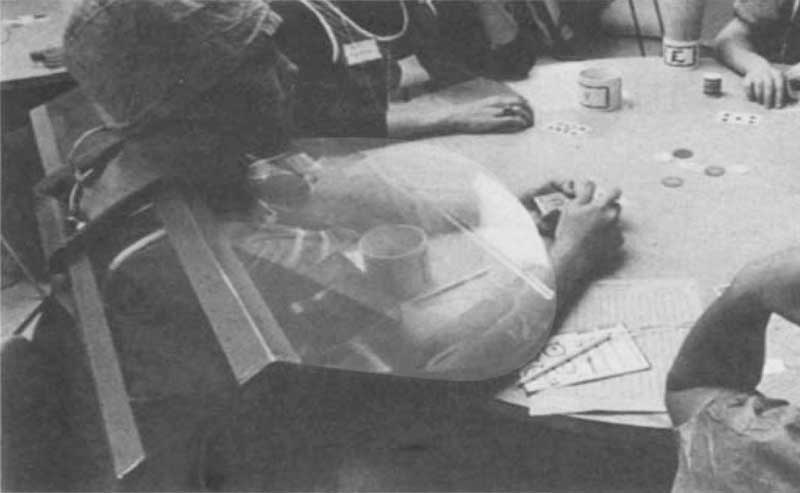
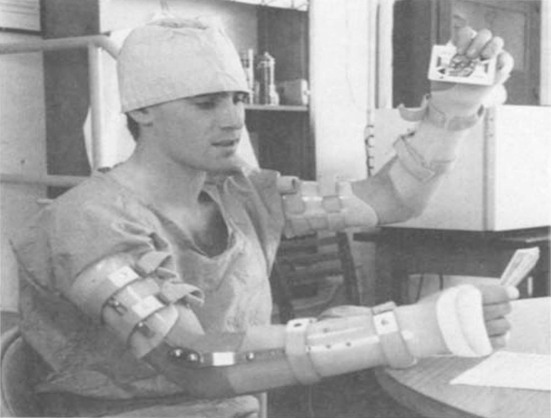
Result: 10 of the 18 recipients caught a cold solely through respiratory infection: inhaling aerosols.
Conclusion
Fomite transmission proved impossible. The difference between aerosol transmission with and without fomites was negligible and no greater than could be expected by chance.
These results suggest that, contrary to current opinion, transmission of rhinovirus, at least in adults, occurs primarily via the aerosol route.
Elliot C. Dick, Lance C. Jennings, Katby A. Mink, Catherine D. Wartgow and Stanley L. Inhorn, Department of Preventive Medicine, University of Wisconsin Medical School, Madison, Wisconsin
This was a very brief summary. The study is available behind a paywall at The Journal of Infectious Diseases Vol. 156, No. 3 (Sep., 1987, pp. 442-448 (7 pages), Published By: Oxford University Press and costs $39,- to download.
The Abstract can be found here.
© 1987 by the University of Chicago. All rights reserved. 0022-1899/87/5603‐0004$01.00
Editor's note
With this knowledge from 1987, let us examine how, 33 years later, our policymakers (represented by Hugo de Jonge) and their prominent senior advisers (OMT member Marion Kuipers Koopmans) was explained.
"Ja, hoe bel je iemand, nou kijk, als je dus iemand wil bellen, en dat nummer begint dus bijvoorbeeld with een vijf, dan moet je je vinger steken in het gaatje waar je de vijf achter ziet en dan moet je naar rechts een rondje draaien tot je niet verder kunt want daar zit een pinnetje, dat houdt je als het ware tegen. Dan haal je je vinger uit het gaatje en draai je het volgende cijfer."
Loosely translated from Marion Koopmans
The fallacies put forward by OMT members to reject the aerosol theory were, for example:
- "fretten zijn geen mensen" (naar aanleiding dierproeven)
- "we zijn hier in Nederland" (bij buitenlands onderzoek)
- "dat is klinisch nooit bewezen" (bij laboratoriumonderzoek - wat dus ook nog eens onjuist blijkt)
- "corona is geen griepje!" (op bestraffende toon, waarna de leek beschaamd hoort te zwijgen)
- "onderzoek daarnaar zou afgekeurd worden" (om de onwrikbare dogmatiek aan te geven waarvoor de wetenschappelijke methode plaats had gemaakt)
Now what?
Trust in government officials and academics continues to decline, especially in the health/pharmaceutical sector. They have an image problem that cannot be solved without structural changes, because they are simply incapable of doing so. They are incapable of conducting science, in which my trust remains high. However, the scientific method is no longer being applied, and that starts with being transparent and always demanding the same transparency from others.
The loss of respect is therefore what they deserve. Policymakers are no longer the sensible, competent people to whom we want to entrust leadership. Doctors are manipulated by their suppliers. Not to mention journalists.
In their desperate resistance to that reputational decay, they become increasingly fierce and vicious, like a bear being pushed further and further into the corner. It's going to lash out.
In the event of a system failure, the actors themselves are unable to adjust the system. After all, that would be an acknowledgment of the fact that they have collectively made a mess of it. Because this failure is about egos, positions and careers, and not about the national interest or public health, they will fight their positions to the last breath. We will see which way the ship will ultimately turn.

In the postscript, Marion Kuipers is mentioned as the name instead of Koopmans ( somewhat understandable, given their views 😉 )
Corrected!
What a fantastic headline! It immediately triggered me to read.
November '19 via all the red phones: "Boys (m/f), a couple of clumsies in Wuhan have released a virus that has improved to such an extent that it spreads easily through the air.
What are we going to do to avoid panic?"
Indeed... you probably know https://virusvaria.nl/the-biggest-cover-up-in-history/
I still have to weave the Omikron storyline through that, realized after office hours with a cold virus and a sequence of most contagious variant. Nothing had ever been done with it because it wasn't deadly enough. The bat-woman went to work on that. Reason: she had a secret romance with the animal testing supplier, who was involved in the wet market. When his family was affected by Covid, she realised what was going on...
You use the term 'dogmatics', Anton, and that seems very appropriate to me. "Scientists" who talk about "scientific consensus" to indicate that we don't need to talk about anything anymore are, in my opinion, dogmatists, who think that "science" consists of a collection of doctrines. The worst part is that these "scientists" have not understood what the essence of science is.
A comparison I sometimes make myself, they think that science is kind of magic trick. This is the only way to understand that they do not take transparency for granted. After all, you can't ask a magician exactly how that works, with that rabbit out of that hat...
“while I have seen dozens of documents in which contamination has indeed been demonstrated”
I would very much like these titles with URLs if possible
Thanks!
Well, once I start…see https://virusvaria.nl/virusontkenners-ter-info/