


Since it is perfectly understandable that perusing a 168-page grade report is shelved by this and that, I thought it would be an idea to pick some elements from it. This will give an impression of what is covered and demonstrated. I will try to describe the results of an entire chapter in a few paragraphs, so no underpinning or references. Chapter 6 is treated in more detail because new data were used in that chapter, providing real new insights. At other points, it deepens phenomena we already suspected.
Short link to this article: https://t.ly/SdCRs
Chapter 1: Introduction and justification
The authors point to the complexity of the issue and the imperfections of the available data, which are discussed in detail in the report. In doing so, they realise that this is a politically explosive issue. They consider the accessibility of the data insufficient.
Chapter 2: Excess mortality patterns
There is no doubt that, since mid-2021, there has been a substantial unaccounted-for excess mortality that continues to this day.
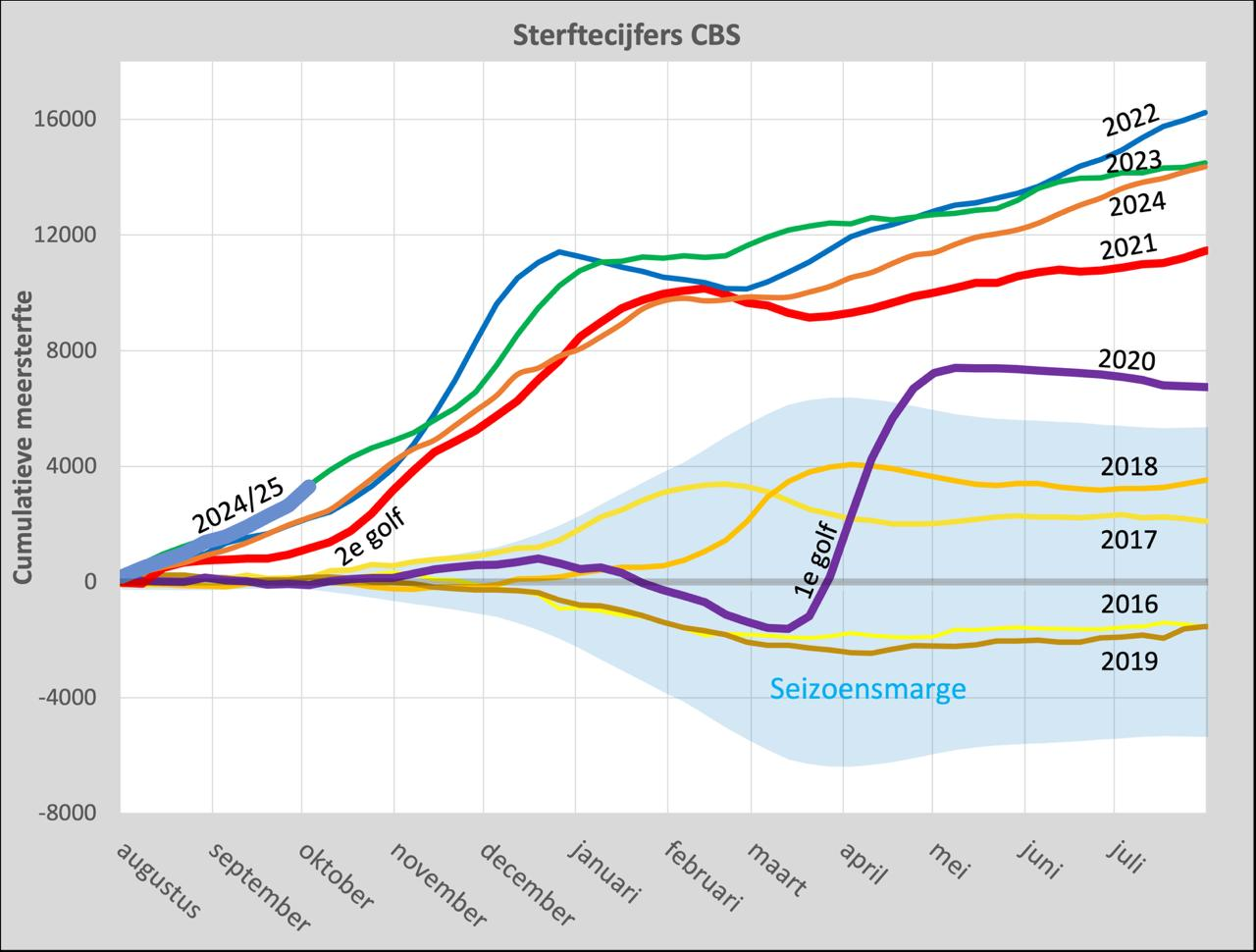
The weekly bandwidth is considered a 'safe' limit by government institutions and therefore also in the media. This is misleading when assessing longer periods. Variations per week are much greater in percentage terms than per month, quarter or year. The bandwidth narrows considerably for longer periods.
At higher mortality projections, excess mortality decreases. The government institutes include the misunderstood excess mortality years in their calculations. Consequently, the predicted mortality becomes higher, resulting in a reduction in excess mortality. Therefore, this study uses recalculated mortality projections based on mortality probabilities by age and size of age groups based on 2010-2019 statistics.
This allows for fine-grained analyses. See here in a graph the mortality probabilities for men and women aged 45-60 years, from 2010-2023.
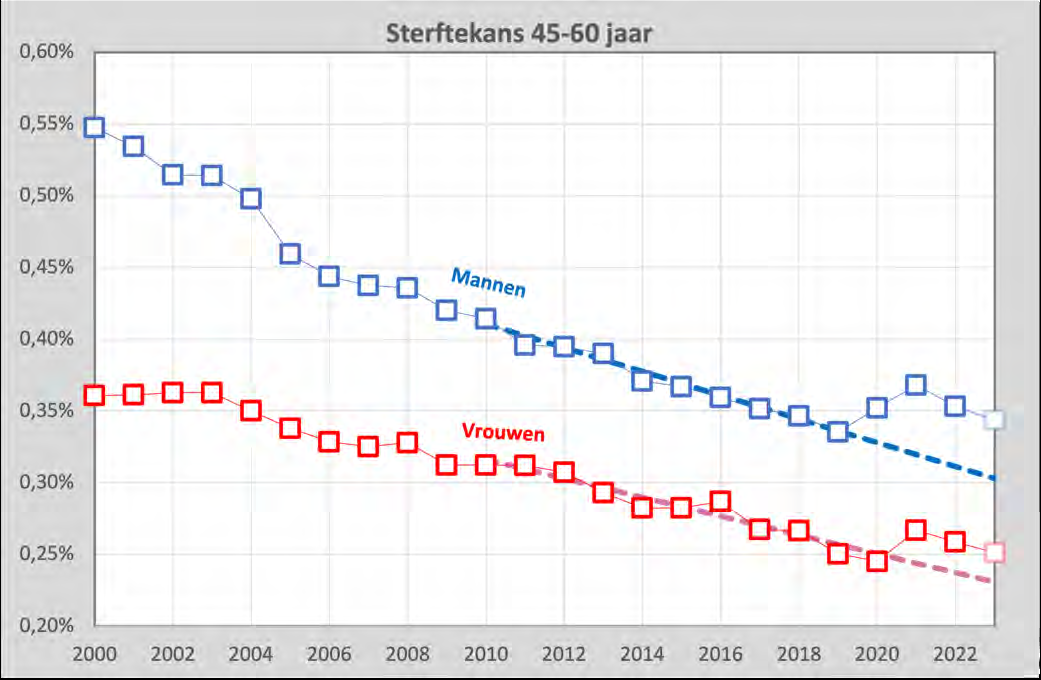
What is not included in the graph above is the expected underput after excess mortality. This is included in the investigation. Missed sund mortality contributes to overdolution. This extra excess is not included in the government communication.
The excess mortality rates vary by age group. After 'full' Corona year 2020, in 2021 and 2022 they are at roughly around 10% to 15%.
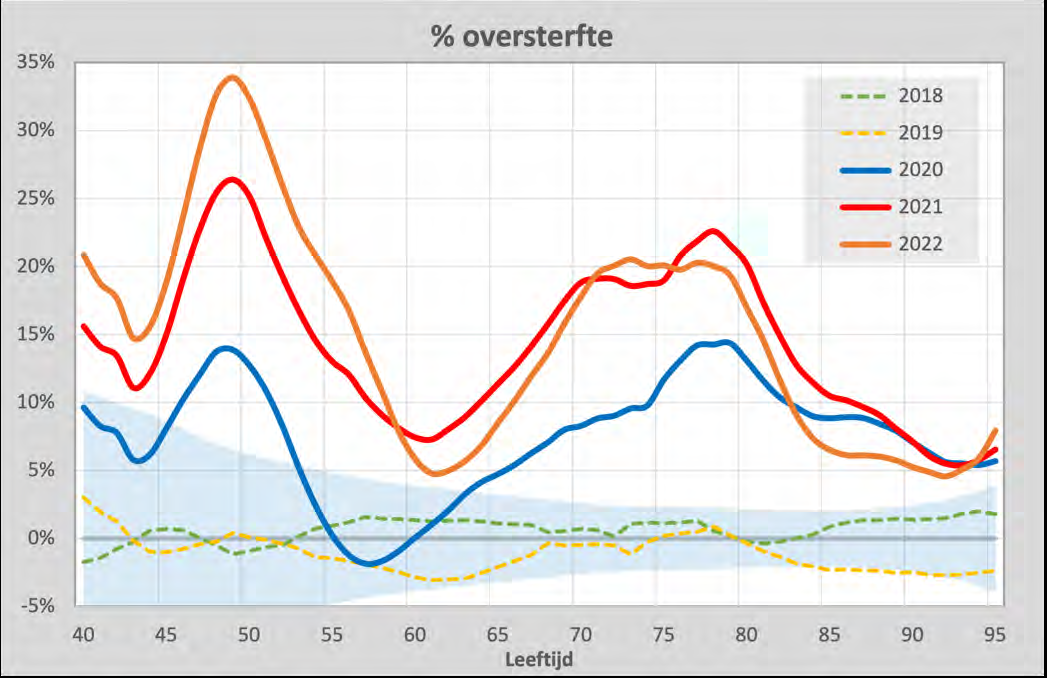
Also, by 2021, the average age of death drops by 5 years. So people are dying younger. This continues in 2022, when corona no longer plays a significant role. The duration and quantity of this phenomenon exclude that the main cause is to be found in delayed care or in (undiagnosed) Covid-19.
Chapter 3: Adverse reactions in a trial and in a report database
Examples that cause concern.
Safe? AstraZeneca: een dubbelblinde trial wijst uit dat de prik ernstige bijwerkingen veroorzaakte. Dit past niet bij het predikaat "veilig", waarop het volksgezondheidsbeleid is gebaseerd. Er is alle reden om op grond van deze data bezorgd te zijn over in ieder geval dit specifieke vaccin.
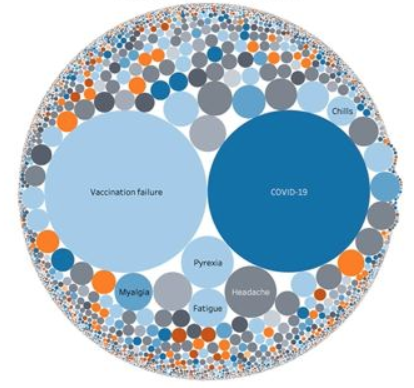
Effective? EMA (European Medicine Agency): Eén van de twee meest voorkomende meldingen na Covid-19 vaccinatie is "Covid-19", minimaal twee weken na de vaccinatie. Vindt de infectie in de eerste twee weken plaats, dan wordt de melding niet geclassificeerd als "Covid-19" maar als "Vaccination Failure". Die twee meldingen bij elkaar opgeteld betekent dat het krijgen van de ziekte verreweg de meest voorkomende bijwerking is van de beoogde beschermer tegen die ziekte. Dit zet vraagtekens bij de effectiviteit.
Chapter 4: meta-analysis of peer-reviewed literature
International differences in periods of virus spread, vaccination campaigns and seasonality make comparing studies a challenge. Systematically designed studies could facilitate this. Unfortunately, due to the diversity in topics, methodology, definitions (even concepts such as 'vaccination status' and 'vaccine effectiveness' are defined differently) and the varying quality of the studies, it is not possible to find a broad basis for general statements. Some conclusions that can be drawn:
- Gezien de variëteit aan bevindingen kon er geen sprake zijn van "Follow the Science".
- There is publication bias. Vaccine criticism is not readily embraced in the healthcare sector. Again, polarisation distorts information exchange.
- Opvallend veel studies tonen aan dat van een "peer review" niet al te veel mag worden verwacht. Illustratief is dat zelfs studies met onduidelijke definities van cruciale concepten ondanks (of juist dankzij) een reviewproces voor publicatie zijn geaccepteerd, terwijl er herhaaldelijk sprake is van ontbrekende ruwe data, discutabele meetperioden, black box modelleringen, discrepanties tussen rapportage en data.
- Wherever there is evidence of high vaccine efficacy, the Healthy Vaccinee Effect is ignored. A separate chapter is devoted to this.
Chapter 5: Macro Analysis
A CBS publication dd 23 November 2023 allows for analyses of protection against Covid-19 mortality. These show that people who got only one shot died from Covid more often than others in the first 4 weeks after the shot: a negative VE, even without observing the HVE. (HVE: People who forgo vaccination often have health reasons for doing so. This distorts mortality rates in favour of vaccination).
Other CBS publications also show correlations between vaccination volume and mortality. The Ministry of Health, which does confirm the correlations, argues that these correlations do not imply causality and therefore sees no need for investigation.
Zooming out, it is striking that the mortality pattern is changing: the deviant behaviour of the second wave compared to the first starts with the vaccination campaign in 2021. The picture fits a scenario in which vaccination generates short-term damage, in the form of mortality. The further course may indicate a reduced general resistance to seasonal viruses. More on this in Chapter 8.
Chapter 6: CBS microdata
[Note: below is just a selection from the more than 60-page chapter by Bram Bakker. It does not do justice to the quality of the work. The real value of this study lies in the verifiable substantiation, insofar as CBS allows this. Many questions remain open, mainly due to data gaps. This makes the call for (re)construction of reliable data even louder.
The analyses were done in the CBS microdata environment, with data at the individual person level, including the CIMS vaccination database used for the ZonMw Excess Mortality programme line. A large part of this chapter describes the methods and techniques used to look at the data. The attempts to distill meaningful data from it from different statistical angles are impressive and are described in detail. Below is only a selection of the results. Note that these statements are thus hard-wired from the source data, not hypotheses based on public reports.
A more comprehensive, substantive summary was made by Jan Bonte on x. Also read the furious column of Maurice de Hond. Herman Steigstra posted an in-depth article on LinkedIn].
Slightly increased mortality is visible during both the basic vaccination rounds and the booster round, especially in older age groups. This can be seen in particular in the unvaccinated groups and to a lesser extent in vaccinated groups. Covid mortality is also slightly increased, but represents only a small part of the excess mortality and cannot serve as an explanation.
The Healthy Vaccinee Effect is a well-known phenomenon. Vaccinated people are generally much healthier than unvaccinated people, including people for whom vaccination no longer makes sense. These will die as unvaccinated and count heavily in the statistics; After all, there are relatively many, compared to the small minority of unvaccinated people. Since this has not been corrected for, a high VE (vaccine effectiveness) is the result. Indeed, as a result, the unvaccinated are doing much worse than the vaccinated. This HVE effect, and thus the measured vaccine effectiveness, normally decreases again after these vulnerable unvaccinated people have died, and that is what we see in the figures.
If this effect is taken into account, there is no actual vaccine protection left. In the younger groups, mortality from Covid-19 is negligible anyway.
Een ander punt: er is een groep gevaccineerden (ca. 7%) die geen toestemming heeft gegeven voor verder onderzoek met hun gegevens. Wie van deze groep is overleden, is bij "ongevaccineerd" geteld. Ook zijn overledenen niet als "gevaccineerd" geregistreerd die wel geprikt waren. Wanneer het register werd bijgewerkt nadat zij waren overleden, waarbij vertragingen van een week of langer voorkomen, werden zij niet meer geregistreerd. Dat is althans een van de mogelijke verklaringen die in het rapport worden gegeven.
Note: after the publication of the report, this statement was firmly substantiated on X by @leon1969. Click here to read more (This was not part of the report)
He concludes:
- people who died between the start of the vaccination campaign (and at least 9 December 2021) immediately after being vaccinated for the first, or second/third time, ended up (in part, depending on the delivery of the vaccination timing) as unvaccinated deaths in the reports.
- a huge number of people exchanged the temporary for the eternal because of vaccinations. The risk of death increased with each vaccination.
He explains the implications for public health policy in This follow-up tweet.
Due to these gaps (HVE, 7%, registration process), both the reported VE and the safety of the vaccines have been presented much more favorably than they actually are.
For myocarditis, both SARS-CoV2 and vaccinations appear to affect the number of myocarditis diagnoses, with the combination being more detrimental.
In various ways, the data are shown to lead to such absurd conclusions that there must be massive data contamination. Concrete example from the report: vaccinated seventy-somethings would be 98.4% less likely to die in the first 4 weeks than unvaccinated ones, regardless of cause of death (p91). HVE cannot correct away this protection from any death. Thus, the quality of the data is questionable.
The reported very high Vaccine Effectiveness, both in terms of Relative and Absolute Risk Reduction, and both for Covid and for non-Covid/ACM, is actually based on the unrealistically increased mortality of unvaccinated people, compared to the normal mortality pattern for people of that age.
In absolute terms, the 'protection' provided by the corona vaccines against mortality from Covid is much lower than the concomitant 'protection' against mortality from something else. Again, this is clearly a signal that indicates impure data.
The subsequent section, with mortality analyses by 4-week period, broadly confirms the results of the previous analyses. The tone becomes slightly more firm. The HVE does not fit the increased overall mortality during the peaks of the vaccination campaigns because a pure HVE effect changes just the distribution of deaths, not the total number of deaths. All the figures suggest that for all younger groups, vaccinations were at best ineffective and therefore pointless.
Ook de eerste booster, die apart wordt bekeken, dankt de veronderstelde VE aan de extreem verhoogde sterfte bij de "ongevaccineerden". De verhoogde algemene sterfte geeft opnieuw aan dat hier niet alleen het HVE een rol speelt. Covid-19 heeft een gering aandeel in de totale sterftestijging.
CBS/RIVM does not notice the artefacts or simply ignores or downplays them.
For younger groups (from year of birth 1960 or thereabouts) the VE is most likely negligible or perhaps even net negative. No one can really make a statement about long-term damage due to a lack of reliable data.
The small increases in overall mortality of different birth year groups move synchronously with the respective vaccination rounds.
A separate and extensive chapter is devoted to heart failure (myocarditis, etc.). The clearest safety signal is found in the youngest group, 1980-2020, with a greatly increased risk of the condition around the primary vaccination (dose 1) and also in the second half of 2021.
Chapter 7: Reliability of the data
Underlying this chapter is the work of Wouter Aukema, who, among other things, has provided insight into the EMA data. Again, problems with the CIMS register are cited. Graphs show how records have been deleted. The reasons for this have never been explained. The ECDC and Minister Kuipers confirmed that records of deceased (and emigrated) persons are not included. The correction that was promised on this never took place.
Ook van de in hoofdstuk 3 genoemde "failed vaccinations" is niet duidelijk wat daarmee is gebeurd.
Following a FOI request, RIVM provided the data (records) of all people who were both vaccinated and died between January 2021 and January 2024. However, vaccinations after April 2022 are missing, even though vaccinations were carried out. The part that does seem to be complete shows, for example, that people over 80 had a mortality risk of 0.0037 within one week after the first vaccination. It normally fluctuates around 0.002 per week. The risk of mortality was therefore almost twice as high for them in the first week after vaccination.
[Note: combining this data with the non-registration of people who died shortly after vaccination is in line with the previously observed increase in the VE.]
Chapter 8: Medical Considerations
[Note: now I have to be careful because Jan Bonte co-authored this]
This chapter was produced with the cooperation of Jan Bonte and Jona Walk.
These medics have also seen that there has been excess mortality since the introduction of these vaccines in the Netherlands and this leads them to wonder whether there can be a medical relationship between these two phenomena. An earlier meta-analysis showed that the mRNA vaccines do not reduce overall mortality in any case, which is an important test. No statement could yet be made about medium- and long-term effects.
They discuss the possible mechanisms of these vaccines, which can cause side effects. How often they actually occur is the domain of statisticians.
Studies at the population level indicate that there is an increased risk of myocarditis/pericarditis (inflammation of the heart muscle and inflammation of the pericardium), especially in boys and men aged 12 to 30 years, menstrual disorders and vascular occlusions in the retina of the eye, resulting in partial or total blindness.
Cases have been described in which mRNA derived from the vaccine was found: severe and fatal inflammation of the brain, a severe polymyositis (generalized muscle inflammation), a case involving severe inflammation of the liver, a case of a severe recurrence of a herpes zoster (shingles), thyroid abnormalities, kidney disease, and a range of skin abnormalities.
Not all of these symptoms result in mortality, just like the very common fever, muscle aches, chills, fatigue and headache. For people with a relatively high probability of dying in the coming weeks or months, this impact of the vaccination may bring forward the moment of death. This is followed by a list of cases of healthy people with fatal inflammatory reactions and heart failure, all with serious suspicion of vaccination.
Autoimmune diseases can be triggered by Covid-19 and/or vaccination. Most of the time, these diseases do not lead to immediate death, but increase the risk of premature death in the medium and especially long term.
Here, too, special attention is paid to myocarditis in young people, also repeatedly demonstrated with pathological examinations. The big question for the medical profession is always the incidence: how often does it occur? Lareb's statement that Covid-19 leads to myocarditis more often than vaccination is not supported by the available data. The study design of the study cited by Lareb is inadequate for several reasons. For example, the incidence among the population cannot be determined. This is due to the fact that many more people were infected than tested. Another study also found that the incidence of myocarditis had not increased among young people until May 2021, i.e. until vaccination. If myocarditis occurs after Covid-19, it happens in older patients with comorbidities.
Another autopsy study shows that myocarditis should be included in the analysis of Covid-19 vaccination and mortality. In both the short and medium term, myocarditis can certainly contribute to excess mortality.
As far as thrombosis is concerned, the signals are less clear and, in any case, strongly related to other risk factors.
After a brief discussion of the innate and adaptive immune system, it is explained that the innate immune system is also affected by vaccinations, sometimes for the better but sometimes not. In that case, defences against other diseases weaken. As yet, this is not addressed in the introduction and registration of new vaccines. Studies show that Covid-19 vaccinations but also the disease itself have effects on the innate immune system.
There are many conceivable mechanisms by which the Covid-19 vaccines could contribute to excess mortality. The authors criticise the registration trials and propose a feasible monitoring method that could very quickly signal whether an adverse reaction is associated with vaccination.
Chapter 9 - Conclusions and recommendations
The excess mortality itself is not up for debate. Statistics such as those described and carried out in this report make a certain causal relationship between Covid-19 vaccinations and mortality plausible. Research into the relationship between vaccines and mortality is necessary, given the circumstances. It has been made clear that it is no longer sufficient to point to previous studies, including those by RIVM/CBS and data from the EMA. We have seen no signs in either our micro- or macro-analyses that vaccines have ultimately provided real protection against overall mortality.
Lack of transparency is crippling not only for the vaccination programme but for science in general. This will require a different handling of data.
We have made it sufficiently clear with this report that the Covid-19 vaccines are probably not at all ‘safe’ and ‘95% effective’, as successive health ministers have claimed as a mantra for a long time. The Dutch media, with several science journalists in the lead, have so far seized on everything to ridicule a possible suspicion of the vaccines in advance.
Therefore, this is the most important thing: ensuring that further research into the data and safety of vaccines is normalised. This report is as transparent a representation of the current state of affairs as possible, with the knowledge we could gather within our means at this time. We therefore hope that the publication of this report will be able to trigger something along these lines.

Beautiful, readable summary of an extensive work that is about to become well known!
Thanks again! Is it an idea to send this summary to the members of the cabinet, the House of Representatives, the Senate and to the parliamentary inquiry into the corona committee! Minister Agema is too personally involved medically because of her chronic illness, which makes it difficult for her, I think. Down with the ostrich politics!
Good, Anton.
Must admit that I also lost my concentration at a certain moment. It confirms what "we" already think. And "we" are not only of course, although it seems if you follow the MSM. Misschien zitten (in willekeurige volgorde) Meester & Jacobs, Herman Stijgstra, Cees vd Bos, Robert Malone, Dennis Rancourt, Steve Kirsch, professor Fenton, John Campbell, de mensen achter Panda Uncut, John Ioanidis, Jay Bhattacharya, Jan Bonte, Maurice de Hond, Jona Walk, Maarten Fornerod, Aseem Malhotra, Dick Bij, Pierre Capel, Theo Schetters, BLCKBX, DNW etc. all wrong. I have not seen any substantive refutation yet. Only insults and personal attacks. The graph at the top speaks volumes. We don't have to make it more complicated.
Where is the substantive discussion? Maybe a good start seen at Blckbx DWIV with as guest chairman of the NVJ (Dutch Association for Journalism). They disagreed, but in a polite way.
Goeie uitzending van Blckbx, Anton! Eigen parochie natuurlijk, maar wie weet, groeit die.
Dank Cees!
This Summary draws Fermere conclusions than M&J.
In my opinion, the only tenable conclusions are:
1. There is increased mortality in a cohort if that cohort has just been jabbed.
2. This indicates mortality due to the vaccine, and of course in the vaccinated
3. the HVE in combination with errors in the data ensures that the data shows just the opposite, namely excess mortality in the unvaccinated and under-mortality in vaccinated people. With a very large HVE, the data can even be good! (Anne Laning rightly argued that).
4. We already know for sure that the CIMS is incomplete due to 3% privacy refusers and by deleting records of people who were already deceased at the time of registration.
5. Because the data are incorrect and the HVE is difficult to determine, it is very difficult to determine the VE and mortality of the vaccine.
6. What is certain is that the VE and mortality have been presented far too rosily in previous CBS/RIVM/NIVEL reports on the basis of these data. But how much, we don't know. And it will be very difficult to determine that exactly. Normally, you do that with an RTC with placebo. But in hindsight, I think you can hardly solve this. You would then have to check the files of the deceased and check why they were not vaccinated. Maybe with a large enough sample? Then you can determine the influence of the HVE and with correct (i.e. corrected) other data you can then calculate the VE and the mortality of the vaccine. In short: that will be very difficult.
Thanks Jan, very pure. We're not that far apart. Because the scientific uncertainty was used as a counter-argument in the report, I formulated it more bluntly. It may not be so explicit in M/J at times, but I think it's all defensible with the report in hand.
Dear Anton,
For the sake of completeness, I would like to say this, in order to avoid any misunderstanding. By writing down my thoughts, I also organize them more and more sharply. I think this correctly describes the current state of affairs.
H.2 is decent. But the fact that excess mortality will fade away in 1.5 years is debatable. Anne Laning argues (in my opinion on reasonable grounds) that in view of the time of death and lost QALYs, the under-mortality should be spread over approximately 5 years. So then the expected under-mortality is less and so is the measured excess mortality.
H.3. Investigations by pharmaceutical companies are notoriously rattling....
H.4. The text is tendentiously written down by M&J. They should have adhered to data and analyzes and conclusions and should not write about hassle around publications. That only arouses allergy and suspicions… ..
But the findings (rattling data and rattling definitions/methods) are correct. There is no good evidence for the VE and mortality of vaccines. Because no RCTs have been performed. And the one who had started got sick halfway through (placebos still vaccinated).
H.5. Your first paragraph is also challengable, because a strong HvE cannot make a good breakdown of the effects of the puncture on whether or not vaccinated people. That is the crux of the criticism of Anne Laning. And he is really right about that. So although M&J are aware of the HVE, they themselves do not keep it sufficiently into account which crazy results this can lead (and Maurice is also teeth there). That laning is a vaccine protagonist, and partly blind, but he is not stupid! And therefore often rightly criticizes the vaccine critics. And is, rightly, allergic to tendentious language use of M&J. But he believes again too lightly positive publications about vaccines. M&J should work with Laning!
The only thing you can conclude is that every round of vaccinations of a cohort with increased mortality coincides in that cohort, without (per cohort selective infections with Corona) being able to explain this. This leaves vaccination as the most plausible explanation.
H.6. Of these, only the following remains:
a. the CIMS database is polluted with too few people with status "Vaccinated".
b. because of the HVE (and missing "Vaccinated people") you cannot make any meaningful statement about the subgroups vaccinated or not.
c. Both artificially matched and crude mortality data show that there is increased mortality in that cohort after a round of vaccinations of a cohort. Breakdown by vaccinated status is impossible due to errors in the data and the unknown value of the HVE. Because there is pollution and increased mortality, the only conclusion you can draw is that reports by CBS/RIVM/NIVEL make overly optimistic statements about low mortality due to vaccines and about the high VE. But how much too optimistic that is, cannot be determined with the current data. And probably not even without further primary data collection of the reason for not vaccinating people (very) (shortly) before their death.
In your description of H.6, this is the only "hard": " The small increases in overall mortality of different birth year groups move synchronously with the respective vaccination rounds. ". Incidentally, this is a very crucial finding!
But all your statements about breakdown in subgroups are not sustainable; And not all those of M&J are also sustainable.
H.7. generically, the findings are correct. But statements about breakdowns are highly questionable.
H.8 In my opinion, it is difficult to judge in terms of scientificity. I don't think it's the strongest chapter....
H.9.
The only tenable conclusions:
1. There is damage to vaccination due to synchronous occurrence of increased mortality and vaccination rounds in corresponding cohorts; But we don't know how big it is A.G.V. the HVE and errors in the data.
2. The VE reported by CBS/RIVM/NIVEL is certainly too high due to errors in the data. But it could be that the VE is positive.
3. Further investigation may show whether the damage, depending on the age/risk group, is smaller than the VE profit. And therefore vaccination for certain groups is useful. But that will not be easy; Not because of the data, because that seems to be repaired; But because of the HVE. The HvE can only be switched off in an RCT. Afterwards it might be possible by finding out through a sample what the reasons were not to vaccinate people in their last weeks/months and on what scale it happened. So very difficult… ..
Dear people, When looking up information about vaccinations in nursing homes, I came across the following: National Institute for Public Health and the Environment rivm.nl Work Instruction Corona Vaccination Institutions with medical service. Received at the same time as flu shot. Vaccinations for children aged 6 months – 4 years and 5 years – 11 years Comirnaty Omicron JN.1 Register subject with text about source system etc. different e-mail addresses including cimsbeheer@ rivm.nl. Sometimes it says private above. Among other things, at page updates and registration. I also came across lci.rivm. And I thought I knew a lot, but it's much worse. They even vaccinate primary vaccination series in children under 5 years of age and then the booster. Folks, stay away from pediatricians with your kids! If there is no other option, find someone who wants to help you without those jabs! Anton, can anyone figure this out? I've used a space here and there so as not to put some who would like to read along on a track... Thanks in advance!