


If you read scientific articles about HCQ (hydroxychloroquine) you will mainly find studies with negative results and even studies that were stopped prematurely due to the damage the drug caused. Exceptions are rare: articles by Dr. Raoult and claims by Dr. Zelenko, an orthomolecular general practitioner who, for that reason alone, carries little scientific weight. He has determined a recipe for HCQ that works according to its proponents: the Zelenko protocol.
The Zelenko protocol according to Rob Elens:
hydroxychloroquine 200 mg 2 x per day for 5 days, together with zinc sulphate 220 mg 1 tablet 1 x per day for 5 days together with azithromycin 500 mg 1 tablet 1 x per day for 5 days.
https://zelfzorgcovid19.nl/duitse-onderzoekers-brengen-studie-uit-naar-de-covid-19-behandelresultaten-van-dr-zelenko-uit-new-york/
In the Netherlands, general practitioner Rob Elens has treated 12 COVID-19 patients according to the Zelenko protocol and they have all recovered without any problems. Assuming that's true, it's still not a representative double-blind randomized peer-reviewed study. So it doesn't qualify as scientific evidence; it can put science on a certain track.
For this reason, Rob Elens was reprimanded by the RIVM: he was no longer allowed to prescribe HCQ for corona. The drug would be too dangerous. At the same time, HCQ may continue to be prescribed for other diagnoses such as malaria - as long as it is not corona. The side effects of HCQ are of course known to general practitioners; there is no medicine without side effects. Even placebos have side effects (if you tell them). With HCQ, the contraindications are not corona-related. The problems mainly occur in people who have heart problems.
As mentioned, science has picked up the term HCQ, but they probably did not take the Zelenko protocol seriously or it was not communicated properly in some way. The criticism of the proponents of the various studies:
- Studies have been done with HCQ alone. Regular science has apparently estimated the substance HCQ as an active substance. HCQ is also prescribed for malaria (also preventive).
- Research was applied too late in the disease process. On the one hand because patients could be well monitored in the ICU, on the other hand because things looked so bad for patients that the risk of the HCQ experiment could be better justified
- The doses of HCQ were absurdly high, perhaps to demonstrate the effect more clearly (but we don't know that)
- Due to its side effects, the drug is not considered suitable for large-scale administration as a preventive measure. That was never the intention, but the fervent opponents sometimes appear to be good at coming up with conspiracies (HCQ in the drinking water).
Then a damning study appeared in The Lancet, which stopped all research. The figures showed that HCQ was life-threatening for COVID patients, it only increased mortality.
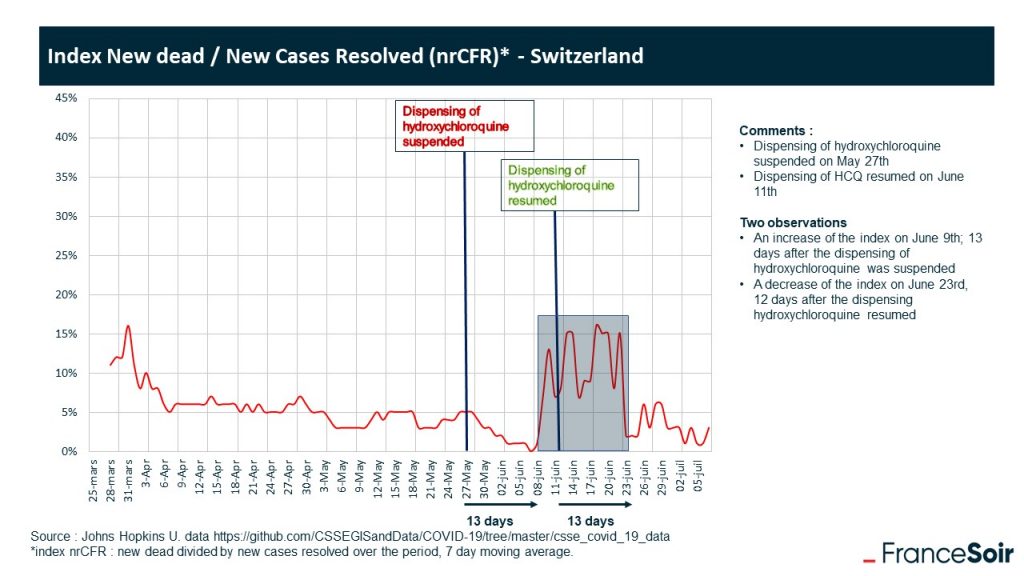
This had major consequences. All studies were stopped and a number of countries where HCQ was being used immediately stopped using it. This also includes Switzerland.
Two weeks later, the Lancet article was withdrawn: It turned out to have been fraudulent by interested parties. Several studies turned out to be unreliable at that time, and these types of hoaxes also occurred at Nature. A crisis in the world of science. If peer reviewing is no longer reliable, what else should we do?
Then who is bothering you? Consider parties that have an interest in ensuring that a cheap and freely available drug against COVID does not come onto the market: manufacturers working on a patent for a corona drug, vaccine makers or institutions that have linked their reputation to the arrival of a vaccine. It's a billion dollar business.
So far it was still undecided for me. I could not imagine that the RIVM would ban a very normal medicine for general practitioners who are used to determining when and for whom a prescription makes sense and for whom it does not. I now think differently about this: The RIVM regularly does things that are at the expense of public health.
I thought the biggest problem was that all those studies did not have the right protocol as their subject. it seemed as if she wanted to investigate per substance what actually helped. Why was there no research with the recommended protocol, for example as applied in Switzerland? After all, things seemed to be going quite well there.

0 Reactions