

Exactly one year ago, on July 12, 2021, Oriana Pepper, British pilot in training, passed away. Last week, the extensive autopsy report became available: she died of septic embolism (blood clot) in the brain. Most common symptoms of this are a TIA or stroke.
She had been stung by a mosquito in Antwerp and the mosquito bite was going to ignite. The exact circumstances can no longer be determined from the media.
De conclusie van de lijkschouwer is hoe dan ook zonneklaar, blijkens het bericht van RTL Nieuws: "De lijkschouwer concludeert dat de bloedstolsels ontstonden na de muggenbeet." Deze conclusie volgt onvermijdelijk uit de constatering dat een muggenbeet voorafging aan het ontstaan van bloedstolsels. Eigenlijk is het meer een herformulering dan een conclusie.
Nu is correlatie nog geen causaliteit. Daarom zijn journalisten altijd voorzichtig om bijvoorbeeld van 'vaccinatiesterfte' te spreken als iemand na vaccinatie overlijdt - een onderwerp dat hier overigens volkomen los van staat. De overledene was inderdaad door een mug geprikt maar hoe lang daarvoor dan? En had zij verder geen prik gehad, bijvoorbeeld van een spin of een wesp? Geen wondje aan haar knie?
Journalists don't get it clear
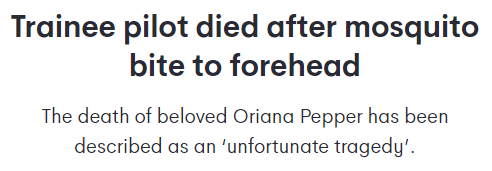
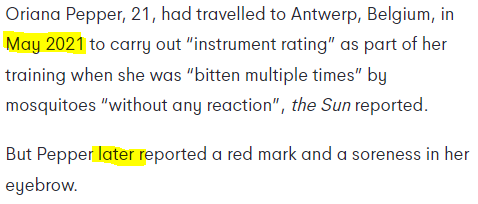
De berichtgeving in diverse media schept verwarring over de plek van de muggenbult: "op het voorhoofd" danwel "boven de wenkbrauw", "boven het ooglid" en zelfs "in het oog". (Enkele schermknipsels ter illustratie hiernaast.)
Ook de termijn die verstreek tussen de vermaledijde insectenbeet en de bloedstolsels is moeilijk te achterhalen in de bronloze of naar elkaar verwijzende berichten. Sommige journalisten reppen van "5 dagen na de beet", in andere artikelen wordt de infectie die haar begin juli fataal werd, gekoppeld aan muggenbeten in mei.
"Op 5 juli was Oriana in België voor haar pilootopleiding. Ze meldde pijn in haar wenkbrauw en een rode vlek na een beet, terwijl ze ook een 'doffe pijn' in haar rug had". Je zou hieruit kunnen opmaken dat ze de pijn meldde op 5 juni.
According to the BBC, she was bitten on July 7 and died on July 12.
Be that as it may, during the apparent development of the blood clots, the pilot also complained of low back pain. We only find this in a few messages and it is also not linked to the mosquito bite by immunologists. That would also be inconsistent with the explanation that a bacterium happened to end up exactly in the vein that leads to the brain, as we will see in a moment.
De BBC schrijft de oorzaak toe aan een bacteriële infectie "and an insect bite on the forehead that also contributed to it". Dat klinkt weer anders.
In short, I don't know exactly how it was through the media.
Nine4news even writes that she would have been stabbed in the eye (!) and died of an unhinged blood clot that is infected with bacteria and gets stuck elsewhere in the body. (That description of septic embolism seemed exaggerated to me but can be found literally on the site of the thrombosis foundation.)
The Telegraph kopt boven een kort artikeltje: "Jonge pilote overleden door herseninfectie na muggenbeet: ’Nog nooit gezien’". Alsof er bij alle dodelijke herseninfecties nooit iemand in de weken daarvoor door een mug werd gestoken: dat zou wel heel toevallig zijn. Of ze bedoelen het opmerkelijke feit dat het een jonge pilote in opleiding betrof, die desondanks werd geprikt.






Immunologist outlines causal chain
Immunologist Ger Rijkers creates clarity for rtlnieuws when asked; he knows how to sharply dissect causality:
- a certain bacterium was already present on the skin (that is not in the autopsy report, by the way)
- when the mosquito pierced the skin, the bacterium entered the bloodstream (that is not a quote from the autopsy report either, but that is how it must have gone)
- the bacterium caused infection with blood clots (otherwise there is no explanation for blood clots)
- the blood clots ended up in the brain because the prick was near the eye, causing the bacteria to end up in a vein that leads directly to the brain.
Irrefutable immunology.
Wetenschapper onthult: "Volgens mij nog nooit gebeurd"
"De belangrijkste boodschap voor de mensen thuis is in dit geval dat het 'superzeldzaam is'", zegt immunoloog Rijkers. "Dit is volgens mij in Nederland nog nooit gebeurd." Dat is een geruststellende gedachte. De immunoloog hoefde dit overigens niet na te kijken want als immunoloog kent hij alle superzeldzame doodsoorzaken volgens hem uit het hoofd. Die zijn dermate zeldzaam dat ze nooit gemeld worden. Daarom is het ook niet zinvol om ze op te zoeken.
Maar: niet voor één gat te vangen, wil Rijkers niet uitsluiten dat er toch iets anders aan de hand kan zijn: het zou misschien toch een tropische mug kunnen zijn geweest die de infectie heeft veroorzaakt: "Er zijn duizenden soorten muggen, die kunnen bijvoorbeeld malaria of het zikavirus meenemen." De mee-geïnjecteerde huidbacterie (staphylococcus aureus) is kennelijk toch geen 100% overtuigende kandidaat. Dus toch een Zika-achtig virus uit Afrika?
"Antwerpen heeft een haven en het kan zijn dat er muggen mee zijn gekomen, maar ik verwacht het niet." zegt immunoloog Rijkers.
Een spijkerharde onderbouwing, die bijval vindt van een Engelse lijkschouwer: "Parsley commented that he had never seen a case like this before". Ook al niet...
Rivm and new insights
rivm
The rivm says about staphylococcus Aureus that especially the resistance of the patient is decisive. Blood clots are not explicitly mentioned as a result of the staphylocuccus aureus, but blood infections. Only in the elderly is there a suspicion of blood clot danger after infection.
But there was nothing wrong with the pilot's resistance.
New insights
Two weeks ago, a study in Science which describes how a defect in the OTULIN gene makes people vulnerable to these staphylococci. These patients often (from the age of ten) suffer from out-of-control infections and necrosis formation. Whether you become a pilot with that I wonder and then you do not let yourself be sent home with a course of antibiotics if you have a weird inflammation above your eye.
Auteur András Spaan (UMC Utrecht en The Rockefeller University) over zijn onderzoek: "We ontdekten dat natuurlijke antilichamen, gericht tegen het stafylokokken α-toxine, de cellen van de patiënten kunnen beschermen en daarmee het aangeboren defect van hun cel-intrinsieke immuniteit kunnen compenseren."
Maybe something had happened to her natural immunity that made it not quite right anymore?
The AD suggested dat Oriana mogelijk de OTULIN-deficiëntie had, anders is zo'n infectie immers niet te verklaren.
It's something. And other causes it could not have been because they are safe.

She was a pilot so almost 100% sure that she 'mandatory' had a jab known to be very safe.
So it must be another, albeit very far-fetched, cause.
Either way, it's sad for this young woman.
Indeed. I can also remember a letter (Pepijn van Houwelingen tweeted that) from desperate parents because their child was not allowed to continue pilot training without vaccinations. It was later said that Pepijn had just written that letter himself to be able to tweet because it was not true at all ... Unbelievable, that mass psychosis and you can't do anything about it.
Good that autopsy has taken place. Now the excess mortality can also be explained. Mosquito bites! A vaccine for this should be developed as soon as possible!
I always think it's so clever! How the media and science work together and then solve such difficult riddles so well and unambiguously. I have such a deep admiration for that! Pretty good though.
Mmm... they have (probably unintentionally) 'proven' that being pricked can be life-threatening.
One option could be that it is a special prick beast. E.g. a mutated mosquito. Taking into account the fact that a mutated mosquito that ends up in nature cannot simply be taken out again.
Also separately if infection in vein face comes that then the brain becomes infected with blood clot .... I have really learned with biology that veins branch into larger veins and find their way to the heart there the small circulatory begins to then enter the large circulatory system and only then possibly goes back to the brain but that blood clot was then long ago stuck in the fine branch of the lungs. Or am I missing something here?