


Like announced Herman Steigstra started calculating and we started thinking further. He just posted the result steig.nl. I shortened his title (the only thing I still had a question mark about) because whether CBS sees 'excess mortality' and how much depends entirely on the 'expected mortality' they choose: their own expectation, that of the RIVM or the 'standard mortality' that we also use on the mortality monitor. We haven't quite figured it out yet in that regard. It is now clear what the RIVM does. That said, below is the article.
CBS sees another 5 years of excess mortality, but RIVM does not see that
Sometimes it takes a while for the penny to drop, but this penny drops with a huge bang. On December 15, 2023, CBS published a forecast with the title:Prognosis of deaths; gender and age, 2023-2070. The interesting thing is that this is indeed a forecast, the first for the year 2023, which was almost over at that time. So that's actually a lame one, because it's accurate.
The forecasts for the following years are more interesting. We are looking until 2040, because the forecasts become more uncertain as the years go by. Even for 2024, the prognosis is uncertain, but these figures do allow us to get inside the head of Statistics Netherlands and read their view on excess mortality. But first we have to take a trip to the expected value, or the baseline, which we will discuss laternorm mortalitywill mention.
The baseline
Both Statistics Netherlands and we have made statistical calculations based on the mortality figures from 2010-2019 in relation to the composition of the population. We will have an update on this in November 2023extensive articlewritten. Our calculated expected annual mortality differed very little from the annual figures that Statistics Netherlands published at the time and therefore gives both sides some confidence about the correctness of the assumptions.
CBS and we calculate this baseline in almost the same way. We calculate a mortality risk over time for each age as a straight line, which decreases very slowly over the years for each age. This is an acceptable approach for a limited time, but at some point the decline in this line will have to stagnate. After all, it seems unlikely that we will ever become immortal.
Mortality rate
The mortality risk per age determines the total expected mortality per year. By multiplying these probabilities by the number of inhabitants per age (we do this separately for men and women) and summing them up, we calculate the total number of expected deaths in a year. Assuming that this probability decreases very slowly, but the population size increases slowly, the overall result is that annual mortality increases slowly. Until 2020, this was between 0.5% and 1.0% per year.
Life expectancy
A frequently used parameter to indicate the expected age to be reached is life expectancy. Life expectancy is defined as:the number of years a person is expected to live. If the future mortality rate would remain the same for every age, then life expectancy would also remain the same. But if the risk of mortality decreases, life expectancy increases at the same time. For someone born in 2020, this was 80 years for men and 83.3 years for women, we read inthis publication from CBSfrom 2020 in which we encounter this graph:

We see here that life expectancy slowly increases with age, but the difference between men (yellow) and women (purple) remains constant at 3.5 years. In oneother article from CBSFrom 2014, this difference is actually becoming smaller: from 7 years in 1990 to 2 years in 2030. But anyway, life expectancy is getting higher, we are getting older, so the chances of mortality are decreasing.
We can also calculate this forecast ourselves using our own calculation model:

We must note that this graph (just like CBS) is based on extrapolating the decreasing risk of mortality. The actual calculations are shown for women. For men, the uncertainty will become so great after 2030 (men would live longer than women), that we have aligned this with that of women, who are therefore also uncertain. But it gives an indication of what we might be thinking about, not an absolute truth.
And now the CBS forecast
After all, that's what we started with. Until 2024, CBS was responsible for the weekly reporting of mortality figures. These were shown in a graph, where mortality was compared to the baseline with bandwidth. This is an example of the reporting at the time:

The thin blue line is the baseline, the expected mortality per week, calculated by Statistics Netherlands. The thick line is the actual mortality.
From 2024, this reporting was taken over by the RIVM, which took the opportunity to present the figures against the background of their own forecast. It was therefore no longer the value previously expected by CBS that was being compared, but their own forecast. If the actual mortality did not deviate too much, the weekly value was “Not increased”.
Now it gets interesting, because now CBS came on15 december 2023so also with a prognosis. This is especially interesting when we look at the forecastsafter2023. We have brought everything together in this graph:
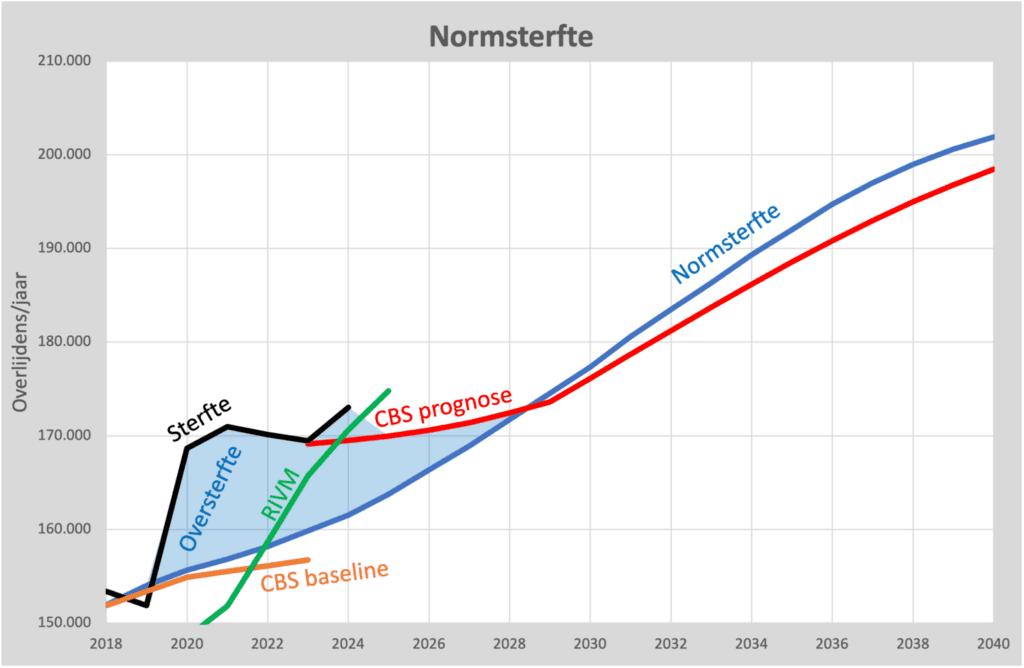
The blue line is the baseline we calculated (marked “Standard mortality”), which is therefore virtually identical to the annual figures from Statistics Netherlands (orange line) until 2023. Statistics Netherlands appears to have already taken into account the expected under-mortality in the years after corona in their calculations.
In 2020, as a result of corona, we see the actual mortality (black) increasing by around 13,000 compared to the expected mortality. The excess mortality is indicated in a light blue color and has continued unabated after the disappearance of corona.
All kinds of explanations are given for this, but the only explanation that is still not accepted is the one that involves vaccination. It would be deferred care, “something about corona” and even the aging of the population was mentioned by those who cannot handle numbers well.
The RIVM forecasts are also included as a green line. Completely unclear what we should understand about this. It seems more like a well-intentioned line to indicate which mortality we should take into account. This forecast therefore no longer has a signaling function, but is still presented as such (see alsosterftemonitor.nl).
But CBS's explanation suddenly sheds light on the matter. The red line is the forecast that CBS is now issuing and we will start in the right half. The most important thing is that the red and blue lines will be very close to each other from 2029 onwards. This means that CBS assumes that the mortality rate will approximately follow our model from that moment on. Statistics Netherlands even expects a slightly lower mortality than we might expect based on the standard mortality rate. The direction of the line between 2020 and 2024 was already the correct one, because it is still being followed according to this forecast from CBS.
As far as CBS is concerned, we can now immediately eliminate everything that falls into the category of “aging” or “end of decline in mortality risk”: the slow decline in mortality risk will continue. The official explanation remains: deferred care, which has long been established to have had a minimal impact on mortality. And finally, the category "unexplained excess mortality", because it cannot be called vaccination.
Forecast from 2023
The next thing we will look at is the CBS forecast for mortality in 2023. Almost all figures were known, so the forecast and actual figures are virtually the same. But what follows is intriguing. CBS expects a slightly higher mortality for 2024 (it looks like mortality will be even 4,000 higher by the end of this year).
But what CBS also expects is that we will not get rid of excess mortality after that. This will slowly disappear, spread over 2024 to 2029, so there are still 5 years of excess mortality ahead. CBS expects it, but provides no further explanation. As a watchdog for our health, the RIVM also provides no explanation, even though they have virtually the same prognosis.
The question is therefore whether we can call this deviation of an average of 13,000/year from the expected value increased. RIVM explicitly reports “Not increased” every week, not only emphasizing the accuracy of their own prognosis but also that the mortality level is not a cause for concern. The institute does not provide any further insight into what is going on. This amounts to covering up the excess mortality that we have continued to see since 2020.
Norm mortality
The confusion surrounding forecasts and expectations is not diminishing. Should we rely on the originally calculated baseline by CBS, which they no longer publish? Or perhaps that of the RIVM and should we accept that what we observe is also the norm and therefore automatically “not increased”?
CBS has lost its wayand apparently cannot choose between prognosis (red in the graph) and expected mortality (orange). The RIVM cannot handle baselines and signal values. Perhaps we can then use the procedure as published inResearchgate, with ultimately almost the same values as those of CBS, but can be reproduced for everyone?
Previously on this site made a pleafor introducing the concept “Norm mortality", just as we already know it for many other variables. Just like the BMI (Body Mass Index), which we use to provide a guideline for healthy body weight. This does not move with the average weight gain. This must then be a reproducible calculation method based on historical mortality figures, where temporary shifts in the image have no influence.
It does appear that with this prognosis, CBS has done justice - in the somewhat longer term - to accepting the originally expected mortality on the basis of mortality probability. After all, Statistics Netherlands' forecasts are again based on the trend in the originally calculated expected mortality.
An “unknown cause” has caused more than 60,000 additional deaths to date. With the forecast for the end of 2023, CBS has emphasized that ournorm mortalityis the correct basis for the calculations.
Conclusions
In order to obtain a good assessment of excess mortality, there must be a reliable long-term prognosis. Statistics Netherlands has issued a forecast for the expected mortality for the coming decades and from 2029 this forecast will again virtually correspond to the values calculated from our own calculation model, thenorm mortality. The difference between the observed mortality and theNorm mortalityis then an objective measure for theexcess mortality.
Sudden deviations of theNorm mortality, whether it concerns incidental peaks or multi-year trend breaks, will have to be explained and proven to be irreparable before the Mortality Standard is adjusted accordingly. Criteria are needed for this because gradual deviation from a prediction is unavoidable and will require adjustment. Given the interests, policy implications and ideologies that may be involved, an independent committee could be set up to advise the government or the Ministry of Health, Welfare and Sport in this regard.

It is logical in itself that the excess mortality will stop at some point because there are no more people left to die sooner due to the excess mortality. Shouldn't we see under-mortality after excess mortality at some point?
I do expect that RIVM will correct the mortality expectation on the advice of CBS and not adjust it upwards by a few thousand per year, as is currently the case. How do you see that Anton and Herman?
By the way, it is cowardly that CBS abandons the old line and simply (without stating a clear reason?) increases it by about 15 thousand. That's not normal!
Excess mortality is always in comparison to what is left of the population at that moment (a bit cynical). Then there can still be excess mortality!
The difference between expectation and forecast is still a subject of discussion and insight. It's like this:
At the end of 2022, CBS established the baseline for 2023. This is based on historical developments in mortality risk and population size. Rounded to 158,000 for 2023. In the last weeks of 2023, CBS issued a PROGNOSIS for that same year. Rounded to 170,000, so it became 170,000. CBS has used that forecast for 2023 as a forecast for 2024 (a bit more) and that is the same as what RIVM uses for 2024. So the figures achieved become a forecast for both the past year and the following year.
RIVM then uses this as their own standard for expected mortality. If mortality corresponds to the 2024 forecast (=mortality 2023), then it is “Not increased” according to RIVM. CBS does not make any statements about this, because as far as we know there is no new expected mortality.
Thanks Herman,
I prefer to stick to your expectations, because CBS, like RIVM, can no longer be trusted. That could have been different if they had identified the causes of the adjustment. Now both say that the realization of year x the prediction of year x+1 has been increased by a percentage for the changed population “pyramid”.
Under-mortality after excess mortality only occurs if mortality is slightly advanced. For example, the average age of death from corona was over 80. After many cases of “died suddenly”, no loss of life will occur.
And just as cynically: the retirement age can only be lowered if, on balance, there are more deaths above the age of 67.
I think I know why men live shorter lives on average than women. The medical world has tailored their concoctions and prey primarily to men. Women sometimes complain that they have not been sufficiently tested and examined about the effectiveness of medications. I don't think they know how much benefit they get from that. They are now working on giving women more attention about the effectiveness of medicines and diagnoses, etc., which is why women will have a higher mortality rate in the future?
Filmtip “First do no pharm”.
Is it really not possible to sit down with the people at CBS and have them explain exactly how they arrived at those predictions/models?
So you can calibrate your own model?
Or is it clear whether manipulation has taken place?
That should be possible, right? Or do they first require questions from the House of Representatives to force them? Can't we have someone from NSC, BBB or PVV ask the Minister of Economic Affairs and Climate Policy?
This is not necessary, because it is already clear. CBS predicts approximately 170,000 deaths for 2024, while we ALSO predict 170,000. To be honest, even a little more. So we just agree! Just like with RIVM, which ALSO predicts 170,000 deaths.
Only it is presented as if that is “normal”. RIVM says in the event of a death that fits the prediction: “Not increased”.
We measure mortality based on what we now call “Normal Mortality”. In fact, we also agree with CBS there, because their long-term forecast corresponds to our own long-term forecast, which simply continues almost linearly.
The only thing we wish is that Statistics Netherlands would make a clear distinction between forecast and expected values.
Yet you write yourself that it is your “conviction” as to how they did that. And I believe you, your arguments are very valid. And it's true.
But it remains speculation.
It would be much better and more illuminating if CBS itself indicated how and why they "jumped" from the orange to red line as a forecast. And ultimately end up back at the old baseline.
Let them explain that, then they have to bare their buttocks.
And finally; keep those figures and sources safe. Because the black line is already deviating considerably from the forecast. It doesn't stop with excess mortality...
Dear Jan,
CBS has released something about the excess mortality on vzinfo.nl. In the Previous article it is called that. This one-liner is also striking, their take-away from the corona years: “In the corona years 2020 and 2021, approximately as many men as women died.” We can do something with that… pfff.