


Microworkshop causality for committed health scientists and wandering science journalists.
Kan een onderzoek naar het effect van een vaccin dat (zeg maar hypothetisch) juist een grotere kans op sterfte ongeacht doodsoorzaak geeft, door het niet corrigeren voor het "healthy vaccinnee effect" de schijn wekken dat het tegen sterfte ongeacht doodsoorzaak beschermt?
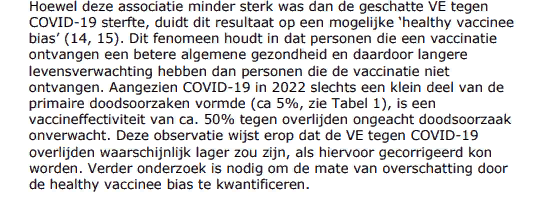
The RIVM researchers were already surprised by a 50% risk reduction in an outcome for which the vaccine was not even designed and attribute that result to the aforementioned effect. See the clipping from the study. However, this fact was ignored in many RIVM and CBS communications and in the newspapers, but it is crucial.
Het "healthy vaccinee effect" betekent dat mensen met een gezonde levensstijl sneller een vaccin nemen en dat mensen met een korte levensverwachting of een ongezonde levensstijl een vaccin sneller zullen laten staan of niet eens halen. In het diagram staat hoe "health" de keuze of de gelegenheid voor de "treatment" beïnvloedt.
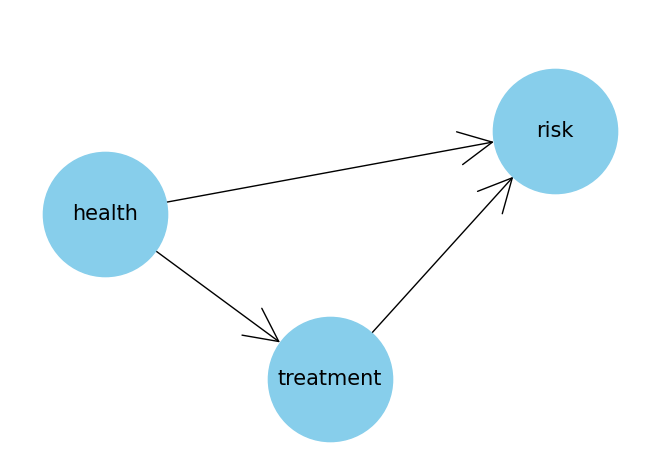
Als je niet voor deze "health" factor corrigeert, weet je ook niet in hoeverre deze factor het waargenomen effect van de "treatment", hier vaccinatie, beïnvloedt. En dat kan tot onjuiste overwaardering van het "treatment" effect leiden, zoals de RIVM onderzoekers in de studie ook vaststellen, of - en dat is thans niet uit te sluiten - zelfs tot een volstrekt omgekeerde interpretatie.
In the graph of a simulation, I have divided health status into four groups, analogous to the ASA classification of anaesthetists. Other classifications are possible, of course, but it's just about the idea.
In this example, the scale varies with ASA 1 to ASA 4 from healthy people to people with poor health and a short life expectancy. The x-axis shows the probability of taking a vaccine, the y-axis shows the risk (e.g. mortality).
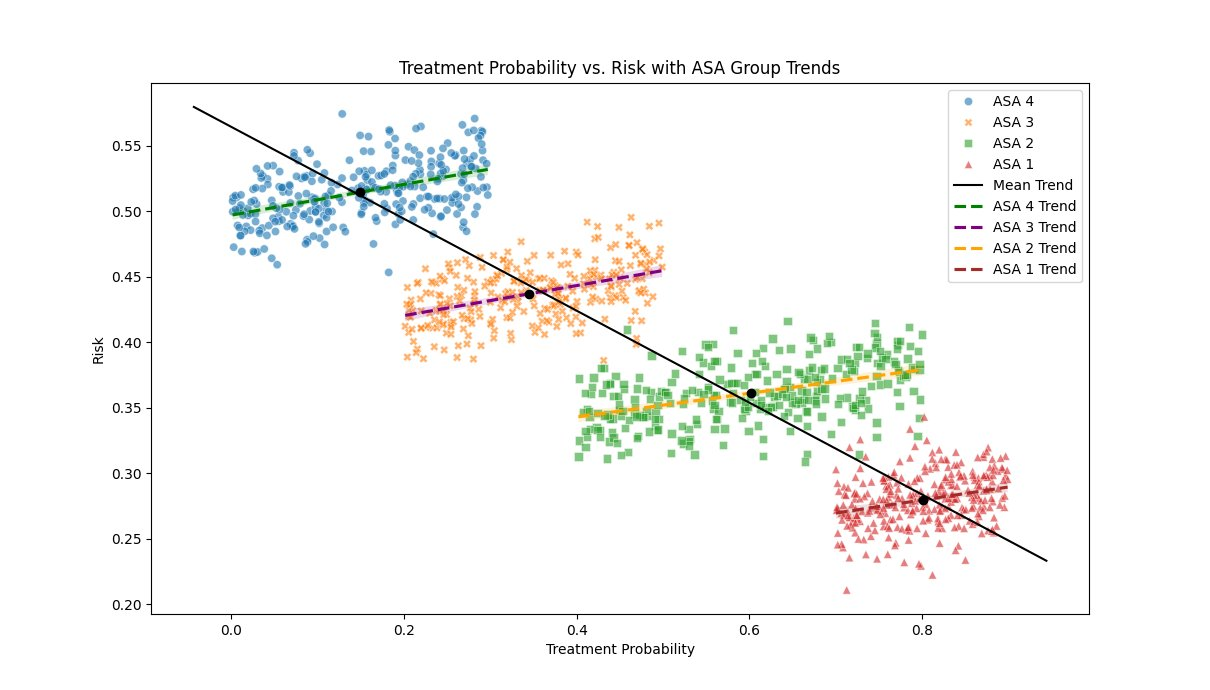
In geaggregeerde vorm, dus als je bovengenoemde classificaties weglaat, zie je een neerwaartse trend en een associatie van vaccinatie met een verlaging van het risico. Maar dat beeld kan evengoed ontstaan - zie ook het RIVM knipsel - door het geaggregeerde risicoprofiel en de geaggregeerde vaccinatiebereidheid. Het is echter niet uitgesloten dat als je wel corrigeert voor gezondheidsstatus en het bijbehorende "healthy vaccinee effect", je in de gedifferentieerde groepen ziet dat vaccinatie juist met een hogere kans op sterfte is geassocieerd. Dat hoeft niet, maar als het wel zo is, zie je dat in de methodiek met geaggregeerde data voor wat betreft de gezondheidsstatus, de methodiek die het RIVM heeft toegepast, niet terug.
Met conclusie: Als je niet corrigeert voor het z.g. "healthy vaccinnee effect" weet je ook niet of je per ongeluk camoufleert voor een averechts effect dat alleen zichtbaar wordt als je dat wel doet.
The hasty and ambitious claims circulated by the PR departments of Statistics Netherlands and the National Institute for Public Health and the Environment (RIVM), namely that vaccination reduces the risk of mortality regardless of the cause of death, has no basis in the RIVM study and therefore does not hold water. The investigation does not meet the minimum conditions of a causal investigation and such causal claims are therefore completely inappropriate.
In view of the above, it is therefore still not excluded that the vaccination campaign could have contributed to excess mortality.
© @dimgrr (Follow him!)

In my opinion, everything stands or falls with the definition of "vaccinated". At the very least, there should be a 3rd category with "recently vaccinated", where you can still argue about the question after how many weeks you count as "vaccinated". In the UK, this has been handled much more precisely (ONS) – the period shortly after the next jabs can also be abnormal.
If one insists on sticking to two groups, it would be interesting if CBS and/or RIVM would present the data in different ways: vaccinated vs unvaccinated and "one or more weeks after vaccination" vs "unvaccinated OR vaccinated less than n weeks ago".