

This is the revision of an earlier article, with additional substantiation at the request of Maurice de Hond who indicated that he wanted to place the article on maurice.nl. And just a few extra graphs.
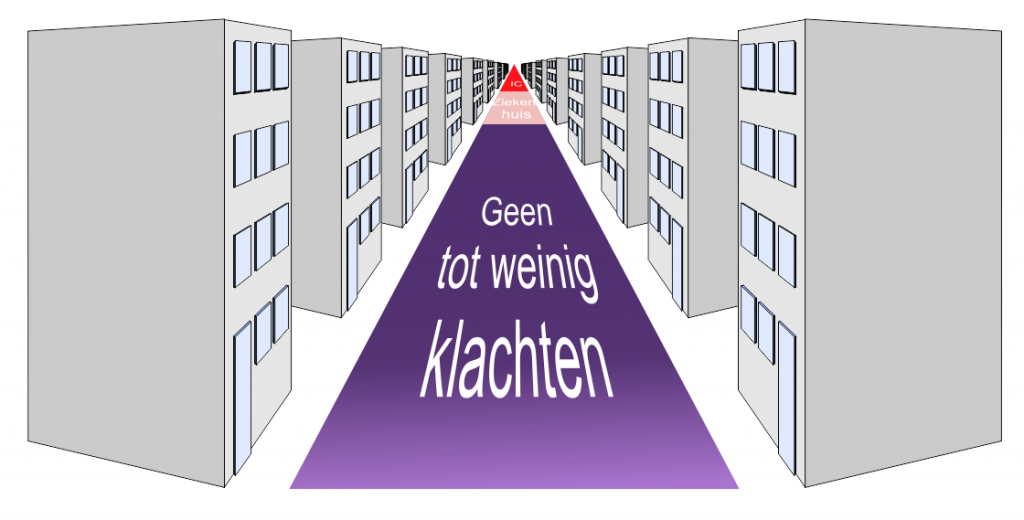
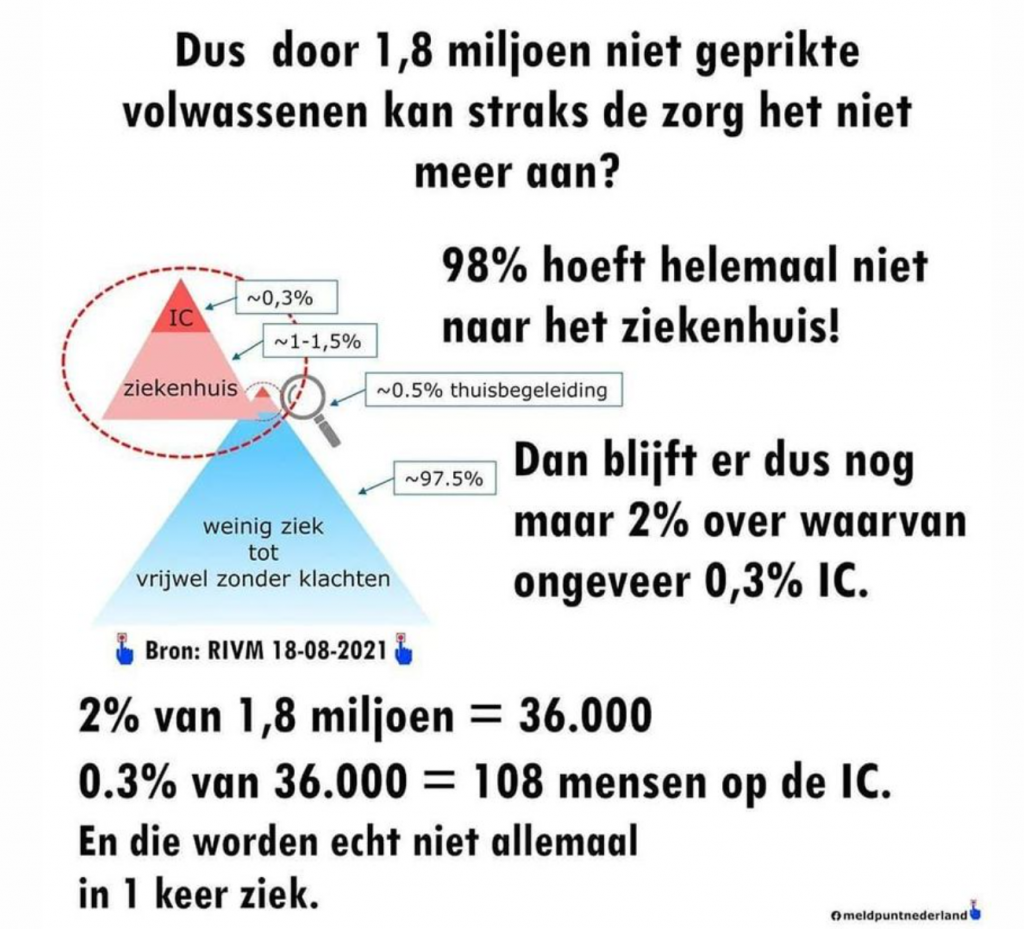
Another persistent calculation error is circulating on social media, hung on the famous Van Dissel's triangle. The big media may be guilty of logical blunders, but wappies can also do something about it. Doctors' collective went wrong before, now it has been FB group Meldpuntnederland. Maybe they have already discovered it, but the picture keeps going around and disinformation has a high viral factor. Enthusiasm creates a bias that allows for the greatest calculation and estimation errors. It's about this picture:
The error
The entire triangle represents 1.8 million people who have yet to come into contact with the virus. The top point is 0.3% of the total triangle and not 0.3% of the 2% that ends up in the hospital. So 0.3% of 1.8 million and not 0.3% of 36,000. That is 50 times as many: 5,400 people in the ICU. Van Dissel recently indicated in the House of Representatives that the unvaccinated will lead to about 20,000 hospital admissions and between 2200 and 3400 ICU admissions.
Nevertheless: a nonsensical doomsday scenario
There is a lot to be said about both 5400 and 2200 ICUs, but not with the objection that is at the triangle. What then:
- Sanquin calculated 93% immunity (and counting, the R is now at 1 and healthcare can handle that). Then 7% of the population is now comprehensible. 7% of 17 million is 1.19 million, not 1.8 million. Now, Sanquin's figures should not necessarily be representative of the average population. So let's assume that 1.8 million for the time being.
- The unvaxed are on average a lot younger, so they cause significantly less hospital and ICU admissions than in Van Dissel's triangle, which is about the total, at the time unvaccinated population. But how much less?
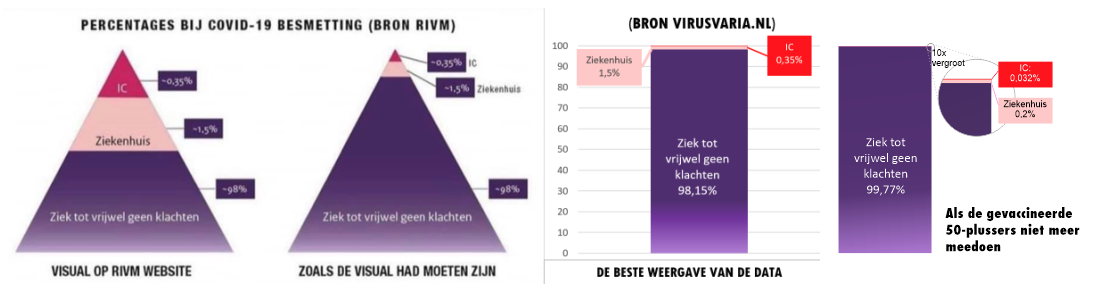
From the beginning of the corona period until now, about 1% to 1.5% of those infected were admitted to hospital, see the pink top of the triangle. (We will calculate with 1.25% in a moment).
That group mainly consisted of people over 50. They have now largely been vaccinated and are therefore well protected against hospital admission. '50+' is still a conservative estimate because the vaccination rate is also considerable among younger groups. At the same time, there are also unvaccinated people among the over-50s, so we keep it at 50+.
The 50+ age group has so far accounted for more than 84% of hospital admissions. See the graph: 16+21+27+17+3=84.
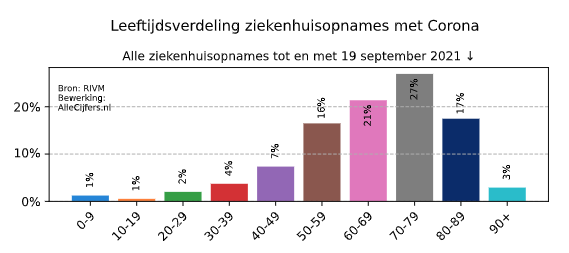
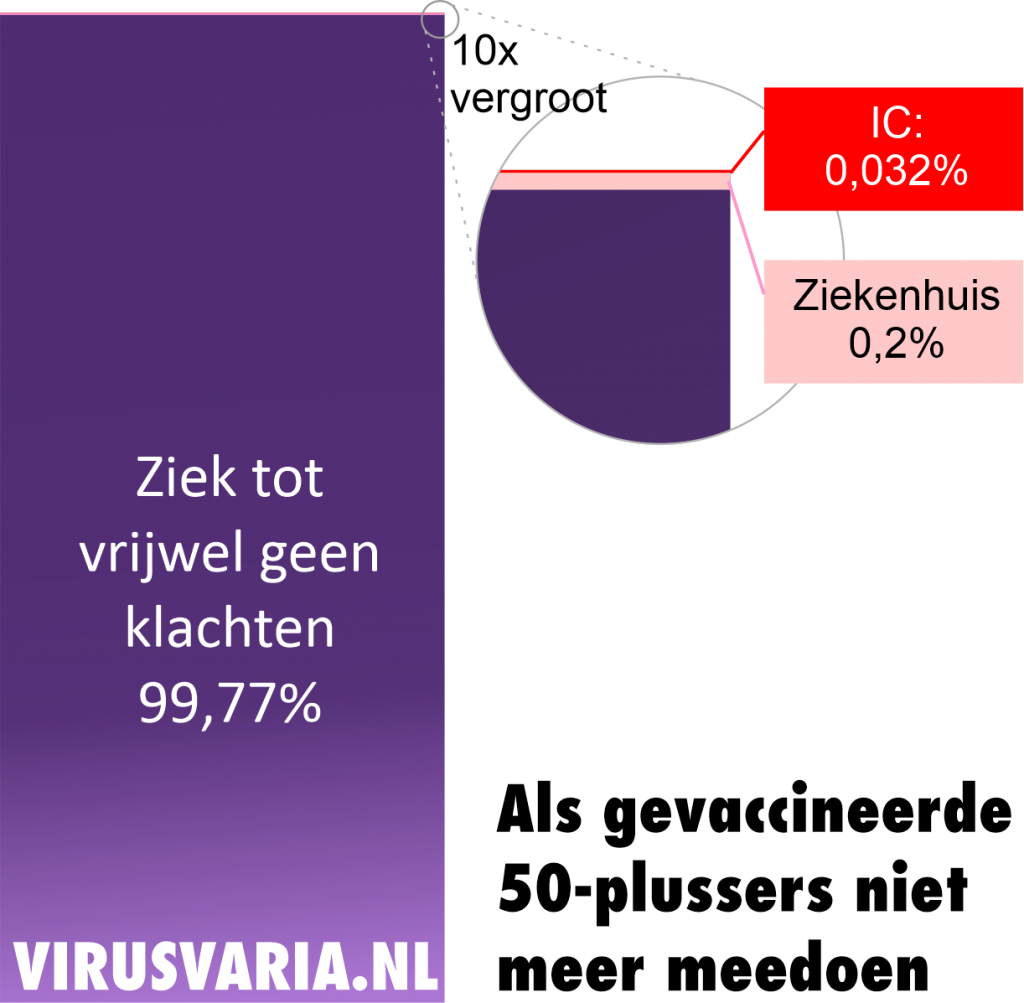
- The patient supply should therefore decrease by 84% thanks to the vaccinations, leaving 16%. Previously, an average of 1.25% of those infected ended up in hospital. After the loss of the over-fiftys thanks to vaccination, 16% of them remain: From 1.25% of all 1.8 million infections, this goes to 0.2%. That means approximately 3,600 hospital admissions.
- Another assumption made by Rivm is that the entire group will come into contact with the virus. That is highly questionable: there is no evidence that the entire population always comes into contact with every widespread virus. Moreover, the susceptible are surrounded by immune people, which ensures a slow spread, provided that the effectiveness of the vaccines is maintained. Perhaps only 30% of the group is infected per flu season - which is not a strange percentage, considering previous virus explosions and flu seasons. There is no 100% certainty about this. instability of the vaccines and possible adverse effects with new variants. For the upcoming flu season, based on one third of the total group of 3,600, 1,200 hospital admissions remain.
- Consciously Unvaccinated Persons (BOPpers) know better how to protect themselves effectively: avoid enclosed spaces with strangers, work on a strong immune system. Meet on terraces or otherwise at home, where your air purification is in order. Check your CO2 meter regularly etc. etc. The Netherlands has a rather toxic indoor climate in public spaces due to negligence of public health guards. Health awareness and alertness to the indoor climate will further slow down the spread among that group. Maybe by half or more, but let's say a reduction of one third. That leaves 800 admissions.
Then we arrive at about 800 hospitaladmissions, spread over the coming flu season of several months. At the current average recording level you will get through that quickly. You wonder what the BOPpers can actually be 'blamed' for. Are we now so woke that people are no longer allowed to get sick...?
- On to the ICU. According to the RIVM triangle, on average a quarter of admissions to the ICU (0.3% versus 1.25%). In the Current RIVM data turns out to be one fifth: 0.21% to be precise. Given the age of the group concerned, that percentage will also be much lower. The RIVM data shows that of the total of 13,550 ICU admissions, 11,822 were over fifty. That is 87%. Of the calculated 800 hospital admissions, not a quarter or a fifth goes to the ICU anymore, but 87% less: 16% of the 800 hospital admissions remain, which then form the ICU patient supply. We are talking about 128 ICU admissions, to be spread over the entire season.
The scenario could be even more favorable
To counterbalance the doomsday scenarios, we also make some more positive assumptions. We can go even further in this regard. As mentioned, the BOPpers are better informed about adequate protection methods. (Are the basic control signs still mentioned since 'ventilation' is mentioned?). This probably also has consequences for the severity of the disease.
- By paying attention to outside air and ventilation, there will not only be fewer infections, as discussed above. If it does go wrong, high, seriously pathogenic doses may also occur less often or rarely. After all, it seems that the viral dose has a major impact on the course of the disease. Because I think that it is precisely the false security of the emphasized basic rules that has caused many serious infections, I then take another 40% off for the BOPpers, and then I am frugal. This leaves 76 ICU admissions per flu season.
- Please also remember that we have not taken into account the 93% immunity of the Sanquin blood test. If that percentage is truly representative of the Dutch population, the final total could drop by dozens of percentages...
What can go wrong
- The decrease in the protection of the vaccines could increase the burden of care again, both in terms of hospital and ICU admissions. If the vaccines turn out to protect so poorly that the above numbers become much higher, the question arises whether the end actually justifies the means. Especially when it comes to vaccinating children.
- Los van de hierboven beschreven verlaging van de mortaliteit van Covid-21, ook door mutaties, kan de druk ook weer te hoog worden door bijvoorbeeld griep of andere seizoensvirussen waarop ons immuunsysteem al te lang niet meer is getraind. Of The Vanishing Act wordt The Reappearing Act. Dat wordt dan echt een probleem want over een crisisaanpak om de zorgcapaciteit uit te breiden wordt amper gesproken. Zijn we niet door schade en schande wijs geworden? Nee dus: "de maatregelen hebben geholpen" en "de voorspellingen kwamen allemaal uit." Kortom: beleidsaanpassingen zijn, gezien de behaalde successen, niet nodig.
- It is surprising that the current continuous excess mortality among the elderly is never mentioned in connection with increased hospital admissions. Pressure on healthcare is apparently the crucial factor for media and politics, not how many people die more than usual.
All things considered, it really doesn't seem possible anymore to shift the blame to the wappies. A 10% higher vaccination rate is really not going to make a difference given the target group. No matter how skilfully outgoing Minister De Jonge brings his mission, if things go wrong again, the blame lies entirely with the medical advisors. What they did wrong, that was not the point now. The point of that triangle has been made.
The perspective of the OMT
"Daar in de verte, dat zijn er echt heel erg veel hoor!"