

Open letter to the medical line
In one of the countless discussions on Facebook, I once again saw that someone wanted to put things in order in a long comment with a story about corona and, in this specific case, face masks. The story showed that there was a bell ringing somewhere in that head, but the clapper had lost its way. To be able to feel that, probeer ik zoiets in eerste instantie terug te voeren tot het type mens. Ik zag goedbedoelde misvattingen, belerend zonder bijzondere kennis, flarden van (vaak achterhaalde) inzichten of, en dat is moeilijker om iets aan te doen: 'wetenschappelijke feiten' verkeerd met elkaar combinerend. Dan hebben ze er wel iets over gelezen hebben maar dat toch niet echt begrepen. Dus ik ging eens naar zijn profielpagina: Hoe oud, wat luistert/leest zo iemand, hoe ziet zijn tijdlijn er uit. Ik ben niet heel ver gekomen want ik zag tot mijn ontsteltenis ook wat zijn beroep was: ICU verpleegkundige. Echt schokkend.
Je kunt zeggen 'Ja maar het is geen arts, het is maar een verpleegkundige'. Dat dedain hebben artsen, maar ik ben geen arts. Bovendien zou everyone, ongeacht zijn beroep, moeten 'begrijpen' hoe hij/zij (mag ik hij zeggen voor het gemak?) hoe hij zich moet beschermen en wapenen tegen virusbesmettingen. Als iemand die op de IC werkt al met verkeerde concepten over besmetting rondloopt, wat zegt dat dan over zijn opleiding? Over zijn collega's, zijn leidinggevenden, de artsen, over de hele cultuur op de IC, in het ziekenhuis...? Zo'n man werkt dagelijks tussen de besmette aerosolen!
Intubations
Until recently, aerosol studies were almost exclusively about aerosol-generating actions in the ICU: intubations. Apparently there is a lot of chattering and splashing involved and the contaminated air from the lungs comes out through a tube, without having to bypass bends, valves, folds or wetness. Almost invisible splashes land on the face. The researchers did not look any further. The few studies that showed airborne transmission of viruses were not addressed. Aerosols were the domain of the ICU, they didn't need anyone else so no one had to interfere with that.
There are now piles of publications on virus transmission. And they still just don't know how it works in hospitals. Now I am not out to ridicule people, not even doctors. They really work hard and want the best for their patients. But for that you have to master the material. I find it worrying that it falls short in this.
It seemed as if only the RIVM/OMT was terribly behind. There are signs that the situation has not yet penetrated the entire medical line, with a few exceptions.
Below is the lesson from the ICU. He responds to someone who makes a fair comparison between breath through a (double-layered, I imagine) mouth mask on the one hand and a wind through underpants/pants on the other:
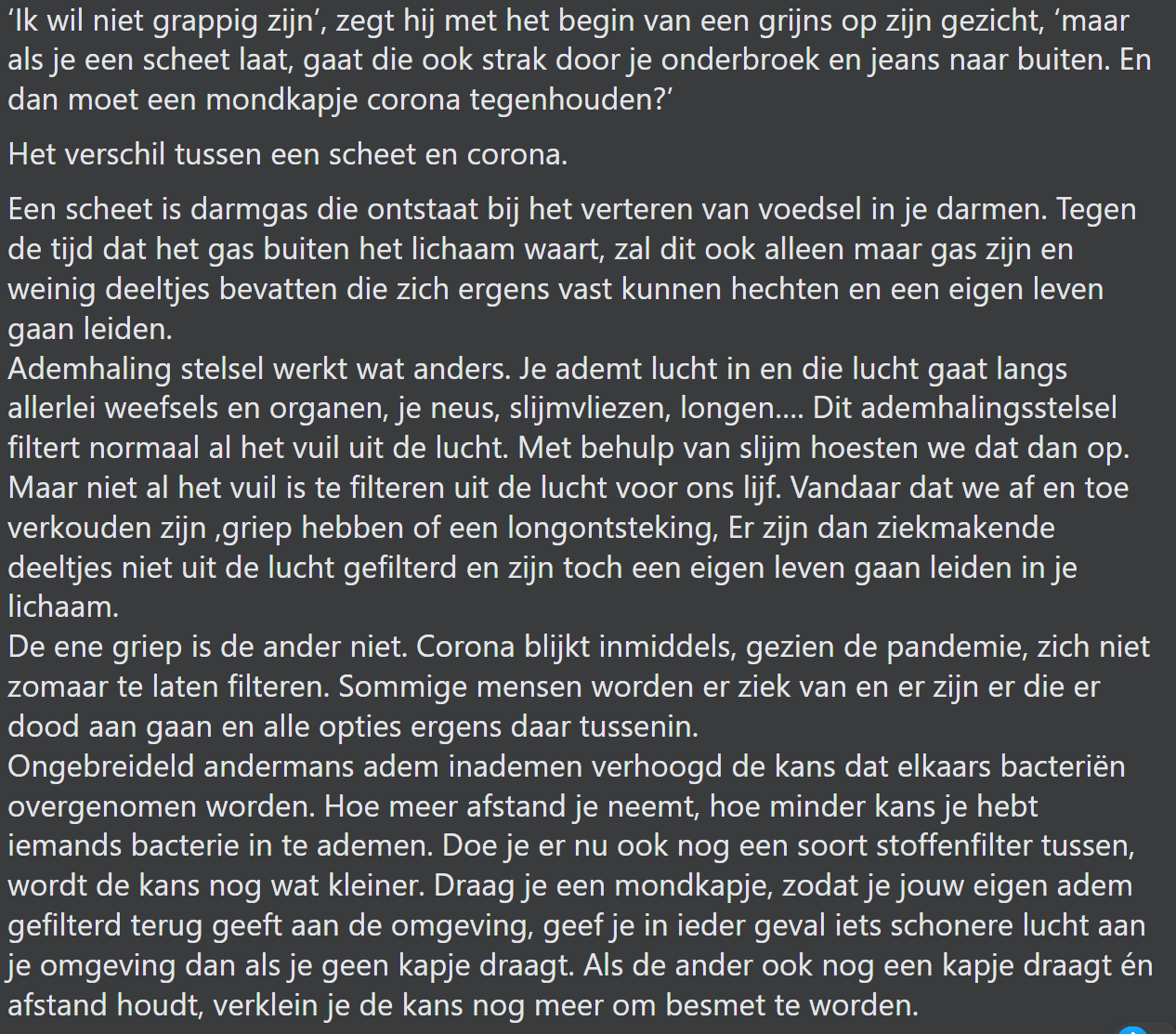
Weet je wat je ruikt als iemand een wind laat? Dat zijn ook aerosolen. Daar kan virus in zitten, bij zieke patiënten. Waarom het advies om de wc te spoelen met gesloten deksel? De gevaarlijkste aerosolen hechten zich juist nergens aan vast, die blijven zweven als een gas en kunnen dan makkelijk geïnhaleerd worden. De IC-er veronderstelt het tegendeel: dat deeltjes zich ergens aan zouden moeten kunnen hechten om 'een eigen leven te kunnen gaan leiden'. Dat is precies verkeerdom. Als deeltjes zich ergens aan hechten, worden ze eerder ongevaarlijk. Besmetting via voorwerpen komt weinig voor en uitbraken op die manier al helemaal niet. Wat niet wegneemt dat persoonlijke hygiëne -en bewustwording van hoe je zelf verspreidt- helpt bij virusbestrijding.
Then he mentions filtering the breath. In doing so, he forgets an important distinction. Nasal breathing filters, mouth breathing hardly does. Virus that lingers in the nasal mucous membranes gives the immune system more time to react. The mucous membranes are equipped for that function, they immediately alert the immune system and work the junk out again. The deeper in the airways, the more difficult that becomes, especially with stuff that reacts with lung cells.
With air filtering, you don't have to wait until you breathe in. Think of ionization, UV-C, HEPA filters, humidity. Or simply: open windows.
Een ander aspect: Hoe kleiner en lichter de aerosolen, hoe moeilijker te filteren. Je kunt je voorstellen dat grotere aerosolen uit de bocht vliegen tegen slijmvliesplooien of blijven hangen in de neusharen. De kleinste liften moeiteloos mee met je adem en belanden ongehinderd rechtstreeks (diep) in de longen. Die longen zijn toegerust op het verwerken van schone lucht en proberen daar uit te halen wat er uit gehaald kan worden. Bijna het omgekeerde van slijmvlies. "Besmet worden via het slijmvlies" is dus ook veel te kort door de bocht of het zit er gewoon faliekant naast. Je wordt het ziekst van virus dat juist not in the mucous membrane.
Dit zijn trouwens geen speciale eigenschappen van corona, zoals de IC-er stelt, dit geldt voor alle respiratoire virussen en is decennia geleden ontdekt, als je terug gaat zoeken. Dit heeft meer met mechanica te maken dan met medicijnen. Artsen hebben daar soms moeite mee. Net zoals ze heel vroeger vonden dat ze hun handen niet hoefden te wassen. "Hoe kan een doktershand nou iemand van het volk besmetten?" Ondenkbaar was dat. Gelukkig is dat verleden tijd, al zie je er nog steeds sporen van die mentaliteit bij medici als Andreas Voss. "Hoe kan een doktershand nou iemand van het volk besmetten? Dat geeft het toch niet..." je hoort het hem zeggen.
What is it that makes doctors pretend that corona would be so different from other respiratory viruses. Interestingness? The agreements were already known in January.
Face masks revisited
A face mask is a very coarse grille, compared to a virus. If you can smell cigarette smoke or fog a mirror through a face mask, aerosols will pass through. Do you put on a face mask against the smoke in a smoky room? At the end of the evening, you can smell how much smoke it has captured from the face mask. Nevertheless, you have ingested much more.
One and a half meters: Usually wrong
Nog zo'n misvatting: "Hoe meer afstand, hoe minder kans op besmetting". Een gevaarlijke halve waarheid waar je binnen echt niet op kunt rekenen, juist in de winter. Zoals een hele kamer naar rook stinkt, zo kan hij ook vervuild zijn met virusdeeltjes, zelfs die van iemand die al weg is (over anderhalve meter gesproken!). Die virusdeeltjes adem je hoe dan ook in, met elke ademteug weer. Je persoonlijke viral dose threshold bepaalt na hoeveel ademteugen je ziek wordt. Dat verschilt per persoon, per moment.
Dan komen in de uitleg van de IC-er plotseling bacteriën ter sprake maar dat is toch iets anders dan een virus? Dat schiet hier het doel voorbij maar ik schrik er wel van dat een IC-verpleegkundige die woorden door elkaar gebruikt. (Mijn moeder gaf 'Gezondheidskunde' op de 'Huishoudschool', die wist dat echt beter.)
As an ICU, you also know a thing or two about the aerosol-generating intubations (I hope anyway). A face mask stops larger saliva and snot droplets. Unfortunately, those droplets do not cause many illnesses because it is difficult to inhale them. Those barely visible splash droplets during intubations were traditionally called aerosols.
De onzichtbare 'gasachtige' aerosolen bleven buiten schot. Behalve bij producenten van vernevelaars en de medicijnen voor vernevelaars. Als je daar onderzoeken over leest, snap je hoe infectief aerosolen zijn. Een medicijndosis die via inhalatie wordt toegediend moet 20 tot 50 keer lager zijn dan bij andere toediening. En dan hebben we het gewoon over gas, niet over 'druppeltjes die groot genoeg zijn om een eigen leven te gaan leiden'.
Appeal to all nurses and doctors who recognize themselves in the misconceptions: for God's sake, read up. There is so much more knowledge than that shown by the RIVM. And that also applies (I fear) to practicing doctors, medical managers, advisors. Much more effective measures can really be devised with fewer side effects. But if you get stuck in old views and confirm each other and even teach each other with outdated knowledge, then it will take generations before anything improves.

0 Reactions