


AstraZeneca is van de markt gehaald. Reden: "er zijn voldoende andere vaccins die misschien wel beter werken." Nobel toch? Nou: niet zo nobel dat ze zich niet achter de kleine lettertjes in de bijsluiter verschuilen.
In England, the The Guardian (volgens sommigen een "betrouwbare bron" 😂) een mooi artikel over de vrijwllige terugtrekking. Wat niet wordt vermeld is dat ze het spul al een tijdje aan de straatstenen niet meer kwijt konden. De AstraZeneca prikken waren in veel landen al geschrapt vanwege de slechte reputatie. Ze bleken na verloop van tijd (want geen enkel coronavaccin is vooraf grondig getest) één bijwerking te hebben: TTS (trombose met trombocytopenie). Eentje.
Despite this, the vaccine is still labelled as safe and effective, according to the Guardian.
Dit ondanks het feit dat AstraZeneca onlangs voor de rechter heeft moeten bevestigen dat de vaccins in "extreem zeldzame gevallen" bloedstolsels kunnen veroorzaken, met een geschat risico van één op 50.000 op het ontwikkelen van de mogelijk dodelijke complicatie. Deze bijwerking werd op 7 April 2021 toegevoegd in de bijsluiter. Over de overige bijwerkingen geen woord.
England: Didn't read the fine print? Too bad!
More than 60 relatives have started a lawsuit against AstraZeneca. Twelve of them have had to give up the fight.
Twelve relatives are stopping the legal battle now that it appears that their loved one was jabbed after April 7. That is the date that the pharmaceutical company added the side effect to the package leaflet.
Didn't read the fine print? Too bad!
It's your own fault, you should have paid more attention.
Death.
It seems that AstraZeneca is not to blame for people vaccinated after April 7. Continuing is not an option for the surviving relatives because losing this case would mean that, if they do not win the case, they would have to pay for the legal costs of the pharmaceutical company. They can easily run into the barrels. No one is going to run that risk.
And not a word about the liability of the doctors who administered the injections. Or about the government, which forced the shots. Or the institutions that have stamped them. That's easy to approve and push, without any liability. What did the doctors receive per injection?
It is of an unprecedented scoundrel.
English The National Message about it. Below are a few excerpts.

Radio host Lisa Shaw, 44, mother of one, suffered a blood clot and was treated, including cutting away part of her skull to relieve pressure. But it didn't help.
Een lijkschouwer concludeerde dat ze "overleed door complicaties van een AstraZeneca Covid-vaccin", als gevolg van door het vaccin veroorzaakte trombotische trombocytopenie.
Haar man, Mr Eve, vertelde aan The Telegraph dat het "onrechtvaardig" was dat hij en andere families van familieleden die stierven nadat de waarschuwing was uitgegeven, niet verder konden met de rechtzaak. Hij zei dat hij zich "totaal beroofd" voelde. Hij en andere families kregen £120.000 (ca. € 140.000) compensatie aangeboden van de overheid voor het verlies van hun dierbaren.
Note: It is not clear to me why AstraZeneca is defending itself in this way at all. It will be because of reputational damage. The National writes that the British taxpayer must pay any damages because of the indemnity clauses.
AstraZeneca wordt ook gedekt door de WHO: "het vaccin is veilig en effectief om mensen te beschermen tegen de zeer ernstige risico's van Covid-19, waaronder overlijden, ziekenhuisopname en ernstige ziekte". De WHO erkende het "zeer zeldzame" risico op bloedstollingscomplicaties, maar zei dat het voordeel van inenting met de prik "veel zwaarder weegt dan de risico's".
In The Telegraph, the pharmaceutical company (paywall): "Ons medeleven gaat uit naar iedereen die dierbaren heeft verloren of gezondheidsproblemen heeft gemeld. De veiligheid van patiënten heeft onze hoogste prioriteit en regelgevende instanties hebben duidelijke en strenge normen om het veilige gebruik van alle geneesmiddelen, inclusief vaccins, te garanderen."
"Uit het bewijsmateriaal van klinische onderzoeken en praktijkgegevens blijkt dat het AstraZeneca-Oxford vaccin voortdurend een aanvaardbaar veiligheidsprofiel heeft. Regelgevende instanties over de hele wereld verklaren consequent dat de voordelen van vaccinatie zwaarder wegen dan de risico's van uiterst zeldzame potentiële bijwerkingen." (Yes of course, they're going to admit that they've been asleep!)
Rejected vaccines are chemical waste. What a shame!
PGB = Personal budget, intended for people who are insufficiently self-reliant or cannot participate well in society. (Care Guide). Often with reduced legal capacity. There, the Dutch residual stock of AstraZeneca was put away for a while, in 2021.
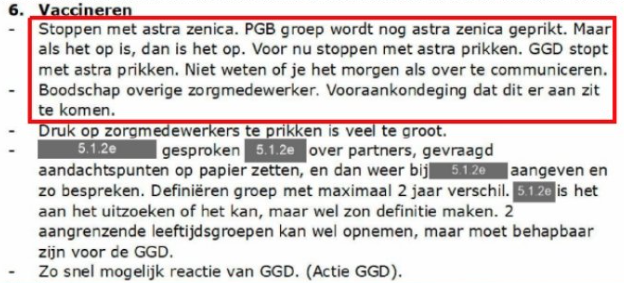
"Als het op is, dan is het op." Ja, we zijn in goede handen hoor! De zorgzame overheid... Mensen met een persoonlijk gebonden budget zijn goed om chemisch afval in weg te werken, daar komt het eigenlijk op neer. Hoe er met mensen wordt omgesprongen... Of begin ik oud te worden? Dit moet toch gaan klappen op een gegeven moment, het dedain wordt onverdraaglijk. En ze hebben het zelf niet eens in de gaten. Eigenlijk is het al aan het klappen, het valt alleen niet zo op omdat in slow motion gaat.
Did they also let those incapacitated people read the small print properly? Their supervisor? Their guardian? Their doctor? Yes, those piercing doctors... what role they played is unimaginable. All fans of Károly Illy and Ab Osterhaus.

Well the other vaccines still
It remains to be seen whether AZ's risk profile was really that much worse than that of the other vaccines, including the popular Pfizer vaccine. Pfizer does not have to worry: the European member states have confirmed with a signature that they were well aware that the long-term effects of the Pfizer vaccines are unknown. They have also confirmed that nothing is yet known about what side effects may occur.
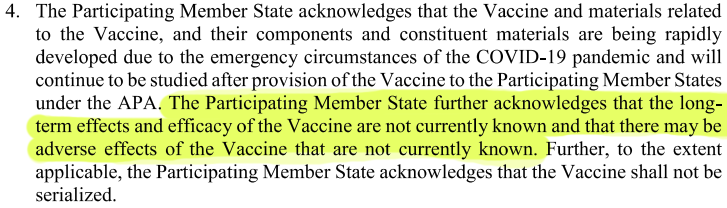
So Pfizer is not to blame, they have even warned about it in black and white. But AstraZeneca apparently had a weaker lobby; the CEO probably didn't have any direct SMS line with Ursula von der Leyen. So with Pfizer still being injected, in some countries in babies from 6 months.
To refresh your memory, you can also read the history of AstraZeneca in the Netherlands on the basis of the WOB documents, on the Substack van Cees van den Bos.
Of anders de hiernavolgende Twitterdraad van Cees: "Weet u nog..."

Hi Anton, the unabashed scurrilousness is outrageous. We have to keep calling a spade a spade. The psychopaths who had this on their conscience and still
always have not a single glance worthy of judging. And whether the judiciary will ultimately turn out to be independent? …. We'll wait and see
Outrageous, but maybe it's even worse than you think.
The harmful effects of the AZ injections came to light relatively quickly. Soon after the 'clot shot' things went wrong. Or not if you were lucky. That 1 in 50,000 is therefore what the seller himself indicates. The marketing department, so to speak. So in reality, it will be worse. Ogically, there will be a multiple of that number of serious side effects. Most people don't just drop dead, but first get serious complaints from which most people will normally recover. There are also lawsuits about this in England.
The mRNA jabs will show a much more insidious pattern of side effects. If someone dies or becomes ill months after an injection, the bandage is not so quickly made. Astra Zeneca's side effects were 'blindingly obvious', just to stay in the English realm for a moment. Is AA now being used to make the mRNAs look better?
What also played a role at that time (February-March 21) was that people had no choice which vaccine they received. If you were on the roll for AstraZeneca, you got AstraZeneca or you had to wait until everyone was vaccinated, which could mean that it was not your turn until September.
I saw it as a marketing ploy: give people the illusion of choice and they will take more.
At that time, I was still working at the Thrombosis Service and, as a doctor, I received worried phone calls from patients (all of whom have an increased risk of thrombosis) asking if they should take the Astra vaccine. I then said that I thought it would be wise to wait his turn, not to take a vaccine: the corona season (read flu season) was almost over and therefore the chance of 'infection' was small anyway. And by September, it would be clear how reliable/dangerous an mRNA vaccine is for people who are prone to clotting.
I was unable to convince ANY of these worried callers at the time that in dubio abstinae (when in doubt, don't do it) was the best choice for those people. That's how the fear was.
For what it's worth: here is a publication (on which I am a co-author) from which you can conclude that the vaccines (mostly Pfizer) that were given to patients at the time (who had their blood values checked at the Thrombosis Service) were thrombogenic for humans, given that the coagulation value (INR) decreased on average (and the lower the value the greater the chance of clotting). At the same time, on average, more people had an INR that was too high after vaccination (compared to before vaccination), which increases the risk of bleeding.
Nice stuff.
https://www.ncbi.nlm.nih.gov/pmc/articles/PMC8899332/
'Our' conclusion: flush out, but check. By that time I was already gone...
Unbelievable. And there's just research that states that Pfizer and Moderna injection didn't show increased thrombosis levels. I don't believe any of it. That whole Big Pharma is really a deep black pool of horrible.
Unbelievable. Can you explain to both Jip and Janneke how to increase and decrease INR at the same time? Could that work differently for each patient or would it have been different vaccines?
Interesting contribution, Willem. Given the quotation marks and your comments, the recommendation was not entirely unanimous....This report -as far as I understand it- should set off quite a few alarm bells. And this is only about coagulation risks. Perhaps an idea to send the link to the science editors of NRC? They should wake up too, shouldn't they?
I agree with Anton. A short explanation would be nice.
Diffuse intravascular clotting sounds plausible to me.
What is diffuse intravascular coagulation?
Diffuse intravascular clotting – often abbreviated to 'DID' – is a serious condition in which blood clots form in small to medium-sized blood vessels. These blood clots are called microthrombi. They can get stuck in all kinds of organs. Because parts of those organs no longer receive oxygen-rich blood, they can die. This can cause extensive damage to all kinds of different organs. A situation in which multiple organs no longer work properly is called 'multi-organ failure'.
Diffuse intravascular clotting can lead to many different complaints. Often the condition will lead to bleeding. Because clots form in the blood vessels on a large scale, many clotting factors are used up. This leads to a situation in which the body is no longer able to stop bleeding. This creates a clotting disorder. This is called 'consumption coagulopathy'. That is why people with DID often have a bleeding tendency.
Hi Anton, very interesting, thanks!
What is the source of that photo with "PGB group is still being pricked astra zenica"? Was that in an email?
Geen dank! Ja dat zijn e-mails uit de WOB-documenten. Onderaan het artikel staan hyperlinks naar die documenten, dat heb ik nu duidelijker gemaakt. Ook onder het plaatje zelf nu.
This reminds me of the "injection" of the BA.1 bivalent vaccines in autumn 2022.
For those who miss the context: at the end of 2021, the Omicron twins BA.1 and BA.2 arrived. What many people don't know is that these are genetically extremely different from each other, and just as different from each of them compared to Delta. Because BA.2 was initially missed, a bivalent vaccine based on BA.1 and Wuham was made. But by the fall of 2022, BA.1 was already completely extinct, and so was Wuham's Delta descendant. Either the variants that were circulating were all BA.2 or close BA.2 relatives (BA.4/5 differs only a handful or fewer mutations), for which the 'new' vaccine was no longer targeted.
'Fortunately' there was already a switch and also a bi-valent for BA.4/5 for sale. However, the Netherlands had already bought a million pieces of the BA.1/Wuham shot and was going to prick it up before you got the new BA.4/5.
The GGD website even openly stated "you are not allowed to choose".