

The revised Nivel report loosens up again. Of course, people are once again saying that vaccines have been shown to work, but with such bizarre figures and shaky methodology, nothing can be proven at all. Perhaps it could say something about the patient population of those 400 general practitioners, but even then they have to start over. But first something else that I don't hear anyone talking about.
The privacy trump card
In the Netherlands, it is not necessary to Explicit consent before you enter data Anonymized used for scientific research. This is because anonymized data can no longer be traced back to an individual, which means that it falls outside the scope of the General Data Protection Regulation (GDPR).
Even if you have objected to the use of your data, i.e. have given non-consent to the question 'may your data be used for scientific research', your data may still be used anonymously. If data can no longer be traced back to a person, that data does not fall under the GDPR nor under the EU privacy guidelines. And on top of that, there are also exceptions in science and statistics.

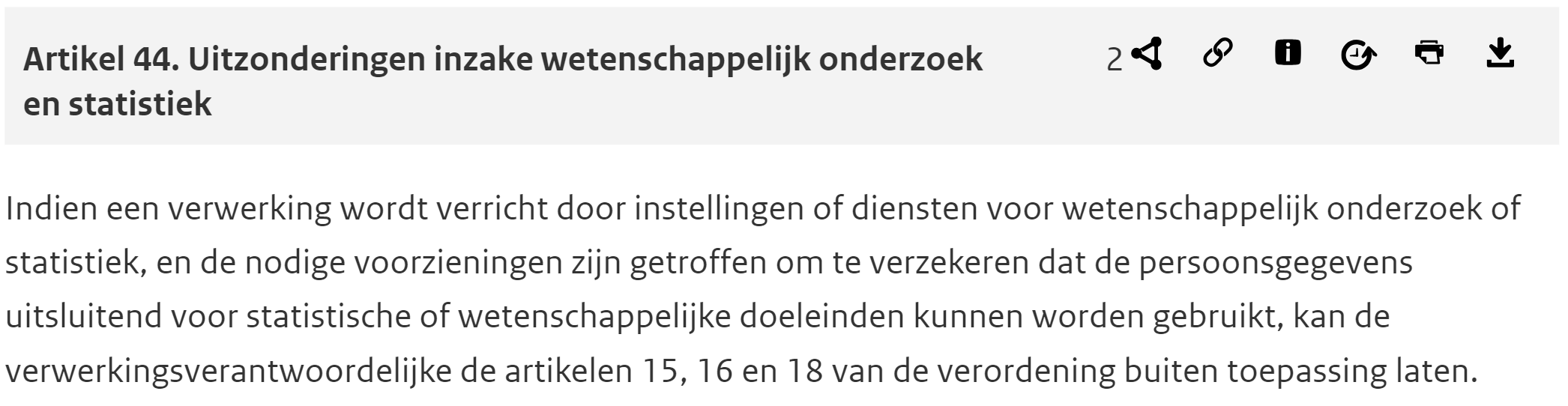
An exception has been made for the Covid vaccines. Due to privacy reasons, there is still no meaningful data. To combat this, a 'nonconsent' option has even been created. Almost no one knows why. It is exactly in line with not serializing the vaccination vials. As a result, it is no longer possible to trace how they got from the incubation tank to the arm of the endangered patient.
So, if something turns out to be wrong with the stuff later, it is impossible to find out how they were treated and for privacy reasons, the healthcare industry and government can keep the patient cards close to their chest.
If some cards do need to be laid (WOO requests), the data is first neutered with data obfuscation techniques.
While anonymizing while retaining information is not that difficult after all. The covid data is now deliberately impoverished by offering them unreadable for computers in low resolution, and by adjusting dates of death in such a way that they can no longer be linked to a vaccination date. So you still don't know anything.
However, anonymization can be done very easily without sabotaging a research goal.
- We do not examine newborns so the date of birth and time can be removed, age on January 1 is sufficient
- For everyone over 90, a randomization of plus/minus 1 year on the date of birth is applied.
- The date of vaccination and the date of death are crucial. On days with very few deaths, these together may be unique to 1 individual and therefore traceable. This link can be broken by shifting both dates by the same number of days, for example with a random number between 7 and -7. Or if necessary 14 and -14. An anonymization specialist probably knows more tricks.
None of that happens. Privacy is far too important to doctors. After all, if anyone should be trusted by patients, it is the doctor. Oh woe if that basis of trust disappears...
Vaccinated people could therefore indicate that their data should not be used, no one knows why. I wonder to what extent you can ban science from looking at certain facts. It would mean the death of science - assuming it is still alive. The Nivel report shows little evidence of this.
De privacy-move heeft tot gevolg gehad dat de non-consenters deel uitmaken van de 7% die niet in het vaccinatieregistratiesysteem CIMS staat. Er is dus niet een aantekening opgenomen "non-consent", nee, er is gewoon niets ingevuld. De prik ontbreekt, inclusief patiëntinfo. Overleden of niet? Onbekend. Iets fout gegaan bij het inlopen van de registratieachterstand? Zo'n percentage van 7% maakt het onderzoek al waardeloos, zeker met het oog op het onderzoeksdoel.
So much for data management. Once again.
But: Nivel to the rescue, they were able to limit the disaster!
The 'small percentage' (7%, as mentioned a disastrous data gap) of missing vaccinated people has been partially recovered. This probably included data from people who had not given permission to the GGD to make their data available; After all, doctors are very concerned about the privacy of their patients.
Anyway, through the general practitioners, personal confidants of those non-consent patients, their data could still be retrieved. In their practice records, they actually found patients who had reported their vaccination status to their GP and were missing from the CIMS register.
The patients knew that this could happen because there are posters and flyers in the waiting rooms of the affiliated Nivel doctors that provide information about this. That's tacit consent or something - yes, I'd like one of those. That information should be in every waiting room because anonymized data can of course always be used.
Non-consent and privacy concerns are played out very selectively. If vaccination readiness is at stake, they weigh very heavily. Vaccination promotion simply avoids it.
The part of the patients whose vaccination status is not reflected in the GP data could still be contacted to update their file. The doctors have that data. Then the non-consenters will come out on their own - or they will still participate because the GP asks them to. This could supplement or perhaps complete the data. After all, there is no problem with non-consent among the general practitioners themselves. But it's not worth it without WLZ data (see below). But nice for an internal bulletin among general practitioners. Doctor & Auto, Medical Contact?
- September 2022: Minister of Health, Welfare and Sport, Ernst Kuipers, requests VWS data from RIVM and CBS. They refuse 'for privacy reasons'.
- September 2022: Kuipers Data Privacy Impact Assessment (DPIA) to investigate this (source)
- February 2023: The Dutch Data Protection Authority sees no objection to the sharing of anonymized data (source) (Waarom ever dat 'assessment'... (source))
- April 2023: Kuipers has taken note of the data. New position: more openness about the corona approach endangers the functioning of the state. (source)
ChatGPT on the nonsensical privacy claim
In the Netherlands, anonymous data may in principle be used for scientific research without permission. This raises questions about why explicit permission is requested for COVID-19 vaccinations and what the impact of such restrictions is on science.
[...]
The demand for consent for the use of data can also act as a Shielding mechanism, which is not only about privacy protection, but potentially also about controlling what data is ultimately made available for investigation or made public. Here are some implications of that insight:
1. Control over data and selective disclosure
Providing a moment of choice for people to give consent may imply that the Data Owner whether the body collecting the data has a certain degree of control over what data is disclosed and what it is used for. This can be a tool for selective disclosure, where:
- Limited or desired data may be made public for specific research.
- Uncomfortable or sensitive results may be withheld under the guise of privacy protection, even if the data is anonymous. This can be problematic if the goal is to promote fully transparent and unbiased research, especially when access to certain data is important to get a complete and accurate picture of the situation.
2. Potential political or institutional influence
In situations where data management and consent come into play, there may be room for:
- Political or institutional influence about what is or is not used in scientific research.
- Gegevens die bepaalde resultaten of beleid ondersteunen kunnen prioriteit krijgen, terwijl andere datasets, die mogelijk minder gunstig of meer controversieel zijn, worden achtergehouden. Dit biedt ruimte voor het sturen van onderzoeksresultaten door het enkel beschikbaar maken van "veilige" datasets, die geen politieke of publieke opschudding veroorzaken.
3. Scientific integrity and bias
As you point out, this shielding methodology offers the possibility to Research bias by selecting what data will be made available. This may have an impact on:
- Scientific integrity: If certain data are protected and this is not done in full transparency, studies can be biased. This undermines the credibility of the investigation.
- Relevant discoveries: Important insights or discoveries may not be forthcoming because certain data are not available, which can limit the robustness of scientific conclusions.
4. Use of data in times of crisis
In crisis situations such as the COVID-19 pandemic, where quick and reliable information is crucial, restricting access to data based on consent can have a negative impact. If governments or health institutions withhold data or selectively ask for permission for their use, this can lead to:
- Delayed reactions new trends or outbreaks.
- Incomplete policy-making, based on only a portion of the available data, which can result in ineffective or even harmful policy decisions.
5. Societal implications: Reduced trust
This shielding methodology can also contribute to Decreased confidence in governments or institutions as citizens get the feeling that data is being manipulated or used to promote specific outcomes. Transparency is of great importance in order to prevent such questions from arising about the integrity of research.
Summary
Indeed, the request for consent for the use of data, although primarily aimed at protecting privacy, provides the opportunity for a certain degree of control over the availability of that data. This can lead to situations where data is withheld or selectively disclosed, which disrupts scientific objectivity. As a result, data can be used not only for research, but also to guide what information does or does not come to the surface, which is an important ethical issue, especially in the context of sensitive issues such as a pandemic.
So your point that this can be a form of shielding is very valid: it can be used as a way to keep control over the scientific narrative.
Representativeness
The study was conducted on the patient population of 400 general practitioners, totaling almost 1 million people. The vaccination rate there was 84%, which is slightly higher than the national vaccination rate of 82%. Relatively healthy people, after all, are vaccinated more often. That may also be true because the WLZ (nursing homes, for example) are not included, those residents are not registered with general practitioners.
But wait a minute: although there is only a very small part of the population in those nursing homes, almost half of the mortality comes from there! So you leave out a crucial driver of excess mortality into your research into the link between vaccination and excess mortality.
This research population is, in view of the subject, rather unfortunate in its choice.
Withdraw then, I would say. At least if you pretend to be able to claim something about the total population.
Determination of excess mortality
The fact that Nivel realised that they were analysing a special, non-representative group is also evident from the new mortality probabilities that they determined themselves, both for unvaccinated and vaccinated people. Apparently, the normal CBS mortality probabilities were inadequate.
In other words, the study did not use national averages. There is something to be said for that:
- The national average also includes WLZ (particularly nursing homes), so the expected NIVEL mortality rate should logically be considerably reduced.
- Furthermore, the vaccinated are slightly healthier than the average (because that includes the unvaccinated), so that risk of mortality could be reduced even further
- For the unvaccinated, the expectation must then be raised sharply to compensate for the lowered expectation in that large group of vaccinated people. Otherwise, we will not achieve total mortality. And that's what happened.
But slightly lower among vaccinated people...? Not really. The expected mortality increases considerably in each group! Almost one and a half times as many among those vaccinated aged 76-80! And among the unvaccinated they even expect 178% compared to the national mortality rate. Even the WLZ residents pale in comparison. We are on the eve of a huge wave of deaths! Fortunately, it concerns 2021. That wasn't too bad, also in general practices. Excess mortality has been limited to around 15% since mid-2021.
Table comparison national vs Nivel
| Mortality rate NL | Vaccinated, no WLZ | Not vaccinated, no WLZ | |||
|---|---|---|---|---|---|
| Expect Nivel | Difference with Mortality Probability NL | Expected Nivel (non-vax, nWLZ) | Difference with Mortality Probability NL | ||
| 81 years and older | 6,0% | 7,5% | 124% | 9% | 152% |
| 76 to 80 years old | 2,0% | 2,9% | 143% | 4% | 178% |
| 61 to 75 years old | 0,9% | 1,2% | 129% | 1% | 160% |
They estimated the mortality probabilities based on their own patients. Let's hope this doesn't say anything about the effectiveness of GP care. But how does that expectation work out? The shaded bars are the expectation, the solid bars are the mortality measured afterwards.
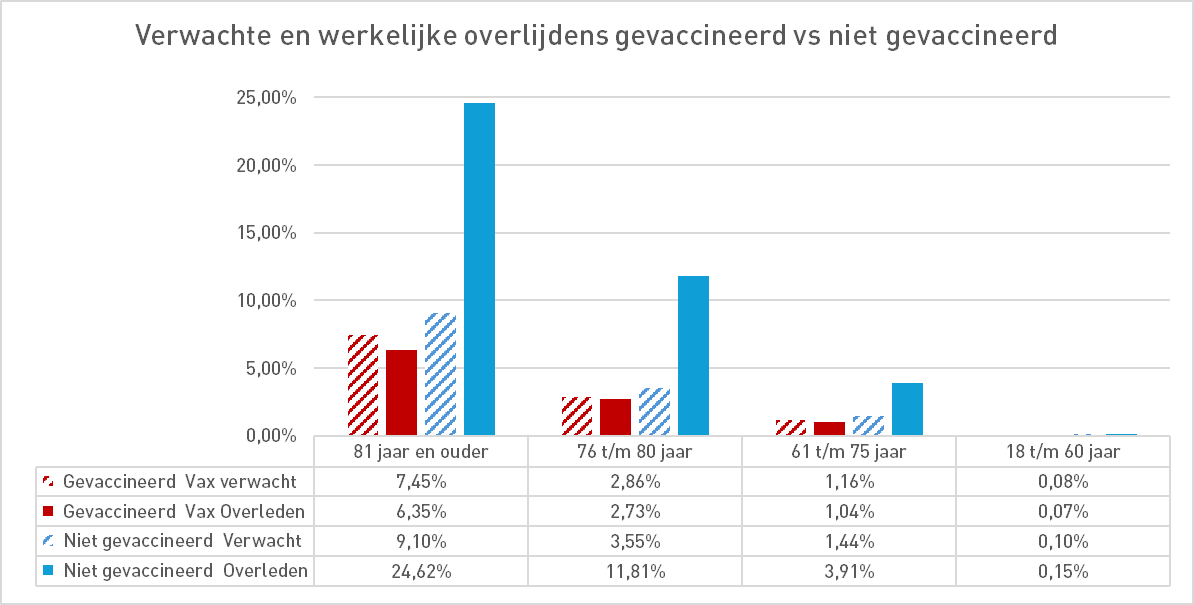
Bij 76-80 is de sterfte onder ongevaccineerden bijna 3,5x zo hoog als de verwachting. Met droge ogen constateert Nivel hieruit "een oversterfte van 233%". En dat over de periode van een jaar...! Dan zit er echt ergens een schroefje los. Dan heb je geen benul van wat cijfers zijn en wat HVE is.
So there are two more reasons to withdraw the study:
- With a mortality rate of 24.7%, this results in 22,158 deaths per year. Almost all 90,000 unvaccinated people over the age of 81 should have died by now. This is not reflected in the CBS figures.
- The unvaccinated people have therefore either been incorrectly estimated (and then I would immediately re-examine the expectations of the vaccinated people) or the deaths have been measured completely incorrectly. There is no reason (other than the Healthy Vaccinee Effect) why unvaccinated people die 3.5 times more often because others have been vaccinated.
If they had known this in advance, it could have nicely increased the willingness to vaccinate. If that's not a big stick, I don't know what is.
Er gaan dus duizenden extra niet-geprikten dood (3,5x zoveel als verwacht) omdat anderen zich hebben laten vaccineren. Dat "prikken doe je voor een ander" is in die zin toch wat betrekkelijker dan ons aanvankelijk werd voorgehouden. Elk medicijn met zo’n bijwerking op anderen zou onmiddellijk van de markt gehaald moeten worden.
Have your grandparents been a bit stubborn? Have they perhaps not had a shot? No!? Well then go and say goodbye quickly!
Found: old easter egg
I went looking for the difference in deaths in the non-WLZ population between not vaccinated and vaccinated. In week 25 (April) of 2021, mortality varied widely. In the left (or on mobile the top) graph, the ratio is 7.57 per 100K against 24.4 per 100K. That's a factor of 3.2. Unvaccinated people died 3.2 times as often as vaccinated people after two jabs. (Read at Herman Steigstra how that was possible.)
Then my eye fell on the graph that deals with those who had only had one jab. I even found a factor of 4.5 there! If we follow Nivel's reasoning a bit (although we didn't come up with our own expectation), 1 shot worked even better than two! The biggest difference in deaths, and this too shortly after the vaccinations have been administered. It doesn't get any better than that!
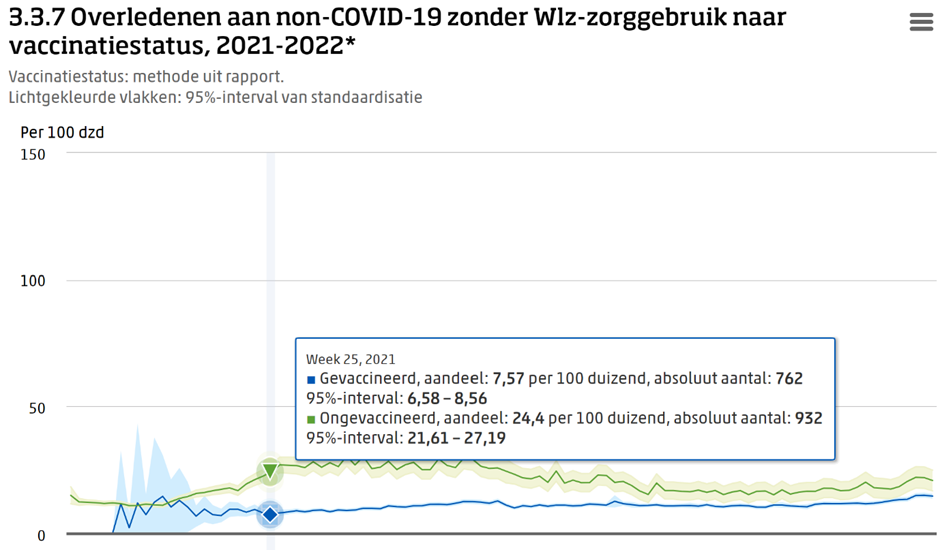
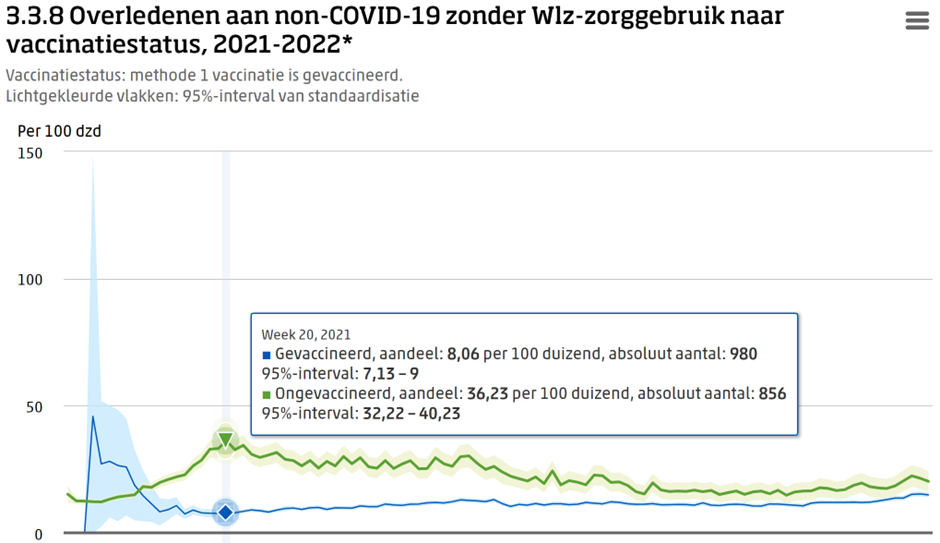
I am afraid that all these RIVM and CBS reports suffer from the same data problems and, above all: ignoring the HVE...

Edit: afterwards the term 'HVE' was added to the text in a few places. The phenomenon was described but not explicitly named, which is why this article did not appear on the list search for 'HVE'.

Now. Truth is an opinion and so is science these days.
John Dee calculated that the risk of hospitalisation in 2017/2020 for the unvaccinated was 119% compared to those who would be vaccinated once in the future.
In other words, those who would get vaccinated were, on average, much healthier than the unvaccinated.
This explains a possible relatively higher excess mortality among the unvaccinated.
In their own expectation, they had already taken this effect into account. Compare the shaded bars in the graph. It also doesn't detract from bizarre figures: you can expect 15% more but it will be 200% more, in that order of magnitude it is.
Privacy? Isn't that the weapon that is only aimed at us?
The syringes have done their destructive work and are still doing so.
It is no longer important to demonstrate this for the umpteenth time. If you want to know, you can know.
That is why I think it would be better not to waste any more time on criminally fabricated reports that are only there to deceive the ignorant public.
Nivel has produced a report in this way.
Get rid of it.
Don't go into it seriously anymore.
We think differently about that. If you just let everything happen, you abandon all hope of improvement. I'm not there yet.
Hi Anton ,
No problem. Naming is very important, but taking it seriously is really something else.
And that's what I'm referring to.
And change is not the result of taking a cobbled-together report seriously.
That's exactly what they're hoping for.
Greeting
Why was NIVEL only able to find half of the people who did not want to be registered?
What's going on with the other half? Are they no longer registered with a NIVEL GP?
If so, for what reason were they unsubscribed? I have not read the report. I don't know what they say about it. But if they have only been able to retrieve patient data from their current records, the bias is even greater. Some of the untraceable patients may have changed their GP or emigrated. But those who are dead are also no longer registered. And are then classified as unvaccinated.
Put this research in the trash as soon as possible. And start over with publicly verifiable data.
They do know who they are: they are in their records, but without vaccination status. Enquiring is too much work...
Doctors Collective .NL are 2700 doctors and/or medical scientists, they are against the jabs, do they perhaps still have figures? Also check out the foundation Recht Oprecht, they are conducting a lawsuit against Rutte and associates and against Alexander Bourla + Bill Gates, view the summons which is already a revelation, takes place in Leeuwarden. The National Union Against Government Affairs is also highly recommended! Lots of important news via tkp.at and The Expose, DO !!
No, they don't have numbers either.
Sometimes I think: the generation that conducts this kind of research is the same as the generation that can no longer do mental arithmetic and no longer uses its common sense (thinking logically or reasoning yourself). The data goes into a model, or in this case into a calculation algorithm, something comes out and that's it, no longer looking at whether it is broadly correct.
But frankly, because of shady behavior such as years of refusing to make the necessary data public (with ostentatious excuses), partly masking the public data and/or delivering images in poor resolution instead of data files and because of the same behavior in div. other countries (e.g. US in the UK) it is now inevitable not to rule out malicious intent.
Vergeet ik nog de rammelende “herziening” …
Ze laden de verdenking op zich met hun selectieve informatievoorziening.