


Earlier, my aversion to anti-vaxxers has been weakened after discussions on Facebook (thanks to the tenacity and convincing substantiation of Muriel van Koppen) and, I admit, reading some articles on the site of Critical Pricking and also -or should I even say- on that of foundation vaccine-free. There they also fly out of control, but of course you always have to look critically, even if it concerns criticism. More than a year ago I discovered that there were actually a surprising number of sensible noises there. I still keep that sympathy away from discussions because I don't want to disqualify myself immediately: anti-vaxxers are not taken seriously because they are anti-vaxxers and they have no arguments, only gut feelings.
"Anti-vaxxers weigeren de wetenschap te volgen" hoor je dan.
Nu echter blijkt dat onze overheden en gezondheidsinstituten tegen elk wetenschappelijk inzicht in draconisch beleid hebben uitgerold middels leugens, bedrog en manipulatie, is voor mij de grens wel bereikt. Ik kan die strijd niet meer zien als "wetenschap tegen anti-vax". Het bewijs is nu geleverd dat overheden en artsen "pro-vaxxers" zijn die zich afkeren van de wetenschap. Juist zij zijn het die met onwrikbare misvattingen hun eigen functioneren desnoods onwetenschappelijk willen bevechten ten koste van anderen. Vele, vele anderen.
Eigenlijk vind ik het jammer om in termen van "pro-vax" en "anti-vax" te moeten spreken. Vaccinaties zijn helemaal niet categorisch goed of slecht. Elk vaccin zou op zich moeten staan. Gezien de massale impact van massavaccinaties zal steeds opnieuw, bij elk vaccin, uiterst zorgvuldig moeten worden bewezen dat een vaccinatie absoluut geen kwaad kan. Die wordt immers aan gezonde mensen, kinderen en zelf baby's toegediend. Elk leven dat juist bij die groepen door bijwerkingen verloren gaat, is er een teveel, al staat er de redding van een kwetsbare of misschien wel terminale patiënt tegenover.
Zijn sommige levens dan meer waard dan andere? Helaas is dat zo. Een veelgebruikte schaal daarvoor is QALY, waarin per patiënt het aantal verwachte levensjaren wordt geschat. Dus als je tijd is gekomen en je hebt je leven geleefd, dan sta je er anders voor dan een kersverse wereldburger die nog moet leren lopen. "Iets waard zijn" is dan ook geen juiste term, het gaat meer om het accepteren van de levenscyclus. Als je oud bent, ben je net zoveel waard geweest als wat die baby nog moet worden. Maar ja, hoe werkt het: uiteindelijk moet alles toch worden gekwantificeerd want er moet worden geroosterd, verdeeld, gebudgetteerd.
Ik wil maar zeggen: de ene vaccinatie is de andere niet. Ik heb niks met mensen die principieel voor of tegen "vaccinaties" in het algemeen zijn.
Looking for a better narrative
Nu blijkt dat we wat we geleerd hebben van overheden, toezichthouders en andere controlerende systemen niet meer kunnen geloven maakt dat ruimte om andere mogelijke "waarheden" kritisch te bekijken en niet de waarheid die ons op de staatsmedia wordt voorgeschoteld.
Zo zag ik een stuk over hoe het met het 'samen eronder krijgen' van pokken is gegaan. Ik had er al van gehoord uit de anti-vax hoek. Het had daarom het nadeel van de twijfel. Inmiddels is dat voor mij omgeslagen tot het voordeel van de twijfel. Alle feiten die er worden neergezet zijn dusdanig makkelijk verifieerbaar dat ze in grote lijnen wel moeten kloppen. De 'feiten' rond de Covid-bestrijding zijn daarentegen gehuld in rookgordijnen en aantoonbare onjuistheden. Maar ja pokken, dat was nu juist dat succesverhaal met dat inoculeren van koepokken...
Eerst een video die ik al eerder eens wilde delen, daaronder volgt een stukje wat de aanleiding was voor deze post: een Substack-artikel over pokken - waarvan ik werkelijk niet beter weet dan dat nou juist een zeer effectieve vaccinatie is. Het is natuurlijk maar een artikel op Substack maar omdat er zo ondubbelzinnig tegen ons gelogen is, zullen we toch ergens vandaan moeten zien te halen hoe het dan wel zit. Van het rivm, CBS, omroepen of andere overheidsinstanties moeten we het niet hebben, zoveel is duidelijk.
And then smallpox. Pay special attention to the parallels with what we have experienced now. Lessons learned? I wonder.
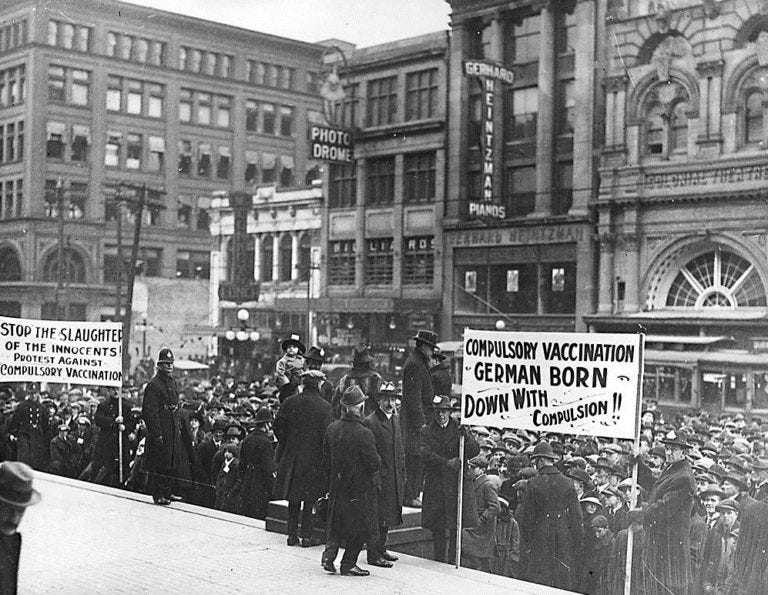
Excerpt from het Substack-artikel van "A Midwestern Doctor":
Historic public protest from 1885 against compulsory smallpox vaccination
As widespread skepticism about the vaccination increased, so did the enforcement of the vaccination mandate without there being a legal possibility of obtaining an exemption, regardless of the situation or a doctor's judgment. Around the world, there were numerous reports of vaccine refusers being fined and jailed or forcibly vaccinated. Parents often chose to undergo the punishment if it allowed them to protect their children from vaccination.
There were attacks on officials who forced vaccination and riots broke out regularly. This quote from 1874 by emeritus professor F.W. Newman sums up the atmosphere of that time:"Ik kan geen fatsoenlijke en acceptabele termen bedenken om datgene te beschrijven wat ons dertig jaar geleden onmogelijk had geleken: het verplicht toedienen van een vaccin op het tweede kind van een gezin, terwijl het eerste gestorven was aan diezelfde vaccinatie, om vervolgens de vader naar de gevangenis te sturen wegens weigering.”Many reports on the horrific enforcement of these mandates and the resistance to them within the United States can be found in chapters 8 and 9 of Dissolving Illusions (bol.com). The most striking story, however, took place in England.
The manufacturing city of Leicester was subject to the English Act of 1840 requiring immunization, and the Act of 1859 mandated that every child be vaccinated within 3 months of birth. Because refusal to vaccinate could be punished with fines or imprisonment or both, many vaccine refusers agreed to vaccination anyway. Despite the high vaccination rate, a smallpox epidemic of 1871-1872 occurred, with 3,000 cases of which 358 died, leading to growing skepticism about vaccination and increasing enforcement of vaccination mandates. In 1869, 2 criminal prosecutions took place against vaccine refusers. In 1881, there were 1,100 (in the entire period of persecution, there were a total of 6,000, with 64 prison sentences and 193 property seizures against those who were too poor to pay the fines).
By 1884, 5,000 subpoenas had been issued against the unvaccinated, a case that completely overburdened the legal system. Letters in the local newspaper at the time revealed widespread disregard for the irrationality of the procedure and the medical profession's steadfast defense of a dangerous practice that had clearly failed over the past 80 years.
Tensions reached a boiling point and on March 23, 1885, a large protest broke out, estimated at 80,000 to 100,000 people. Citizens of all professions from all over England took part and they received support from citizens from all over Europe. The procession was two miles long, with protest signs and banners making clear the crowd's sentiments against vaccination. The demonstration was successful and the local government agreed with and acknowledged their demands for freedom.
The demonstration was successful and the local government agreed with and acknowledged their demands for freedom.
[Actually the most special sentence in the whole story (AT)]
The Leicester model
Mr. Alderman Butcher of Leicester addressed the protest. He mentioned the growing opinion that the best way to get rid of smallpox and deadly infectious diseases: to use a lot of water, to eat well, to live in light and airy houses, while it was the best way to do the job of the municipality to keep the streets clean and the sewerage system in order. He stressed that if this was not done, it was unlikely that a law of Parliament or vaccination could prevent the diseases.
That year, after the protest, the government was replaced, mandates were terminated, and by 1887, the vaccination rate had dropped to 10%. To replace the vaccination model, the Leicester activists proposed a system to immediately quarantine smallpox patients, disinfect their homes and quarantine their contacts, in addition to improving public sanitation.
De medische gemeenschap verwierp dit model fel en voorspelde ijverig dat Leicesters "gigantische experiment" spoedig zou resulteren in een verschrikkelijk "bloedbad", vooral bij de onbeschermde kinderen, die door overheidsartsen werden beschouwd als "zakken buskruit" die gemakkelijk konden worden opgeblazen scholen (samen met veel andere hatelijke en hyperbolische retoriek die op hen is gericht). Deze pokkenapocalyps zou voor altijd dienen als een les tegen vaccinweigering waar de medische professie hun inzet op inzet.
Because the predicted catastrophe failed to materialize and Leicester had dramatically lower smallpox rates than other fully vaccinated cities (ranging from 1/2 to 1/32). Various rationalizations were put forward to explain this, but as the decades passed, there was a gradual public acceptance of Leicester's methods, but even 30 years later, an article in the New York Times still predicted disaster around the corner and it was imperative that Leicester change their methods. Fortunately, the value of Leicester's new approach to quarantine and improving public hygiene was recognised and gradually adopted around the world, leading to the eventual eradication of smallpox. Because smallpox is usually6-7 days need close contact for transfer, it seems plausible that a quarantine approach could be the primary approach responsible for smallpox eradication.
Er is dus niks nieuws onder de zon wat die vaccinatieplicht betreft, nu technologisch aangevuld met digitale certificaatjes. Overheden en medische toppers hebben de wijsheid bepaald niet in pacht. Ze doen maar wat, als je naast de lijn van de wetenschap legt. Blijft de vraag hoe dit ooit goed te regelen zal zijn... Wie is te vertrouwen? Wie is er integer? Is het überhaupt mogelijk om mee te bewegen met de voortschrijdende wetenschap en in een democratie niet het onderspit te delven wegens wankelmoedig beleid? Willen de mensen niet alleen maar 100% zekerheid, terwijl de wetenschap vooral vraagtekens neerzet?
Democratie staat op gespannen voet met wetenschappelijk verantwoord beleid. Wat verzinnen we daarop? Overheidsinstituten blijken in elk geval niet het antwoord te zijn. Moeten we gaan denken in de richting van crowd sourcing?
