


Chairman of Royal Horeca Netherlands (KHN)
Furious about the ongoing economic damage
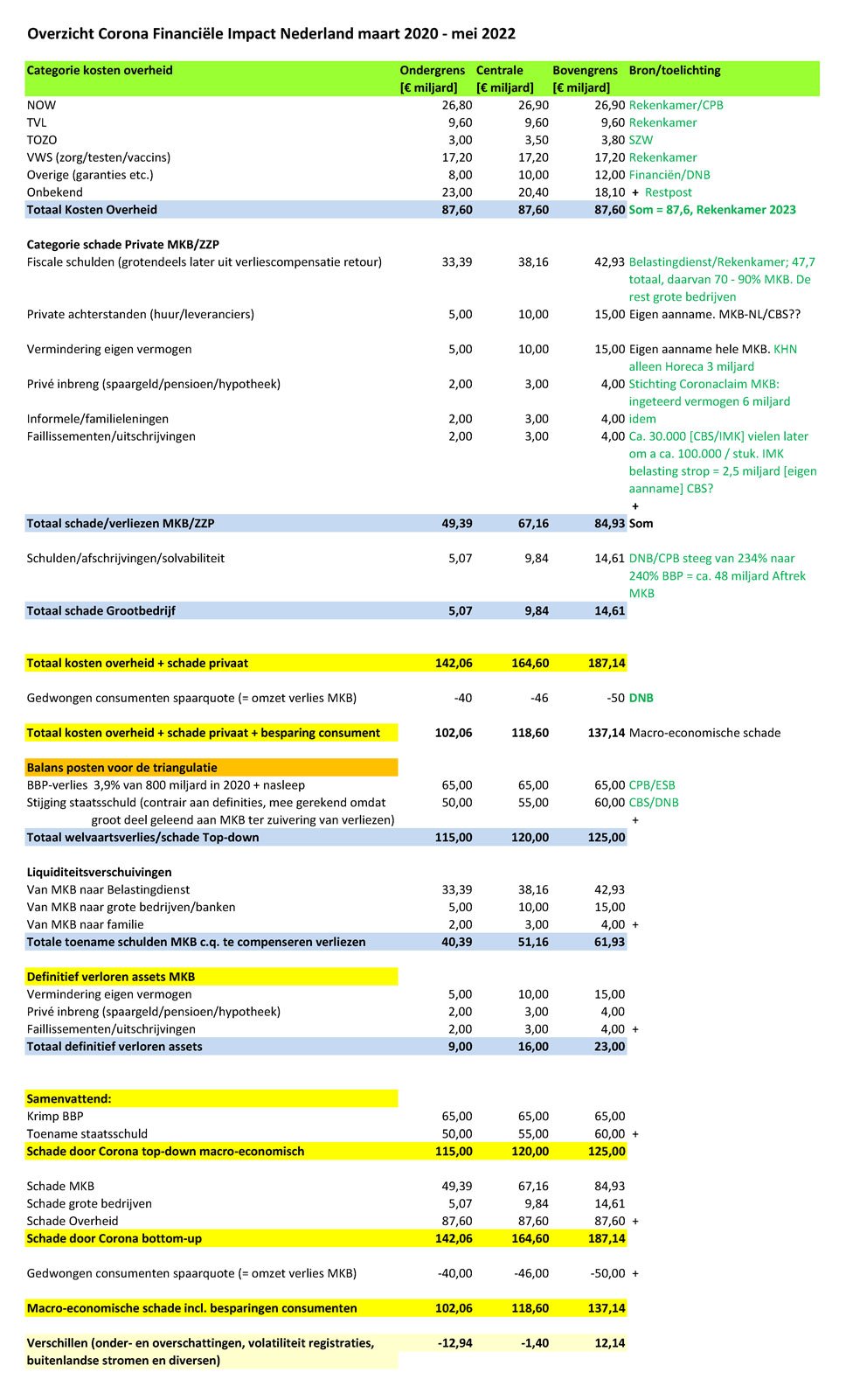
Based on rough estimates, SMEs, including the catering industry, have privately incurred approximately 57% (approximately €67 billion) of the macroeconomic damage (approximately €118 billion). From piggy banks, pension provisions, family loans and mortgages.
De grote bedrijven namen "slechts" ca. €10 miljard voor hun rekening (supermarkten en bouwmarkten draaiden topomzetten).
The government was responsible for approximately €87 billion.
Consumers actually saved approximately €46 billion.
Willemsen does not have the figures, but he is rightly still angry about this, because the image has been presented by the government that the catering industry was 100% compensated...
From civil obedience to deep powerlessness
Robèr Willemsen's position as chairman of Koninklijk Horeca Nederland is characterized by an unprincipled course and a tendency towards opportunism. In the initial phase of the crisis, around March 2020, Willemsen was completely carried away by the social panic, while by April 2020 it was already clear that this panic was exaggerated. Many of its members already realized that…
Gedreven door een misplaatst verantwoordelijkheidsgevoel sloot een deel van de horeca al op 15 maart de deuren, nog vóórdat de officiële lockdown door het kabinet werd afgekondigd. Mogelijk mede door deze vroege volgzaamheid werd dit aanvankelijk "beloond" met een snelle financiële omschakeling van de overheid: binnen vier à vijf weken werden de eerste steunbedragen al uitbetaald. Dit vroege succes van de MKB-lobby, gesteund door de "diepe zakken" van de ministeries van Economische Zaken, Sociale Zaken en vooral Financiën, zorgde voor onderling vertrouwen.
Only when the operational restrictions became structural in nature in June 2020 and the sector began to feel deep economic pain, did Willemsen harden his tone and seek confrontation. During the crisis, he remained between two thoughts: on the one hand, to join in with unworkable restrictions as a result of the importance for public health, which he also experienced, and on the other hand, to act against the policy. This split led to great frustration among its members. In a moment of reflection, he admitted during the interrogation that, if he had not been chairman of KHN, he would have told the government long ago to just sort it out and simply threw the doors open.
Internal rebellion and the arbitrariness of political closing times
This ambivalent attitude caused deep rifts within its own supporters of approximately 17,000 companies and more than 200 local departments. A significant number of members accused the national leadership of operating too softly. Local departments, especially in Venlo and Leeuwarden, refused to be forced into the polder model any longer and demanded much more freedom. KHN had the greatest difficulty in keeping these rebel members in line. The internal pressure sometimes became so uncontrollable that Willemsen, for example, negotiated an extension of the closing time from 5:00 PM to 8:00 PM, purely to tame the Venlo and Leeuwarden departments. These three extra hours, obtained quite easily from Grapperhaus, under threat of non-cooperation, naturally felt like a victory to the chairman; but also as a sign of complete arbitrariness, because from a medical point of view there was a negligible difference between a closure at 5 p.m., 8 p.m. or 10 p.m. It was pure symbolic politics, which did, however, have a huge impact on the earning capacity of entrepreneurs.
From June 2020, Willemsen decided to take a tougher stance towards the cabinet, because the arbitrariness and double standards became unacceptable. While citizens were first allowed to have 2, then 4 and then 3 people visiting at home [which no one adhered to], the catering industry became the ultimate victim of similar symbolic closures, which logically led to major resistance within its supporters.
The interrogation did not mention that parts of the catering industry (particularly the nightlife) certainly had a superspread risk in some settings (close to each other, alcohol, singing, if not well ventilated).
The Hague's power politics, backroom dealings and institutional cracks
In order to exert some influence, KHN was forced to transform into a quasi-political lobby party. In this light, it is remarkable that Willemsen explicitly mentions his close lines with coalition prominents Jan Paternotte and Rob Jetten in his personal notes, as well as his regular subsequent contacts with VVD faction leader Klaas Dijkhoff about a motion that was ultimately not implemented. Although some successes were sometimes achieved through intensive collaboration with MKB-Nederland, KHN's cold conclusion was that the individual entrepreneur did not matter at all electorally and policy-wise. People had to go straight in to be heard at all, as the sector was not considered an equal discussion partner.
De feitelijke besluitvorming lag in handen van slechts drie bewindspersonen. De goede contacten en gesprekken met Mona Keijzer van het Ministerie van Economische Zaken (EZK) hielpen niet; EZK werd buitenspel gezet en had feitelijk niets in te brengen. Afspraken die met EZK werden gemaakt, werden door de rest van het Kabinet stelselmatig niet nagekomen. Het wantrouwen liep zo hoog op, dat Willemsen expliciet moest eisen dat gesprekken genotuleerd werden, omdat toezeggingen naderhand simpelweg werden ontkend. Zo was er met EZK besproken dat het nachtleven met goede ventilatiemaatregelen prima open kon, een verslag daarvan is doelbewust nooit gemaakt. Rutte bleef tot ergernis van Willemsen het hele nachtleven labelen als "bedompte ruimtes", wat totaal bezijden de werkelijkheid is: heel veel nachtclubs zijn uitstekend geventileerd.
The disregard for the sector was also evident on February 2, 2021, when the new roadmap was communicated purely for information purposes without the sector being involved in its creation in any way. However, the communication suggested that the map had been drawn up in consultation with the sector (including KHN). Moreover, crucial outcomes of OMT advice were not shared in advance, but had to be heard by the chairman via television or in talk shows.
The subsequent contact with Minister Stef Blok was cold and completely unworkable, in contrast to the reasonable constructive relationships that sometimes continued to exist at official level with EZK officials.
The absurd enforcement madness and the failure of the Corona Admission Ticket
The practical implementation of the policy fell into complete absurdity. It was in no way explainable that student houses without any form of ventilation were packed, while professionally ventilated catering establishments had to keep their doors closed. Repeated requests to Health, Welfare and Sport Minister Hugo de Jonge to provide medical substantiation for these measures were systematically ignored; there was never an answer. Instead, rigid enforcement was opted for, which varied enormously from municipality to municipality and gradually took on extreme forms. In some municipalities, enforcement officers literally walked across terraces with measuring tapes to fine entrepreneurs if tables were at 1.44 meters instead of the mandatory 1.50 meters. While open-air terraces were much easier to control than illegal gatherings in parks or student houses.
Smart, proactive measures - such as maintaining a distance of 1.5 meters without absolute restrictions on numbers, especially outdoors - were systematically rejected. The initiatives surrounding Field Labs with advanced air treatment are also being stifled because the government refused to think in terms of possibilities and only thought in terms of limitations.
The introduction of the Corona Admission Ticket (CTB) and the associated 'Dancing with Jansen' campaign turned out to be a debacle that lasted only two weeks and caused nothing but damage. KHN ultimately agreed with the CTB and thus said yes to a measure that the KHN board knew in advance would never work in practice. It was a choice between this unworkable system or a total closure. The responsibility and enforcement task of this policy were completely thrown over the fence of the catering industry, which led to a wave of fraud, aggression and physical threats from the public towards the catering staff. The public partly accused KHN of agreeing to the CTB's discriminatory measure. This led to insults and anonymous threats.
Het CTB, bedoeld als versoepeling, vormde uiteindelijk een verzwaring: het dwong tot uitsluiting van gasten en eiste een onmogelijke handhavingstaak op de werkvloer. Omdat de handhaving per gemeente gigantisch verschilde, verdampte het maatschappelijke draagvlak en nam de handhavingsmotivatie bij de lokale horeca leden zelf ook volledig af. Ondertussen werden er miljoenen aan publiek geld verspild aan volledig lege teststraten en subsidies voor controlehulpen. Het kabinet leed aan een diepe tunnelvisie die volledig voorbijging aan de epidemiologische realiteit: besmettingen lieten zich niet sturen door horecasluitingen, maar volgden exact het seizoensgebonden verloop zoals analisten als Maurice de Hond al vroegtijdig hadden aangetoond. Dat zag ook Willemsen in de praktijk. Dus "We gingen ja zeggen [tegen voorstellen van de overheid], terwijl we wisten dat het niet zo zou werken." Willemsen voelde zich met KHN ook "gebruikt" om via het CTB de vaccinatiegraad te verhogen.
The ultimate frustration and powerlessness was the last closure during the Omikron lockdown; a completely illogical measure that could not be explained, since the catering industry in neighboring Belgium remained fully open during the same period. And scientists already knew that this variant had much less serious consequences.
Deep cracks in the cabinet and dictatorial actions
The rigid policy caused major political crises within the Cabinet. State Secretary Mona Keijzer, who spoke to Willemsen almost weekly, made it clear non-verbally that she was forced to support measures that she was strongly opposed to internally. This led to great irritation with Minister Ferd Grapperhaus (Justice and Security), who was openly annoyed by her dissident attitude, while mayors also became increasingly divided over the course of action.
Keijzer's eventual dismissal did not materially change anything for KHN; it was simply the final confirmation of the heartless policy towards SMEs. According to Willemsen, Minister Wouter Koolmees of Social Affairs also felt internally dissatisfied with the policy being pursued; This is in stark contrast to Grapperhaus, in whom Willemsen was never able to discover any form of doubt or empathy.
During the cabinet formation period, when Corona fatigue struck, the cabinet certainly did not throw its hat at it; the tunnel vision, that every Corona death had to be prevented at all costs, remained fully intact.
To enforce the failed policy, the Ministry of Justice and Security did not shy away from intimidating tactics. When KHN filed a series of lawsuits to get the one and a half meters off the table and influence public opinion, the equality of the conversation completely collapsed. After the negative court ruling on July 23, 2020, Grapperhaus expressed himself on the telephone in a dictatorial manner towards the catering chairman. He forcefully demanded that KHN immediately remove its own critical roadmap from its website. The government tolerated no contradiction, although its own policy completely ignored the reality in the rest of the world.
The fable of one hundred percent compensation and the starter drama
The most distressing part of the interrogation is the total unmasking of the government rhetoric regarding financial compensation. The public perception that the catering industry was 100% compensated is a deliberate distortion of the truth. Ministers openly announced in the media that entrepreneurs were fully compensated, but in practice the TVL and NOW scheme at its peak often did not cover more than 65 percent of the actual costs. In addition, just before the crisis, the government had introduced the Balanced Labor Market Act (WAB), which significantly increased the unemployment benefit premium for flexible workers, which immediately hit the catering sector extra hard at the outbreak of the pandemic.
De uitspraak van minister Wopke Hoekstra dat het kabinet er was om "de economie te redden, maar niet de individuele ondernemers", legde de kille macro-economische filosofie bloot. De overheid was niet bereid om de gevolgen van het eigen disproportionele wanbeleid te compenseren op individueel niveau. In feite een Toeslagenaffaire in het kwadraat. Starters vielen door rigide peildata volledig buiten de boot en verloren werkelijk alles: hun opgebouwde pensioen, hun bedrijfspand en hun persoonlijke toekomst. De suggestie dat de horecabranche simpelweg maar weerbaarder had moeten zijn, getuigt van een stuitend gebrek aan realiteitszin; de marges in deze sector zijn historisch gezien dun, en een enorme groep ondernemers exploiteert hun zaak puur vanuit passie en bezit geen serieuze financiële buffers.
Willemsen erkende dat de overheid zeker niet niks gedaan heeft; t.o.v. veel buitenlanden heeft de Nederlandse overheid de horeca goed geholpen. Maar het constant gecommuniceerde beeld van 100% compensatie zit hem flink dwars. "Misschien zou ik soms wat diplomatieker hebben moeten zijn, maar ik zou het toch weer hetzelfde doen. Ik ben mijn vertrouwen in overheid wel flink verloren in die periode; en met mij heel erg veel ondernemers".
Interessant is nog deze dubbelhartige bespiegeling van Willemsen: "KHN had de krachtigste lobby in Corona-tijd. Maar VWS was krachtiger. En dat was OK. Maar het was niet OK dat dit over de rug van de horeca en andere kleine ondernemers ging."
Very interesting that he now also thinks that it was good that VWS was more powerful with its one-sided medical approach than he was with KHN... While the policy was based on quicksand.
Willemsen's criticism is justified by the financial facts (see Appendix 1). While the total negative economic impact of the crisis amounts to approximately €164 billion, there has never been a thorough investigation into who bore those costs.
Een grove maar reële schatting toont aan dat het MKB in privé maar liefst ca. €67 miljard van deze totale schade rechtstreeks voor haar rekening heeft genomen. Dit gigantische bedrag is uit de leningen van de belastingdienst, privé-spaarpotten, pensioenvoorzieningen en privé hypotheken en familieleningen getrokken om zakelijke faillissementen af te wenden. De grote bedrijven hebben "slechts" €10 miljard van de schade gedragen.
The government systematically conceals who actually took this blow and suggests that the government did so. However, the government only absorbed slightly more of the damage than SMEs, namely €87 billion.
Opmerkelijk is dat de consumenten juist ca. €46 miljard, gedwongen, hebben bespaard en dus minder hebben uitgegeven aan met name het MKB. Saldeer je dat, dan is de macro-economische schade dus "slechts" €118 miljard i.p.v. €164 miljard. Dat is bijna allemaal gederfde omzet van het MKB.
Zijn uitspraak "Wij hebben voor een groot deel de rekening van het beleid betaald.", klopt dus waarschijnlijk nog meer dan hij zich realiseerde: het MKB heeft ruim 40% van die rekening in privé betaald als je uitgaat van de totale negatieve impact. Ga je echter uit van de macro-economische impact, dan heeft het MKB zelfs ruim 56% van de rekening betaald…...
De sporen van dit destructieve beleid zijn tot op de dag van vandaag nog diep voelbaar, verklaarde Willemsen. De sector kampt nog altijd met een openstaande coronaschuld van €6 miljard bij de Belastingdienst, waarover de overheid momenteel een rente van 4% heft. De meeste werknemers, en zeker ambtenaren, hebben geen centje financiële pijn geleden onder het "Corona schrikbewind"; integendeel, zoals boven is betoogd. Terwijl de politiek en de rest van de samenleving allang zijn doorgegaan met hun normale leven, vechten talloze kleine ondernemers nog dagelijks tegen een gevoel van diepe boosheid en machteloosheid omdat ze gedwongen zijn nog steeds hun schulden van 6 jaar geleden terug te betalen. Dit maakt Willemsen tot op de dag van vandaag woedend....
See the attachment below or download als PDF.

And the next tragedy for entrepreneurs in this sector and the entertainment sector, among others, has already started with the first climate lockdown (code red day). All very sad indeed! First jumping through hoops and cooperating with governments and then the dictatorial axe. Most of the legislation has already been arranged this time. And the fear campaigns are already in full swing in the MSM.