

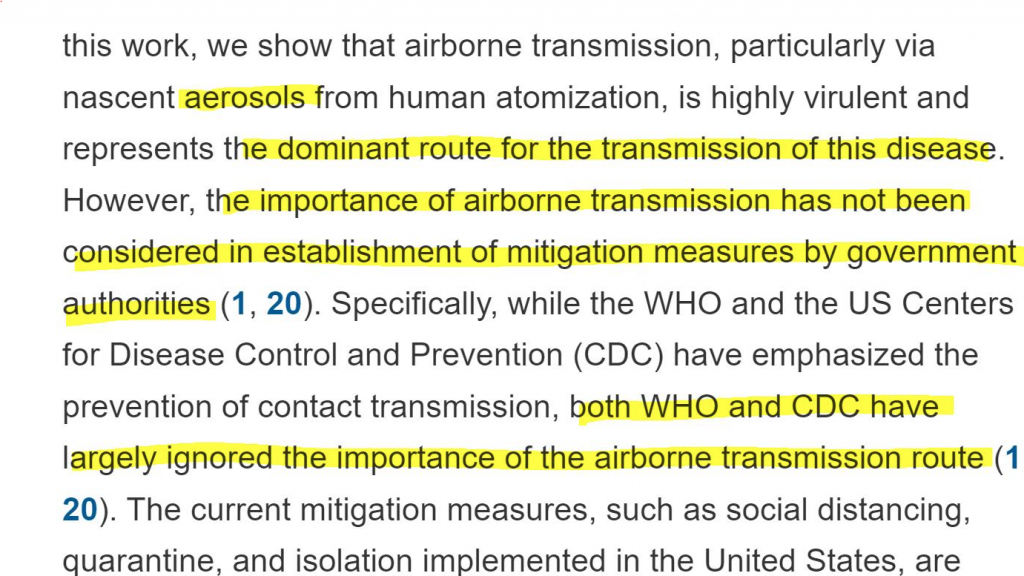
I had planned not to mention any sources, because they are very easy to find for anyone who wants to check the facts. Yet one example of a recent report: this report of the National Academy of Sciences of the United States of America. The lines of the conclusion marked in yellow state:
Aerosols are the dominant route for spreading the disease. The importance of aerosols has not been taken into account in the measures taken by the authorities. Both the WHO and the CDC have almost completely ignored the importance of airborne contamination.
Concise paraphrasing of the main conclusion
With this knowledge, we look at it article in the Volkskrant on 22 June
According to action group Viruswaanzin, keeping a distance is not necessary.
Volkskrant (caption to the photo of the shopping street © Arie Kievit)
That is short-sighted from the Volkskrant. I can't find that statement anywhere on the site viruswaanzin.nl. If it was said in an interview, various contexts for this statement are conceivable.
- For example, keeping your distance can help prevent your own infection or that of your conversation partner, especially if one of them speaks quite a bit about consumption. When coughing or sneezing, such a person should actually stay at home. Keeping distance is therefore somewhat useful and has no influence on the occurrence of outbreaks, which is done in a different way, always in groups. In that sense, someone may say that keeping distance is not necessary because it is precisely those outbreaks that have led to measures that have brought the country to a standstill. (this is constantly confused with 'not being able to rule out a possible contamination').
- Other possible context: Almost no one is infected in the Netherlands anymore. The chance of bumping into someone is now so small that keeping your distance is unnecessary. You are more likely to break your neck at home than to be infected through direct contact with someone within 1.5 meters and die from it. It is not advisable to try to avoid such minimal risks with antisocial behavior, such as keeping an unnatural distance and organizing your life accordingly.
1. The virus is not that dangerous at all
That's right. In the beginning, we thought we were dealing with a killer virus with mortality rates of 15% (SARS) or 34% (MERS). That was an important driver of the lockdown. However, the virus is not that dangerous at all. There are even claims that the virus is less dangerous than the flu. I can't reconcile that with the mortality figures myself (see my blog of May 6), according to that reasoning, it is slightly worse than the flu. But not of a completely different order.
It is a bit silly of the Volkskrant to bring up last year's excess mortality figure. That is the lowest figure in the past five years. In the four years before that, the mortality rate was 3x, 1.3x, 2.5x, 3.5x as high as last year, respectively. De Volkskrant does not even attempt to make a fair comparison, everything is tendentious. I really don't know what's going on in the media, it's worrisome. When the tide turns, they will probably all be pushing at the front again with their sharp pins.
Two years ago, the excess mortality figure was 9,444, which is more deaths than in this flu/corona season. No one remembers that there was an epidemic back then. Whether there was an IC problem... do you remember? There was a flu vaccine, but almost no one thought it was worth getting it (see Other blog). Flu vaccines were thrown away, even by the vulnerable(!). Unbelievable if you compare those reactions with what is happening now and how we try to keep the vulnerable out of the wind - which we ultimately failed to do because it is simply the hardest-hit group again, like every year. There's the lockdown completely nothing .
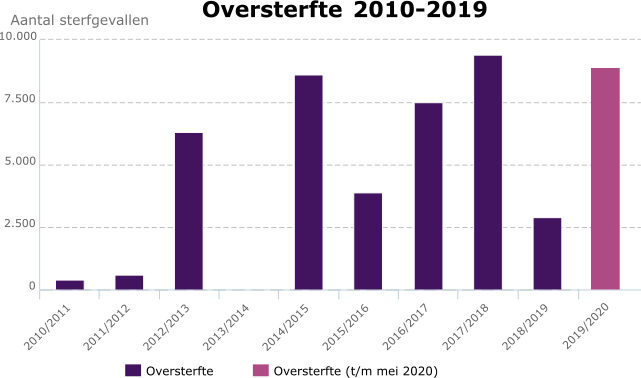
The corona excess mortality is therefore in line with the heavier flu seasons. Would it have been worse without lockdown? There are different opinions on this. Various graphs show the normal course of the epidemic (it is always over within 6-8 weeks). Many specialists are quite outspoken about it: the lockdown has not made much difference.
What the Volkskrant claims about the mortality of the virus in different countries depends very much on
- tests and measurements (different and not always reliable),
- registrations (of varying quality with different standards per country) and
- models (kept secret in the Netherlands).
In any case, there have been many infections in people who have not or hardly noticed it. This leads to the suspicion that the actual number of cases is higher than is thought. There is a lot of uncertainty in this and that leads to estimates.
Guess
De Volkskrant uses unfavorable estimates: a low infection rate. More favorable estimates assume a higher infection rate. This means that mortality (number of deaths per 100 infections) will be lower because there have been more infections than currently estimated by various scientists. This is how 'virus madness' results in the lowest mortality: they assume a higher infection rate. The fact that there was no immunity does not necessarily mean that higher mortality rates would automatically be achieved, as De Volkskrant claims. With a greater spread, mortality simply has to be adjusted downwards.
Not a killer virus
All in all, you have to do your very best to turn COVID-19 into a killer virus. Yes, it's worse than the last flu. It had not been a threat to society or public health. The IC treatments that were targeted played an extra role in the statistics, so that was not such a good move.
Public health has been hit harder by the lockdown than corona could have dealt (see Gupta report) and yet the community is surviving again.
De Volksrant also reports that six to nine thousand people have died of corona. These are mortality figures based on RIVM (6000 COVID deaths) and CBS (excess mortality 9000). VK assumes that the effects of the lockdown themselves have not caused mortality and they of course completely ignore possible future effects. So that's what we do. It is certain that there have been half-empty hospitals and clinics for weeks to months, reduced to decimated care, postponed treatments, fewer referrals, patients who did not dare to go to the doctor or hospital, stress, loneliness, despair. All this took place among hundreds of thousands, perhaps millions of people. All as a result of a serious flu. And then we haven't even mentioned the word economy.
2. The virus spreads through the air
Here de Volkskrant confuses two things. On the one hand,
- individual one-to-one infection, which leads to a smouldering persistence of the virus (from 1 January to 1 March), no one noticed that the virus was already in the Netherlands) and on the other hand
- the situations in which one infected person infects dozens of others, an outbreak that takes on epidemic proportions with an explosive Rt. (and immediately afterwards collapses again, by the way)
It is precisely the latter form, which proceeds via contaminated air (aerosols), that causes outbreaks. In a moderately or poorly ventilated room where many people are together, in offices, in restaurants, the one and a half meter rule is misleading, to say the least, with all its disastrous consequences. And all the unnecessary costs that the business community now incurs to make one-and-a-half-meter working possible.
In an attempt to give the one and a half meter rule some credit, De Volkskrant states that aerosols linger around someone, so the further away you are from them, the safer. That is of course nonsense, it depends entirely on the air movement and vortices at that location. If someone walks by, it can be enough to move an aerosol cloud to the next table while the 'shedder' refills its own aura. Inadequate ventilation can spread aerosols throughout an entire building and certainly throughout a room. We are talking about long-term exposure, from fifteen minutes to two hours or even longer, in a canteen during lunch, in a café, at a choir rehearsal, at a party, at a dinner party.
A stuffy restaurant with 30 people sitting at a distance of one and a half meters can cause 29 infections from 1 'shedder' of the virus. Viewed in this way, the one and a half meter rule is an ineffective, even counterproductive, misleading and cost-consuming rule.
Aerosol deniers, they still exist
De Volkskrant denies that the majority of infections take place via aerosols. They are really lagging behind the latest insights. No reasonable person believes that anymore, and certainly no self-respecting scientist. Everywhere in the world that fact is now accepted, countries are all changing. It is even in Wells' medical manual from 1930, where the RIVM says it got the one-and-a-half-meter rule from. It was a rule of thumb that was undoubtedly thought at the time to do little harm: if it doesn't help, it doesn't hurt. Furthermore, that rule is not scientifically substantiated, in case anyone thinks so.
There is a conflict going on within the RIVM/OMT as to whether all this should be made known or not. It could have major consequences for some of them (I hope they are not jointly and severally liable). Whoever burns his butt... I suspect that they will try to change their mind unnoticed and reluctantly indicate step by step that it is now clear that... etc.
There are now also indications that 'old school' infections via the mucous membranes (direct contact, coughing and sneezing) are less serious than via prolonged inhalation of the virus, where it ends up directly in the lungs. This could explain the large difference in the course of the disease in different people. The immune system responds immediately and one theory is that it may kick in before the virus reaches the lungs. This is not possible if the virus enters the lungs directly - i.e. via aerosols.
3. No need to wash hands and clean surfaces
Of course hygiene is important. De Volkskrant puts words in Willem Engel's mouth, I follow him and have never heard him say that from now on you can stop washing your hands. (What kind of newspaper am I actually reading? It looks like a left-wing Telegraaf.) Washing hands always helps, of course, so you can also shake hands without any problems. Paying more attention to hygiene would also have helped to halve the 9,444 flu deaths in 2018. No rooster crowed about it then and now society is at a standstill. Let's do this every flu season: Stay at home when sneezing and coughing, wash your hands thoroughly, keep a little distance when you have a 'bit of a cold'. Here again: washing hands helps, but it does not prevent outbreaks and they cause the misery.
Anderhalve meter? Niet continu in iemands aura staan is niet voor niets fatsoenlijk. En "Maar even niet zoenen, ik ben verkouden" is ook vanzelfsprekend. Individuele afstandsnormen in acht nemen is echt iets anders dan het land in een kramp dwingen en bedrijven failliet laten gaan omdat ze de anderhalvemeter-regel niet kunnen waarborgen. Ze zouden beter bedrijven kunnen sluiten met slechte ventilatie. Daar is namelijk wat aan te doen en het voorkomt uitbraken. Dat doet de anderhalvemeter-regel niet.
Dysfunctional virus residues
De Volkskrant also claims half-truths: Yes, traces of the virus were still found on surfaces after hours, but no: that virus was no longer able to infect. They don't say that. Without a host, it breaks down quickly, especially in UV light. The DNA remains of the virus are still recognizable.
That does not mean that individual infection cannot take place if you are really unlucky. I remember German studies from the beginning of April that showed this, done by Professor Streeck. If you want to infect someone in this way, it means: Sneeze into your hand and immediately give your shopping cart to someone else with that hand, then there is a small chance of infection. Again, you won't get any outbreaks from that. That doesn't mean you have to leave your snot somewhere. (I find it an annoying point of the Volkskrant, fear-mongering).
4. Untreated
De Volkskrant leaves many important points undiscussed. I do have more serious comments on Engel's statements, but that does not alter the fact that his story is not only plausible in general terms, but above all corresponds to what many other scientists say independently of each other. For a somewhat critical journalist, there are enough starting points to burn the corona policy as implemented in the Netherlands since the end of March to the ground. That type of journalist apparently no longer works for 'the media', for that you have to be on YouTube and on their own sites.
Prefer Maurice
Apart from that, I would have preferred if they had taken a closer look at Maurice de Hond - but for once, don't quote bluntly, don't take a quote from an interview or use lame figures. Simply, on facts, as it should be.
RIVM AND OMT, I SHOW THEM ALL CORNERS OF THE ROOM'
Interview Maurice de Hond about COVID-19
Now Maurice is of course a less easy victim. Despite all his drive, he rarely allows himself to be tempted to make statements that he cannot make scientifically rock-solid. The journalists don't burn their fingers on that, they prefer to keep him silent. Because it is not true a priori, you can taste that in everything.
Onze kwaliteitskranten wekken steeds sterker de indruk dat het hun taak is om het overheidsbeleid te verdedigen.
