

This article is a linguistic addition to the more argumentation-theoretical article Repopulation: a contaminated term goes viral.
Language is sloppy and changeable
We must be aware that language is a particularly messy vehicle for communication. You can use it very precisely, but everything is allowed, so precision is not necessary. Everyone can use language, even people who cannot think very precisely. Unlike computer languages, where you have to at least indicate for each word whether it is a variable, a function, a constant or whatever, spoken language is completely free. That offers unbridled creativity. But that leads to inaccuracies, a problem that in practice is solved by context. In an early love relationship, you fill in those inaccuracies in an understanding manner with desirable outcomes. In politics you use those inaccuracies to criticize each other over words: we now call that a semantic discussion. 'Semantics' used to be about the precise meaning of words or their content, but now it is mainly about the use of the words themselves: their appearance. That is an example of a shifted meaning.
The changeability of language is clearly visible in the spelling, because old books show the solidified spelling of a certain time. The older the more difficult to read. Just as changeable are the meanings and applications of certain words. In other eras with different contexts, meanings can shift. In a rapidly changing social context, new expressions sometimes have to be found. Words are derived from other words or are combined. Words that have fallen out of use are revived with a slightly different meaning. Verbs are 'nominalized' (they are made into nouns and vice versa), they are conjugated, kneaded and trimmed, anything goes... Language is alive.
Meanings are therefore not anchored in dictionaries; Dictionaries are snapshots of common spellings and applications. Dictionaries report on language use, they are behind the times.
How Language Uses Anticipates Dictionary Definitions: Examples
The verb 'to enpopulate' is part of our vocabulary. The Fok forum even uses 'omvolker' creatively. Some examples:
Column by Mark Elchardus, emeritus professor of sociology at the Vrije Universiteit Brussel:Repopulation is a matter of every day (3 March 2020, also published in De Morgen).
Column van Ronald Sørensen": You can't say repopulate (May 11, 2023)
Column van Ronald Sørensen": Repopulating, too sick for words (June 29, 2024)
https://forum.fok.nl/topic/2712510/1/999/waarom-is-het-woord-omvolking-zo-controversieel.html
Het Reformatorisch Dagblad, (May 2024): Are-our-leaders-consciously-engaged-with-repopulation?
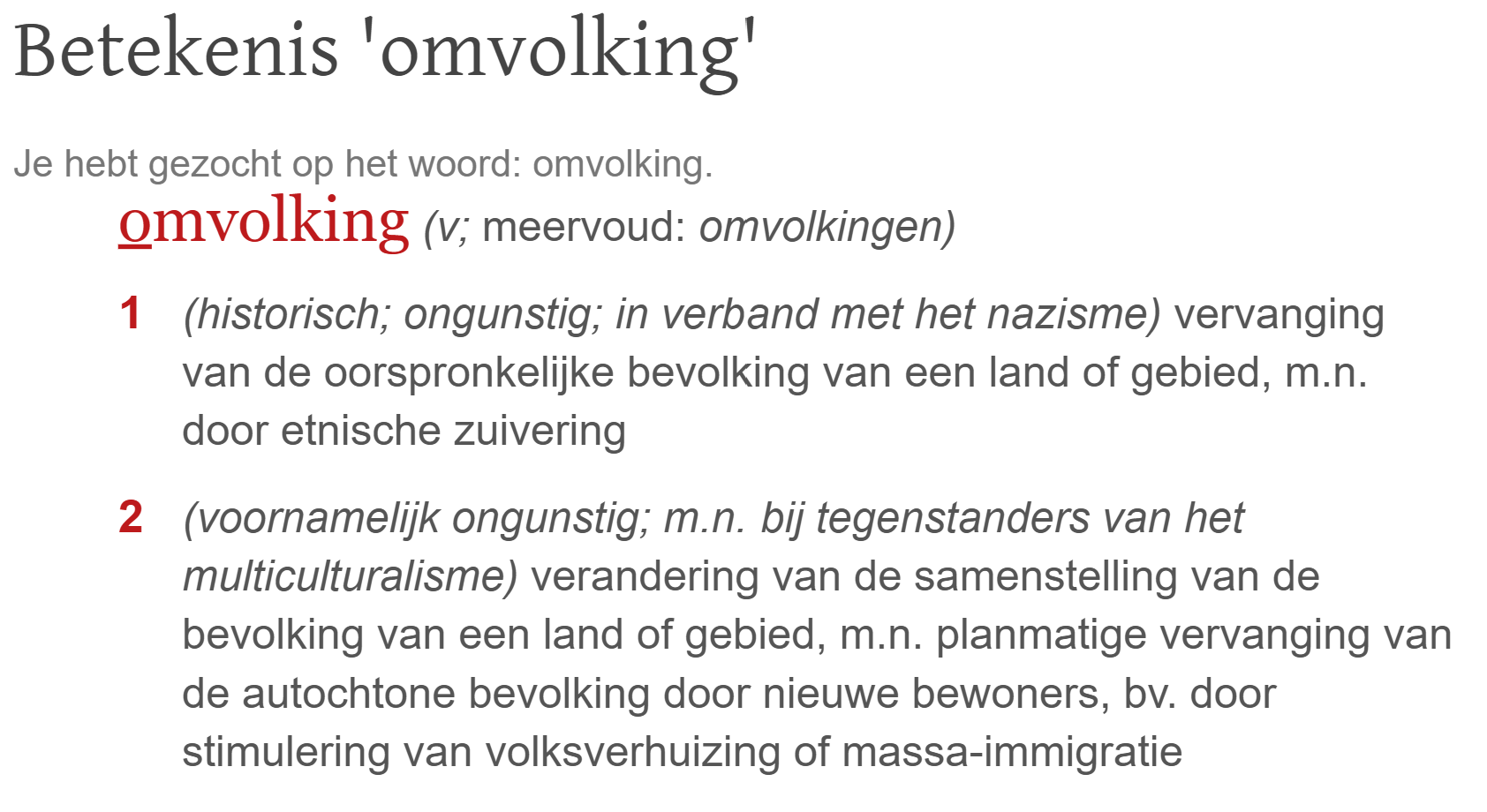
De woordenboeken lopen wat achter. Het werkwoord omvolken komt er zelfs nog niet in voor. ChatGPT volgt de taalontwikkelingen beter dan Van Dale, dat nog een jaren vijftig duiding heeft. In Van Dale ontbreekt zelfs de term "omvolkingstheorie".

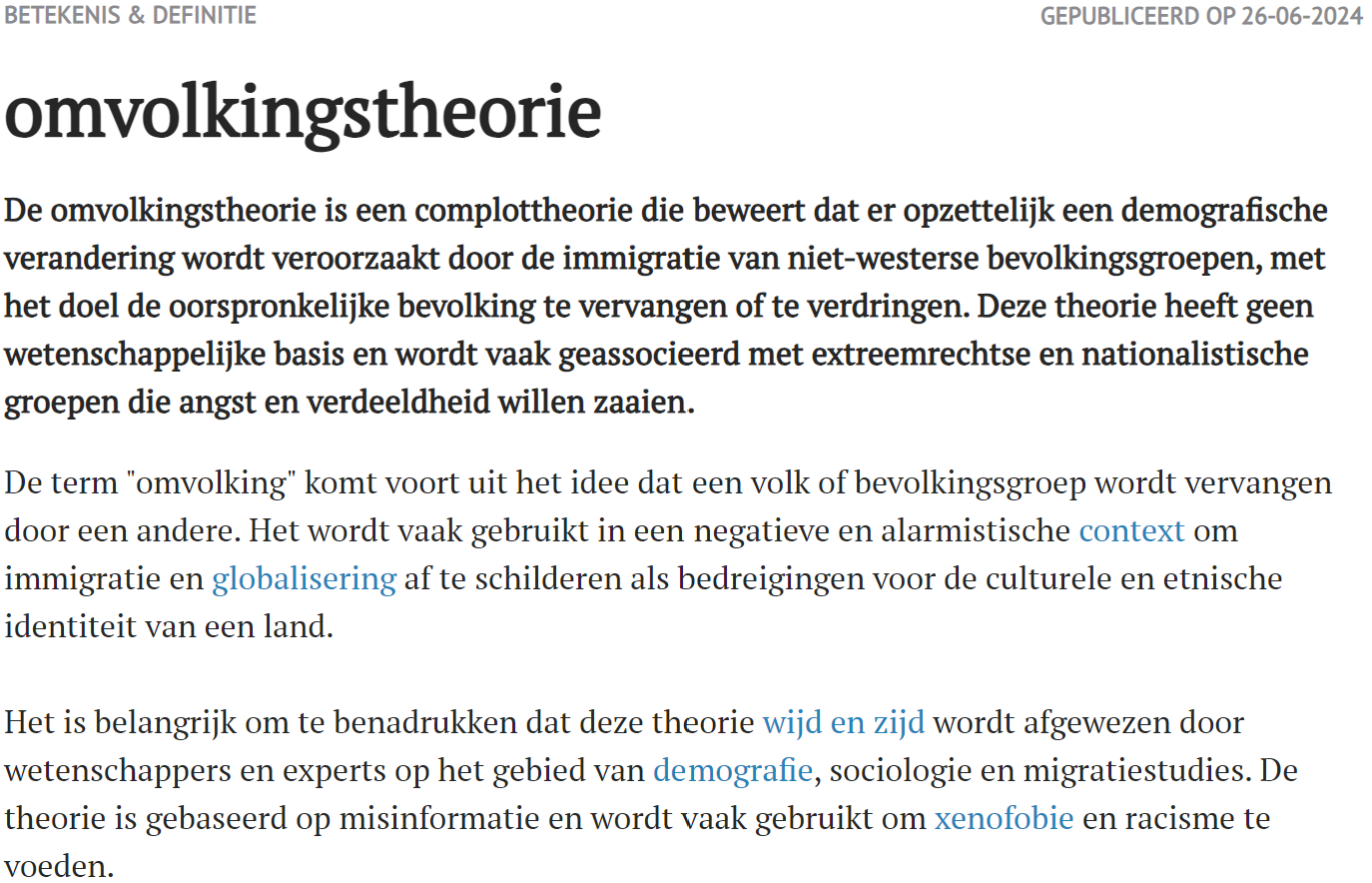
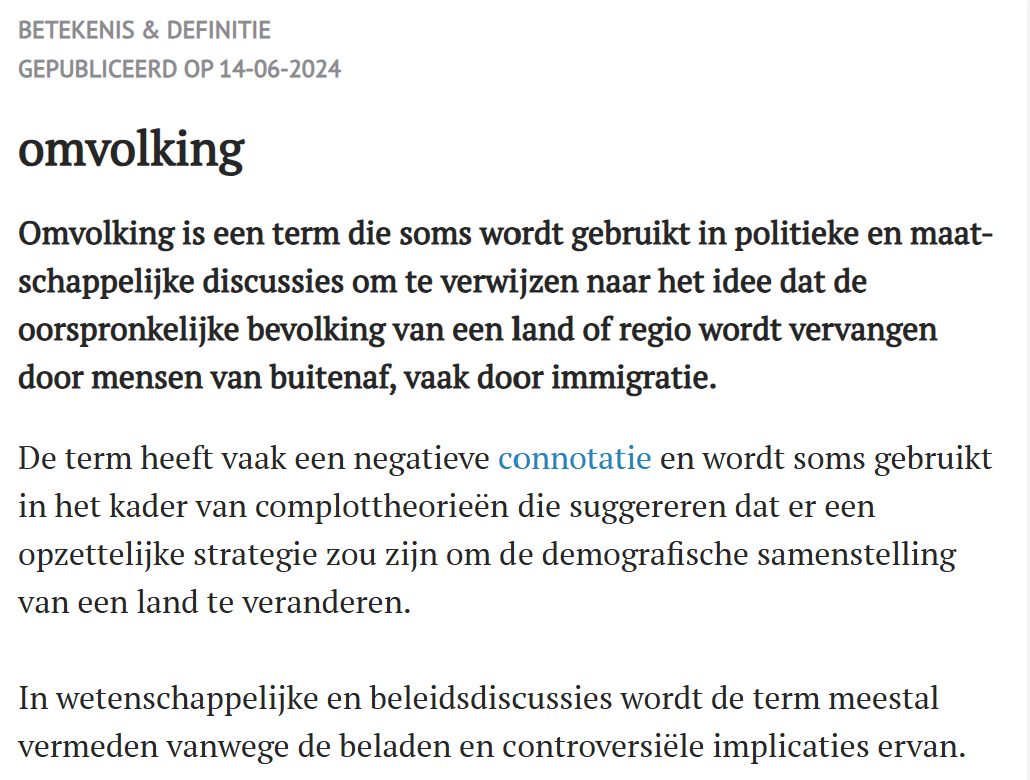
Van Dale:
Neem een woord als "discrimineren". Dat komt van het Latijnse "discriminare," wat (af)scheiden of onderscheiden betekende. De Britten gebruiken het nog steeds zo. Maar bij ons kun je het met goed fatsoen niet meer gebruiken in die betekenis, tenzij in een geformaliseerde setting (strikt wetenschappelijk taalgebruik bijvoorbeeld).
Zo is het in het Nederlands (en in meer Germaanse talen) onduidelijk wat het betekent als een woord op "ing" eindigt. Neem "Bewerking". Als je een muziekcompositie aan het bewerken bent, is het resultaat van dat bewerken de "bewerking". Maar het proces waarmee je bezig bent tijdens het bewerken, dat mag je ook "bewerking" noemen, zoals in de zin:
"Tijdens de bewerking van het epos dacht hij nergens anders aan."
Dat mag ook zijn: "Tijdens het bewerken van het epos dacht hij nergens anders aan."
Als je hierdoor denkt dat je dus overal het woord "bewerking" mag vervangen door "het bewerken", maak je een kolossale denkfout. De zin "Ik vind de bewerking van Tomorrow, zoals Sidney Christmas die zong, echt prachtig" klopt niet meer als je "de bewerking" vervangt door "het bewerken".
This is the source of the misunderstanding.
Het eerste is een zelfstandig naamwoord en verwijst naar het resultaat van het bewerken, een concreet object of fenomeen, het tweede is ook een zelfstandig naamwoord maar toch wat minder zelfstandig: het is de nominalisering van een werkwoordsvorm. Het is eigenlijk de verwijzing naar het werkwoord "het bewerken", de handeling, de activiteit van het bewerken, met de verschijningsvorm van een zelfstandig naamwoord. Laten we die twee even 'toestand' en 'handeling' noemen. Dus we hebben:
Operation (nw, state): object, phenomenon
Machining (n.w., operation): purposeful processing
Compare with:
Overpopulation (nw, condition): object, phenomenon
Overcrowding (nw, act): the deliberate overcrowding
Hee - dat kan eigenlijk ook niet. We hebben nog nooit van actief overbevolken gehoord dus we begrijpen dat met "overbevolking" een organisch proces wordt bedoeld, een neveneffect van iets anders. Overbevolking ontstaat gewoon, om allerlei redenen, en niemand die daar vooralsnog een theorie achter zoekt. We zien het niet als menselijke doelgerichte activiteit maar als een proces dat tot een toestand van overbevolking leidt:
Overpopulation (nw, condition): object, phenomenon
Overpopulation (nw, process): the process of overcrowding
Other alternatives have emerged for that 'process': 'excessive population growth', for example.
The reverse is true for the non-existent term 'underpopulation', which is covered by more specific causal descriptions such as 'aging', 'low birth rate', 'depopulation'.
Click here for some example sentences such as bab.la which gives:
- The problematic mountain regions continue to suffer from depopulation.
- The increasing depopulation of these areas therefore seems unavoidable.
- I am thinking, for example, of increasing depopulation and orographic characteristics.
- Increasing the size of farms leads to the depopulation of the countryside.
- Money will be made, and at the same time depopulation will be stopped.
- The ecological and socio-economic consequences of depopulation must be prevented.
- In Greece, factory closures are accompanied by the depopulation of cities in peripheral regions.
- This is not only a means of preventing depopulation, but it is also promoting stability in the region.
- This will give rise to depopulation and a reduction in economic activity.
- The depopulation of the countryside is a given.
If you think 'depopulation' immediately means deliberate depopulation, deportation or genocide, you are wrong.
Het zou analoog zo moeten werken met de oorspronkelijke, niet-besmette vorm van het woord "omvolking". Denk aan Suriname dat rond 1500 begon met 100% inheemse bevolking. In een paar honderd jaar tijd heeft er door migratie, kolonisatie en culturele uitwisseling een enorme demografische transitie plaatsgevonden: nu stamt nog 3% van de bevolking af van de oorspronkelijke inheemse bevolking. Daar zat géén omvolkingstheorie achter. Niemand die op dat idee is gekomen, het was de loop der dingen.
But then the Nazis came. They aimed for 'repopulation'. Since then, 'conscious repopulation' no longer sounds as implausible as 'conscious overpopulation'. According to the rules of sloppy language (see 'Edit'), this conscious activity is also called 'population'. So we are left with three meanings of the same word: the state, the process and the purposeful activity.
Repopulation (nw, passive): object, phenomenon, state
Repopulation (nw, process): the process of repopulation
Repopulation (nw, act): the purposeful repopulation
Why does this matter?
You can use an ambiguous word (ambigu = multiple meanings) to create an ambiguous word. straw man reasoning stuff. You can challenge a statement that your opponent didn't make at all while using the same word. I show this in the sister article.
Dat de media (weer NRC) onlangs wel een stevig nummer maakten van dezelfde term "omvolking", past in de mediamissie om het 'ultrarechtse' kabinet alsnog te saboteren na de mislukte karaktermoordaanslag op Ronald Plasterk. Er wordt niets nagelaten. Iemand als Jan Paternotte pakt zo'n mediavoorzetje dankbaar op en duikt in Wikipedia. Jan heeft namelijk uit de media begrepen dat "omvolking" een heel slecht woord is omdat maar één van de drie betekenissen hem aanspreekt: de kwaadaardige. Hij citeert ook de AIVD, waar ze ook weer slordig omgaan met de semantiek.
Alle termen met "omvolking" erin zijn dusdanig geframed dat je er niet eens meer tegen mag zijn: de mogen simpelweg niet meer worden benoemd. Ze zijn gecensureerd, gecancelled. Je kunt het struisvogelpolitiek noemen, maar zo gaat dat in media en politiek.
Chewing on those terms for a while
The term Repopulation sec means nothing more than a population that changes composition. The term has become contaminated because of its connotation with the Nazis, who actively pursued Germanization of conquered areas, wanted to purify their own population (they did NOT call that repopulation) and resorted to inhumane practices when repopulating conquered areas.
The result of the process of 'repopulation', you could call it 'repopulation', is observable: the population of a city or district no longer looks the same as it did 20 years ago. Many people speak to each other in languages that you as a native do not understand and manners do not match. That is an organic process, nowadays mainly a side effect of border and migration policy, economic conditions, war, increased mobility. You can welcome this or find it disastrous and everything in between, but denying it is ostrich politics.
Als mensen door het gebruik van het woord "omvolking" daadwerkelijk gekwetst worden, kun je daar een ander woord voor kiezen. We hebben zo ook afscheid genomen van Zwarte Piet. Het Zwarte Pieten legioen hebben we -met tegenzin- toch omgevolkt tot Regenboogpieten.
Of course, repopulation can be a goal of certain activities, but then you have to explicitly speak of active or deliberate repopulation. Just as with a fire you have to speak of an arson or arson or pyromania. Population was one of the goals of the Nazis. The theory why and how they wanted to achieve that, Their repopulation theory So, it was that a country was better off if its population was replaced by Aryans. Violence and genocide were not shunned.
Ik schrijf met nadruk "hún omvolkingstheorie" omdat er ook andere omvolkingstheorieën zijn, zoals multiculturalisme dat expliciet een verandering van de bevolkingssamenstelling bepleit.
From a multicultural angle, for example, there is also a plea for repopulation of the Netherlands: more colour and more diversity is the goal, with more tolerance, a creative melting pot of cultures and an open society with a fairer distribution of our wealth as a result.
Remains the Population conspiracy theory. There are all kinds of variants that have in common that they exclude organic repopulation as a side effect: it must and it will be intentional. This whole migration policy, it is suspected, was devised to force repopulation. We are being chased away! Conspiracy theorists recognize a systematic set-up; a theory that is being rolled out. Consider, for example, the delusion that the current migration policy is being carried out at the behest of a small group of baby-blood-drinking royals and nobles, big industrialists and politicians, who initiate each other into Klaus Schwab-like capes with an erotic ritual, blackmailed if necessary after temptations on a private island of a movie tycoon who committed suicide in his cell, controlled by a 5G pole. A story similar to the one outlined by the AIVD.
So.
Als we het woord "Repopulation" gelijk gaan stellen aan "Population conspiracy theory", kunnen we een woord als "discriminatie", "slavernij" of "depopulatie" ook niet meer gebruiken, dat kunnen immers allemaal beoogde doelen zijn, of ze zijn dat ooit geweest. Slavernij stond centraal in het business model van mensenhandelaren, willen we dat woord dan nog gebruiken? Ook "discriminatie" is een concept dat deel heeft uitgemaakt van gedachtengoed dat de zwartste bladzijden uit de geschiedenis kenmerkt. Een woord dat nog steeds gebruikt wordt, ook door de groepen die nu in de gordijnen klimmen vanwege de term "omvolking".
Vreemd genoeg ging het er nog niet zo lang geleden om of je voor- of tegenstander was van zo'n gedachtengoed. Tegen slavernij zijn was goed. Het was verfoeilijk om slavernij te bewonderen, vergoelijken, faciliteren of eraan te verdienen. Het merkwaardige is dat dat bij "omvolking" andersom ligt. Niet degene die die nazi-theorie omarmt gaat aan de schandpaal, maar juist degene die zich fel tégen omvolking uitspreekt.
Do we still get it?
Ik wel. De verklaring die voor de hand ligt is dat degenen die verandering van de bevolkingssamenstelling voorstaan, zich ongemakkelijk voelen omdat ze in een vergelijkbare positie komen als de Nazi's: zij zijn zelf immers degenen die "omvolking" faciliteren. Dat woord willen ze niet omdat het een nazi-term is, ondanks dat we hebben gezien hoe mooi (multi)culturalistische, (multi)raciale samenlevingsidealen kunnen zijn. Voor Nederland, een land van kaaskoppen, is het een onmiskenbare vorm van bewuste omvolking als wordt gestuurd op het veranderen van de bevolkingssamenstelling. Dus omvolking mag wel, het is zelfs cruciaal onderdeel van het multiculturele gedachtegoed - het mag alleen niet zo genoemd worden.

Dear people, Language education for a 9-year-old child today: Attention, so LANGUAGE!
Fill in the words: Duty, wave, place, street, dust, weather, disaster.
– Book, the eternal heat....
-Politics is in charge...... (in box above the lesson: Conscription is the duty to work in the army for a while.)
-On the market...... there are only two stalls left
-Fossil fire.... is forbidden
-There is a period of autumn.... in December
-It starts with a blank head......
I shuffled it a little bit to avoid getting into trouble, but when I watched this lesson with my grandchild, I got palpitations of bewilderment and of course I didn't show it to the child. Going to school is already so terribly intense these days (especially for children who think, also because that is no longer allowed).
The citizenship lessons are almost all about the "word games" that the Paternottes of this world use.
All very worrying!