


Clear causal link between mortality and Covid vaccine rollout
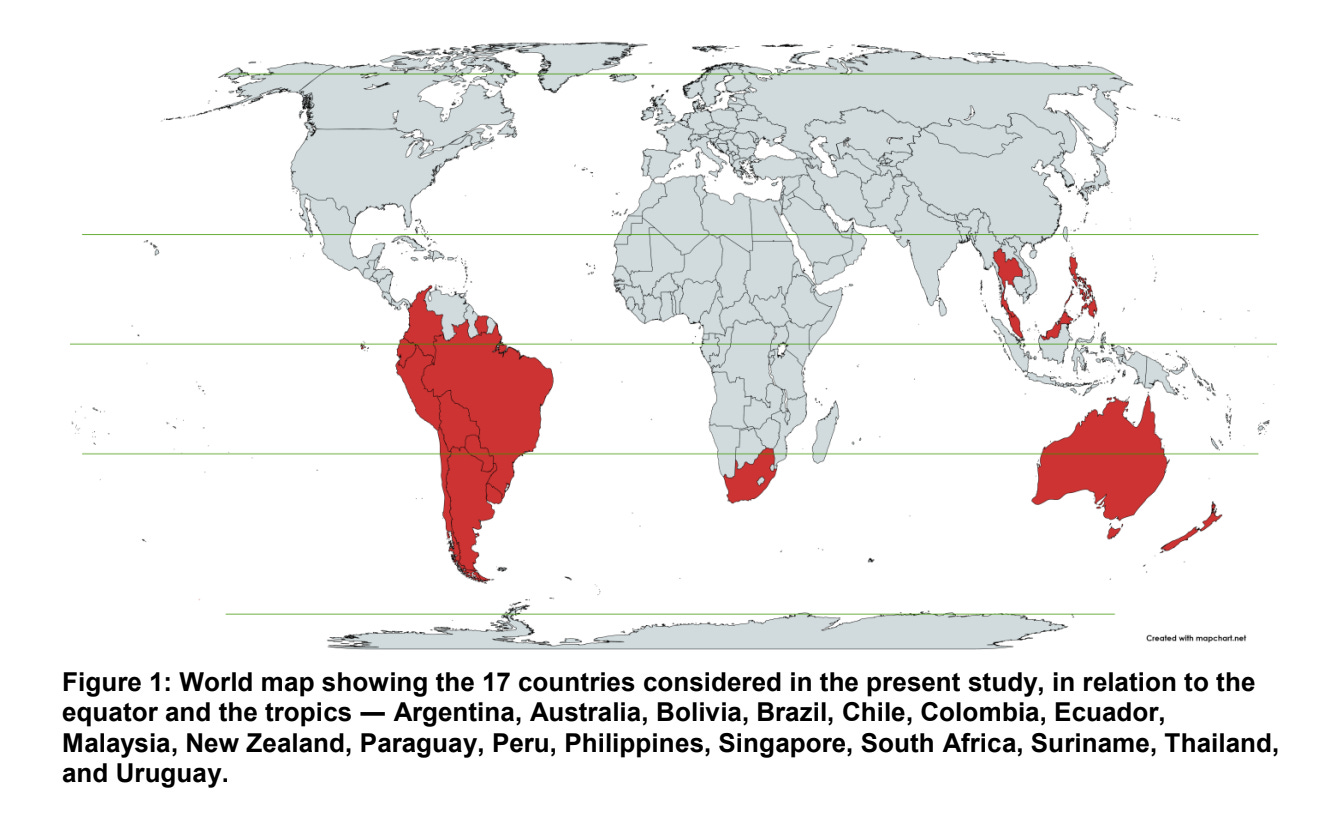
What Byram Bridle was already beating the drum about in May 2021 is now, three years later, also the outspoken position of a new article by Denis Rancourt et al (180 pagina's), waarin de sterfte door alle oorzaken (ACM) in 17 landen op het zuidelijk halfrond en in de equatoriale regio wordt geanalyseerd. De auteurs vinden een "duidelijk oorzakelijk verband" tussen pieken in sterfte door alle oorzaken ('ACM', All-Cause Mortality) en de snelle uitrol van vaccins over vier continenten.
I read it, wanted to devote an article to it and then saw that Rebekah Barnett already a fine one Summarizesg . This is my adaptation of it, including some additions on my part.
"De COVID-19 vaccins redden geen levens en blijken dodelijke giftige stoffen te zijn."
Het nog niet ge-peerreviewde artikel van Denis Rancourt et al. probeert het risico op dodelijke toxiciteit per injectie te kwantificeren, dat "buitengewoon groot lijkt te zijn bij de meeste ouderen". De auteurs concluderen dat "overheden onmiddellijk een einde moeten maken aan het beleid om ouderen voorrang te geven voor injectie met COVID-19". Dit op basis van publieke cijfers van 17 landen op het zuidelijk halfrond.
All-cause mortality: the ultimate vaccine test
In the summer of 2021, it was clear that the persistent excess mortality did not match the promise of the vaccinations. ACM (mortality from all causes) is the final bill: if it is far too high, something is not right at all. As an epidemiologist, someone like Christine Stabell Benn has always been keen to compare the ACM of vaccinated people with that of unvaccinated people. It has also been a reason to withdraw effective vaccines: it helped well against a certain disease, but jabbed people died more often from other things than before from the disease. The WHO also sets this mortality requirement on paper for vaccines. Only not now because it is an emergency situation.
The data for thorough analyses must come from the government, but they do not deliver, they do watch out. Rancourt et al. therefore have to rely on ACM mortality peaks at population level in several countries, from public sources that vary greatly from country to country. Whatever we have instigated on virus varia, which Herman Steigstra has energetically addressed.
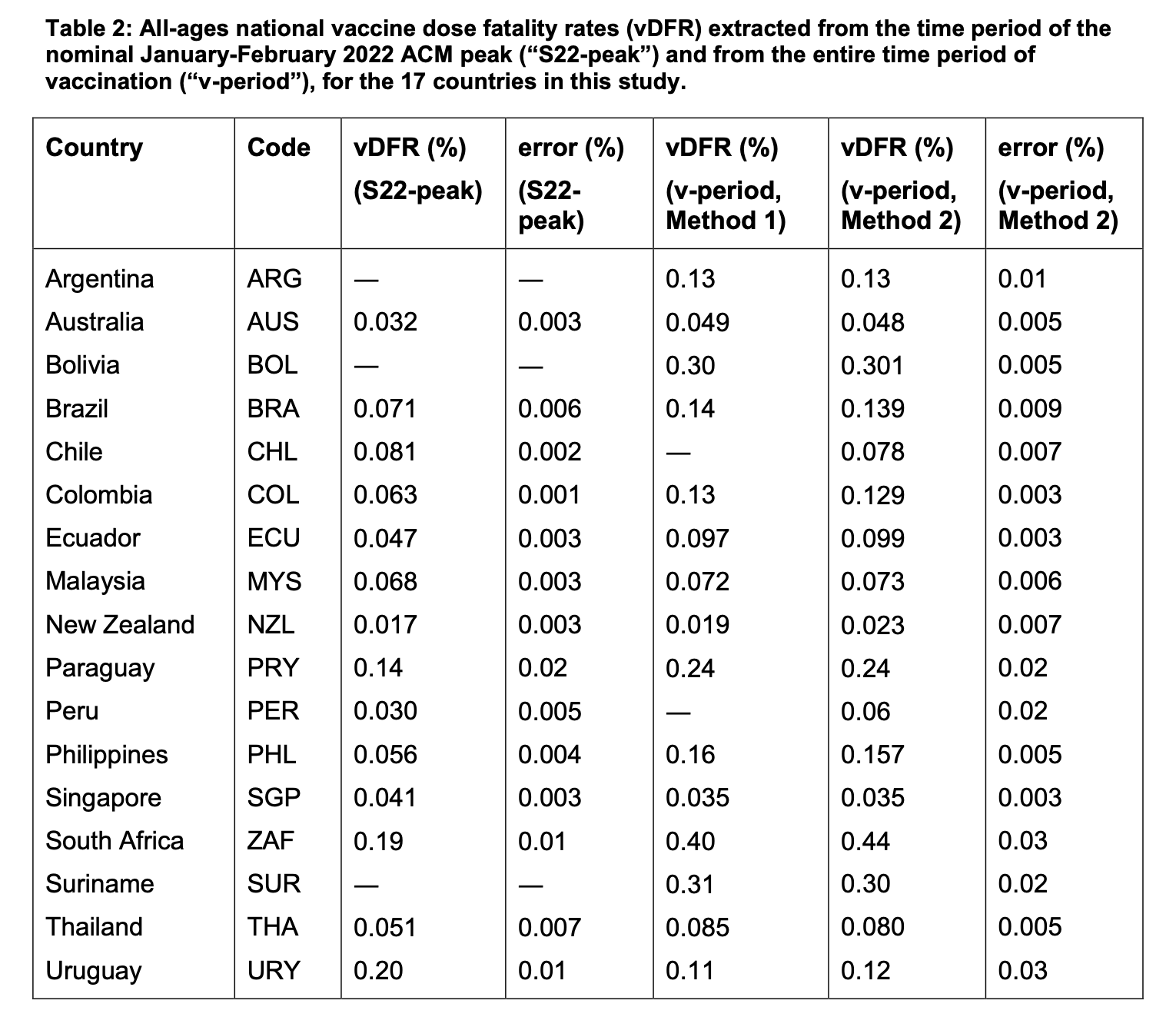
Vaccine-dose fatality rate (vDFR)
The authors calculated the mortality rate from vaccination and arrived at about 0.05% (1 death per 2,000 injections). This number increases exponentially with age: the vDFR doubles with every five years of additional age, to about 1% for people aged 80 and older.
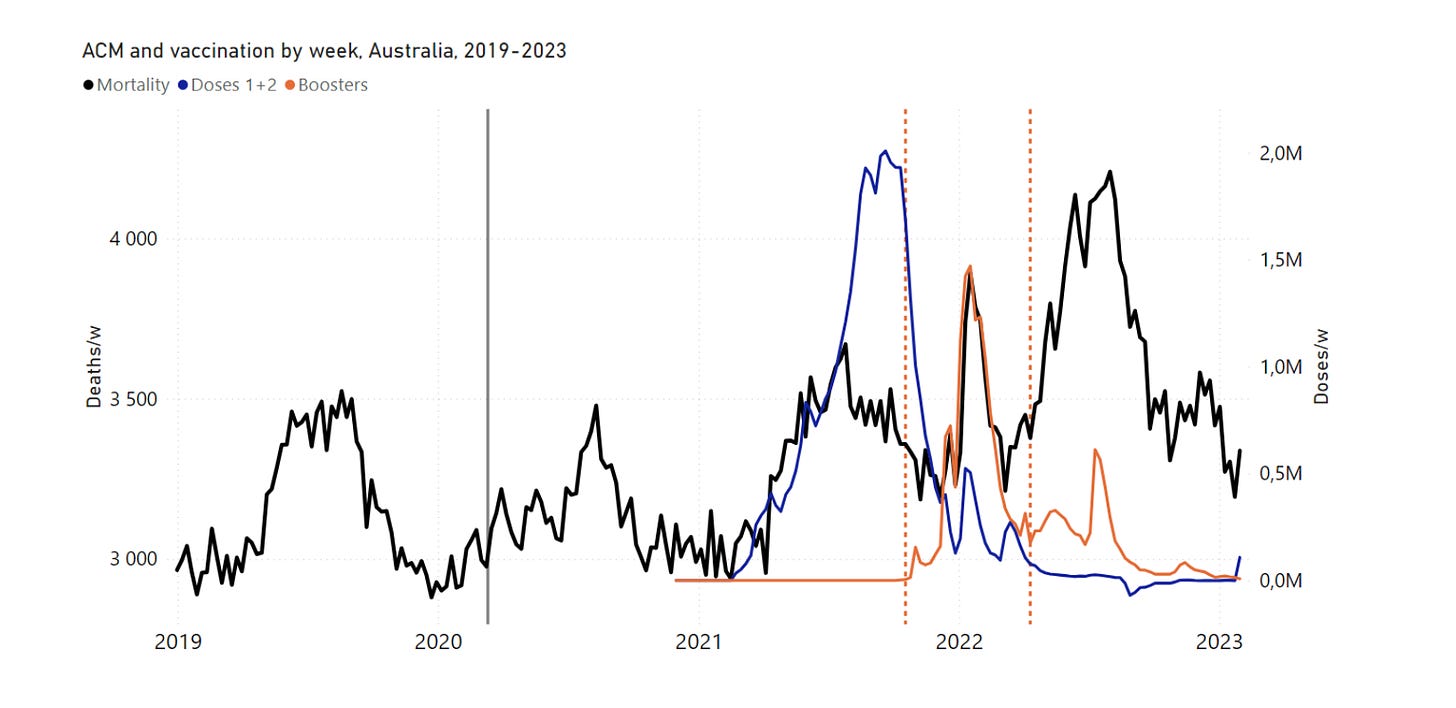
Australia
One could argue that for the Australian analysis, the sharp spike in ACM coincides with the initial spread of Covid across the population (especially in Western Australia, Queensland, and South Australia) and that these deaths are therefore Covid deaths. Rebekah also believes that Rancourt has not convincingly dismissed this counter-argument in his previous articles on Australian ACM.
What is not included in her own summary is that Rancourt also explains in the presentation that it is impossible for a wave of disease to break out everywhere in the world at exactly the same time. For him, this is an important basis for the statement that 'it cannot be a virus, it cannot do that'.
But it is clear that Australia and New Zealand had their turn much later, while Rancourt says it emerged everywhere at the same time, so how does he reconcile that? Of course: different laws may apply to islands when it comes to spreading viruses - but it wasn't due to a virus, was it? He needs to explain that better.
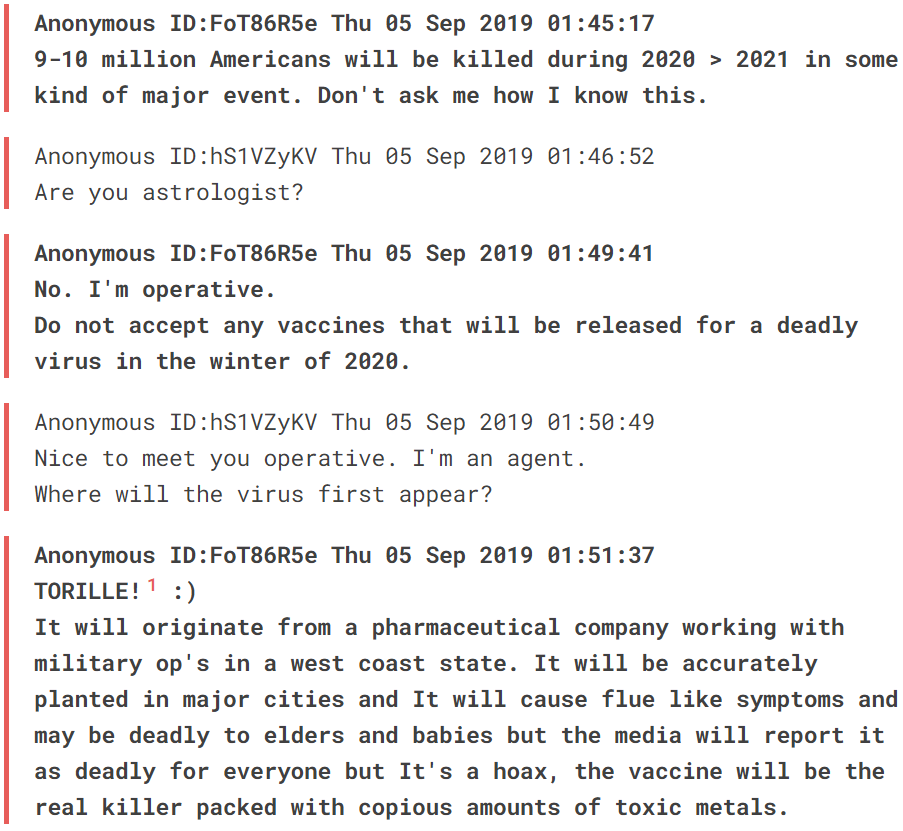
In any case, Rancourt does not appear to be a sinister conspiracy theorist here, otherwise he would have mentioned another option. An 'Anonymous' predicted quite precisely what would happen in 2019. For a conspiracy theorist, this would be sufficient evidence to assume planning.
(this message is also in the Wayback Machine on that date, so it was not manufactured afterwards).
Een analyse van de sterftecijfers van Queensland door Dr. Andrew Madry laat zien dat de stijgende trend in ACM begon bij de uitrol van de primaire serie en negen maanden voor de verspreiding van Covid in de gemeenschap. Toch houdt Rancourt hier "de maatregelen" in belangrijke mate verantwoordelijk, terwijl die zeer strenge maatregelen in Nieuw-Zeeland en Australië dus niet dat effect hebben gehad.
It is clear that the vaccines also turned out to be disastrous in Australia. His points:
- Most Covid deaths in Queensland were fully vaccinated (and some boosted) when state borders first opened in December 2021/January 2022;
- Excess mortality began in 2021 when the vaccine rollout was in full swing, but many states did not have Covid;
- Unprecedented high rates of adverse event reports when most of the population was vaccinated and there was no Covid. More than half of those who reported an adverse event reported to the hospital, which gives an idea of the severity of the side effects.
- Gegevens uit New South Wales laten zien dat degenen met meer doses vaccinatie met Covid in hogere mate overleden of zich in het ziekenhuis en op de IC presenteerden dan degenen met 0-2 doses. Het antwoord hierop is mogelijk: "hoe ouder, des te vaker geprikt". Is dat zo? De gegevens zijn niet leeftijdsgestratificeerd en niemand van het Ministerie van Volksgezondheid is in staat of bereid geweest om de effectiviteit aan te tonen door de volledige naar leeftijd gestratificeerde gegevens te publiceren. Sterker nog, ze wringen zich in bochten om dit niet te doen, net als bij ons in Nederland.
- Een Bradford Hill analyse van het Australische ACM door analist Dr Wilson Sy, waarvan hij concludeerde: "Sterkte van de correlatie, consistentie, specificiteit, tijdelijkheid en dosis-respons relatie zijn de belangrijkste Bradford Hill criteria waaraan de gegevens voldoen. Dit suggereert dat de Australische pandemie inderdaad iatrogeen (door artsen veroorzaakt) is, waarbij de oversterfte grotendeels werd veroorzaakt door COVID-19 injecties."
The common thread:
"In 9 van de 17 landen is er geen waarneembare oversterfte totdat de vaccins zijn uitgerold [...] In de andere 8 van de 17 landen wordt een nieuw regime van hogere mortaliteit gestart na 11 maart 2020 en voorafgaand aan elke toediening van het COVID-19 vaccin
In alle 17 landen wordt vaccinatie geassocieerd met een regime van hoge mortaliteit, en er is geen verband in de tijd tussen COVID-19 vaccinatie en proportionele vermindering van ACM."
[By this he means that the average mortality is slightly increased, so for example also in the summer. How does that work, that mortality increases before vaccination, in mid-2020...? Typically a problem that occurs when you try to sail alone on ACM. You will want to compensate for an underlying flu wave and before you know it you will be working on a baseline again from which you can deduce the excess and decreased mortality in order to arrive at corona.]
There are many graphs with temporal correlations. They are all variations of the below, for all 17 countries, with different methods of analysis. I don't find them all equally convincing.

In sommige grafieken zie ik iets anders dan wat Rancourt eruit haalt. Voorbeeld: Peru, het land met de meeste Covid-doden per mln inwoners. Hij koppelt vaccinatie aan sterfte. Maar mensen stierven voordat er werd geprikt. Vooral de eerste twee sterftegolven vallen op in de blauwe lijn. Covid was dus wel degelijk ofwel ernstig of er werd bv. geen antibiotica meer gegeven bij long- en ademhalingspatiënten. Covid werd ook niet als zodanig gezien: "we wisten er niets van" dus werd er niet adequaat behandeld, dat kon niet eens. Maar vaccinatie (oranje) kwam pas daarna. Mij bekruipt het gevoel dat de "1-year moving average" een manier is om vaccinatie en sterfte over elkaar heen te krijgen. "Associated with" heet het dan.
Another graph is this one showing a correlation between countries with more jabs and higher mortality versus countries with fewer jabs and lower mortality.
As we have already figured out, that is a meaningless graph. You should also make this mortality comparison for 2020 or even earlier. What did the mortality ranking look like at the time, did it differ between countries where there would be little and a lot of vaccination later on? Has that vaccination changed anything in those relationships? In any case, no positive effect was discernible in Europe.

Criteria for causality
Volgens de auteurs voldoet hun analyse ruimschoots aan de "robuuste criteria" die zijn opgesteld door de legendarische wetenschapper John Ioannidis:
"Experiment: The same phenomenon is observed independently in different jurisdictions, for different age groups, and at different times, which constitutes sufficient verification in independent large-scale experiments in the real world.
"Temporality: The many incremental increases and abnormal peaks in ACM are synchronous with the rollout of vaccines; Even in jurisdictions where excess mortality only occurred after about a year after the declared pandemic until the vaccination was implemented.
"Consistence: Het fenomeen is kwalitatief hetzelfde en van vergelijkbare grootte telkens wanneer het wordt waargenomen."
Daarom "kan er weinig twijfel over bestaan dat de massale COVID-19 vaccinatiecampagnes de tijdelijk geassocieerde oversterfte veroorzaakten in de 17 landen van de huidige studie, en in andere landen die tot nu toe zijn onderzocht," aldus Rancourt et al.
Evidence for causal link between vaccines and ACM surges
The authors refer to a plethora of evidence supporting a causal link between vaccine rollouts and ACM spikes:
- Autopsies. One systematic review van 325 autopsies naar aanleiding van sterfgevallen in verband met Covid-vaccinatie tot 18 mei 2023 toonde aan dat "in totaal 240 sterfgevallen (73,9%) onafhankelijk werden beoordeeld als rechtstreeks te wijten aan of significant bijgedragen door COVID-19-vaccinatie."
- Studies by Vaccination-induced pathologies
- An established causal link with pathology caused by vaccination, based on histopathological and immunohistochemical staining of skin biopsy samples
- Secondary analysis of serious adverse events reported in placebo-controlled, industry phase III randomized clinical trials
- More than 1,250 peer-reviewed publicationss about side effects of COVID-19 vaccine
- The well-known vaccine compensation programs of states around the world, including deaths from the COVID-19 vaccines
While the above does not prove causality on its own, but rather demonstrates plausible mechanisms and circumstances, the authors provide the following to demonstrate the causal relationship. This link is made in several studies at the population level:
- One overview study by Mark Skidmore, which was later Withdrawn onder zware druk op de redactie van het tijdschrift door partijen die niet blij waren met zijn conclusie: "Met deze onderzoeksgegevens kan het totale aantal dodelijke slachtoffers als gevolg van COVID-19 inenting oplopen tot 278.000 wanneer dodelijke slachtoffers die mogelijk zijn gevallen zonder inenting, worden verwijderd". [I have to say that I didn't see much in it even then]
- Previous quantitative evaluations of vaccination dose mortality (vDFR) based on all-cause mortality (ACM) data in different countries (Rancourt, 2022; Rancourt et al., 2022a, 2022b, 2023) (View Rancourt's papers here)
"Deze bevindingen zijn overtuigend. De associaties zijn talrijk en systematisch en er zijn geen tegenvoorbeelden. We hebben in ons uitgebreide onderzoek naar ACM geen bewijs gevonden dat COVID-19 vaccins een gunstig effect hadden."
Denis Rancourt et al.
Tackling counterarguments
The authors refute several counterarguments, including that the ACM peaks are caused by
- Seasonal effects
- heat waves
- Earthquakes
- other aggressive Covid countermeasures
- underlying health conditions
- Covid infections.
[I still miss the climate in this list]
So there are a few things to criticize, but they do make a point that Covid itself cannot have been the driving force behind ACM:
"Wat betreft de theorie van het ontstaan van een of meer varianten van SARS-CoV-2, zou dit ontstaan gelijktijdige pieken en pieken van sterfte moeten veroorzaken in 17 landen verspreid over 4 continenten (Figuur 1, Figuur 2, Figuur 4, Figuur 11, Figuur 14, Figuur 18), wat statistisch gezien onmogelijk is als we de theorieën van spontane virale mutaties en contactverspreiding van virale luchtwegaandoeningen aanvaarden; en al de resulterende pieken van sterfte zouden het opmerkelijke toeval hebben dat ze zich precies voordeden op het moment dat vaccinatieboosters werden uitgerold."
'Vaccines have saved 20 million lives'
Believers in Covid vaccine modeling will throw up their hands at this point and shout, 'but Covid vaccines have saved 20 million lives! Of course, the ACM has risen, but Without the vaccines, it would all have been much worse'.
Rancourt et al. rightly do not waste many words on this. The model calculation has often been wrong by a factor of 40 (and more). The effects of natural immunity were overlooked, the vaccines were supposed to be highly effective. Many articles have already been written about this, such as this from Brownstone.
They do mention the argument that a study in 108 countries found that those with the highest Covid vaccination rates also had the highest Covid death rates, while the reverse was true for countries with low Covid vaccination rates. [We have already done that (thanks to Herman) better contradicted].
Incorrect data underestimate harmfulness
De auteurs suggereren dat de discrepantie tussen hun bevindingen en de officiële Covid-gegevens die worden gerapporteerd door overheden en gerelateerde toezichthoudende instanties komt doordat "het monitoren van bijwerkingen, de rapporten van klinische studies en de statistieken van overlijdensverklaringen de dodelijke toxiciteit van de injecties sterk onderschatten".
Joel Smalley has reported extensively on the situation in Australia and what is going wrong there. I recognize a lot of what is happening on the other side of the planet:
- There is a double standard when attributing deaths to Covid [the same WHO guideline applies as the one we have complained about here before].
- Underreporting that is not included in any official publication
- Not a good follow-up of reported injuries and deaths
- Autopsy not encouraged for post-vaccination deaths
- No active monitoring tests for Subclinical damage
- Medical censorship means that medical professionals are not only inadequately trained but also strongly discouraged from properly diagnosing and reporting vaccination injuries
There is also evidence of death code tampering inflating Covid deaths and hiding vaccine deaths. For example, miscoding vaccine deaths in Minnesota led to accusations of “data fraud” against the CDC.
Two waves of injuries and deaths
Last week, cardiologist, internist and epidemiologist Dr Peter McCullough said in a speech to the European Parliament [last week we already noted that that was not a speech to the European Parliament, but OK]:
"Er zijn twee schadegolven geweest in de wereld. De eerste was de SARS-CoV-2 infectie, die ten koste ging van de zwakken en ouderen. En de tweede golf zijn nu de COVID-19 vaccins."
Watch Dr. McCullough's full speech to the European Parliament on 13 September 2023 (17 min)
One explanation for the two waves is the phenomenon of 'spikeopathy', as Jillis Kriek described on this site in December 2022 in 'What Covid 19 and mRNA vaccines have in common'. Later, in June 2023, it was explained in a peer-reviewed article in the journal Biomedicines, titled 'Spikeopathy': COVID-19 Spike Protein Is Pathogenic, from Both Virus and Vaccine mRNA. 'Spikeopathy' refers to the toxic effects of the spike protein, whether it comes from the SARS-CoV-2 virus or is produced by gene codes in mRNA and adenovector DNA vaccines.
In addition, the mRNA vaccines also deliver lipid nanoparticles (LNPs) into the body, which are themselves pro-inflammatory and which deliver the spike-producing mRNA to parts of the body where the viral spike protein does not normally reach.
Dr. McCullough has previously suggested that taking Covid 'vaccinations' increases the risk of damage due to exposure to spikes . He suggests limiting exposure to spikes by avoiding the injections and nasal rinses as a prophylactic.
I sense a heavy bias in Rancourt's piece. He focuses exclusively on vaccine damage and sees deaths from Covid as fairly normal seasonal deaths. I'm more in tune with Dr. McCullough. Covid was no darling and has caused a wave of injury and death - albeit less than the vaccine and also much less than all the measures that resulted in the declaration of official panic status, which also prevented Covid from being treated effectively. What mortality would have looked like without the accumulation of policy errors will always remain a matter of discussion.
Either way, Rancourt and McCullough draw the same conclusion - the only appropriate response is to stop poking.
Question for readers who would like to participate:
How do you explain the existence of datasets/analyses that seem to directly contradict Rancourt's findings, such as this analysis by ACM In several countries where the author believes that the vaccines have been beneficial?
Conclusion
With admiration for the hard work, I am afraid that Rancourt has allowed himself to be carried away in his consternation. That is very understandable because it is appalling what has taken place. The system has become corrupted from top to bottom (but especially above) under pressure from what is going on in a global market of hundreds of billions.
The reality is more diverse, more dynamic and therefore much more complex than he tries to imagine. In that simplification process, valid critical questions sometimes lapse. That is a pity, the scientific tone regularly swings towards activism that does not tolerate contradiction.
*Rancourt is no longer bothered by any peer review process and publishes directly on his website. There are advantages and disadvantages to this, but in the current climate, in which the Integrity of medical journals disappears and activist journalists and academics successfully lobby for the retraction of research they don't like, rather than honouring the scholarly tradition of debate, it's understandable that some researchers simply quit.
Denis Rancourt therefore no longer sees any point in the peer review process. In my opinion, his piece could really improve - with the right peers.

All the graphs make me a bit red-eyed. And the reality does indeed seem even more complicated.
An important fact that has contributed (still contributes?) to the high mortality (due to or with Covid) is the ban on treatment. In your article you mention antibiotics. Pneumonia, triggered by a virus, can eventually turn into a bacterial infection. And a traditional antibiotic treatment would offer relief. In addition, the bans on hydroxychloroquine and ivermectin on pain of deprivation of the license. That cost many lives.
I'm glad I never took one of these shots. As far as I'm concerned, there is more than enough evidence that the whole approach has backfired, to put it euphemistically. The fact that it is not recognized in the MSM, and that 80% of the population believes the story of the 20 million lives saved is a problem. Although I recently saw 15 million pass by (also without any substantiation).
That is the key question for me now. Not the question WHETHER the measures taken (including the Non-Medical Interventions such as lockdowns etc.) were harmful. That is obvious. I would like to understand the origin of the madness, at the risk of diving into conspiracies. If we now assume (for arguments sake) that the measures are as catastrophic as we assume, then the question remains whether it was set in motion consciously or unconsciously.
If I put everything together (and that in itself is quite a task), then there has been deliberate manipulation, very bad choices have been made with regard to health care, with catastrophic consequences for the global economy, among other things.
There has been a 100% bet on 'vaccines' that have cost governments billions. Could it really only be about turnover from the pharmaceutical companies? Who, by the way, have a big finger in the pie with agencies such as CDC and EMA. Could it be so banal? And that the rest of the developments resulted from the spasmodic clinging to the narrative?
I think that various parties had hoped for a continuous contraction of the world economy in which climate goals could be achieved. So then you abuse a crisis to achieve other goals. To claim that the virus was deliberately created is going too far for me. That it was caused by a lab leak is now the most plausible scenario. That it was then covered up is also clear.
I no longer believe it was inability. But what then? And why is it (Mattias de Smet answers this) that so few people are skeptical?
Nuance is somewhat lost and local variations remain out of the picture, but Rancourt's approach is certainly refreshing.
For example, the benefits of measures to ACM depend on specific local circumstances and customs.
Or e.g. people with a positive Covid test
are not treated for potential pneumonia, but that they are put on the ventilator when it has gotten out of hand, which can be seen as iatrogenic action in retrospect, depends on: whether one has tests and then whether there are people who can be tested positive, whether one pursues a withholding hospitalization policy because of fear of capacity problems, they have access to ventilators, they have enough staff in the hospital and last but not least they think that ventilators where heavy people are intubated on the ventilator in a prone position work.
In Germany there was sufficient staff and capacity and there was little in the way of treatment with ventilators.
In Italy there was a shortage of staff and an oversupply, and no holding off policy and I think it was decided to put several people on a fan.
These countries gave huge differences in ACM in the pre-vaccination covid year.
In Australia, due to isolation in the same period, people with a positive test were lacking
and did not pose these risks of potential iatrogenic damage. Less was died (but also not lived).
I don't know the situation in Peru. You would say that not knowing that people were testing positive, no iatrogenic damage could take place in the way described above.
Definitely deserves further investigation.
Analysis of local working methods and circumstances can only help us further.
It is all the more reprehensible that WHO, as a know-it-all, seems to be striving in advance for a coercive one-fits-all approach.
PS. I suspect that in respiratory problems, factors of air pollution and the more favorable conditions for all kinds of harmful aerosols penetrating deep into the respiratory organs also play an important role in the respiratory system, in combination with a decrease in D supply and a related reduction in immunity at the end of winter.
It's nice that you give a Dutch adaptation of the article. With all due respect to you, I think it's a bit of a weak conclusion. Of course it is complex, and peer-reviewed is better. That's true for any article about this draft, right? The challenge you give your readers is now returned, so that you can really add some "opinion and science columns" :).
I couldn't make more of it this time. That happens sometimes, for what it's worth...