

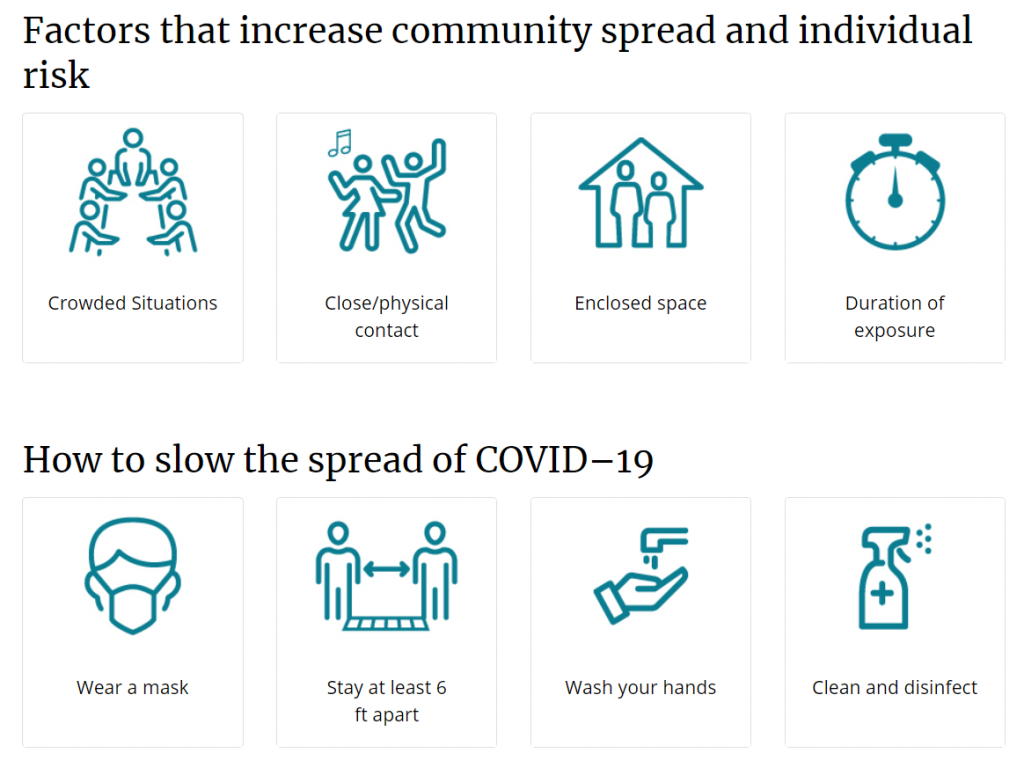
The CDC (the American RIVM) clearly indicates how spread takes place and how to prevent spread, complete with icons. You would say that the two, cause and control, must have a clear connection. How can it be that measures are recommended that will only have a marginal effect on the spread factors outlined?
The modes of infection
The top row of icons outlines a number of circumstances that play a major role in infections.
Point by point:
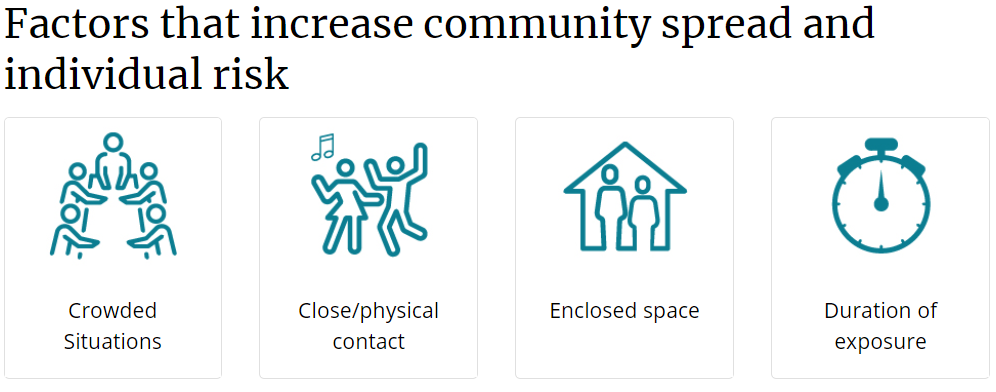
- Group formation - using meetings as an example, an activity that takes place indoors
- Proximity/physical contact - with the example: dancing, which usually takes place indoors (apart from summer festivals)
- Being together in closed spaces - so outside or in non-enclosed areas it is not that bad
- Duration of exposure - if you only come into contact with the virus for a short time, there is not much to worry about
Al deze voorbeelden hebben gemeenschappelijk dat ze vooral binnen plaatsvinden. Dat wijst toch echt zonder uitzondering op het gevaar van het inademen van besmette lucht. Fysiek contact wordt ook genoemd. Dat is niet mogelijk zonder de besmettelijke factor van nabijheid dus eigenlijk dubbelop. [Het is overigens wetenschappelijk nog de vraag of fysiek contact zo'n enorme verspreidingsfactor is. Dierproeven weerspreken dat, zie ook verderop: "the transmission rate when freely mixing infected mice and contact mice does not differ appreciably from when the two groups are separated by a double wire screen". Uitbraken door fysiek contact van grote groepen mensen zijn moeilijk denkbaar.]
Preventing contamination
You would then say that the measures respond to the most important modes of infection.
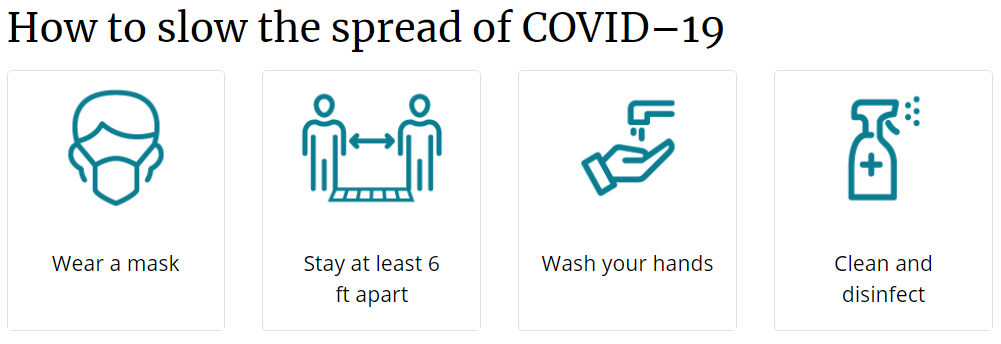
- Mouth/nose masks - These act like a permanent handkerchief, catching splashing droplets. Contaminated breath must pass through or past it, otherwise you suffocate. The cleaning effect on contaminated breath is minimal. If you are in a room with contaminated air for a long time, they hardly help, whether you are meeting or dancing.
- keep a distance of 180cm - If you are in a room with contaminated air for a longer period of time, the effect of keeping your distance is very relative. Of course: if an infected person is in the same place for a long time, the virus concentration around that person will be highest. This requires a windless space without turbulence: no air movement, so no people walking around and certainly no air conditioning. So that is also not good protection in the infectious situations outlined.
- Washing hands - Basic hygiene is always good. There are viruses that are transmitted through feces, saliva or blood. Respiratory viruses, on the other hand, are most harmful when they are inhaled. The route of infection via objects or surfaces is extremely difficult for a respiratory virus. So this is also not an adequate measure, given the contamination risks outlined.
- Cleaning and disinfecting - The same applies to washing hands. The connection with crowds, proximity, enclosed spaces or duration of exposure is hard to find.
Possible explanation
It seems as if contamination through the air is taboo. The list of risky situations shows that people know how it works. Traditionally, there has been a belief that the word 'airborne' would cause great panic. Americans used to fear that viruses would spread from Africa. (Nowadays we do that more efficiently, with airplanes.)
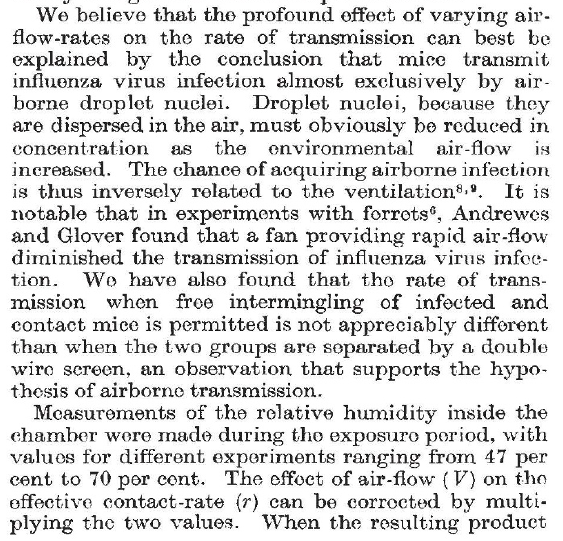
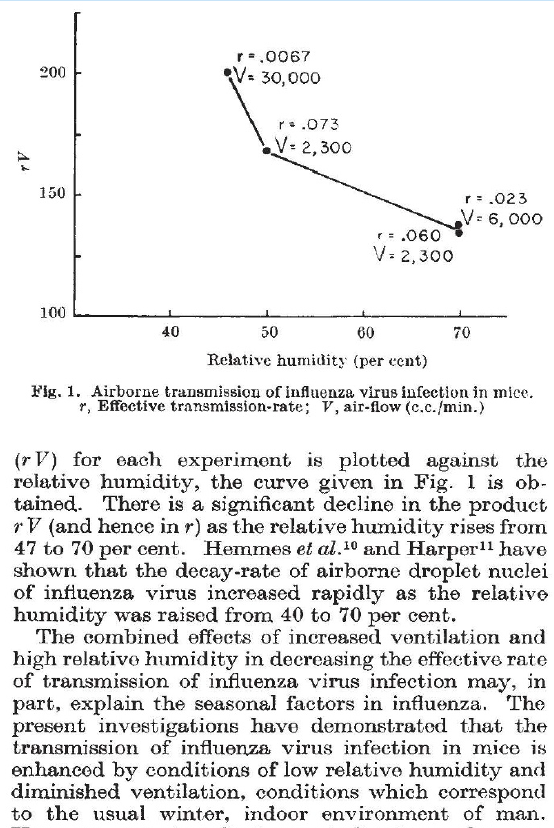
The measures can be seen as nothing more than punching the air, while you simply need to change the air. The importance of ventilation and humidity has long been known. An article in Nature, published in 1962, is telling. This concerns experiments with contamination via aerosols. It leaves nothing to be desired in terms of clarity: ventilation and humidity make the difference.
Vertaling: "We believe that the large effect of varying air flow rates on transmission rates is best explained by the conclusion that mice transmit influenza virus infection almost exclusively via airborne droplet nuclei. Droplet nuclei, because they are dispersed in the air, naturally decrease in concentration as the ambient airflow has increased. The risk of airborne contamination is therefore inversely proportional to ventilation. Remarkably, in experiments with ferrets, Andrewes and Glover found that a fan that provided rapid airflow reduced the transmission of influenza virus infection.
We also found that the rate of transmission when free mixing of infected and contact mice is allowed is not appreciably different from when the two groups are separated by a double wire screen, an observation that supports the airborne transmission hypothesis. [...] There is a significant decrease in infections as humidity increases from 47 to 70 percent."
The reluctance to name effective measures is difficult to understand, looking at the main transmission routes.
It is logical that non-medical measures are lacking
What's missing? These are mainly non-medical measures. It appears to have been a mistake to rely so heavily on doctors and certainly on virologists. You have to treat a virus, at best you can work on symptom control, but then you soon end up in the field of an internist-infectiologist or - in the case of respiratory viruses - a pulmonologist. Virologists are used to being able to do very little except shout that everyone should be vaccinated. Arming the immune system; there are actually no other medical instruments.
Meaningful measures include the following non-virological guidelines because respiratory viruses spread through physical laws:
- Education about breathing - Awareness of clean breathing vs risky breathing.
- CO2 meters: understand what human-polluted air is
- Air treatment: ventilation, humidity, ionization, filtering, UV operation. Avoiding risky opportunities. This is also effective for otherwise polluted air, so it is certainly suitable for mutants or other respiratory viruses.
The RIVM and CDC could make themselves useful by stopping spreading misinformation. With the right clear and logical communication, more deaths can be prevented than with any face mask.
- Nutrition information - Maintaining the immune system. What our grandmothers did with cod liver oil has been adopted by the superfood and supplement industry. The wildest claims are going around, so just go to the Nutrition Center, although there is undoubtedly a lot to comment on. In any case, I don't see a Double Whopper and Pepsi-Cola in the Wheel of Five.
Volg je die "Schijf van vijf" dan krijg je bijna alles wel binnen. Om de hiaten op te vullen moet je supplementen slikken (ja, 'moet'). Zeker tijdens het griepseizoen.- Vitamin D (see the brochure from the Nutrition Center) in
- Zink.
Takeaways from a old Volkskrant article:- WHO: 31% of the world's population does not consume enough zinc
- Zinc's main function: proper functioning of the immune system
- The Netherlands is not known for 'severe' zinc deficiency, but many people are still below the recommended daily requirement.
- Zinc inhibits the overactivity of the immune system. [cytokine storm]
- Not from the article but from scientific studies:
- Infections consume a lot of zinc (people with little zinc are more heavily infected, but at the same time zinc levels also decrease due to infections. The connection is there, but the hard causality is not yet. It is better to have too much zinc than too little.
- You have to go crazy to overdose. It builds up very slowly in your body and you don't build up a reservoir, so keep taking!)
- Zinc deficiency can be accompanied by loss of smell and taste. [rings a bell?]
- Making first-line medication available
You have to catch some diseases early. If the GP can nip an emerging infection in the bud with little-injurious (or even harmless) and cheap medication, it is criminal to forbid this. Here too, you must be prepared to investigate during a crisis, especially if the risks are minimal. The Netherlands could have been much further along with HCQ/Zinc, Ivermectin and many other medicines for which 'only' indications of effectiveness exist - so no, no hard evidence. Involve the GP in a national trial design through standardized reporting of the results. Come up with something! But yes, that is something with data, that is not the responsibility of virologists.
The RIVM does not go along with all this.
Onwetenschappelijke tegenwerpingen van van Dissel
Why not throw in ventilation, air humidification and ionization, and hepa filters? Jaap van Dissel insists that this does not help, as these are large droplets, which he believes are the most infectious. I believe that is indeed the case under the microscope and in the lab. It is not his only objection. I have not looked for the sources, but the reasons given by Jaap van Dissel boil down to the following
- Mice are not people
- Ferrets are not people
- Influenza is like Sars-Cov-2
- There is too little pathogenic virus in aerosols
- HCQ poses a risk of death from heart failure
These objections are actually too ridiculous to take seriously, but because Van Dissel says it, many people accept it anyway. This means that arguing is pointless, and no reasonableness can cope with the fallacy based on authority. A celebrity (preferably elderly, one with a white coat and stethoscope) will really have to be thrown in to change public opinion. Below are van Dissel's statements with suggested answers:
- Mice and ferrets are not people
If we accept that animal testing has no predictive value regarding the effect on humans, we must stop it immediately. The possibility that a different systemic response occurs in animals has never before been a reason to completely ignore research results. In fact, every vaccine must first be tested on animals, even though we know that nothing can happen to it. - Influenza is like Sars-Cov-2
Dat iets niet identiek is aan iets anders is evident. Daarom kunnen we het immers onderscheiden. Het is een drogreden om te zeggen: dat gedrag zal niet hetzelfde zijn want het is iets anders. Respiratoire virussen vertonen enorme overeenkomsten, daarom hebben ze de gemeenschappelijk noemer 'respiratoire virussen'. De al engere gemeenschappelijk categorie 'griepvirussen' en 'seizoensvirussen' vernauwen het spectrum verder.
De transmissieroute is verder een grotendeels natuurkundig verschijnsel waarmee vervuilde lucht diep in de longen kan belanden, waar longcellen hun best doen de adem zo efficiënt mogelijk om te zetten. Jaap van Dissel zou eerder moeten bewijzen dat transmissie van Sars-Cov-2 fundamenteel anders verloopt dan die van het influenzavirus. Op zijn minst zou hij een geloofwaardige hypothese moeten kunnen opperen waar de verschillen vandaan zouden kunnen komen. Zelfs dat heeft hij niet. Hij stelt gewoon dat het niet zo is. Dat is onwetenschappelijk. - There is too little pathogenic virus in aerosols
Dit geeft echt blijk van onkunde. Er zijn legio wetenschappelijke studies over het belang van virustransmissie via de lucht, zie ook de herhaalde dierproeven die dit sinds 1962 bevestigen en talloze observaties (klinische experimenten met een dodelijk virus op mensen zijn niet toegestaan dus het ontbreken daarvan is een mager argument). Uit het doseren met inhalators weten we dat inhaleren 40 keer effectiever is dan andere routes. Verder kan de duur van de blootstelling aan aerosolen in de uren lopen. De blootstelling aan een druppel is een fractie van een seconde - je laat iemand niet bij herhaling in je gezicht spetteren. Aerosolen liften mee met adem, ze komen direct in de longen. Vallende druppels hebben hindernissen te nemen als afstand, slijmvlies (zowel een fysieke hindernis alswel uitgerust met een krachtig immuunsysteem), verdunnend speeksel/snot etc.
Zelfs als hier twijfel over bestaat, zou het tijdens een crisis als deze in de strijd moeten worden geworpen, al was het maar gemonitord om het effect te kunnen meten. Niets van dit alles. - HCQ poses a risk of death from heart failure
HCQ is al een oud medicijn dat al decennia wordt meegegeven als preventie tegen malaria, zonder bijwerkingen. Er zijn veel artsen en onderzoeken die de genezende werking van HCQ op COVIC-19 aantonen. Artsen kennen de bijverschijnselen en kunnen het beste beoordelen of de patiënt die voor hun staat ervoor in aanmerking komt. Van Dissel wil onomstotelijk bewijs van de werking tegen Covid. Als je het geen kans geeft, kom je er nooit achter. Als het middel niet werkt, wordt een patiënt in elk geval strak gemonitord wordt hij tijdig ingestuurd. Wat is er in hemelsnaam op deze middelen tegen?
Er zit duidelijk iets op slot in virologenhoofden. Ik geloof niet dat het commerciële belangen zijn, daarvoor is het allemaal te stompzinnig, te doorzichtig en te incoherent. Voor mij is het overduidelijk het effect van de 'massavorming' en het 'expertfalen' zoals uitgelegd door Prof. Mattias Desmet, toegepast op de 'oogkleppenmentaliteit' zoals uitgelegd door Prof. Jimenez.
Wat een pech. Dit wordt de grootste medische en bestuurskundige blunder uit de geschiedenis. Beleidsbeslissingen met meer schade en ellende tot gevolg dan welke eerdere beslissing ook. En dan reken ik oorlogen mee.