

Not that I intend to make a report of every hearing day, but this was possibly even worse than the previous hearing day. The timeline of the early corona period was now discussed with both Jan Kluytmans (physician microbiologist, Amphia Hospital Breda, OMT member) and then with Mayor Jack Mikkers (Mayor of 's-Hertogenbosch & Chairman of the Brabant-Noord Safety Region). Both told how they experienced that period. What stood out?
Jan Kluytmans
Prof. Dr. Kluytmans, co-owner of the PCR rapid test company Movida and OMT member, discusses the chronology of events and the administrative and procedural activities of the OMT. Sometimes there is frustration: he has brought up issues that were never discussed in OMT 'due to technical problems', and probably a few more had to be installed on Zoom when the meeting started. We know that. There were still some friction points that the corona committee clearly exposed: broadly speaking, he is concerned about new European regulations that make manufacturing your own tests virtually impossible. Only commercial parties can still deliver. "Afhankelijkheden worden alleen maar groter." In Denmark, the Statens Serum Institute itself carried out high-volume testing. In the Netherlands, the RIVM is a small expertise center and he sees that capacity declining. [A trend that is also is observable in agriculture, fishing, education, industry, culture and energy supply. It's not going well - ed.]
The OMT was instructed to operate exclusively in the medical domain. It therefore did not or hardly consider economic and social effects in its advice. Kluytmans sees that things have not been optimal there and argues for a parallel structure next to the OMT: one for acute crisis, one for medium/long term with broad representation (economists, social scientists). Kluytmans believes that sitting together at the table is very important if experts with different perspectives want to understand each other. Simply reading each other's notes misses an important dimension. So more meetings (three times as many), that sounds like the correct The Hague solution with a good chance of being adopted by the PEC.
- Let's remember for later: Kluytmans realized that he was in the eye of the storm in Brabant. He had tested the hospital staff and was shocked by the number of positives. But that was in a hospital, around patients. To get an impression of the spread, he had suggested to the mayors that a group of civil servants should also be tested.
So much for scientific exchange.
While I was curious about the evaluation of the OMT-output: medical advice. This doctor-microbiologist from the OMT does not look at the substantiation or effectiveness of the measures announced by the OMT. These are NOT evaluated. Who are they going to question about that? It seems like that topic is being avoided, as expected. A pass will soon be given without checking the work. More important is 'how did you feel about it?'
- No reflection on whether the chosen interventions actually worked, regardless of the lockdowns.
- Not a word about the scientific basis under 1.5 meters, aerosols, the mandatory face mask, school closures, the curfew.
- No discussion over of asymptomatische verspreiding de paniek rechtvaardigde die eruit voortvloeide terwijl Kluytmans nota bene zelf ontdekte dat het personeel met "hele milde klachten"(!) positief was.
- No question marks in the PCR test methodology, the number of cycles, the reliability.
- No reflection on iatrogenic damage: whether filling ICUs with ventilator patients was the right approach, or whether to postpone regular care, or the consequences of isolation in nursing homes. If none of that mattered, they could have stopped Covid with an active euthanasia policy. Instead, it was a matter of waiting for the vaccines.
No questions about possible conflicts of interest, as the owner of a company that develops and implements rapid tests (see the comment by P. Koelewijn1comment by P. Koelewijn). Because it concerns the first year, no questions about excess mortality or vaccinations. And certainly no questions about medication or disease severity.
Off-label
In 2020 werd onder de noemer "coronabestrijding" een totaalverbod op off-label voorschrijven van bestaande, geregistreerde veilige geneesmiddelen ingesteld - tenminste als ze tegen COVID hielpen of alleen al werden voorgeschreven. Huisartsen die hydroxychloroquine, ivermectine, of zelfs zink en vitamine D therapeutisch inzetten, kregen het IGJ op hun dak. Ze hebben forse boetes betaald. Rob Elens was daar het boegbeeld van: een huisarts die wél behandelde, die wél zijn patiënten medicatie gaf in plaats van ze naar huis te sturen met een paracetamol en het advies "bij benauwdheid bellen." Andere bekende namen zijn natuurlijk Jan Vingerhoets, Els Veen, Alexander van Walraven, Felix van de Wissel waarnaast nog vele anderen, later verenigd in Het Artsencollectief. Feitelijk werd de hele eerstelijnszorg buitenspel gefloten.
It is significant that the inquiry committee did not ask Kluytmans about this. They had an OMT member under oath, someone who was at the table when it was decided that there should be no treatment (after all, they were in charge of medical decisions), that the only permitted intervention was lockdowns and waiting for an experimental mRNA product that did not even exist yet.
The committee could also have asked:
- "Waarom adviseerde het OMT actief tégen het off-label inzetten van hydroxychloroquine, terwijl (niet alleen Nederlandse) collega's er wél resultaten mee boekten?"
- "Heeft het OMT ooit serieus gekeken naar bestaande, veilige geneesmiddelen als behandeloptie, of lag de focus vanaf het begin uitsluitend op non-farmaceutische interventies en een toekomstig vaccin?"
- "Wat vond u ervan dat de IGJ huisartsen als Rob Elens monddood maakte, terwijl die artsen in het veld stonden en zagen dat hun patiënten baat hadden bij een vroege behandeling?"
- "Had u als microbioloog een medisch-inhoudelijk bezwaar tegen ivermectine, of was dat een beleidskeuze waar u buiten stond?"
Niets van dat alles. Geen woord over het systematisch verbieden van het Zelenko-protocol. Geen woord over het feit dat de enige "zorg" die overbleef bestond uit op afstand toekijken hoe mensen ziek werden, tot ze zuurstof nodig hadden en op de IC belandden om daar de dood in beademd te worden.
En Kluytmans zelf? Die hield zijn mond. Hij was tenslotte OMT-lid. Hij zat in het Systeem. Hem vragen naar Elens zou het hele narratief onderuit halen dat het OMT gewoon "zijn best deed met de kennis van toen." Want met de kennis van toen wisten artsen als Elens, Raoult, Zelenko, Kory, Marik, McCullough en talloze anderen dat er wél behandelmogelijkheden waren. Die kennis werd niet genegeerd uit onwetendheid - die werd actief ontkend en zelfs onderdrukt en bestraft. Er moest per slot geprikt, had Ursula van de Leyen 'uitonderhandeld'. Dat duurde nog even en we hadden wel zieken en urgentie nodig voor noodvorwaarden; daar pasten goed werkende medicijnen helemaal niet bij.
De commissie wilde het niet weten of durfde het niet te vragen. Beide opties zijn even vernietigend voor de geloofwaardigheid van deze "enquête"
Lockdowns
Only the lockdowns are mentioned in passing: "Toen we de lockdown afkondigden was het effect op de R-waarde heel snel. En dat is dus niet zozeer misschien het beleid, maar ook hoe de Nederlandse burgers zich op dit moment ook gingen houden aan het beleid." says Kluytmans. Nothing else.
Let's look at this again using a graph by statistician Fritsander Lahr, which he explained in 2020 at Weltschmerz2Fritsander Lahr at Weltschmerz: https://youtu.be/-U4zJAPmQGs?si=8CJo_e14VkkA6vkp and later in DNW with Marlies Dekkers: https://youtu.be/Jzlteunvn5A?si=Vme0JxtA0oFBIbw7. In onderstaande grafiek zien we de "effectieve R". Als de R boven de 1 is, groeit het aantal besmettingen, onder de 1 neemt het aantal besmettingen af. Lockdowns zijn bedoeld om de R (sneller) te laten dalen, als het even kan tot onder de 1.
Do we see that happening too?
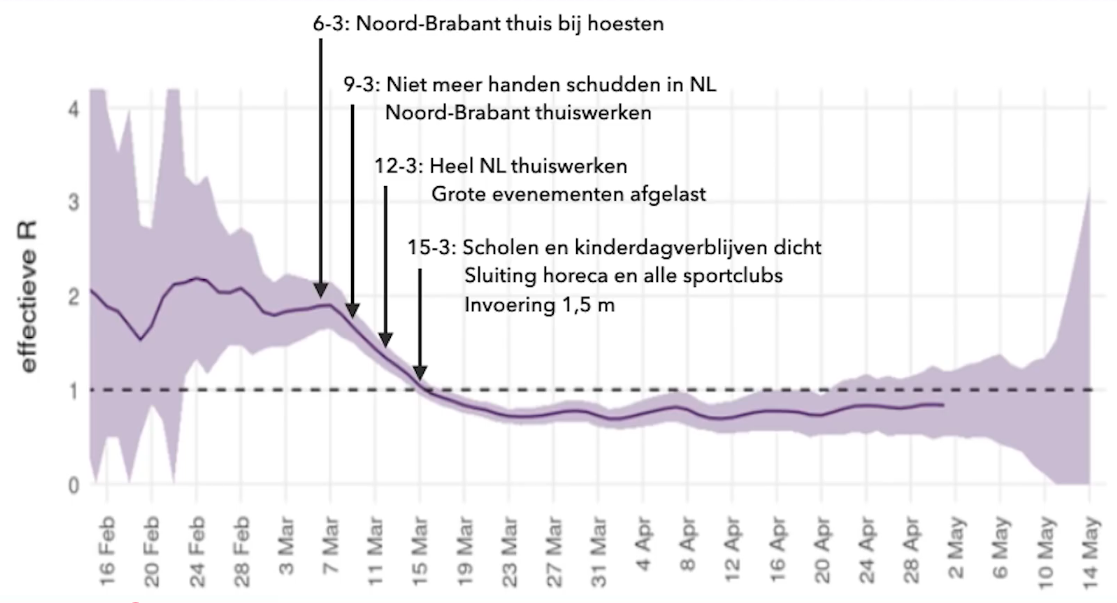
From March 6, Brabanders must stay at home if they cough. And indeed: on March 7 we see the R nodding downwards to a steady decline. No more shaking hands will not cause a new nod, nor will canceling events. Only a week later (March 15) are the schools closed, also to keep parents at home. The R is then already at 1 and the decline slows down to just below 1.
The verdict "Toen we de lockdown afkondigden was het effect op de R-waarde heel snel." is therefore a euphemism. The lockdown itself worked so well that the R fell before it was officially announced.
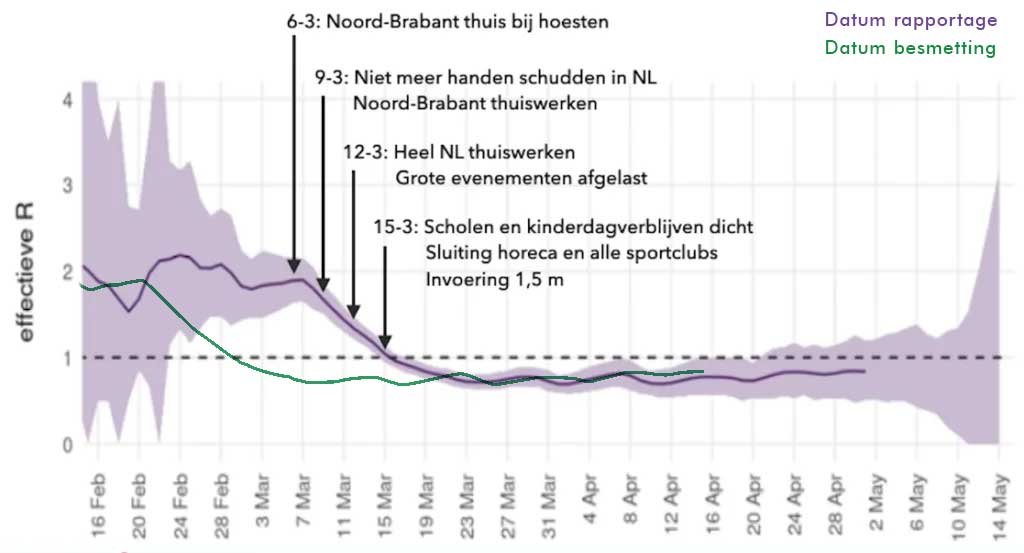
Nonsense of course - also that the March 6 rule would already be noticeable on March 7. The measurement lags considerably behind the time of infection. First we have the incubation period (time from infection to symptoms): an average of 4.6 days. For the generation time/serial interval (time between contamination of primary and secondary case), RIVM uses 3-4 days (depending on variant). Time to test/report is 1-5 days (people often wait until symptoms, plus lab and reporting delays). Then pass it on to the system....Two to three weeks is a reasonable period to adhere to. Let's be lenient: two weeks. This means that in reality the infections had already started to decline two weeks earlier, around February 20 (the green line). Do we see any reflection of the draconian measures that were introduced in that steadily declining line of infection events?
It's a shame that the committee did not give Jan Kluytmans the opportunity to explain that.
A-disease
On January 28, 2020, COVID-19 was classified by the cabinet as an A disease — the most serious category in the Public Health Act. This gave the government far-reaching powers: mandatory isolation, forced admission, quarantine, and the removal of fundamental rights without judicial intervention.
An A disease is intended for conditions such as smallpox, polio, SARS, MERS. These are diseases with extremely high mortality.
Kluytmans already knew at the end of February/beginning of March that this image was incorrect. He had the data himself:
- 4.9% of staff with mild complaints were positive - runny nose, no fever, just went to work
- Half of the positives did not even have a fever - while the WHO definition required fever
- Mortality risk was estimated by himself at 1% - and especially in the elderly, not in the general population
He describes it himself almost casually: "Nou, het bleek dat de helft van de patiënten en medewerkers die wij testen hadden helemaal geen koorts. Die hadden hele milde klachten."
And about that one colleague who turned out to be positive: "Die was eigenlijk niet niet zo ziek. En de volgende dag werd hij wat zieker en toen was hij positief. En toen dachten we al oh jee, die was dus gisteren ook al positief. En die was gewoon helemaal, ja, die was nauwelijks ziek. Die hoestte wat en die had een snotneus."
What the committee did not ask:
- "U zag dat het overgrote deel van de besmette mensen milde klachten had. Vond u de A-ziekte-classificatie nog proportioneel?"
- "De A-status gaf de overheid de macht om mensen gedwongen te isoleren. Was dat gerechtvaardigd voor een virus dat bij de meesten op een verkoudheid leek?"
- "Heeft u in het OMT ooit geadviseerd die classificatie te heroverwegen?"
- "De A-status bleef maandenlang van kracht. Heeft u zich daar ooit tegen verzet?"
Nothing. Why does this matter?
The A disease classification was the legal foundation for everything that followed. Without that status, no lockdown, no curfew, no forced quarantine, no closure of schools and catering establishments. It was the legal key that opened the door to two years of coercion.
And the man under oath knew firsthand that the clinical picture was nothing close to Ebola, smallpox or polio. The committee had an OMT member here who could say: "Ja, we wisten dat het geen echte A-ziekte was naar het klinisch beeld, maar de classificatie bleef staan."
Send to IC
This week's theme is 'the beginning of the pandemic'. ICU capacity was controlled. We do not know why that choice was made; the number of people saved by ICU visits was certainly not impressive. Not even in percentage terms, where the success figures were also adjusted afterwards.3Compare the NICE charts: https://virusvaria.nl/sturen-op-de-ic-waarom-was-dat-eigenlijk/. Perhaps an intensivist will be interviewed - but probably not about those first months. Wouldn't Jan Kluytmans have been the person to inquire what the net medical return was by 'sending to the ICU' and what the adjusted reports would be afterwards?
Jack Mikkers
The mayor of Den Bosch reports on the concerns of a mayor/regional chairman in times of crisis. I found the following striking: Kluytmans had proposed to the mayors on March 6 to test a control group of civil servants in addition to hospital staff. The aim: to compare whether the infections were really atypically high in Brabant, or whether it was already widespread nationally.
Mikkers describes it himself:
"En zijn voorstel was om een referentiegroep te hebben van ambtenaren om die te laten onderzoeken. En dat hebben wij gezegd: dat gaan we niet doen. Want dat zou betekenen dat ambtenaren een soort bevoorrechte positie zouden hebben ten opzichte van anderen, want eh eh meer mensen wilden naar aanleiding van de situatie mogelijk gecheckt worden of getest worden."
And then this:
"Eh dus als je naar een referentiegroep wil, denk ik dat we er van tevoren over na moeten denken hoe we dat willen organiseren in Nederland, in plaats van zoals we het, zoals het voorgesteld was, eh, door, ik denk geheel terecht en met de goede intentie door de heer Kluytmans. Maar wat wij bestuurlijk niet verantwoord vonden."
So Mikkers says in the same breath:
- Kluytmans had "geheel terecht en met de goede intentie" een voorstel gedaan
- That proposal was scientifically necessary - you need a control group to be able to say anything about spread, and in principle it was available
- We rejected it, on a Friday afternoon, together with two other mayors, on non-medical grounds
Met de reflectie achteraf dat je zoiets "van tevoren moet organiseren." Maar dat was precies wat Kluytmans probeerde te doen. De expert doet een voorstel, de bestuurders schieten het af, en achteraf zegt de bestuurder: "Ja, de experts hadden het beter moeten organiseren."
And the committee? He left it there again. No question about what the lack of that control group meant for the quality of the data. No question whether, in retrospect, that decision would not have been better left to an epidemiologist than to three mayors on a Friday afternoon.
I wonder if Kadija Arib's interrogation is just as inspiring.
Footnotes
- 1comment by P. Koelewijn
- 2Fritsander Lahr at Weltschmerz: https://youtu.be/-U4zJAPmQGs?si=8CJo_e14VkkA6vkp and later in DNW with Marlies Dekkers: https://youtu.be/Jzlteunvn5A?si=Vme0JxtA0oFBIbw7
- 3Compare the NICE charts: https://virusvaria.nl/sturen-op-de-ic-waarom-was-dat-eigenlijk/

Kluytmans has made a lot of money with PCR tests in his own lab. He bought a villa and when that became apparent, the group of microbiologists moderated a bit. Did you already forget that?
https://www.ftm.nl/artikelen/ziekenhuizen-artsen-cashen-corona?share=86d8sqXXxT0mCiJueLih9aD5bDQo05VcHLDwMqjuo3xGqeJQgFaJq%2FVkEEGyx90%3D
Yes, I forgot. I'll add it.
He therefore even had the audacity to advise on television to test people daily.
Box!
https://www.ftm.nl/artikelen/ziekenhuizen-artsen-cashen-corona?share=86d8sqXXxT0mCiJueLih9aD5bDQo05VcHLDwMqjuo3xGqeJQgFaJq%2FVkEEGyx90%3D
Pay increase and position elsewhere?
Mayor? Head Lareb?
There are plenty of vacancies for airheads and apparatchiks.
And if they can do something? Then something shadowy, behind the scenes.
What a charade.
All those points you mention:
-No reflection on whether the chosen interventions actually worked, regardless of the lockdowns.
-Not a word about the scientific basis under 1.5 meters, aerosols, the obligation to wear face masks, closing schools, the curfew.
-No discussion about whether asymptomatic spread justified the resulting panic, while Kluytmans himself discovered that the staff with “very mild complaints” (!) were positive.
-No questions about the PCR test methodology, the number of cycles, the reliability.
-No reflection on iatrogenic damage: whether filling ICUs with ventilator patients was the right approach, or postponing regular care, or the consequences of isolation in nursing homes.
I also thought the RIVM 'models' were something that should be discussed. They had been manipulated. Whether through ignorance or consciously, we will leave it open for a moment. I don't want to go in the conspiracy direction :-).
Each and every one of them is extremely relevant. But I fear that these will not be discussed. Simply because each of these points falls outside the frame of reference of this committee. People who still believe in the prevailing narrative (a deadly pandemic caused by a killer virus, and we were saved by science and brave leaders) have no reason to question some of the issues. By the way, there is also a correlation between your points. If the PCR often gives false positives, then asymptomatic contamination is also (partially) explained, but there is also a relationship with hospital treatment. If early treatments had not been prohibited under penalty of fines, fewer iatrogenic deaths would have occurred. Because that would have kept people out of the hospital.
It's a house of cards. If they question even one of your points, their entire faith will collapse. Their image was not created by logical thinking, being critical and looking at facts. Their image is shaped by propaganda and fear mongering. More of a religion or belief than an opinion based on your own observations.
That R value reminds me of the episode in which Maurice compares the measures with the child steering wheel of a child in the back seat.
Oh yes, I'm still holding back :-).
I find it especially courageous and special that you continue to follow these sad 'interrogations' and present them so carefully and compactly, with recommendations for how it would make sense. That you don't become completely disturbed and seriously despondent from constantly beating around the bush. Of not getting to the point and carefully avoiding the real questions and real answers. I can't even last 5 minutes.
Me neither. I wasn't even going to look into the money laundering. I have seen Arib.
Solution: I download the transcripts from @gezondmerels on
It's not that difficult. The committee is completely based on the mainstream story: PCR tests work, Covid was a particularly serious A disease, face masks work, the OMT included the experts who knew everything about transmission and measures. They have never heard of WHO playbooks for pandemic handling. etc. etc. And then talk endlessly (by Van Koesveld) about 'protective equipment' that should all protect against droplet contamination... etc. etc. And they all think that it was excellently organised.
My respect also for your admirable patience and endurance. Another question: could a real bombardment of the email addresses of the PEC members, containing serious language (expressing concerns, asking questions, etc.) help? These people aren't that stupid, are they? Or ignorant? Or silly?
[Arib: I had good hope that something would come of it... Something sensible then]
Astounding indeed. But not stupid, ignorant or silly. Certainly not. I think rather indoctrinated into collectivist thinking, manipulated, frightened. They live in a different reality. These people blindly believe the 'experts' and the authorities that are hierarchically above them. They have never learned to question things. They have grown up and trained in a protected environment in which they have never encountered reasons that could lead to any doubt.
That's what I suspect now. If the system always works in your favor, there is no reason to assume that you are being cheated or used by the system. Maybe that's one of the differences between the skeptics and the followers. Their filters allow no doubt whatsoever. Everything that Anton and the others write down here makes 100% sense, and at the very least you could have a discussion about it. Maybe WE are overlooking everything. I'm open to everything. But I fear that it will remain with a single convert who goes from believer to skepticism. Never seen the other way around.
For me this is the essence of it all. Not Covid, or nitrogen or migration. But the completely different view of reality that people can have. The digital world we live in certainly doesn't help. But that is of course not the only cause.
The fact that the 2020-22 heroism of an OMT member has turned into a confession that too few meetings were held during that time, shows that this OMT member considers himself null and void.
The fact that the pec does not ask this omt member about this time shows that the pec also considers this omt member null and void.
Could the judgment have been different?
“If none of that mattered, they could have stopped Covid with an active euthanasia policy.”
Research into the state of affairs in British care homes shows that this has actually been carried out.
HoHo, you're blaming Kluytman for something you shouldn't blame him for. He is a microbiologist.
The story about R-values etc. is not his profession, but that of epidemiologists! These were: Susan Hahné, Wim van der Hoek, Susan van den Hof and Kylie Ainslie RIVM), Jaap Maas company doctor-epidemiologist (affiliated with the Amsterdam UMC). Almost all unknown names. But these people need to be grilled about the indescribable nonsense that was and is being sold about lockdowns.
It could be that they also had some doubts about that…. They were the accountants. All the others are “autistic” when it comes to infections, cells, viruses, ICs. They have not learned how to contain an epidemic!!!
Let's keep it straight, Jan: I don't blame him for that. He is not even talking about R-values, the point is that this OMT member, like the committee, assumes - and Kluytmans himself says so - that lockdowns work. One of the principles of the mismanagement. Let me explain why that statement is incorrect.