


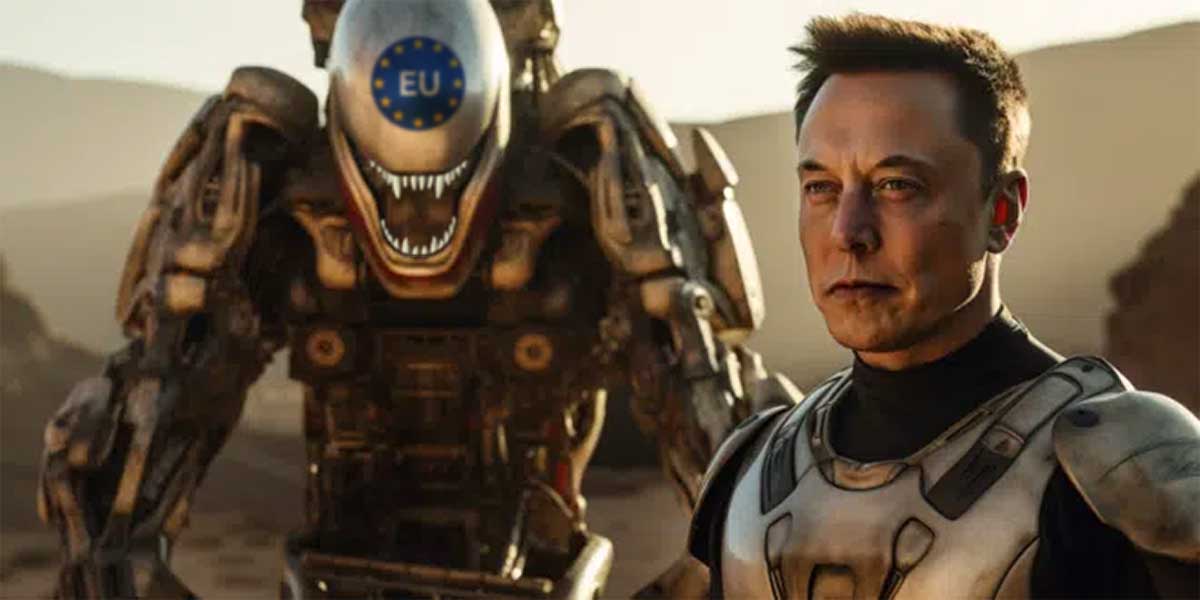
Het laatste salvo in de voortdurende strijd tussen Elon Musk en de EU kwam van de X-eigenaar zelf. Hij onthulde dat X in de aanloop naar de Europese verkiezingen "een illegale geheime deal" aangeboden kreeg: als het platform zou instemmen met het in het geheim censureren van online uitingen, dan zou de Europese Commissie geen boete opleggen voor overtredingen van de nieuwe wet op online content moderatie, de Digital Services Act (DSA). X weigerde mee te werken, maar alle andere grote platforms accepteerden de deal.
Thomas Fazi, 20 JULY 2024
Translated from unherd.com (after a reader tip)
The EU's war on freedom of expression
Elon Musk cannot win this battle
Musk's revelation came shortly after Thierry Breton, the EU's censorship czar, the preliminary findings of the Commission announced dat X's nieuwe "blue check" verificatiesysteem in strijd was met de DSA. Aangezien iedereen zich nu kan aanmelden en een "geverifieerde status" kan krijgen - in tegenstelling tot Musk, toen het platform willekeurig besliste wie het felbegeerde blauwe vinkje waard was - ondermijnt dit volgens hem het vermogen van gebruikers om weloverwogen beslissingen te nemen over de authenticiteit van een account.
De Commissie beschuldigde X er ook van "onderzoekers geen toegang te geven tot zijn openbare gegevens", zoals voorgeschreven door de DSA. Ze drong er bij het bedrijf op aan om dergelijke inbreuken aan te pakken of een boete te krijgen die kan oplopen tot 6% van de totale wereldwijde jaaromzet, die in 2023 ongeveer 3,4 miljard dollar bedroeg. Niet-naleving kan ertoe leiden dat X helemaal niet meer actief mag zijn in de EU.
De redenering van de Commissie is dat het allemaal draait om "transparantie" en het beschermen van gebruikers tegen misleiding en desinformatie. Maar de waarheid, zoals Musk suggereert, is dat dit eigenlijk gaat over de wens van de EU - en het uiteindelijke doel van de DSA - om het online verhaal in het geheim te controleren. Tot zover transparantie.
This mission to censor is backed by Mike Benz, a former Trump official and cybersecurity expert who claims dat "onderzoekers toegang geven tot openbare gegevens van X" niet zo goedaardig is als het klinkt. In feite is het een dekmantel voor de poging van de EU om "de DSA te gebruiken om X te dwingen het censuurteam dat werd ontslagen toen Elon het overnam, opnieuw te bemannen". Elon ontsloeg het team omdat, zoals de Twitter Files revealed, hun enige doel was om in te gaan op verzoeken van de overheid om censuur. Vandaar Benz' bewering dat deze "onderzoekers" eigenlijk "politieke agenten" zijn. Musk repostte Benz's analyse met één woord als commentaar - "Precies" - en voegde eraan toe dat als de EU een handhavingsactie tegen X onderneemt, hij ze voor de rechter zal slepen.
Het taalgebruik en de beschuldigingen zijn niet nieuw. De basisregels voor deze strijd werden gelegd op het moment dat Musk Twitter overnam en tweette "de vogel is bevrijd". Breton replied onmiddellijk: "In Europa zal de vogel volgens onze regels vliegen," met een verwijzing naar de DSA, die diezelfde maand officieel in de wet was opgenomen.
Hoewel Musk aanvankelijk beloofde om "de toekomstige Europese regelgeving te respecteren", duurde de wittebroodsweken niet lang. In mei 2023 trok hij zich terug uit de EU Code of Practice on Disinformation, which was initially voluntary, but subsequently in fact wettelijk bindend werd gemaakt onder de DSA. Dit leidde in december tot een onderzoek naar de vraag of het platform de DSA overtrad op gebieden als "risicobeheer, inhoudsmoderatie, donkere patronen, advertentietransparantie en gegevenstoegang voor onderzoekers". Vorige week werd geconcludeerd dat dit inderdaad het geval was, vandaar de nieuwste krachtmeting.
Het is moeilijk te zien hoe Musk deze strijd kan winnen. Zeker als je bedenkt dat zijn pro-vrije meningsuiting hem niet alleen tegenover de EU heeft geplaatst, maar ook tegenover een aantal andere regeringen over de hele wereld. Musk heeft "takedown" verzoeken challenged in Brazil, India, Australia and Turkey and has even challenged some of these requests in national courts. In almost all cases, however, the platform has responded to governments' requests. From one report Last year it even turned out that X under Musk had approved more than 80% of government censorship requests.
"Het is moeilijk te zien hoe Musk deze strijd kan winnen."
So even as Musk publicly challenges the EU, he deletes posts - as many X users have regretted - due to non-compliance with the DSA. For example, on October 10, days after the Hamas attack, Breton issued a warning aan Musk over vermeende "desinformatie"; X responded by immediately remove or flag tens of thousands of pieces of content.
However, accusing Musk of hypocrisy would be missing the point. Complying with these requests is often the only way the company can continue to operate — and at least Musk, unlike the other major platform owners, has brought online censorship into the open. The publication of the groundbreaking Twitter Files revealed the shocking level of collusion between the US government and social media companies.
But more importantly, Despite censorship, remains the only platform where information can flow relatively freely. In fact, it remains the greatest threat to the establishment's desire for complete control over information - which is why it is being tackled so harshly. But one man, no matter how rich or powerful, cannot be expected to single-handedly take on some of the most powerful governments in the world - let alone the European Union, the world's most influential supranational institution.
There is another factor to take into account. The global assault on freedom of expression is not just the whim of unhinged, power-hungry politicians and bureaucrats. It is a systemic problem related to the structural decline of liberal democratic institutions, especially in the West. As our societies degenerate into de facto oligarchies controlled by increasingly delegitimized political-economic elites, manipulating public opinion – not only through propaganda through traditional mass media channels, but also increasingly through monitoring and micromanaging the public conversation taking place on social media platforms – is increasingly seen as a necessity to keep the status quo safe from the threat to democracy. This is further exacerbated by the increasing militarization of the geopolitical context, which requires an even more compliant population given the political and economic consequences.
It's no coincidence that it censorship-industrial complex begon op te komen in de tweede helft van de jaren 2010. Dit was de tijd waarin het Westen werd opgeschrikt door een ongekende "populistische" reactie tegen de globalisering en de neoliberale orde - Trump, Brexit, de Gele Vesten en de opkomst van eurosceptische partijen en bewegingen in heel Europa.
It was also the moment when the path of future confrontation with Russia was laid in Ukraine - and when NATO began developing the hybrid or cognitive warfare doctrine, which conceptualizes the management of Western public opinion as an integral part of warfare. As Jens Stoltenberg, the former Secretary General of NATO, put it in 2019 expressed: "De NAVO moet voorbereid blijven op zowel conventionele als hybride bedreigingen: van tanks tot tweets."
If we expect to watch Musk fight for us, we have already lost.
De Covid-19 pandemie, waarbij voor het eerst massaal online censuur werd toegepast, gaf de westerse elites wat tijd. Maar niet voor lang. Vandaag overspoelt een "populistische" reactie het Westen opnieuw: Rechts-populistische partijen komen overal in Europa op en Trump ligt op koers om de volgende Amerikaanse verkiezingen te winnen. Intussen zijn de escalerende spanningen in Oekraïne ontploft in een niet meer zo proxy-oorlog tussen de NAVO en Rusland. Vanuit het perspectief van de westerse elites vraagt dit alles om een verdubbeling van het censuurregime, met een groot verschil: online censuur vond vroeger plaats achter gesloten deuren, buiten de wet om en in een context van plausibele ontkenning namens regeringen; tegenwoordig wordt het geïnstitutionaliseerd en gegrondwettelijkiseerd via instrumenten zoals de Digitale Diensten.
Elites rechtvaardigen hun censuur gemakshalve op twee manieren: door de reikwijdte van "haatzaaien" voortdurend uit te breiden tot bijna alles; en, nog onheilspellender, door kritische meningen, vooral over buitenlands beleid en geopolitieke zaken, te bestempelen als "desinformatie" of voorbeelden van buitenlandse inmenging. Het is geen toeval dat het allereerste DSA-rapport van de Europese Commissie volledig gericht was op de kwestie van "Russische desinformatie". Het is veelzeggend dat het rapport "door het Kremlin gesteunde accounts" - potentieel elk account dat kritisch is over de NAVO - bijna op hetzelfde niveau plaatst als accounts die verbonden zijn of geassocieerd worden met de Russische staat.
This deliberate blurring of the lines between illegal and harmful speech, and between critical opinion and foreign propaganda, is central to the censorship regime, because it allows EU elites to determine what hundreds of millions of Europeans can and cannot say and read online. It's state-sanctioned censorship, plain and simple. And it should come as no surprise that the biggest threat to freedom of expression today comes from the EU: after all, the bloc's entire institutional architecture is designed to restrict democracy by transferring power to unpredictable elites who are largely isolated from the people. In turn, the top-down imposition of unpopular policies on the people of Europe inevitably leads to resistance, which then requires the suppression of free speech to counter the resistance. It's a vicious feedback loop.
This kind of mass censorship should really be seen as the last line of defense of a desperate oligarchy – and no one sums up this oligarchy better than Breton himself, a former businessman and military and intelligence contractor turned technocrat-in-chief. If this were a movie, you couldn't imagine a better choice than him as the arch-enemy of the populist rabble-rouser Musk. But it's not a movie. This is a battle that will determine the future of democracy for years to come. And if we expect Musk to fight for the rest of us, we've already lost.
Thomas Faziis a columnist and translator atUnStove. His latest book isThe Covid Consensus, co-written with Toby Green.
 battleforeurope

X is one of the few places where both sides of the polarization “meet” (name calling often). They (from the DSA'84) are apparently afraid of losing sheep.
How do we keep “public” opinion on track? Both come from the same pot, keep people “stupid, ignorant”. Musk was the first private institution to make an agreement in 2017 with the “government” to launch satellites (60,000) around the Earth. The number is now 40+ thousand and is increasing more slowly to reach the number mentioned above. He was/is the first “private” organization that “got” the green light to launch satellites. This gave the “public” the idea that he was in favor of open communication on the internet without censorship/control. However, everything that was discussed on X was saved. He played on/with X, the “opponent”, but was just another pawn to keep an eye on everything.