

This is the sequel to the Yesterday's article, in which we pointed out that the post-Covid research will most likely not only consist of post-Covid patients. What makes that 'highly likely'?
What did the participants look like? The recap in a few highlights (excusez le mot):
- average 49 years
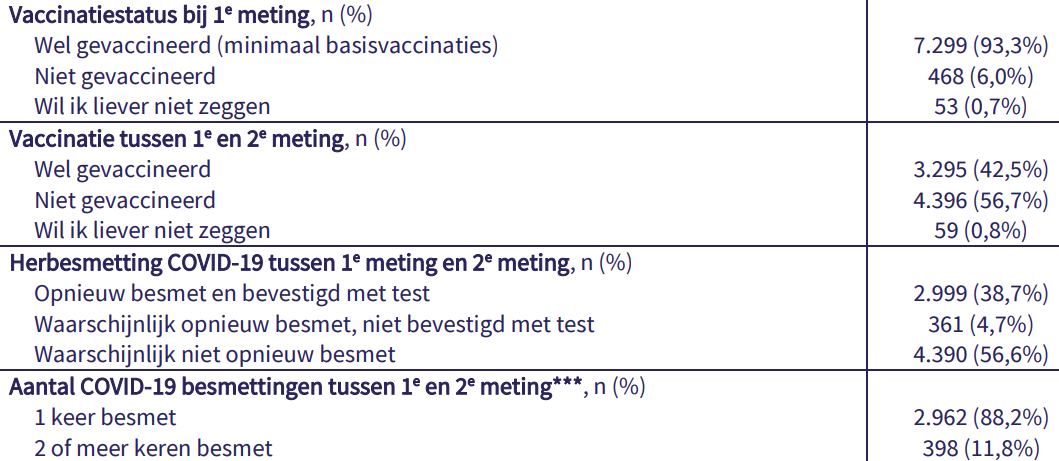
- 93% were vaccinated at the first measurement (!)
- 43% were vaccinated between the first and second measurement (the total will have been close to 100% by then)
- 43% of the total, now almost fully vaccinated group has been symptomatically infected again between measurements 1 and 2, some several times (so much for robust protection)
- 76% of the participants were women (We also see these percentages in similar studies on this subject women)
- 54% highly educated
- 49% had one or more chronic conditions in addition to post-COVID (this seemed like a lot to me but turns out to be quite normal in terms of osteoarthritis, diabetes, hypertension, depression or anxiety disorder and COPD... ☹)
A vaccination rate of 93% and then 43% reinfections, some several times. This is reported but nothing is said about it. Shouldn't you conclude from this that vaccination has in any case not helped against post-Covid? Surely that percentage should be much lower than the national average? It is now many times higher. Genetic predisposition? Or could this not be a reason to (especially together with that tinnitus, see previous article) also think about possible vaccine damage? Still not for the Post-COVID research by Erasmus/C support.
A quarter of the respondents had recovered at measurement 2. These were mainly the people who had not had a serious infection: a shorter duration of illness and did not end up in hospital because of Covid. That sounds familiar, it is also the case with PAIS. Good news or not? A quarter seems like little to me, after a year. But at least it is decreasing! (We hope then.)
And then the ladies...
Everyone who gets complaints looks for a cause. If you can put a name on it, that can help a lot. Not only for the treatment but also for your own peace of mind. So if you are one of the approximately 600,000 women aged 45, 50 years old and you have just recovered or are still recovering from Covid, you are worried if you get symptoms that are -according to C-support- the most common complaints of post-Covid.
Om een indruk te krijgen: als 1% van de 600.000 vrouwen tussen de 45 en de 50 jaar zich met hun overgangsklachten (terecht) zou opgeven voor dit onderzoek, dan heb je al meer vrouwen met "post-Covid symptomen" dan aan het onderzoek deelnamen. Dus enige vervuiling van de pure 'post-Covid' is iets om bedacht op te zijn. Tenminste als je pretendeert aandacht aan 'post-Covid' te willen besteden.
The 20 most commonly reported complaints show a striking similarity with the 20 most common complaints during menopause. (As a reminder, 76% were women, average age was 49). We do not see the typical hormonal symptoms such as temperature dysregulation and changed libido post-covid, but otherwise... compare for yourself.
Post-covid
- Fatigue (5)
- Difficulty with stimulus processing (4 and/or 8)
- Concentration problems (8)
- Loss of Fitness (5)
- Memory problems (8)
- Word finding problems (8?)
- Shortness of breath during exertion (5)
- Irritability (4)
- Sleep problems (3)
- Headache (11)
- Muscle pain (9)
- Pain in extremities (~19)
- Muscle weakness (9)
- Palpitations (10)
- Dizziness (16)
- Joint pain (9)
- Sadness (and anxiety) (4)
- Tinnitus (17)
- Tingling in extremities (19)
- Chest pain (10)
Menopausal symptoms
- Flushes – Sudden heat attacks, often with sweating and redness.
- Night sweats – Heavy sweating during sleep.
- Sleeping – Difficulty falling asleep or sleeping throughn.
- Mood swings – Irritability, anxiety or depressive feelings.
- Fatigue – Constant lack of energy.
- Weight gain – Especially more fat storage around the abdomen.
- Vaginal dryness – Less fluid production, which can make sex painful.
- Memory and concentration problems – Also called 'brain fog'.
- Muscle and joint pain – Stiffness and pain in joints and muscles.
- Palpitations – Irregular or accelerated heartbeat.
- Headache or migraine – Often due to hormonal fluctuations.
- Thinning hair – Hair loss or brittle hair.
- Dry skin – Less elasticity and faster wrinkles.
- Changes in libido – Less desire for sex.
- Bladder problems – Faster bladder infection or urine loss.
- Vertigo – Lightheadedness or balance problems.
- Tinnitus (ringing in the ears) – Ringing or ringing in the ears.
- Burning mouth syndrome – Sensation of burning in mouth or tongue.
- Tingling – Prickling or numbness in hands or feet.
- Gastrointestinal complaints – Bloating, flatulence or digestive problems.
Menopausal complaints also include tinnitus, which was initially not seen as a relevant post-Covid complaint. And it may not be at all, because just like the other complaints, it also fits with the menopause and even more so with post-vax. And I wouldn't be surprised if it also occurs in one of those other 'misunderstood diseases'.
Risers or hot flashes
Most complaints have reduced between the first and second measurement. That is reassuring in view of the possible genetic misery from the Vandenbossche scenarios, DNA pollution, etc., because you would expect more stubbornness, or even increasing complaints. The decreased complaints now appear to be temporary.
However, there are also some risers, complaints that were more often were mentioned than in the first measurement - and that is all the more worrying. With an increase of 10%, the biggest increase is: Menstrual complaints among female participants between 18-50 years of age. From 28% to 31%.
So almost one in three women who reported post-Covid are still experiencing problems with their reproductive system a year after the first measurement and it is becoming more rather than less.
I find this shocking. Especially now that I have just been working on Hans Verwaart's analysis (in between) and have seen that in 2024 there were almost one-third more deaths than expected among women between the ages of 40 and 50. And on top of that, the Yale study that I cited in the previous article, with 69% women in the PVS group.
This is dealt with remarkably easily in the report. This very long-term disruption of the reproductive system is in place 24 between shortness of breath and confusion. Now I don't want to trivialize being short of breath or confused, but if reproduction is at stake, other alarm bells should go off. Not to say: sirens.
Our reproductive systems, like our brains, are exceptionally well protected (Immunological privilege). There are specific barriers and a unique immune environment around these organs. They should not be affected by a virus. And they won't be either. We do know from autopsies that the vaccine spikes are simply found there. This is really of a different order. Think of declining fertility, meaning even fewer births, think of the transferability of defective DNA to offspring... or rather not think about that. So what percentage of those women with menstrual complaints had been vaccinated? If only we knew.
What helps?
The best-rated treatments for post-COVID complaints appear to be alternative treatments: Meditation (83%) and Coaching (73%). The first regular medication is in third place. Coping is key, apparently. But whether that also helps against those menstrual complaints, a year later...


Might an extra shot help against post-Covid?
Do we remember that the shot no longer worked against infection, then no longer worked against getting sick, then no longer worked against hospitalization and then no longer worked for anyone else? And no longer against general mortality? Particularly with a view to young people, protection against 'Long Covid' was at one point the only means of pressure. That also turned out not to be true. In any case, a serious infection is a blow to your entire condition.
For example, there have undoubtedly been post-Covid patients who have taken another booster in the hope that the (supposed) beneficial effect would reduce their symptoms. The 18% of post-Coviteers who, despite everything, had themselves vaccinated again and actually experienced an effect, were unfortunately disappointed. In two-thirds of the cases, it turned out negatively: new complaints and/or worsening of complaints.
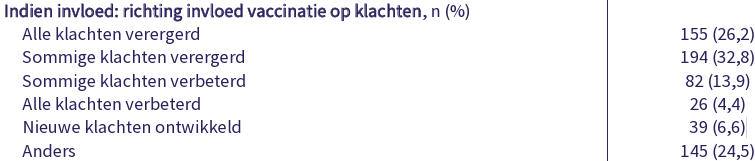
That's crazy actually. You are talking about post-Covid complaints and they are made worse by a shot - against Covid! How is that possible? Wasn't that also the case with those previous injections? It can hardly be otherwise?
In de conclusie van het rapport wordt dit beschreven als "geen significante verschillen wat betreft de verandering in herstelstatus op basis van eventuele herbesmettingen en/of vaccinatie(s)."
It could be a reason to find out what the interaction is between transition, Covid and/or vaccination in that almost fully vaccinated group. Maybe there is something more to find out. This last table invites you to do so - at least, if you are blessed with scientific curiosity. And: if you think your subsidy provider will be happy with that.
Not so. We are looking at a system entanglement that is unprecedented and continues to make victims ruthlessly. The next round of vaccinations is already on the docket.
If all vague mortality is written similarly on Covid, there is no arguing with it in NL. Dutch science falls short in the sense that it is collaborating with a NATO-led takeover.
"Ve're penettrating ze guvernments!" (had Rutte kunnen zijn).
People, think carefully. They have even urged pregnant women to get vaccinated. I repeat my call from years ago: For heaven's sake, don't get your children vaccinated.
I also repeat the conclusion of the previous article: The report does not do justice to both post-Covid and Post-vax patients. It shows a kind of disinterest. As if it is a sweetener for the post-vaxers (and the post-Coviteers who have not had primary care just as well). And women in menopause could have been reassured. All this apart from the fact that everyone with similar complaints is now being handed a very fragile straw.
Or is it just file building for the parliamentary inquiry (vaccines good, covid bad)?

I miss 'brain fog' in the list of post-covid complaints and menopausal symptoms.
A few years ago I read that post-covid was three times more common in women between the ages of 40 and 50 and even nine times more common between the ages of 50 and 60 than in people over 60 or under 40.
The RIVM already concluded in May/June 2021 that they could not demonstrate that vaccinations reduce or prevent post-covid.
Why do you miss that, where do you get your top 20 from?
The terms differ a bit, but I count Concentration problems, Memory problems and Word finding problems well for Memory and concentration problems – Also called 'brain fog'.
You can see it that way. If you have a number of symptoms at the same time, the risk of brain fog is greater anyway. Also in French, German, etc.
There are only 2 women with whom I have talked about the subject of "menstruation" and now both (!) have ended up in menopause after being pricked: my sister 44 years old (who looks away from the cause) and another lady 32 years old who had done with flow after prick 2, fully aware of the pricking cause that also led to major brain surgery (!!). In addition, I recently spoke to a young guy in a student house who told me that just about all the girls there got menstrual disorders after the shot, some of which have not recovered to this day.
That ^ is just a very small selection of all the health issues I see/saw around me. It's completely absurd.
Wow. What do they think of that in that student house? Are they not stirring? If that's the case, I really don't understand it.
Yes, I asked that too. The answer was along the lines of "Yes, what can they do, it is pretended it does not exist, it is not talked about. everything is swept under the table"... Or while, they can't do anything if they are not publicized.
Let them write an article, I'll post it!
They are not going to do that. The level of the student has plummeted to such an extent that people have been stupid enough to get vaccinated. For holidays and parties while they had had many a slumber party all this time during the curfew, among other things (they had my blessing then). They fully participated in excluding the unjabbed. Never before have I experienced so many serious miscarriages resulting in operations and also infertility due to adhered tissues in my environment. Babies with adhered intestines or other abnormalities are also commonplace. Of course I feel sorry for the children. I hope they will find the guts somewhere to take action. As early as the beginning of 2021, the lung fund, together with a company, was looking for recent graduates of biomedical sciences or other relevant study to put "long covid" on the map.
Just an addition. More recent studies show that 'only' 30 to 55 percent of women between the ages of 40 and 55-60 had more post-covid symptoms than men of that age.
But because men also regularly have certain menopausal symptoms/penopausal symptoms, it would have been better if they had compared the percentages with other age groups and genders. Also, after 2021, most healthy men and women in most countries have not taken a booster. The fact that (then) after the age of 60 a lower post-covid risk is found everywhere compared to people under 60 is, according to the vaccination adepts, proof that injecting helps. Critics will rightly say that post-covid symptoms, especially in women between 40-60, are polluted by menopause and menopause.
Unfortunately, "polluting" data is a problem. This is also the case with the HPV shot. Previously, it was rare for a case of cervical cancer at a young age, but with the HPV shot you could prevent cervical cancer at a later age (because it took years for the disease to manifest itself). Now the MSM says that especially young women without an HPV shot are under 32 years old! cervical cancer. These are quite large numbers, also with HPV shots. Could the cause be the Corona shot? Or a combination that also causes more metastases because that was also much less common before? Instead of research with this data soup, a white coat is already shouting in the newspapers that it is the HPVunvaccinated's own fault.
No, because their HPV effect conclusions are nonsense. Explanation: In the first mass vaccination year, the turnout was less than 50 percent and the percentage has remained fairly stable for ten years afterwards. These first girls are now a maximum of 25-26 years old. The average vaccination rate of the over-26s is therefore much lower than 50 percent. They were later given the opportunity to be vaccinated, but less than 15 percent actually did so. I estimate that this percentage is rather below 10 percent. Also, the percentage of people under the age of 26 who get cervical cancer is negligible. At least 90 percent of the age group they studied will 'only' get cervical cancer after the age of 25. Mind you, these are very small numbers, which makes it difficult to draw firm conclusions. In any case, the effect of the shots is rather zero and perhaps negative. Maybe Anton can write a devastating print about it if he can get the source data to the surface.
please, I already have my hands full... 😅
Yes, I mean that it is nonsense what is now being claimed. Unfortunately, more shots will be given by this white coat horn. At my grandchildren's sports club, almost all 10-year-old children went for the free (that was explicitly stated in the brochure: free now and pay for yourself). HPV shot. So sad. Quite right Anton, you already do so much! 🙏
I heard many women in my area who got menstrual disorders after the injections. Also women of 70 who suddenly started menstruating again.
I heard Agnes Kant of the Lareb say on radio 1 at the time that they had received (as I seem to remember pretty surely) 14,000 reports of this, so that women no longer had to report it.