
Virusvaria-lezer JVI, naam bij de redactie bekend, gaf een commentaar op de vorige post, dat ik hier graag als zelfstandig artikel presenteer (verluchtigd met grafiek en tabelletje van eigen hand). Temeer daar een andere zeer gewaardeerde lezer en bijdrager (Jan van der Zanden) een interessant weerwoord leverde. Des te interessanter, niet alleen vanwege zijn encyclopedische kennis maar vooral vanwege zijn ad interim werk bij het CBS. Hij heeft bovenop de materie gezeten.
Now we all understand that the level of pension has something to do with life expectancy. But to what extent has Covid affected that? It seems that life expectancy has been shortened and then the retirement age should be lowered, I understand from JVI. But we don't hear anything about that and we don't see anything in the forecasts. Jan van der Zanden, however, objects that this is all regulated by law. According to him, CBS is not doing anything strange in this regard (except for withholding data on mortality in combination with vaccination status, of course).
My intuition tells me (I'll just share it with you) that those vaccination statuses would have been headlines in the media if it had suited the government. Read: if the retirement age were to be raised because the vaccines had really been as effective and life-extending as RIVM and NIVEL have shown.
If there had already been laws in that situation that prevented an increase, they would have been amended or otherwise removed, for example because of the exceptional situation. And of course that's not happening now. Because the lower the retirement age, the more expensive: people save for a shorter period while payments must be made earlier. The corona crisis continues to worsen.
But: be sure to read for yourself what both gentlemen argue. They both know very well what they are talking about, you can assume that.
To understand the government's lukewarm, negative response to 'norm mortality' 1Read the post about the reactions to Normmortality and to be able to explain CBS's complete silence, you should perhaps look at another, politically sensitive, policy area where a kind of 'norm mortality' already plays a major role. This also opens up a new perspective on the socio-economic consequences of the COVID-19 crisis. Additional material for cost-benefit analyses?
I summarize in 8 points:
- There has been an implicit 'standard mortality' for some time now, namely in the context of the policy of systematically raising the state pension age. This policy started in 2013 and in 11 years the state pension age has been raised from 65 to 67 (effective from 2024). Further increases (up to age 72) are planned in the coming years;
- The justification for the policy was the trend increase in the remaining lifespan of 65-year-olds predicted by Statistics Netherlands, i.e. the DECREASE in mortality rates for people over 65. Increasing the state pension age by 2 years should therefore correspond to an approximately 2-year higher remaining life expectancy of 65-year-olds in 2024 compared to 2013. These 2 years are approximately 10% of the total remaining life expectancy of 65-year-olds in 2013 (roughly 20 years). On average over an 11-year period, the decline per year should amount to approximately 0.9%. You should also compare this factor per year with 'volume effects' such as aging to determine how the total mortality of people over 65 has developed;
- Unfortunately, a 10% increase in expected remaining life did not occur in 2013-2024. CBS's predictions turned out to be too high. The remaining lifespan of 65-year-olds in 2024 will be barely higher than in 2013. For time series, see:
https://www.cbs.nl/nl-nl/nieuws/2024/45/prognose-levensverwachting-65-jarigen-20-96-jaar-in-2030 (
N.B. Open the first table of this web page;)
| Life expectancy at age 65, observation. | |||
| 2003 | 2013 | 2023 | |
| Observation in years | 17,78 | 19,6 | 19,87 |
| Increase every 10 years | +10,2% | +1,4% | |
| Source: CBS | |||
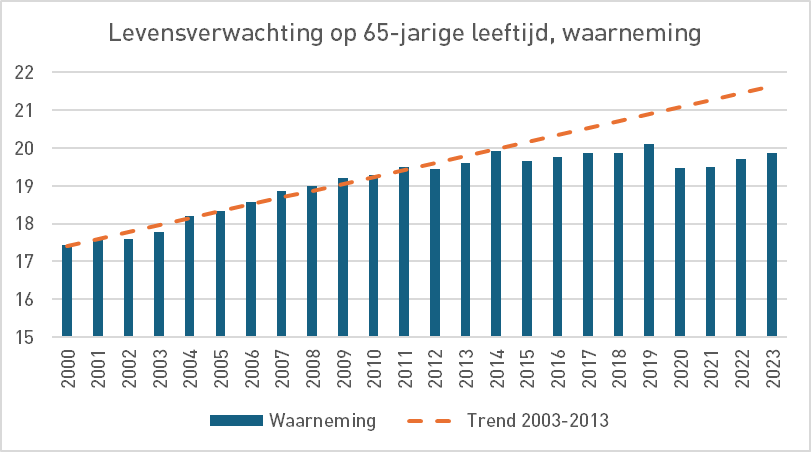
- The too low lifespan was not only the result of the significant increase in mortality during the COVID-19 crisis, because even in the period 2013-2020 there was no observable increase in the remaining lifespan at 65 years (early 2013: 19.6 years, early 2020: 19.5 years). In other words according to the 'pension policy standard mortality', there was actually already 'excess mortality' shortly after the start of 2013. It is true that COVID-19 mortality is a major new problem, see point 7;
- Nevertheless, the government (Rutte cabinets after Rutte-1, and the Schoof cabinet in 2024) continued to raise the state pension age in 2013-2024. CBS has also never raised the alarm about its own far too high predictions. The result was that after 2013, people gradually had to give up more and more of their pension (in terms of time and money), without getting anything back. At the beginning of the period this sacrifice was still limited, but now it can be said that a major social problem of unequal treatment of pensioners has arisen. Time for a parliamentary inquiry?
- The CBS forecasts that were too high were one-sidedly based on developments in 2000-2010. However, that decade was certainly not representative. In 2000-2010 the expected remaining lifespan of 65 year olds indeed increased by 2 years, but in the fifty years before 2000 this increase was only 3 years! Given that history, it is astonishing to see how a statistical agency can make long-term forecasts, simply extending developments in a relatively short, exceptional period (decades) into the future! But yes, for Rutte-1, CBS's reputation was only in the field of 'descriptive statistics', they never did 'explanatory statistics' before;
- But there is more. We are not only dealing with a failure to increase the remaining lifespan (at least 10% over 11 years) but also with an additional decrease of 10% in the expected lifespan due to much higher mortality in 2020-2024 during the COVID-19 crisis. This is a major problem for anyone who wants to convince the public that the state pension age can be increased further. This is now being advocated again, during election time, by the VVD.
The decline in expected lifespan in 2020-2024 is not apparent from the CBS table in the November 2024 report, but is unmistakable, because according to the definition of 'statistical expectation', the expected remaining lifespan at 65 is no different than the weighted sum of the years and mortality probabilities for all ages over 65. If there is a 10% higher mortality across the board, this should sooner or later manifest itself. translate into a 10% decrease in the remaining life expectancy of 65 year olds. So instead of an addition of 2 years compared to 2013, life expectancy should actually be reduced by 2 years for people who are retiring now. The remaining age has now become 17.5 years again, just like in 2000, a decline of a quarter of a century! - CBS does not dare to show this in the table. To justify this, CBS referred in previous reports to the incidental nature of the increased COVID-19 mortality, including references to experiences with the Spanish flu after WW1. Now that higher mortality continues, this is no longer possible and CBS has chosen NOT to portray the consequences of the crisis in any other way. CBS writes in the November 2024 report that the prediction of the life expectancy of the Dutch population will from now on no longer be based on trends in the Netherlands, but on trends estimated by an 'international model'! CBS will not make any further statements about this model. So from 2020 (beginning of the COVID-19 crisis), expectations of the remaining lifespan for the Netherlands are given based on the international model (NATO?)…
Response from Jan van der Zanden (ex-CBS director ad interim)
I don't think the article (by JVI, ed.) is very objective. But maybe I'm not reading properly or I don't know something...
CBS neatly reported on 11/8/2024 that life expectancy has decreased.https://www.cbs.nl/nl-nl/nieuws/2024/45/prognose-levensverwachting-65-jarigen-20-96-jaar-in-2030And also that this is due to Corona (obviously not due to vaccinations, but they don't know that there and they don't talk about that; but we wappies know better...).
And shortly afterwards (11-11), the minister froze the state pension age for 2030 in accordance with the law.https://www.awvn.nl/pensioenregeling/nieuws/aow-leeftijd-in-2030-67-jaar-en-drie-maanden/#:~:text=Net%20als%20in%202028%20en,geen%20sprake%2C%20meent%20de%20minister. He reported that the decrease was actually enough to lower the age, but that is not allowed by law. And he expects that the decline is not so structural that it is not necessary to adjust the law. The expectation is probably (but that is my speculation) that from 2031 or 2032 the state pension age will rise again because life expectancy has increased again.
And the VVD election manifesto simply states that the state pension age increases as life expectancy increases. I think that's been there for years. And also that the link between AOW (and WIA and WW) with minimum wage will not be abandoned; the link with Social Security and that type of minimum benefit. Mi. completely right.
I really don't understand the criticism in your article. C.q. I can find no facts to support the criticism.
What is really wrong with CBS is that they keep coming up with excuses (possibly on behalf of VWS, where the CBS director was here for the director!!!) to withhold detailed data about mortality and vaccination status. That is really very serious and bad.
Possible follow-up in the comments!
References
- 1

Point 4 states a life expectancy from 65. This is expressed in days. I hope you meant years.
Adjusted, thanks!
Lunch break, nice new article (eat with attention 😉), the realization that others have already read it with great attention shows that “days” should be “years” and that feels good. Because that means, in my eyes and I hope in your eyes too, Anton, that the number of readers here is fewer than for articles/messages in the MSM, but that the readers of the MSM often rush to headlines and accept the propaganda as truth and the readers here actually do something with the information to uncover the truth.
What I still miss is the effect of the baby boom generation that is now retiring. Perhaps not interesting for the statistics, but it is an argument for the disguise. The aging of the population is causing greater pressure on services and perhaps the government wants to use lies and deceit (the truth is so boring) to ensure that the state pension and healthcare do not become too expensive? And buying bullets is also so much better than keeping people alive longer.
Most baby boomers have been retired since age 65. What also plays a role is that the government made a large grab from the pension pot during the banking crisis in 2008, to save the banks. The EU now wants to tap into that pot more often for their criminal agendas
Indeed, life expectancy has already increased less since 2013. This is partly because we had two heavy flu seasons before 2020, with approximately 10,000 additional deaths. Between 2013 and 2020, we had an average of 5,000 flu deaths annually, while ten years earlier this number was approximately 2,500 annually.
Interesting article. Thanks!
Als brainstorm:
Isn't it true that after, say, the age of 55, little work is done? -And if this is the case, isn't it much cheaper to leave the labor process with a good arrangement (e.g. 70% of your last earned salary)? That makes a difference of 67-55=12 years of 100% continued payment.
I think they used to call this (before my time): VUT. Why not reintroduce that scheme? Saves money regardless of remaining life expectancy.
Or is it the intention (speaks the devil in me) that the aging population will throw in the towel long before the age of 67 (or 72). Of course, you don't have to pay anything to people who voluntarily leave the workforce = it is the cheapest..
The pity, Willem, is that this money comes from a different “pot”.
The 100% continued payment comes from the government, while it is currently only 70%.
Early retirement was there because there were too many employees for too little work (it can happen that way).
So the elderly had to make room for the young.
Now the older people have to continue working for the young people, but this is not experienced that way by the young people. They believe that the elderly benefit. I don't know what we benefit from then.
All statistics show that since early retirement has been abolished, people continue to work much longer. Now also after the age of 65 and a significant proportion also after their state pension age.
And that is very good for 3 reasons:
1. Rest rust!
2. The state pension does indeed become unaffordable as we grow older without working longer. See France.
3. The labor market is tight. If people do not continue working, even more labor immigration is needed. No asylum immigration, because unfortunately most of it does not work after many years.
Not rocket science, but it has still not gotten through to a number of political parties.
In FR you must have worked enough “tremesters” to receive a full pension. Many people no longer start working at the age of 16 but somewhere in their 20s, so at the end they have to work much longer than until 62. Wives of people with their own business, for example farmers, have often never officially worked and then receive 450,00 euros per month. They can't make it that way. Retirement in FR is much less luxurious than people often think.
Something different. NRC has an article about crazy wappies who file a complaint with the disciplinary board:
https://www.nrc.nl/nieuws/2025/10/10/aan-het-ziekbed-van-joop-sterk-stonden-zijn-familie-en-de-artsen-tot-de-laatste-snik-tegenover-elkaar-a4909128
It appears to be a missed pulmonary embolism:
Joop Sterk stares ahead, breathing heavily. […] The Covid test taken is positive, the oxygen level in Sterk's blood is low. “Acute respiratory disease due to SARS-CoV-2,” the doctor notes under the heading diagnosis in the medical file. […] After a number of days of relative stability, Sterk's situation deteriorated on December 7. The amount of oxygen in his blood continues to decrease. “The patient feels sick and short of breath.”
It is also suspected that he is suffering from one or more blockages of the pulmonary artery, so-called pulmonary embolisms. The ventilator makes it impossible to make a definitive scan of his lungs. As a precaution, the doctors give him blood thinners. […] In the presence of his wife, Joop Sterk died in hospital on Wednesday evening, December 8, 2021, nine days after his admission.
The article also contains a sentence that states that the doctors had to deal with restrictions imposed by the government. In my opinion they are guilty of this. There are people on a list who had to sell things to the Germans otherwise the family would be taken seriously and were severely punished for this after the war... I heard the same excuses from the beginning of 2020 when I still thought I could convince the healthcare providers, including two ICU doctors in my area, that the protocols were fatal in many cases. Mostly economic explanations for this lack of norms and values.
The following sentence struck me:
'An ambulance transports [...] in the middle of the night to the emergency room of the Catharina, where a young doctor examines him. The Covid test taken is positive, the oxygen level in Sterk's blood is low. “Acute respiratory disease due to SARS-CoV-2,” the doctor notes under the heading diagnosis in the medical file. Sterk is immediately given oxygen through his nose.'
Just before this, this person suddenly became unwell (as stated in the article). Sudden collapse, low oxygen levels, older age, male gender, history of cancer (all stated in the newspaper article), could this not (also) be a case of pulmonary embolism? Has a CT angiography been performed in due course to rule out pulmonary embolism? What was the D-dimer?
It's not in the newspaper article. The disciplinary board has ruled.
I can't say anything else about it. And by nothing I really mean nothing, so I'm not going to do that.
It is of course a mustard after the meal, but the statement of the disciplinary college to which the NRC article links contains more information:
https://tuchtrecht.overheid.nl/zoeken/resultaat/uitspraak/2024/ECLI_NL_TGZRSHE_2024_108
The assessing ANIOS ER did not request a CTPA on the night of admission, but ANIOS surgery (?) did do so in the morning. The following day it was noted that the CTA “[doesn't] show any indications of pulmonary embolism.”
“The standard laboratory examination on December 6, 2021 showed that the D-dimer had increased.” So apparently measurements have been taken before, but the result(s) are not stated. Even though D-dimer determination is “standard laboratory research”, it is not mentioned in the lab results of the night of admission (Lab: L 6.5, CRP 57, PCT 0.43, Hb 8.3, Na 132, K 4.0 Urea 11, creat 110, eGFR 54, ABG (with 6L 02): pH 7.51, pCO2 27, p02 68, bic 24.3, lactate 0.90).
Striking: AOW age can increase due to higher age, but the law says nothing about lowering it if the average age decreases. Smartly done. As if they knew what was coming.
Correct, it is legally arranged that the retirement age may be increased if life expectancy increases, but not reduced if it decreases.
So if life expectancy increases again after a dip that lasts for a few years (due to, for example, Covid, vaccination, war, etc.), the retirement age may be increased again. Even if life expectancy has not yet returned to the level before the dip.
So there is actually no implicit standard mortality that would be based on the state pension age, at least as far as I have been able to deduce from the law.
It's really different than you suggest.
The state pension age does not increase at all “always with an increase in life expectancy”. So not at all extra after a dip.
Article 7A paragraph 2 of the AOW law states.
V = 2/3 * (L – 20,64) – (P – 67)
So:
Increase = 2/3 * (Life expectancy at age 65 – 20.64) – (Existing Pension Year – 67)
So, rounded off and limited to increments of 3 months, the following applies:
Pnieuw = powder + 2/3 * (l (65) - 20.64) - (powder - 67) =
67 + 2/3 * (L(65) – 20,64)
In short, P does not rise at all after a dip.
The standard of 67 years and the life expectancy of 20.64 years were established in 2012 and this 67 years would be achieved gradually in 2024.
The link was reduced from 100% to 2/3 = 67% in 2020. And then it was also established that the state pension age cannot be lowered.
The state pension age is now 67 + 2/3 of the additional life expectancy of a 65-year-old from 2012 (which was 20.64 years at the time).
It now appears that due to the excess mortality after Corona/vaccinations, the 67 years, let alone the 67 years + 3 months in 2028, was not correct. But further increases will not occur until life expectancy again exceeds the originally intended trend.
Thank you for correcting my interpretation of the government information. So there is an implicit standard mortality, based on life expectancy in 2012. Interesting. That's not too bad.
However, the law does not stipulate that the state pension age should automatically decrease if life expectancy decreases. So the government could do it, based on this implicit standard, but they don't have to. That's how I understand it after your explanation, Jan.
No, according to the 2020 amendment to the law, it may not be reduced if life expectancy is lower. Then the AOW law must first be amended.
And I/AI had overlooked something.
The amendment was submitted in June 2019, well before Corona. So that wasn't the reason!!!
It was decided that the state pension age was frozen at 66 years and four months, while it should actually have been 67 years in 2021. From 2021, the state pension age will increase in three steps to 67 years in 2024, three years later than previously anticipated.
And the option to reduce has been removed to prevent a yo-yo policy.
I would like to return to the history of the increase in the state pension age. This shows that the big mistake was made in 2012. This meant that the increase to 67 years in 2024 was fixed.
A mistake was made again in 2022: based on the figures, a further increase to 67+3 months in 2028 should not have been allowed. After that, his raise was, rightly, frozen. I have not yet found out why that decision was made in 2022. Probably because the excess mortality was expected to be only temporary.
Minister Van Hijum did “honestly admit” in his letter that based on the data, the 2028 increase was unjustified.
Conclusion: JVI is certainly right that the increase was inappropriate and is in accordance with the spirit of the 2012 law.
For enthusiasts an extensive factual account (from AI).
==========================
How did the decision to increase the state pension age come about?
See the easy-to-read version with graphs here: How did the decision to increase the state pension age come about.docx https://janvdzanden-my.sharepoint.com/:w:/g/personal/jan_janvdzanden_onmicrosoft_com/EU_IJybFHBlCihd1_kwPE9EBqFyPLpicrIYm_BSQoAGXTA?e=r64VpU
The increase to 67 years was adopted by parliament in June-July 2012 as a fixed trajectory: 2013→2019 (66 years)→2023 (67 years). Only from 2024 would the state pension age be linked to life expectancy. Life expectancy forecast for 65 year olds: 20.96 years in 2030 | CBS
This means:
1. The decision was political, not evidence-based monitoring: In 2012, the entire trajectory to age 67 was recorded, without an interim evaluation or correction option.
2. No 5-year outlook in 2019: The increase to 67 years of age in 2024 was already decided in 2012. There was therefore no moment in 2019 when the government could look at the data and decide not to proceed.
3. Signs that things might go wrong:
o The increase from 2000 to 2010 was already extreme compared to the 50 years before
o It was already apparent in 2015-2017 that life expectancy was stagnating
o But the political decision contained no brakes
4. The link to life expectancy came too late: From 2024, the state pension age will be linked to current figures, but by then the damage had already been done.
Conclusion
The increase to 67 years was not a data-driven decision made in 2019, but a political decision from 2012 based on overly optimistic CBS forecasts, without the possibility of adjustment when it turned out that reality was different.
The visualization is now complete and clearly shows that:
See: https://claude.ai/share/efcc3f33-e4e7-48a5-8962-2a8eac8a3916
• The decision was too early and too rigid
• There was no correction mechanism
• The signals of stagnation were ignored
• People are structurally disadvantaged as a result
Analysis of CBS forecasts, actual developments and the impact on AOW benefit duration
CRUCIAL: When was the increase to 67 years decided?
• June-July 2012: Law passed by the House of Representatives and Senate
• Fixed trajectory: 2013 → 66 years (2019) → 67 years (2023)
• Only from 2024: Link to life expectancy according to CBS formula
• Conclusion: The increase to 67 years was a political decision in 2012, NOT based on subsequent monitoring
What does this mean for responsibility?
• 2012: Cabinet decides on a fixed trajectory to age 67 based on optimistic CBS forecasts
• 2013-2019: Life expectancy stagnates, but trajectory continues (no interim evaluation/correction)
• 2020-2023: COVID-19 causes additional decline, but 67 years will still continue in 2024
• From 2024: Only now linked to life expectancy, but the 'damage' of 67 years has already been done
KEY QUESTION: Could people have known in 2012 that the increase was too optimistic?
PARTIALLY. The decision was made in June-July 2012, based on CBS forecasts from that period.
• The extreme increase in life expectancy in 2000-2010 was already atypical compared to 50 years earlier
• CBS should have made a more conservative forecast given the historical context
CRUCIAL ERROR: The trajectory to 67 years was laid down as a political decision without an escape clause. Linking to life expectancy would only take place from 2024 onwards.
1. Were CBS forecasts optimistic?
YES. CBS consistently predicted 20.8-21.0 years of life expectancy at 65 for the years 2026-2030.
Reality: In 2024, life expectancy is 20.3 years – lower than all forecasts from the years 2020-2023.
2. Was the 10% increase assumption correct (2013-2024)?
NO. Expected: 19.6 → 21.6 years (+10%)
Actual: 19.6 → 20.3 years (+3.6%)
3. Was there already 'excess mortality' before COVID-19?
YES. Between 2013-2019, life expectancy at 65 increased by only 0.1 years (19.6 → 19.7).
For the policy goal, this should have already been ~20.5 years in 2019. An interim evaluation should have identified this.
4. Has COVID-19 caused additional damage?
YES. Life expectancy fell from 19.7 (2019) to 18.9 (2020-2021).
A setback of 0.8 years, on top of already lagging behind the target. Nevertheless, 67 years was implemented in 2024.
5. Should adjustments have been made in 2013-2019?
YES. It was already clear in 2015 that life expectancy was stagnating.
But the 2012 political decision did not contain a correction mechanism – the train to age 67 could no longer be stopped.
Where did it really go wrong? That is in 2022. Despite the lower life expectancy, it was decided to increase the state pension age to 67 + 3 months in 2028. That shouldn't have happened. But it cannot simply be reversed.
Of course that suited her. It really seems like they have turned a blind eye. If it had been the other way around (financial negative effect) they would undoubtedly have reacted alertly, amended laws or whatever.
It's even more complicated. An acceleration was implemented in 2016 and a temporization in 2020.
Adjustments could therefore have been made at two points, because it was then known that the trend (67 years in 2024) was too optimistic. But the tenor remains approximately the same. So AI was completely wrong.
I have modified my .docx (see link above). I think it's completely correct now.
I think it's a killer that things can't be reversed or adjusted. With the right people in power, we can cancel contracts and laws and amend laws. We can leave the EU and NATO and adapt Dutch laws to the current situation. If we stop paying the EU and Capitalists, everyone can retire at 65 again.
Okay… De levensverwachting stagneert, maar de kans om ouder dan 90 te worden is gestegen? Ik heb meer vertrouwen in de artikelen en reacties hier op virusvaria dan in de media!
https://esb.nu/nederlanders-onderschatten-hun-levensverwachting/
For the enthusiast in this challenging matter; Due to the lower life expectancy after/because of corona, I remember CNV leader Fortuin talking about saving €5 billion on the AOW, which you can do fun things with in a collective labor agreement.
Only now elections and cuts to, for example, the AOW have come forward again (new NATO standard), for example by raising the AOW retirement age to 73 years. I can't make it more fun for you, but I can make it more complicated.
Well, exaggerating is also a skill: I don't see that happening in 73 years anytime soon.
But our pension billions, prosperity and sovereignty are “at stake” due to, among other things, the Euro crisis and the Euro debt mountain after Corona.
Look, now we're getting somewhere Anton. Sometimes it takes a while. 😉
In my opinion, the pension law is the main reason to expect low mortality. This low forecast is far from consistent with the long-term trend.
If you calculate historical figures into the future, you end up with much higher mortality, and therefore lower life expectancy.
I suspect that CBS has deliberately kept these figures low in order to substantiate the figures by law.
That is why I am not surprised about the current mortality figures (with some exceptions).
But the 80+ shows 'normal' mortality.
I already wrote something about it.
https://x.com/BonneKlok/status/1780603844378140798?t=h8YYoYAv_swM7DEVNATGKQ&s=19
https://www.ad.nl/economie/met-67-jaar-en-3-maanden-met-pensioen-blijft-nog-wel-even-want-heel-veel-ouder-worden-we-niet-meer~a1ca0f46/
Dus dat?
What I miss in the above considerations is the effect that increasing the retirement age has on life expectancy. Think of the debilitating effect of the lost enjoyment of life at the prospect of having to work longer, plus the devastating effect of working itself. Rust rust? Yes, perhaps for a few completely unimaginative zombies who, after retirement, are bored out of their minds.
When someone asks me how I manage to be so old and healthy, my answer is: Little alcohol, no tobacco, masturbate regularly and WORK AS LESS AS POSSIBLE!
Economic explanation(s) of a lot of what we are in: Hester Bais with Jorn Luka in The Trueman Show. Hester definitively has the contract/evidence in her hands. Please share this story. In the meantime, anyone who can bring the details to light remains just as important, such as this site virusvaria, because every death also generates money because there is no longer a pension to be paid, etc. I hope from Hester's words that it takes less than 20% of the people to bring out the good (in my own words).
Thanks everyone for the comments on the article!
Especially 'my opponent' Jan van Zanen, in consultation with AI, did his best and managed to uncover additional information.
However, the responses are mainly focused on the first point I wanted to make (the ratio of standard mortality to increasing the state pension age) and not so much on my second point, namely that CBS refuses to include the high mortality of the COVID-19 crisis in the calculation of the expected remaining lifespan of people over 65.
That is a shame because the second point is precisely important for cost/benefit (CBA) analyses. Anton and Herman recently attempted to identify some of the direct costs/benefits of the COVID-19 vaccinations. They expressed this in terms of years of life lost. Of course it makes a lot of difference (a factor of 10 or so) if you only take into account the years of life lost of the deceased (estimated excess mortality) or also the expected years of life lost of the other population. In the first case you are talking about hundreds of thousands and the second case about millions of years of life. A complete CBA should also include an analysis of the indirect costs and benefits (for example effects on mortality via the economy, social relations, etc.).
In this context I also have a set of additional questions, because it is bizarre that CBS refuses to calculate the consequences of the OWN NL population and mortality figures with the OWN models ('cohort' and/or period models) in the remaining life expectancy of Dutch people over 65!
Yet there is no misunderstanding about this. CBS confirms the refusal by simply admitting this openly in the first years of the COVID-19 crisis, explaining the likely incidental nature of that crisis. If the crisis later turns out to not be very incidental, CBS will not make any further calculations, but in the 2024 report it will be stated bluntly, without stating reasons, that CBS will from now on focus on an 'international model'.
This state of affairs naturally raises questions:
1. Why exactly is the current CBS model no longer sufficient?
2. Why, according to CBS, was this model suitable for supporting the policy regarding raising the state pension age in the period 2012-2024?
3. More specifically: how will CBS justify plans to further increase the state pension age if the expected remaining lifespan is no longer directly based on the NL population?
4. Why does CBS not opt for a similar solution as RIVM, namely continuing with the existing modeling, but with an adjustment, for example the inclusion of an increase component, in the models for 'unexplained' higher mortality?
5. Did CBS actually decide on its own to switch to the international model, or did it first discuss this with clients, or possibly even exert pressure from clients?
6. When discussions have taken place, who has been discussed and how great was the pressure from clients (please specify by policy area and level: are those parties national/international and governments/businesses by sector)?
7. We see in recent history that there is an aversion to accepting a decrease in expected (remaining) lifespan. This is evident, among other things, from existing legislation regarding retirement, which formally stipulates that a decrease in the current state pension age is even excluded. Does aversion also play a role in CBS's decision to switch to an international model? Because it is known that the Netherlands has a relatively high mortality in the COVID-19 crisis compared to other countries, so that 'internationalization' (on balance) for the Netherlands means a relative reduction in mortality and an increase in the expected remaining lifespan.
8, What does that international model look like?
9. Who created that model and who else uses the model?
Finally, I would like to say something about Jan van Zanen's criticism of me in the main text of the article.
…my objectivity. I am certainly not neutral because I also belong to the large group of most affected people who retired/are/will retire (at least) 2 years later than expected. But this does not mean that my criticism of policy and CBS is not factual and objective.
…CBS. Jan says: CBS neatly reported on 8-11-2024 that life expectancy has decreased...
And also that this is due to Corona...
In that reference, Statistics Netherlands only reports the excessively high expectations in general from 2013 onwards (without, incidentally, putting on the blame itself). They also do not mention their refusal to calculate the effects of COVID-19 on mortality. CBS does use the term COVID-19, but as a (partial) explanation for the failure of its own (much too high) expectation of the development of lifespan after 65. This is therefore incorrect (those expectations were much too high long before 2020) and actually quite brutal, this is not 'neat' at all.
...the VVD. I read the following in the media about the CPB's calculation of the recent election manifestos of 10 political parties:
...VVD, SGP and Volt want older people to work longer, which will reduce expenditure on AOW. The precise increase in the state pension age varies per party, from a few months for VVD, SGP and JA21 to a whole year for Volt…
These 4 parties apparently see a significant additional source of financing for their plans in the coming government period and an even further increase in the state pension age. The fact that JA21 is not mentioned in the first line is probably because they did discuss this subject with CPB, but did not mention this in the public version of their program...
Until 2024, CBS openly communicated that there was (still) excess mortality even though Corona had already disappeared. After that it was covered up, mainly by RIVM.
I later added to my response:
1. There were two moments when the retirement age was adjusted [for 2020]. It was already known at that time that life expectancy was increasing less quickly than expected when the law was introduced. However, no action was taken to (temporarily) freeze the retirement age. That, in my opinion, is a policy error. I didn't know that at first. My bad for describing that incorrectly initially. You were right on this point.
2. I noted that Minister Van Heijum stated in his letter that the state pension age is too high given the current mortality rate. But it has simply been agreed (only in 2019/2020) that the state pension age will never decrease. That's pretty “fair” in my opinion.