


The Doctors Covid Collective reports in Her brochure, which I completely agree with, that one in every 250 children (0.4%) will have a serious side effect from a vaccination. Mental health nurse specialist Martin Voerknecht posted it and I saw it pop up in more generally reliable 'sources'. The echo chamber. I also shared it on Facebook myself, but then read the Pfizer report and discovered that it is incomplete and therefore misleading information. Here is my correction.
Earlier this week, there was an update of the Pfizer document with the COVID-19 vaccine (oftewel de officiële 'bijsluiter'). Daarin staat inderdaad dat 0,4% van de kinderen een "ernstige bijwerking" kan verwachten van vaccinatie. Op een school van 1000 leerlingen zouden dus vier leerlingen erg ziek worden. Oftewel: Van elke acht klassen krijgt één leerling iets ernstigs. Dat kan zijn:
- Hospitalization (or extension thereof)
- A life-threatening condition
- Dropout, disability or disability ("Een aanhoudende of significante onmogelijkheid of substantiële verstoring van het vermogen om normale levensfuncties uitvoeren").
(I have left out death and birth defects because there is no question of that in young people for the time being, neither in the studies nor in the vaccination campaigns.)
It seems worse than it is
Eén op elke 250 kinderen een ernstige bijwerking: hoe kan de Gezondheidsraad dat goedkeuren vraag je je af. Totdat je verder leest in het document:
Serious Adverse Events
In Study 2, among participants 16 through 55 years of age who had received at least 1 dose of vaccine or placebo (Pfizer-BioNTech COVID-19 Vaccine = 10,841; placebo = 10,851), serious adverse events from Dose 1 through up to 30 days after Dose 2 in ongoing follow-up were reported by 0.4% of Pfizer-BioNTech COVID-19 Vaccine recipients and by 0.3% of placebo recipients.
The percentage of serious side effects is indeed 0.4% in the vaccinated but in the control group it was 0.3%. So that's not so bad. Apparently there is a background of 0.3% serious conditions that are comparable to the symptoms perceived as side effects. That means that in a school of 1,000 students, there are always three students seriously ill, which seems like a lot to me. We assume that this 0.4% also applies to young people from the age of 12.
Let's assume this is the case, then there remains a 0.1% difference between vaccinated and not vaccinated. That's 1 in a thousand - and that comes from a relatively small study, so whether it is representative or significant is entirely questionable and I actually already know the answer.
A total of 2,260 adolescents aged 12-15 years also participated, (1,131 vaccine, 1,129 placebo). Can you deduce anything from that? (In the 55+ group, the proportions were similar: 0.8% against 0.6%.) The placebo group has also been vaccinated, so further side effects will only be seen in the tens of millions of children who are now injected with it worldwide.
Verderop in de fact sheet (p30) volgt er specifieke informatie over de jongsten van 12-15 jaar:
Unsolicited Serious Adverse Events in adolescents 12 through 15 years of age
Serious adverse events from Dose 1 through up to 30 days after Dose 2 in ongoing follow-up were reported by 0.4% of Pfizer-BioNTech COVID-19 Vaccine recipients and by 0.1% of placebo recipients. There were no notable patterns or numerical imbalances between treatment groups for specific categories of serious adverse events that would suggest a causal relationship to Pfizer-BioNTech COVID-19 Vaccine.
Dit is niet erg consistent: bij de placebo's tussen 12-15 zijn er veel minder "ernstige bijwerkingen" dan bij de placebogroep tussen 16-55 jaar. Driekwart minder zelfs!? Terwijl de kinderen die het echte vaccin hebben gehad dezelfde 0.4% ernstige bijwerkingen hebben. Je zou daar toch een uitleg of nader onderzoek bij verwachten voordat kinderen daadwerkelijk wereldwijd worden gevaccineerd. Niet dus. Terwijl de netto bijwerkingen toch 0,3% zijn in plaats van 0,1%, dus drie keer zo veel. Dat moet je kunnen verklaren voordat je gaat injecteren. Maar nee, ze zagen geen patronen waaruit verband met het vaccin zou kunnen blijken en dan houdt het op.
At the same time, these are such small subgroups that you can wonder whether or not you can actually decide whether or not to inject the entire population on the basis of those studies.
So: vaccination may be safe for children after all?
Let's calculate that 0.1% in a straightforward way. You can then make the calculation with 0.3% yourself in your mind. When vaccinating 1.1 million children in the Netherlands, 0.4-0.3=0.1%, which is about 1,100 children, will receive a serious side effect on top of the 3,300 children who normally become seriously ill. Those 1,100 would have survived corona effortlessly without vaccination.
Bovenop bovenstaande cijfers komen nog de myocarditis/pericarditis-gevallen die er sinds enige tijd uitspringen bij de meldingen. Deze aandoeningen zijn niet opgevallen in de onderzoeken en vallen dus niet onder die gerapporteerde 0,4%. Mogelijk zullen ze vaker gemeld gaan worden nu ze eenmaal erkend zijn als bijwerkingen. Artsen maken immers alleen melding van "verdachte" overlijdens en niet van overlijdens waarvan ze nog niet kunnen vermoeden dat ze door het vaccin veroorzaakt zijn. Hugo de Jonge noemt zoiets een 'verborgen gebrek'.
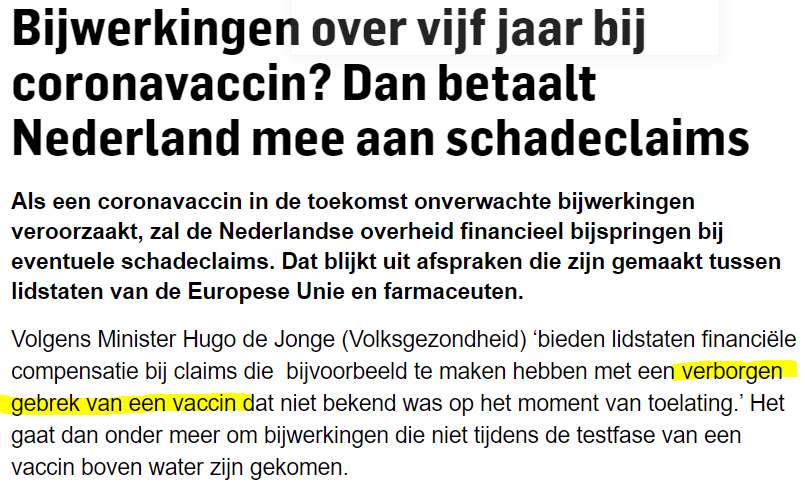
Met onderzoekjes onder een paar duizend gezonde jongeren haal je die 'zeldzame' gevallen er natuurlijk niet uit. Om verborgen gebreken te ontdekken zou je elke "ernstige bijwerking na vaccinatie" moeten melden. Dat is dan ook verplicht en een voorwaarde om te mogen vaccineren en om een of andere reden gebeurt dat gewoon niet, zelfs niet bij overlijden na vaccinatie (zie previous post). Reporting is quite a lot of work for doctors. Only if the doctor has a serious suspicion that it could be due to the vaccine, i.e. in the event of a registered side effect, then he/she will take the trouble.
General practitioner Jan van Tienen (who is also concerned about youth vaccination) previously said that the Lareb doubted whether a death reported by him was due to the vaccine. The severe body stress was seen as a normal side effect and if a vulnerable patient can no longer handle it, it is not really due to the vaccine but more to the patient's condition. So: no side effect, was the reasoning.
Unknown side effects are not reported, known side effects are put into perspective. What is left then?
Your own child must be really unlucky to be one of 1,000 (or 250) children who will have to deal with, for example, paralysis or infertility - should that ever occur. Maybe it's just 1 in 10,000, we don't know. Not knowing is annoying, but not wanting to know that you don't know is bad.
It is your own risk assessment or that of your teenager, who have a reputation for assessing risks. But the decision to do this to possibly thousands of children, for absolutely nothing - that doesn't sit well with me.
Under 40? Under 50? Under 60?
Many arguments against vaccinating children also apply to anyone under 60 without obesity, underlying lung or heart failure, with a healthy blood level (such as sufficient Vitamin D and Zinc). The Covid symptoms are less favorable than in children but still at a level for which we never forced vaccines in the past, let alone paralyzed the entire country. All hypochondriac have now run to the injection sites and adults, even in the face of mortal fear, are expected to be in their right mind. Children are far from being in their right minds, they are still growing. And certainly not after a year of persistent threats, avalanches of fear and vaccine propaganda.
