


Het effect van een angstcampagne op de kwaliteit van zorg werd in algemene termen besproken in het artikel "fear protocols", deel III van de nocebo-reeks. De daar genoemde afwijkende antibioticabehandeling wordt in dit artikel verder uitgediept door Jillis Kriek.
A recipe for disaster
Pneumonia from virus to bacteria
Pneumonias are especially common during virus season. A distinction is made between pneumonia caused by a virus or bacteria, but distinguishing is not easy. Usually this is done by analyzing the symptoms. Viral infections are usually mild, do not require hospitalization, and they generally go away on their own. However, bacterial infections can cause many problems resulting in death. Leaving pneumonia untreated can be risky.
The graphs below clearly show that viral and bacterial infections show a large correlation. That's not surprising. Viruses can weaken the alveoli, so everyday bacteria, which are all around them, can suddenly become a major problem if they end up in already weakened or inflamed lungs. An ideal environment for this, however uncomfortable: the hospital.
You don't want to have pathogenic bacteria in your body. You can disinfect and care for a suspicious wound, but you cannot stick a patch on your lungs. Viral pneumonia can therefore quickly spill over into bacterial inflammation and pose a danger.
A bacterial infection is one of the main complications of viral infections that cause people to die.

It is common to treat pneumonia antibiotics to be prescribed to prevent or prevent a bacterial infection.
Piekgebruik in tijden van griep...
In the graph we see about 30,000 dispensings of the antibiotic drug amoxicillin, which is widely used in respiratory infections in combination with pneumonia. The beginning and end of the flu epidemic is indicated by the red stripes.
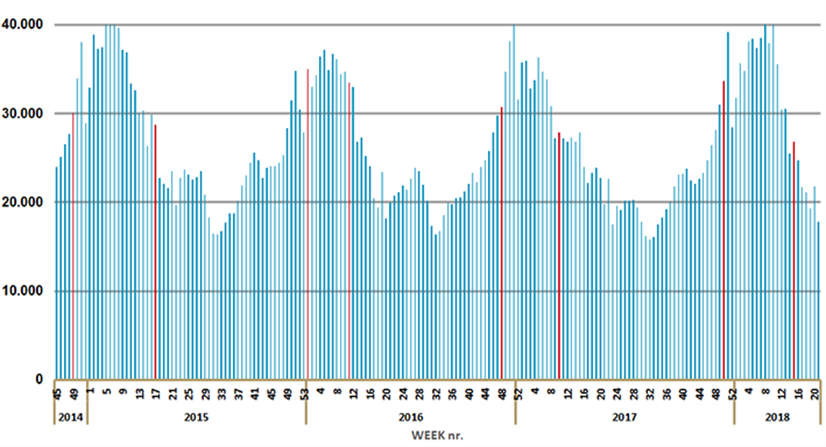
Amoxicillin is a broad-spectrum antibiotic given in multiple infections, such as in the lungs, trachea, throat, sinuses, middle ear, bladder, skin, heart, stomach, and intestines. During flu season, it is mainly infections of the respiratory system that need more treatment than in the summer.
...maar niet bij Covid
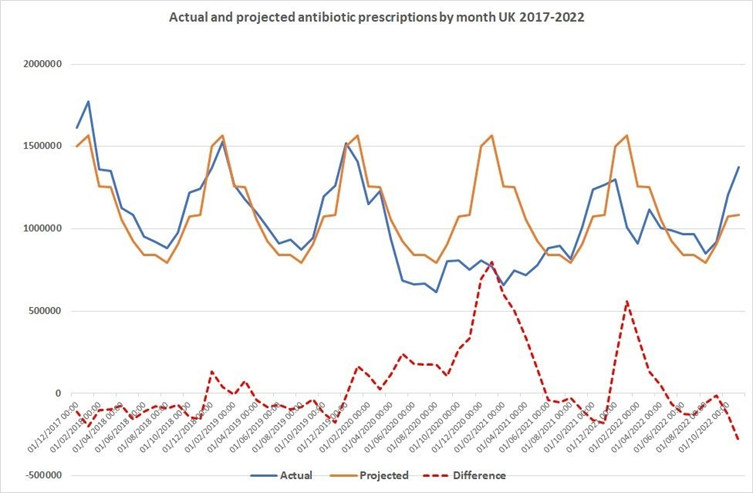
'Flu' is an umbrella term for different respiratory infections that was coined because it is not possible to distinguish directly between the symptoms and the treatment protocols do not differ much from each other. Covid-19 was obviously not allowed to be included. If we can rely on the graphs, then corona has been treated very differently from all other respiratory infections and it almost seems as if the guidelines for amoxicillin have been adjusted. After all, antibiotics, and in particular amoxicillin, would not work against Covid-19, caused by the SARS-CoV-2 virus. This is clearly visible in the image below from the UK. The blue line shows the use of amoxicillin from 2017 to 2022.
Amoxicillin and Azithromycin in The Netherlands
In the Netherlands, we see a striking pattern in the use of antibiotics. The antibiotics prescribed for covid-19 in case of suspicion or detection of a superinfection are Amoxicillin and Azithromycin But let there be a huge decrease in its use during the Covid epidemic while you would expect an increase there. In 2020 (p. 19) and 2021 (p.17) we see a decrease of no less than 225,000 prescriptions amoxicillin per year. We are now back at a level Similar to that of before the corona epidemic.
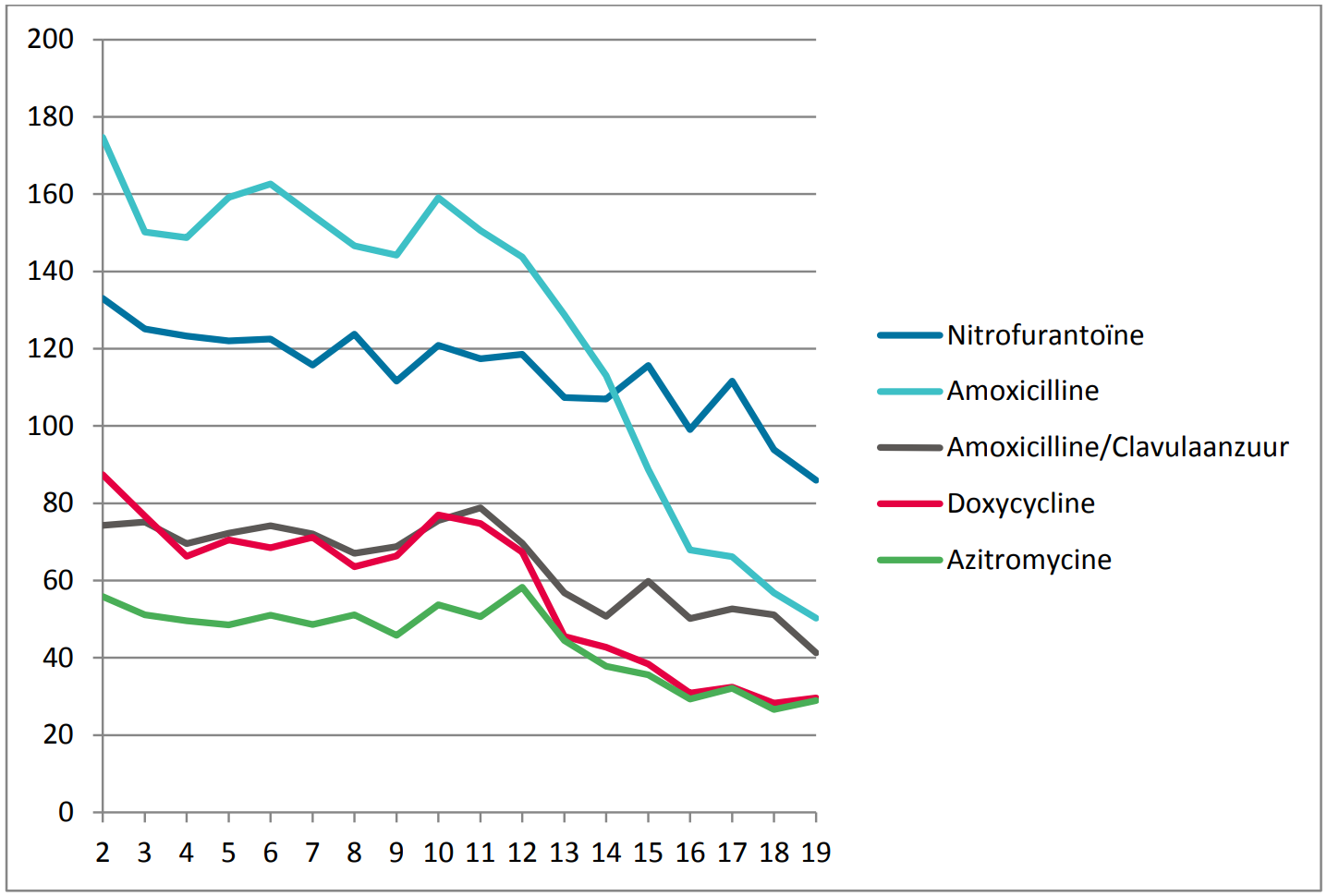
100,000 enrolled patients (PDF NIVEL, pg. 3)
In the graph we see a decrease of almost 70% of this antibiotic agent Amoxicillin, more than two-thirds less. From 170 to 50 per 100,000 people in the first three months of 2020. Converted to three million over-65s, this is a decrease of at least 3,000 prescriptions per week, while we would expect an increase in the event of an epidemic of a respiratory disease. We also see a decrease of around 50% in Azithromycin.
Where the number of antibiotic treatments had clearly increased due to the flu epidemic which was also prevalent at the time and the corona was still dormant among the population, we see a huge decrease in flu patients from the moment corona became dominant according to the narrative. The use of the drug that would logically be used against respiratory infections such as Covid, Amoxicillin, see a decrease from week 10. The peak of corona admissions and perhaps also of the flu, where antibiotics maybe could still help in week 13. Respiratory patients, including a number of flu patients, did not receive antibiotics during this period, although this would have been administered for respiratory infections in previous years.
Perhaps we are dealing with a confusion here because in The guidelines A number of things are mixed up:
"Met azitromycine is ruime ervaring in de behandeling van diverse longaandoeningen. Er zijn mogelijk antivirale eigenschappen, maar bij MERS-CoV was het gebruik van macroliden bij IC patiënten niet geassocieerd met reductie in mortaliteit en afname van ‘viral load’"
The mechanism is apparently not clear to the researchers. Indeed, antibiotics do not help against viruses but against bacteria. This is also cited in the same description.
"In een kleine Franse patiëntenserie in een niet-gerandomiseerd onderzoek werd bij 6 SARS-CoV-2 positieve patiënten met relatief milde kliniek azitromycine toegevoegd aan de behandeling met hydroxychloroquine ter behandeling van bacteriële superinfecties. Bij deze 6 patiënten waren de nasofaryngeale swabs na 5 dagen PCR-negatief (met 1 rebound op een later moment). Theoretisch zou dus de besmettelijkheid sneller afnemen. Echter is het op dit moment niet duidelijk of ook de klinische uitkomst verbetert." 1link to French research
Apparently, the drug has been used against bacteria, which could have made it easier to resolve a covid infection, but the penny does not seem to have fallen completely.
"Azitromycine inzetten als antiviraal middel op basis van de bevindingen van 6 patiënten is te prematuur. Voor gebruik als immuunmodulator zoals bekend uit de kindergeneeskunde, zijn nog onvoldoende aanwijzingen. De combinatie van azitromycine en (hydroxy-) chloroquine wordt ontraden vanwege de verhoogde risico’s op ritmestoornissen. In de Franse patiëntenserie werd niets gemeld over de bijwerkingen, zoals QT-tijdverlenging, zodat veiligheid bij COVID-19 patiënten niet bekend is."
And this is what we have to do with as far as antibiotics and HCQ are concerned, and these guidelines have also remained in force for a very long time. There has apparently been no intention whatsoever to investigate this. This text speaks volumes!
Antibiotics have mainly been used for flu, not for Covid-19
The relationship between antibiotics and viral infections can be seen on the basis of the graphs below. Graph A shows confirmed virus infections, Graph B: pneumonia. Both graphs are exclusive, so without, Covid-19.
Elke gekleurde lijn geeft het jaarverloop weer. Zowel de griep als longontstekingen verdwijnen op het moment dat covid-19 dominant wordt en andere virusinfecties heeft verdrongen - volgens de autoriteiten.
This is most evident in the yellow line (2019-2020): after week 12 in 2020, flu and pneumonia both drop back to summer levels. The following year, the green line remains flat. At the end of the corona period and the flu wave in 2021/2022 (red line, week 10), we only see an increase that corresponds to the use of antibiotics.
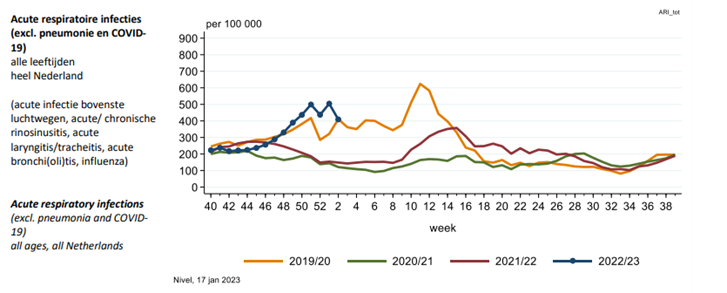
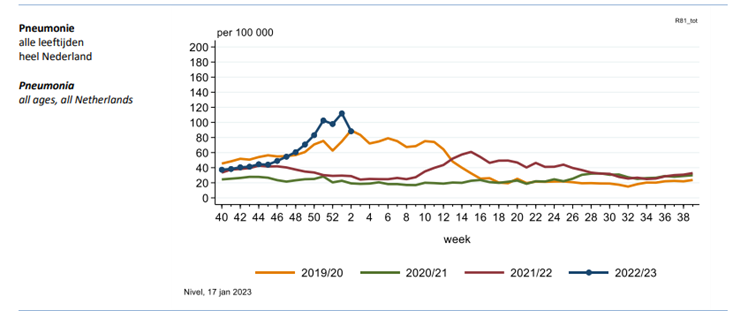
Het lijkt wel alsof Covid-19 genezend werkt op luchtweginfecties en longontstekingen maar dat is natuurlijk niet zo. Het lijkt er meer op dat men genoegen heeft genomen met de diagnose "Covid" en geen bijzondere aandacht meer heeft besteed aan virale dan wel bacteriële aspecten, zoals dat bij griep wel altijd gebeurt.
NIVEL is also in the dark about the cause of this decline (page 5 of the PDF). Perhaps there is another advisory body with other guidelines whose existence is still unknown to me? In any case, it can be concluded that the use of Amoxicillin and Azithromycin has decreased due to a national or international adaptation with very likely adverse effects.
Covid-19 and pneumonia
The most recognizable thing about covid-19 is the filling of the lungs because the own immune response runs wild. Dit is het gevolg van de 'cytokinestorm' en zou je een overschoten ontstekingsreactie kunnen noemen. Een ontsteking in de longen, ook wel pneumonie genoemd: het meest herkenbare symptoom van de covid-19 infectie.
Whereas in the case of influenza a distinction was made between a virus infection and (bacterial) pneumonia and these can often coexist (and one after the other), this is not registered as such with covid-19. This may explain the abnormal treatment and the huge decrease in antibiotic use.
Studies that have properly investigated secondary bacterial infections concluded that:
"Deze studie bevestigt dat de incidentie van secundaire bacteriële infecties zeer hoog is bij kritisch zieke COVID-19-patiënten. Deze patiënten lopen het grootste risico om een secundaire pneumonie te ontwikkelen."
Secondary infection in COVID-19 critically ill patients: a retrospective single-center evaluation
"Deze studie bevestigt dat de mortaliteit bij patiënten die superinfecties opliepen 83% bedroeg, tegenover een algemene mortaliteit van 38,1% bij alle opgenomen COVID-19-patiënten."
Secondary Bacterial Infection and Clinical Characteristics in Patients With COVID-19 Admitted to Two Intensive Care Units of an Academic Hospital in Iran During the First Wave of the Pandemic
The first studies on covid-19 and pneumonia also showed that around 50% of covid-19 patients have died in hospital with or from the consequences of bacterial inflammation. Our Dutch researchers had also established this.
"Sterfte als gevolg van longbacteriële superinfectie en sepsis bleek echter een vaker voorkomende causale keten van gebeurtenissen te zijn die patiënten met ernstige COVID-19-gerelateerde longschade aanzienlijk in gevaar kunnen brengen. Wij veronderstellen dat een dergelijke causaliteit nog vaker voorkomt in klinische settings waar ademhalingsinsufficiëntie beheersbaar is door mechanische beademing of extracorporale oxygenatie. Voorts impliceert dit dat bacteriële infecties kunnen bijdragen tot de buitensporige cytokine-afgifte die bij ernstige COVID-19 wordt waargenomen, hetgeen "cytokinestorm" wordt genoemd, en gedeeltelijk de overeenkomsten tussen COVID-19 en sepsis16 kan verklaren. Daarom stellen wij voor dat bacteriële infecties in gedachten worden gehouden als een potentiële verstorende variabele in studies over ontstekingsreacties en cytokine-afgifte bij COVID-19."
Nature, Causes of death and comorbidities in hospitalized patients with COVID-19 | Scientific Reports
It is clear that a bacterial infection contributes to a high mortality rate in hospitals. Examine that the incidence have researched come up with different figures but generally between 5 and 10 percent of people enter the hospital with a superinfection. In the hospital, this number increases, and eventually more than 50 percent of people who did not survive have developed a superinfection.
This is a significant group of people. It is therefore a mystery why the use of antibiotics has decreased so much, and perhaps this even partly explains the persistent mortality that we have seen in recent years.
The question is justified to what extent this has had an impact on the mortality rate? More than half a million fewer prescriptions of antibiotics that could have been used to treat the respiratory tract during the corona period. Judge for yourself!
Other potentially effective treatments were also not given a chance
In een recent verschenen onderzoek wordt de werking van het hierboven ook genoemde verboden medicijn HCQ (hydroxychloroquine) geëvalueerd in combinatie met het antibioticum Azitromycine, exact zoals hierboven door SWAB besproken is voor de Nederlandse richtlijnen. Het ligt in lijn met de resultaten van het onderzoek dat men in Nederland links heeft laten liggen. Beide onderzoeken zijn niet "retracted" maar wel nog steeds "preprints", ondanks dat de eerste studie al drie jaar oud is. Het medisch establishment heeft er nog geen stempel op kunnen zetten.
"Van de 30.202 patiënten met behandelinformatie stierven 191/23.172 (0,82%) patiënten behandeld met HCQ-AZ vergeleken met 344/7.030 (4,89%) onder degenen zonder HCQ-AZ."
Source: https://www.medrxiv.org/content/10.1101/2023.04.03.23287649v1
Footnotes
- 1link to French research

Good that this has been analyzed in this way! Serious and disturbing.
Thank you very much for this enlightening piece. Unfortunately, it confirms my suspicion that the medical world mainly works with "peat lists". Predetermined symptoms lead to disease a or b. There was no peat list of Corona yet. There was, of course, but that was called "Flu" and was under the G and not under C. Desperation was the result, of course. The medical world has learned to see patients as complex biological individual life forms that need to be analyzed on an individual-by-individual basis. The general medical world's answer to disease is... you'll never guess... "Models". (Another good opportunity for ai) And with Corona, politics has even taken over the role of the doctors and set the models themselves and named contradiction as quackery, while of course they themselves were 100% guilty of it. I have caught my GPs using peat lists several times. For example, the primary reason that a vitamin B12 deficiency was only discovered after decades was the primary cause of "burnouts". Which were not burnout at all. The same goes for D3 etc.
"Antibiotics do indeed not help against viruses but against bacteria".
This dogma is ineradicable in the medical world. But ignores the effect of antibiotics. An AB cure is to support the immune system in case of inflammation. Whether that inflammation is bacterial or viral, it doesn't matter.
If the medics looked a little further than their noses, they should at least notice that an AB cure for flu or another viral infection does help.
In addition to my response, a message from someone who really knows. 🙂
https://www.youtube.com/watch?v=KtBWJ4mGjpM
See minute 3:12.
Thanks for this interesting piece.
In this context, the following report/ brochure from the OECDC, ECDC, EFSA and EMA may be illuminating:
https://www.ecdc.europa.eu/sites/default/files/documents/antimicrobial-resistance-policy-brief-2022.pdf
This shows that the current EU/EEA policy is to closely monitor and, if possible, limit the use of antibiotics for humans and animals ("One Health Approach"). That policy was already in place before 2020.
The aim is to combat AMR ("AntiMicrobial Resistance"), i.e. resistance of bacteria. AMR is apparently already a major problem: 33000 deaths in the EU in 2019 and more than 1 million deaths worldwide, according to the OECD (page 13).
"Hidden pandemic"... it even says at the beginning of the report,
Many well-known parties of the rollout of the covid-19 vaccination come across this connection again. But also from parties from the food and agricultural sector.
A lot of information from the EU monitoring is available from the ECDC. For the Netherlands, RIVM produced a detailed report on the consumption of antibiotics in the Netherlands:
https://www.rivm.nl/publicaties/nethmap-2022-consumption-of-antimicrobial-agents
Of course, it remains strange that the restrictive policy for people canned has not been relaxed during the Covid-19 pandemic.
Has this had any consequences? Presumably so. In any case, there is sufficient information available to investigate the relationship between covid-19 mortality and (limitation) of the use of antibiotics.
Of course, antibiotic use has long been a concern. We also suspected that it must have been a policy but could not substantiate it. Still, a note: The standing policy should not have been "relaxed" for Covid at all. This can be seen in the years before: it is still being used.
Something else has happened: that policy (if that is the cause at all) has been imposed exclusively on Covid. There are suspicions about the motives behind this, but that too is a guess (panic reaction or double agenda?).
Covid patients soon received palliative treatment 'because antibiotics do not help against viruses'. See also Midazolam, about which there may be a follow-up article.
There are also signs that vaccinated people received different treatment than unvaccinated people. After all, if you were properly vaccinated, it couldn't actually be a real heavy Covid. Then it had to be something else, perhaps a bacterial infection.
Shocking, but as far as my knowledge (once graduated in molecular cell biology) allows, completely correct.
The whole thing just started with the denial that the c19 virus is just a respiratory infection virus like any other. It HAD to and WOULD be a "terribly deadly lung virus," and unfortunately, due to the aforementioned misapprehension, it has become so for many, by flatly refusing very obvious medication for the bacterial superinfection that often results from an initial viral infection.
Unbelievable, what stupidly sticking to a 'top-down' scripted narrative can do.
Not only the use of antibiotics, but also of ventilators, midazolam, nebulization with bronchodilators/ constrictors, in short, worldwide medical (mis)policy that was aimed at getting as many people as possible to die as quickly as possible.
Why should this kind of policy be rolled out? Most people cannot comprehend such a thing, and this is put squarely into the conspiracy theory corner by the profiteers.
But still, 1 hypothesis is that just like during the credit crisis of 2008, in which the global housing market imploded and several banks went bankrupt (Lehman) but also ABNAMRO was nationalized while other institutions (private equity, hedge funds) benefited greatly from it, financial derivatives (mortgage backed securities (MBS)) played a key role, cooked up by Wall Street bankers like Blythe Masters (1, again ex-JP Morgan), and referred to as financial weapons of mass destruction by Warren Buffett.
Now the same bankers have repeated the trick that was played with mortgages at the time with life insurance (2,3).
Bundling life insurance policies that pay out more as long as people die early enough but actually cost capital as people get older, and sell these as derivatives to pension funds is a revenue model. Of course, since 2020, the focus has shifted to a "killer virus" that turned out not to exist or at most turned out to be influenza.
Central banks again play a major role; ECB and Fed balanzen that increased by 1,000 billion between 2008-2009 increased by 5,000 billion per central bank in the period 2020-2022 (4). Overall, the increase since 2010 was about 20,000 billion (5). What is written on these balanzen: derivatives...
1. https://sandiegofreepress.org/2012/07/blythe-masters-inventor-of-the-financial-weapon-of-mass-destruction/
2. https://www.nytimes.com/2009/09/06/business/06insurance.html
3. https://archive.is/spiJo
4. https://fred.stlouisfed.org/series/WALCL
5. https://www.yardeni.com/pub/balsheetwk.pdf
"as long as people die early enough" – I would almost say: 1 + 1 = 2 ... (i.e., it doesn't seem like speculation anymore).