

Het dossier dat de overheid aan het opbouwen is, is weer wat aangedikt. Na de diverse afleveringen van "De vaccins werkten uitstekend, kijk maar naar RIVM, CBS, Nivel en UMCU" krijgen we nu "Covid was echt heel verschrikkelijk, kijk maar naar het Long Covid rapport". Dit Erasmus/C-support rapport, over twee jaar onderzoek naar Long Covid, heeft echter niet heel veel losgemaakt. Dat zal ook te maken hebben met de ongrijpbaarheid van het fenomeen want mail-Covid (it's not a long version of Covid) has a wide spectrum of complaints. Not only the nature, but also the severity of the complaints varies from patient to patient. In addition, 43% of the group studied has chronic comorbidities and there are no diagnostic tests to detect the disease. Then bake a cake out of that.
Summary
Post-Covid is not a disease, it is a syndrome: a symptom that can have various causes. We see the same spectrum of symptoms in side effects of Covid vaccination and menopausal symptoms (76% of the participants are women).
The group studied is composed of people who have concluded that their symptoms were caused by a previous corona infection. 93% of them were vaccinated but Most are infected before their vaccination. This suggests that the vaccine At least not afterwards has been beneficial against post-Covid.
43% of this almost fully vaccinated group has contracted Covid again 1 or more times after vaccination. Do unvaccinated people also show repeat infections so often? I have not come across these percentages in any study. Unfortunately, this was not relevant to this report.
Anyone who thinks that underlying causes are also being sought: unfortunately. Patients with, for example, Lyme, fibromyalgia, ME/CFS, burnout or PTSD could easily have participated in this study with their complaints pattern. Were they among them? No attempt has been made to distinguish true 'post-Covid' from other causes. That is a missed opportunity and does not do justice to the actual post-Covid patients. People stick to symptom descriptions and the impact of those ailments.
This report mainly serves as very welcome mental assistance and recognition for PAIS/PVS patients - but health-wise we will not be Much wiser van. Het behandelt inderdaad niet meer dan "de impact van", en dat is ook de titel. Het is ook weer een officieel, academisch rapport waarmee Karremans kan wapperen als hij moet verdedigen hoe ernstig Covid wel niet was. Ongetwijfeld goedkeurend toegeknikt door ZonMw.
The report is download here. The audience summary gives a good impression. I will discuss a few things that struck me and were not so emphatically highlighted in the report.
First the design: the research revolved around two online questionnaires, which were completed by approximately 7,750 participants one year apart. All post-Covid patients, including possibly people who identify as post-Covid patients. It has not been verified, for example with a test.
The point is that no one knows what should be tested for. PAIS (post-acute infection syndrome, with the same complaints) is a well-known phenomenon and the more severe the infection or treatment, IC for example, the more frequent and the longer the post-syndrome. So it doesn't sound very 'novel' or 'Covid'-specific. Anyway: there are now a lot of them at the same time! And attention always helps.
Testing for antibodies (virus) and vaccine spikes (jab) would have been interesting. But unfortunately, it remained with online questionnaires so that distinction was not made. It is self-report so the participants can decide for themselves what the cause of their complaints was. You can ask yourself whether they then choose a self-chosen intervention that they rely on just as easily as for the angry external factor against which they sought protection.
The participants are invited after registering with C-support, which is the platform for "Nazorg voor patiënten na een coronabesmetting". Op de website vinden we: "Have you had Covid-19 more than three months ago? And are there still complex complaints? Then you can register with C-support."
Duizenden mensen hadden zich al aangemeld, toen in oktober 2021 op de C-support website dit panel werd toegevoegd: "Symptoms after vaccination". Maar dat was natuurlijk slechts voor 'een klein aantal mensen' bedoeld...
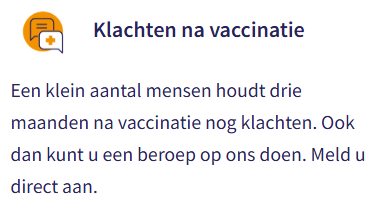
Het onderzoek startte in februari 2022. In het rapport zelf (zo'n 3 jaar later dus) lezen we nu "Patients can register themselves with C-support if they still suffer from symptoms related to COVID-19 at least 3 months after a COVID-19 infection." Geen woord (meer) over post-vax. Ook in het rapport wordt geen onderscheid gemaakt tussen post-Covid en de eventueel (later nog ingestroomde) post-vax groep. En hoeveel waren dat er?
It is not even clear whether any post-vax patients who have reported are also referred to as post-Covid patients, or whether they are not included in the reporting at all.
Most participants, 67%, contracted the infection before they could be vaccinated. In other ZonMw studies, this would immediately be translated into vaccine protection against post-Covid (because only 33% remains after vaccination!) Unfortunately, the data to calculate this properly is lacking. Because if 67% of all (first) infections took place before the vaccination campaign(s), that is exactly right and that is not the case. And then it would turn out that the vaccinations were largely done after meals anyway - and they don't want that because that is simply not the case. Susan van 't Hof probably can't imagine that.
Whether the post-Covid symptoms emerge before or after vaccination has not been asked, as far as I can tell. The assumption is probably that it also took place before vaccination. In NEJM (Long Covid Defined), however, we read that post-Covid may only emerge after months. Then someone could also have been vaccinated by now... Hmm, where does it come from?
Dokter: "Tsja mevrouw, dat doet toch sterk denken aan Long Covid."
Mevrouw: "Potverdorie. En dat maar liefst twee maanden nadat ik die positieve test had!"
Dokter: "Ja, dat kan wel eens. Een peer reviewed onderzoek in New England Journal of Medicine heeft uitgewezen dat het zelfs wel drie maanden later nog de kop kan opsteken!"
Mevrouw: "'t is toch wat. En u had me vorige week nog wel gevaccineerd."
In the appendix I also see that at the first measurement something is reported about a small group of unvaccinated people. They recovered more slowly between measurement 1 and measurement 2, but whether they were older, had more comorbidities or were not vaccinated for some other reason, we don't know so there is little to be deduced from that, although it can be used for the statement "gevaccineerden herstelden sneller." That was the case with previous ZonMw studies.
Tinnitus: a white raven
The questionnaires are not included in the appendices. In the graph below we see the percentage results: the orange bar for the complaints in measurement 1 and blue for measurement 2.
It is striking that tinnitus (ringing in the ears) was missing from the first questionnaire. It was therefore not initially seen as a possible after-effect of Covid. It has been reported in that context, but very little in relation to the other side effects. Causal relationship has never been demonstrated. Tinnitus, on the other hand, is a known and described side effect of the Janssen Covid injections. And Lareb received 600 post-vax tinnitus complaints, even after the Pfizer shot.
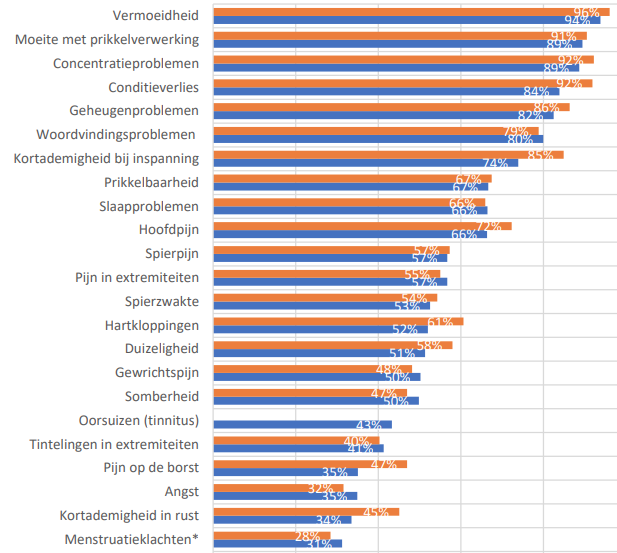
So after feedback from the 93% (or now more) vaccinated study population, tinnitus was added to measurement 2. Simply: as a post-Covid complaint!!
As many as 43% appear to suffer from tinnitus. Almost half! From Covid...!? Studies show that the tinnitus rate after Covid is usually around 5% until 15%. It is often blamed on stress. A single report is between 20% and 30%, but there too no distinction is made between post-Covid and post-vax. Tinnitus is also reported as a side effect of the jab in the underreported VAERS.
Coincidentally, while writing this article, a Yale study that does exactly this: distinguish between post-Covid and post-vax (PVS). They believe that 60% tinnitus in PVS.

As an aside: the Yale study
It is a very small study but it is in-depth. At least here it is recognized that there is post-Covid and post-vax and that it is essential for the patients and for the possible treatment to make that distinction. There is even more interesting to come out: The toxic spike protein, which is associated with these complaints, was elevated levels found in vaccinated patients, two years after the injection. Prof. Buckhaults thinks (on X) that this is only possible if the body continues to produce new spikes itself. The vaccine can achieve this, because it gets the mRNA to the cell nucleus. A Midwestern Doctor also talked about shedding.... But we'll leave the horror scenarios for what they are.
So whether all those complaints actually come from the virus? I suspect (and hope) that Jan Bonte will write a thorough piece about this Yale study.
… in our study, significantly elevated levels of circulating S1 and S were observed in a subset of post-vaccination syndrome (PVS) participants both in the infection-naïve and infection-positive groups up to 709 days post-exposure. This is in line with the findings of S1 persistence in monocytes in people with PVS. Circulating full-length S has also been detected in cases of myocarditis after vaccination. Given the striking similarities between post-COVID and PVS symptoms, there has been speculation about the possible causative role of the persistent presence of spike protein causing the chronic symptoms. In addition, a recent study has shown that spike protein binds to fibrin, leading ex vivo to inflammation and neuropathy in animal studies.
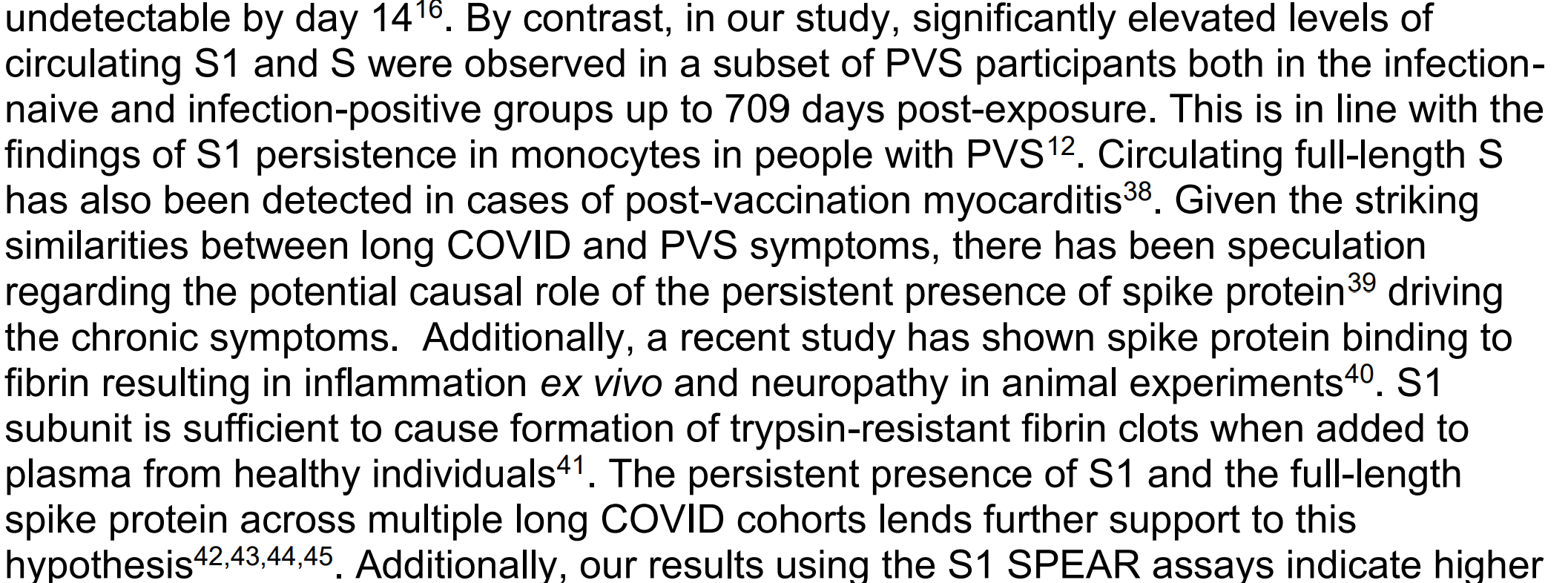
Your own body as a producer of spike protein that causes chronic symptoms. How many people would that concern? These are real disasters, even if it is 1 in 100,000.
This aside.
Other candidate causes
So much for tinnitus. But what about those other complaints? Are we actually still looking at post-Covid symptoms here?
To be able to characterize post-Covid, C-support has created a supposition bedacht. "Aangenomen wordt dat deze vijf pathofysiologische mechanismen een rol spelen bij post-COVID" For example, we read in the report:
- Dysregulation of the immune system
- disruption of the intestinal flora
- Autoimmunity
- damage to the vascular walls
- Microclots
- dysautonomia
Five? I think there are six. But yes, numerical insight has proven to be not the strongest point in medical science in recent years, as evidenced by the latest ZonMw reports from Nivel and the UMCU and what the RIVM and CBS have shown.
Point 2, disruption of the intestinal flora, I will take a break. It is also not treated separately. The gut biome is as underestimated as it is complex and is strongly related to the other points mentioned. Good blood flow is essential for the gut biome and a healthy gut biome is all about the immune system.
The list of five looks familiar: it could have been a post-vaccination list. If a distinction had been made between vax- or virus-induced, this could have provided interesting information: perhaps the post-vax symptoms were less severe than the post-covid symptoms, they went away earlier or there were differences between the two symptom packages. One does not need to know it all so it was out of the focus of the research.
Click here to read how ChatGPT categorizes the five points of Erasmus/C support under vax or virus
1. Dysregulation of the immune system
✅ Both after vaccination and after infection, dysregulation of the immune system and chronic inflammatory reactions can occur.
- Post-COVID often involves a dysregulation of the immune system such as increased activity of pro-inflammatory cytokines.
- Corona vaccinations can lead to a disrupted immune response, with the body struggling to properly regulate infections and inflammation.
2. Autoimmunity
✅ Both post-COVID and vaccination can trigger autoimmune reactions.
- Corona vaccinations can trigger autoimmune reactions, possibly through immune activation against the body's own tissues and IgG4 shift.
- Post-COVID is associated in some cases with Autoantibodies, indicating a possible autoimmune component.
3. Damage to the vascular walls
✅ This is seen in both cases.
- Viruses, including SARS-CoV-2, can cause the damage endothelial cells, which causes vascular problems and inflammation.
- Corona vaccinations can cause inflammatory reactions in the vascular walls, which can lead to Endothelial dysfunction, which can cause symptoms such as fatigue, dizziness and brain fog.
4. Microclots
✅ Both post-COVID and post-vaccination Microclots Observed.
- In post-COVID, microclots are a much-discussed phenomenon. Studies show that in some post-COVID patients, Long-term coagulation activation is present.
- Corona vaccinations are associated with the formation of microclots, which may contribute to long-term symptoms such as fatigue, brain fog and circulation problems.
5. Dysautonomia
✅ This is reported in both cases, with PAIS/long COVID and with corona vaccinations.
- PAIS, and especially post-COVID, is associated with dysautonomia (problems with the autonomic nervous system), such as POTS (Postural Orthostatic Tachycardia Syndrome).
- Dysautonomia can lead to symptoms such as rapid heart rate, dizziness, low blood pressure, and temperature regulation problems.
- Corona vaccinations can cause disruptions in the autonomic nervous system such as POTS or orthostatic intolerance.
So no distinction can be made based on those 5 criteria: all post-vax misery can be handled effortlessly under the post-Covid umbrella. That saves a lot of hassle. And it cannot be ruled out that this will also happen in this C-support study. In any case, nothing is done to make a distinction, on the contrary.
So it is not actually a post-Covid study. It is actually a study of the impact of misunderstood diseases.
As mentioned: based on the self-reported complaint patterns, patients with, for example, chronic Lyme, fibromyalgia, ME/CFS, burnout or PTSD could have effortlessly participated in this study, in addition to post-vax patients. But also women in menopause...
The report therefore does not do justice to both post-Covid and Post-vax patients. It gives a kind of disinterest. As if the report is a sop for the post-vaxxers and for the post-Coviteers who have not had primary care and have become sicker than necessary. And the women in menopause could perhaps be reassured. All this apart from the fact that the others who have reported with similar complaints now think they have grasped a very fragile straw.
Or is it just, like the ZonMw excess mortality reports, ordinary file building for the parliamentary inquiry: vaccines good, covid bad ?
In a next post I will discuss the most common complaints and in particular the last two categories: PVS and women in menopause, because they are very easily included under the post-Covid umbrella.
Read more about the report in Menopause, injection and virus: the post-covid report
.

"Or is it just, like the ZonMw excess mortality reports, ordinary file building for the parliamentary inquiry: vaccines good, covid bad?"
My Dutch is astonishingly poor, so I was happy to see some words I could understand.
Vaccines very good,
Covid very Beeeeeed.
Do you agree, Marion?
The virus comes with great certainty from a laboratory. Whether the complaints are the result of Covid or vaccination does not matter much for the reputation of Marion and her colleagues. They are virologists and vaccinologists who have put together both pathogenic products.
Moreover, many people with PVS have just said it was long covid. Not only because it was more socially accepted, but with Longcovid the medical costs are reimbursed by the insurance and you can't do it in the sickness benefit, with PVS, except for a few cases.
You have to be careful with this story!
The high vaccination rate in the 2022 population was only representative of the elderly. However, only 4% of participants are over 66! Above the age of 18, the vaccination rate should be on average (only) 82% according to RIVM (annual report for 2022). Furthermore, the high percentage of women is suspicious and also the fact that apparently everyone had paid work and almost 97% indicate 'Dutch' as ethnicity!
The most important omission of the survey is not including the sector of work/activities. of participants. At least I didn't see that in the report and its appendices.
Because the characteristics mentioned strongly suggest that the participants may be (or have been) disproportionately active in the healthcare sector itself.
If so, then the experiences of this group are certainly not representative and rather 'worst case' with regard to the complaints picture.
After all, these are people who have been in contact with COVID-19 patients much more frequently than elsewhere in society, who work in a sector with large staff shortages, high work pressure (burnout?) and who have been exposed to vaccination pressure and Indian stories about the possible effects of the virus above average (PTSS?).l
In short, probably not a story that Agema can use for the population, but perhaps useful for the management of personnel (at least partly, namely the 'white, white coats') in healthcare.
Better let the researchers be careful with their story 🙂
It could well be that they are mainly healthcare workers. I don't know whether they have come into contact with the Covid virus more often, everyone has come into contact with it. There are not only Covid patients in a hospital. Is the percentage so much more than in the outside world? Only a small percentage were admitted to hospital due to Covid. But indeed: the target group is certainly not representative!
Wasn't vaccinated, but had them Covid in December 2021. Week hospital. My GP called it cytokine storm. After that a lot of complaints. Almost everything that is in the list. I'm not done with it yet, but fortunately it's getting better.
Nice, yes it can take a long time. It is hard to imagine that they injected people with stuff that caused them to induce that disease themselves, without getting long-term effects... As a post-Covid patient, I would be just as angry about that as a post-vax patient!
I know someone, young sporty woman, who had a severe Covid in the first wave. I fully understand that she has been pricked as often as possible out of sheer fear. After she realized that her health was deteriorating with each injection, she stopped doing so. She will not be the only one. Because of the haggling, there is never recognition and separation of what has caused what, so that a therapy cannot be developed. It is very important that the truth is put on the table as soon as possible.
Even greater importance is of course a total ban on bio labs and gain of function research!
We didn't know that you could sign up for postvax: my wife had complaints for 1.5 years after Pfizer!
Post Covid for vaccination makes sense because in 2020 the virus most closely resembled the original bioweapon from Wuhan. And that same spike protein was of course also in the mRNA vaccines.
Can't we sue the state for not respecting Article 11 sufficiently based on the assumption that the hospitals were full of unvaccinated people. If it can be shown that that is a lie.
The suspicion is therefore that this is one of the reasons that there is such a fuss about making the data public.
I actually found the answer quickly: our world in data > hospital admissions fell in the summer of 2021 briefly followed by 2 major winter waves 21/22 and 22/33. Don't think there were enough unvaxinated people to fill the hospitals again. So vaccination just doesn't work or backfires.
Don't forget that already in 2019, tens of thousands of people were injected with corona modRNA "vaccine" in the context of "clinical studies". Those people were just walking around and since the lipid nanoparticles containing modRNA end up in the environment/food chain via urine and feces, it is VERY possible that people who became ill in 2020 were directly exposed to the so-called "vaccine" or through the environment.
'Do unvaccinated people also show repeat infections so often?'
Unvaccinated people are less often/never tested for the 'new disease', because why should they?
This is problematic for them to the extent that it means that they are not still considered psychogenic with all kinds of complaints that were considered 'between the ears' before 2020 (unjustly in my opinion), while someone who identifies himself as a long covid patient sees all doors open for them.
Not that you can expect much help for treating a disease for which there are no objective criteria. But, and I just want to say that: that someone who has all the symptoms of long covid, but does not consider himself a long covid patient, pushes himself into the corner of: 'it must all be psychological' while someone with the same symptoms but who does consider himself to be a long covid (keep capitalizing that rotten word on the auto-correct) patient, he gets all the attention, he is taken seriously, he DOES get help.
Or as Obelix said about the Romans: 'Strange guys, those doctors and scientists.'
In the time of the vaccination passport, many unvaccinated people and booster refusers went to extra lengths to get a positive test. They were going to try to infect each other.
If you didn't have a passport, you had to be able to show a 24-hour negative test to enter somewhere. So unvaccinated people did test a lot.
A test was not necessary for vaccinated and boostered people. When they were sick, they were much less likely to think of Covid, because the vaccine was effective according to the advertisement.
A large proportion of those unvaccinated people who had to be tested each time will eventually have had a (false) positive result. Et voila, another wonderful (manipulated) statistical result emerges: unvaxed and unboostered people get covid more often than vaxed.
It is very difficult to debunk Propaganda with honest arguments.
Anton
As for those intestinal problems, you shouldn't push them aside too quickly.
There are indications that the virus and the vaccine affect the composition of the intestinal flora and especially reduce the number of bifidus bacteria. Unfortunately, I did not keep the source.
I had a lot of problems with my intestines after the vaccination. The food went in and came out almost immediately. I sat on the toilet more often than on a chair. In addition, I had many other complaints.
At a certain point, after I had knocked on the door of the doctor, I started with a very good probiotic. After three months I was almost completely cured.
By the way, I am sure that my symptoms were caused by the vaccine. Firstly, because they started shortly after the injection and secondly because I did have antibodies against spike protein and antibodies against the nucleocapsid protein (virus) tested.
No, I'm not pushing it aside. It is not an item in the report. What I am pointing out is that all those other characteristics they mention are actually related to the intestinal biome. So it is central, it seems to be an underlying factor rather than a separate symptom. It is very conceivable that it (also) leads to specific intestinal complaints!
The moment for me that I realized something was wrong was HdeJ's comment.
We can only solve this misery by vaccinating, vaccinating and vaccinating even more.
I am a very simple guy and I really like simple solutions.
And I have learned that there is no (!) problem that can only be solved in one way.
And there was the turning point and I knew I was being duped.
Whether it concerns the people in Groningen who we let go.
Or the people in any conflict with the government.
That government that you can expect something from is choking you hard.
Well then my government can also go to shit.