

Viruses do not exist. Viruses are computer simulations that fit observations. They are nothing more than models we create ourselves. No virus has ever been physically isolated, and a definition for 'virus' has been devised that is still not met. Thus the repeated complaints from virus deniers against virus variants. (Those 'postulates' themselves are partly outdated - but that is also another discussion).
All in all a challenging and therefore amusing controversy, but this site is about an infectious respiratory disease - from viruses or something else - and the response to it. The question is how proportionate and substantiated the response was and is, especially in the Netherlands. Call it a virus, an exosome, a replicon, or a self-replicating pathogen - the name does not change the reality: contamination between individuals exists, is experimentally reproducible, and the discussion about what to call it only distracts from pandemic handling: how do we deal with infections: can we prevent or moderate them and at what cost? We still have to learn to deal with infections; viruses or not.
Are there studies on this?
Especially in the initial investigations, forcing infections was not always easy.1November 2020 article: Hard evidence of infectious aerosols Het druppeldogma zat in de weg. Men heeft het vaak geprobeerd met neusdruppels: vrij kansloos, want dat is alsof je een schuimblusser probeert aan te steken met een lucifer en als dat niet lukt concludeert "er bestaat geen vuur" of "overslaande brand is onmogelijk". De neus, slijmvliezen en bovenste luchtwegen (aka mucosale bescherming) vormen immers de belangrijkste firewall tegen pathogenen, die binnen minuten worden afgevoerd richting slokdarm, weg van de ontvankelijke longen. In latere studies gaat dat een stuk beter. Er staan er hieronder enkele genoemd.
Another basis of evidence is the fact that - in other types of research - serial passage is used: how a pathogen adapts to a new host. This is studied by transferring infections from animals to other animals. So that works without any problems. Also a number of links to studies.
Finally, a few studies with ferrets that infect each other, in different setups. Poor animals...
Contact or air
1. The Poker Experiment (Dick et al., 1987) 2Dick EC, Jennings LC, Mink KA, Wartgow CD, Inhorn SL. Aerosol transmission of rhinovirus colds. J Infect Dis. 1987;156(3):442-448. PubMed: https://pubmed.ncbi.nlm.nih.gov/3039011/ JSTOR (full text): https://www.jstor.org/stable/30134751
Already treated in 20233Playing poker with infections https://virusvaria.nl/pokeren-met-besmettingen/:
What happened:
- 8 sick Donors played 12 hours of poker with 12 healthy Recipients
- Half of the Recipients were physically prevented from touching their faces
- A separate experiment tested only contaminated objects (cards, tokens, furniture — zero Donors in the room)
The outcome:
- Aerosol-only: 56% contaminated, all routes: 67% contaminated (difference not statistically significant)
- Fomites-only: 0% besmet
There is something transmissible that goes from person to person through the air. Fomites do nothing. The discussion about what exactly it is, virus or not, is irrelevant to the outcome.
2. EMIT-1 proof-of-concept (2012) 4Killingley B, Enstone JE, Greatorex J, et al. Use of a human influenza challenge model to assess person-to-person transmission: proof-of-concept study. J Infect Dis. 2012;205(1):35-43. PubMed: https://pubmed.ncbi.nlm.nih.gov/22131338/ DOI: https://doi.org/10.1093/infdis/jir701
Donors en Recipients in quarantaine without mechanical ventilation.
Secondary attack rate: 16%. Transfer takes place.
3. EMIT-1 follow-on (Killingley et al., 2020) 5Nguyen-Van-Tam JS, Killingley B, Enstone J, et al. Minimal transmission in an influenza A (H3N2) human challenge-transmission model within a controlled exposure environment. PLOS Pathog. 2020;16(7):e1008704. Full text (open access): https://journals.plos.org/plospathogens/article?id=10.1371/journal.ppat.1008704 DOI: https://doi.org/10.1371/journal.ppat.1008704
Same setup, but now with mechanical ventilation. Secondary attack rate: 1.3%. Turn on the ventilation, and the transmission disappears. Ventilation only dilutes things floating through the air. The agent appears to be transmissible through the air.
"The main difference between these studies was mechanical building ventilation, suggesting a possible role for aerosols."
4. EMIT-2 — naturally infected Donors, still ventilation dependent6Coleman KK, Bischoff W, Tellier R, et al. Evaluating modes of influenza transmission (EMIT-2): Insights from lack of transmission in a controlled transmission trial with naturally infected donors. PLOS Pathog. 2026;22(1):e1013153. https://journals.plos.org/plospathogens/article?id=10.1371/journal.ppat.1013153
Naturally infected Donors (no lab inoculation, mild symptoms, possible cross-immunity in recipients, 8 people 2-4 hours in a room with one donor), limited ventilation but high air recirculation, regulated climate (temp, humidity). Zero transmission. Mild symptoms and cross-immunity probably played a role.
Conclusion: without concentrated respiratory plumes - no transmission.
(Note: they made the donor cough several times. However, they would have been better off letting him sing some carnival songs, as evidenced by this piece in Nature, February 20197Nature, februari 2019 https://www.nature.com/articles/s41598-019-38808-z)
Serial passaging
Serial passage involves infecting a healthy animal with tissue from a sick animal. That healthy animal becomes sick. A healthy animal is then 'infected' with that new lung tissue, etc. → repeat 10-20 times. At the end, the mutations of the tissue are mapped.
5. Serial passaging: A/Kansas/14/2017 H3N2 — 17 passages8Dynamic adaptation mutations and pathogenic characterization of a mouse-adapted seasonal human H3N2 influenza virus. Virol J. 2025.
Full text: https://virologyj.biomedcentral.com/articles/10.1186/s12985-025-02793-9
17 passages in mice. Wild type: zero detectable RNA in lungs. Passage 17: 1010 copies/mL, lethal. Fourteen specific mutations accumulated (Virology Journal, 2025).
6. Serial passaging: A/Switzerland/9715293/2013 H3N29Synergistic PA and HA mutations confer mouse adaptation of a contemporary A/H3N2 influenza virus. Sci Rep. 2019;9:16616. Full text: https://www.nature.com/articles/s41598-019-51877-4 DOI: https://doi.org/10.1038/s41598-019-51877-4
Serial passages, polymerase activity increased >300%. Synergistic mutations in HA and PA caused lethal pneumonitis where the wild type did nothing (Scientific Reports, 2019).
7. Serial passaging: A/HK/1/68 H3N2 — genomische analyse10Ping J, Keleta L, Forbes NE, et al. Genomic and protein structural maps of adaptive evolution of human influenza A virus to increased virulence in the mouse. PLOS One. 2011;6(6):e21740. Full text: https://journals.plos.org/plosone/article?id=10.1371/journal.pone.0021740
39 variants from 10 independent passages. 51 of 115 mutations under positive selection, 27 parallel mutations. Virulence increased by factor >105.
8. Serial passage: SARS-CoV-2 Beta — IFITM3 as a barrier11IFITM3 deficiency drives SARS-CoV-2 adaptation while preserving variant-specific traits. Nat Commun. 2026. Full text: https://www.nature.com/articles/s41467-026-68485-2
20 passages in IFITM3-deficient mice. Virus replicated more efficiently in mice, but at the same time lost fitness in human cells. A classic host-adaptation trade-off (Nature Communications, 2026).
9. Serial passing: SARS-CoV-2 Beta and Delta — parallel evolution12SARS-CoV-2 rapidly evolves lineage-specific phenotypic changes during serial passage in hACE2 transgenic mice. Commun Biol. 2024;7:248. Full text: https://www.nature.com/articles/s42003-024-05878-3
20 passages. Early passage virus (P2) versus late (P21): dramatic difference in virulence, weight loss, and mortality. TNF-deficient mice were spared — the mechanism has been causally demonstrated (PNAS, 2023).
10. Serial passaging: SARS-CoV-2 N501Y VIC2089 — 21 passages13SARS-CoV-2 mouse adaptation selects virulence mutations that cause TNF-driven age-dependent severe disease with human correlates. PNAS. 2023. PubMed: https://pubmed.ncbi.nlm.nih.gov/37523564/
21 passages. Early passage virus (P2) versus late (P21): dramatic difference in virulence, weight loss, and mortality. TNF-deficient mice were spared — the mechanism has been causally demonstrated (PNAS, 2023)
11. Natural serial passage on an industrial scale: Danish mink14Emergence and spread of SARS-CoV-2 variants from farmed mink to humans and back during the epidemic in Denmark, June-November 2020. PLOS Pathog. 2024;20(7):e1012039. Full text: https://journals.plos.org/plospathogens/article?id=10.1371/journal.ppat.1012039
Large-scale natural serial passage. ~136 human-to-mink transmissions, ~59 mink-to-human transmissions, mink-to-mink transmission between farms. The Y453F Spike mutation emerged early and dominated — population-scale adaptive evolution (PLOS Pathogens, 2024).
12. H5N1 — transmission between mammals15Eisfeld AJ, Biswas A, Guan L, et al. Pathogenicity and transmissibility of bovine H5N1 influenza virus. Nature. 2024. https://www.nature.com/articles/s41586-024-07766-6
Bovine H5N1 transmission from mother to pup in mice. Inefficient but real respiratory droplet transmission in ferrets. The authors: "a paradigm shift."
13. Bonus: systematic review confirms aerosol as dominant route16Transmission route of rhinovirus — the causative agent for common cold. A systematic review. Am J Infect Control. 2023;51(4):438-445. https://www.ajicjournal.org/article/S0196-6553(22)00866-5/fulltext
Conclusion after 25 studies: "Moderate evidence that airborne transmission is the major transmission route of rhinovirus in real-life indoor settings."
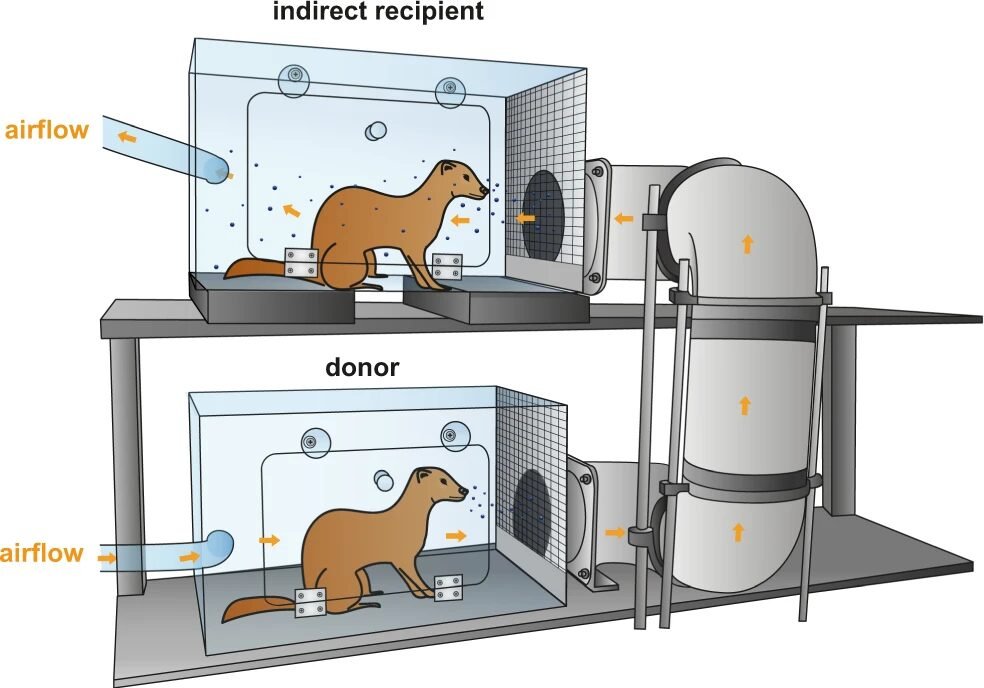
Physically separated ferrets
These are perhaps the strongest experiments yet.
14. Zhou et al. (2018) — from impactor-studie17Zhou J, Wei J, Choy KT, et al. Defining the sizes of airborne particles that mediate influenza transmission in ferrets. PNAS. 2018;115(10):E2386-E2392. PubMed: https://pubmed.ncbi.nlm.nih.gov/29463703/ Full text: https://www.pnas.org/doi/10.1073/pnas.1716771115
The setup:
- Two stainless steel chambers, one for Donor frets, one for Recipient frets
- Connected by a impactor — a plate with holes that separates particles by size
- Four different impactors tested: 50% capture efficiency at 9.9μm, 5.3μm, 2.5μm, en 1.0μm
- Air flow exclusively from donor to recipient chamber via a vacuum pump
- HEPA filters on inlet and outlet
Large droplets (>10μm) are struck against the impaction plate due to their mass and inertia. Only small aerosols make the turn and reach the receiver.
Results:
- Transmission via particles >1.5μm was successful
- With the 9.9μm and 5.3μm impactors: transmission occurred
- With the 2.5μm impactor: reduced transmission
- With the 1.0μm impactor: no transmission via natural exhalation - but there is with artificial aerosolization of the virus
- Donors were the most contagious for fever, and remained contagious for up to 5 days
- Viral load in the air correlated with transmission success
The implication: the infectious particles are in the fine aerosol fraction (1.5-10μm), not in the large droplets that settle within a meter. This explains why ventilation has such a dramatic effect in the EMIT studies — it dilutes precisely these particle sizes.
15. Kutter et al. (2012) — pandemic vs seasonal influenza in ferrets18Kutter JS, Spronken MI, Fraaij PL, Fouchier RA, Herfst S. Exhaled aerosol transmission of pandemic and seasonal H1N1 influenza viruses in the ferret. PLOS One. 2012;7(4):e33118. Full text: https://journals.plos.org/plosone/article?id=10.1371/journal.pone.0033118
The setup:
- Two rooms connected by one 7×7×15cm tunnel with mesh at both ends
- Air flow 12 L/min from donor to recipient
- No direct contact possible — only what floats through the tunnel
- Exposure: 3 hours (to approximate real human exposure time) and continuous (>24 hours)
Results:
- Continuous exposure: robust transmission
- 3-hour exposure: viral RNA in the throat, but below the infection threshold
- Seasonal flu produced lake virus in exhaled air, but pandemic strains were more efficient in transmission, i.e. more transmission per exhaled virus particle
- This shows that transmission efficiency depends not only on the amount of exhaled virus, but also on intrinsic properties of the strain
16. Turgeon et al. (2019) — the three-chamber setup with particle separator19Turgeon N, Hamelin MÈ, Verreault D, et al. Design and validation with influenza A virus of an aerosol transmission chamber for ferrets. Int J Environ Res Public Health. 2019;16(4):609. Full text: https://www.mdpi.com/1660-4601/16/4/609
The setup:
- Three airtight chambers in series — index ferret in cage 1, two naive ferrets in cages 2 and 3
- Air flows from cage 1 → cage 2 → cage 3
- Between cage 2 and 3: a particle separator with adjustable cut-off size (5-8μm aerodynamic diameter)
- Cage 2 receives drops + aerosols; cage 3 receives only aerosols
- Ferrets stayed in the setup for 10-12 days — long-term natural exposure
Results:
- Influenza transmission via aerosols-only (cage 3): 2 out of 3 experiments
- Influenza transmission via aerosols + droplets (cage 2): 3 out of 3 experiments
The inescapable conclusion
The first few studies mentioned speak for themselves.
With serial passage, if it were a static toxin, each passage would greatly dilute it. You should see no more disease after 3-4 passes. It must therefore multiply in a host to regain a pathogenic effect ('viral' aspect).
You even see the reverse of weakening: the contagiousness of the disease becomes stronger, the agent adapts, the same mutations appear in independent experiments, and it develops resistance to antibodies.
The ferret experiments prove robust contamination (via aerosols).
Either way: something is replicating. Something mutates. Something evolves. A disease is transmissible from individual to individual. So again:
"Noem het een virus, een exosoom, een replicon, of een zichzelf vermenigvuldigend pathogeen agens - de naam verandert niets aan de realiteit: besmetting van een ziek naar een (vatbaar) gezond individu bestaat, is experimenteel reproduceerbaar, en de discussie over hoe we het moeten noemen leidt alleen maar af van de pandemie-handling: hoe kunnen we besmettingen voorkomen, matigen en behandelen."
Again: it's the aerosols
The public health implications are far-reaching, especially as current recommended measures to limit the spread of COVID-19 focus on social distancing, wearing face masks when around others and washing hands. As for aerosol transmission, measures such as physical distancing of one and a half meters indoors does not helpone false sense of security give and lead to exposure and outbreaks. Given the current rise in cases, clear guidance on control measures against SARS-CoV-2 aerosols is essential to help contain the COVID-19 pandemic…
The public health implications are broad, especially as current best practices for limiting the spread of COVID-19 center on social distancing, wearing of face-coverings while in proximity to others and hand-washing. For aerosol-based transmission, measures such asphysical distancingby 6 feet wouldnot be helpful in an indoorsetting,provide a false-sense of securityand lead toexposuresandoutbreaks. With the current surges of cases, to help stem the COVID-19 pandemic, clear guidance on control measures against SARS-CoV-2 aerosols are needed
International Journal of Infectious Diseases, November 202020IJID,November 2020:-Viable SARS-CoV-2 in the air of a hospital room with COVID-19 patients
The cover-up committee sits there and stares impassively when the one and a half meter rule is discussed. The drip dogma has brought an incredible amount of misery.
The dogma that infections of respiratory diseases occur via droplets and/or fomites creates more room for research in which an error - such as a lab accident - can have epidemic consequences. Thanks to the drip dogma, this danger is not recognized and experiments become easier and cheaper to carry out.
The basic assumption for any infectious respiratory disease should be that transmission occurs through the air unless proven otherwise. However uncomfortable that may be for virologists and pharmaceutical companies.
Footnotes
- 1November 2020 article: Hard evidence of infectious aerosols
- 2Dick EC, Jennings LC, Mink KA, Wartgow CD, Inhorn SL. Aerosol transmission of rhinovirus colds. J Infect Dis. 1987;156(3):442-448. PubMed:
https://pubmed.ncbi.nlm.nih.gov/3039011/JSTOR (full text):https://www.jstor.org/stable/30134751 - 3Playing poker with infections https://virusvaria.nl/pokeren-met-besmettingen/
- 4Killingley B, Enstone JE, Greatorex J, et al. Use of a human influenza challenge model to assess person-to-person transmission: proof-of-concept study. J Infect Dis. 2012;205(1):35-43. PubMed:
https://pubmed.ncbi.nlm.nih.gov/22131338/DOI:https://doi.org/10.1093/infdis/jir701 - 5Nguyen-Van-Tam JS, Killingley B, Enstone J, et al. Minimal transmission in an influenza A (H3N2) human challenge-transmission model within a controlled exposure environment. PLOS Pathog. 2020;16(7):e1008704. Full text (open access):
https://journals.plos.org/plospathogens/article?id=10.1371/journal.ppat.1008704DOI:https://doi.org/10.1371/journal.ppat.1008704 - 6Coleman KK, Bischoff W, Tellier R, et al. Evaluating modes of influenza transmission (EMIT-2): Insights from lack of transmission in a controlled transmission trial with naturally infected donors. PLOS Pathog. 2026;22(1):e1013153.
https://journals.plos.org/plospathogens/article?id=10.1371/journal.ppat.1013153 - 7Nature, februari 2019 https://www.nature.com/articles/s41598-019-38808-z
- 8Dynamic adaptation mutations and pathogenic characterization of a mouse-adapted seasonal human H3N2 influenza virus. Virol J. 2025.
Full text:https://virologyj.biomedcentral.com/articles/10.1186/s12985-025-02793-9 - 9Synergistic PA and HA mutations confer mouse adaptation of a contemporary A/H3N2 influenza virus. Sci Rep. 2019;9:16616. Full text:
https://www.nature.com/articles/s41598-019-51877-4DOI:https://doi.org/10.1038/s41598-019-51877-4 - 10Ping J, Keleta L, Forbes NE, et al. Genomic and protein structural maps of adaptive evolution of human influenza A virus to increased virulence in the mouse. PLOS One. 2011;6(6):e21740. Full text:
https://journals.plos.org/plosone/article?id=10.1371/journal.pone.0021740 - 11IFITM3 deficiency drives SARS-CoV-2 adaptation while preserving variant-specific traits. Nat Commun. 2026. Full text:
https://www.nature.com/articles/s41467-026-68485-2 - 12SARS-CoV-2 rapidly evolves lineage-specific phenotypic changes during serial passage in hACE2 transgenic mice. Commun Biol. 2024;7:248. Full text:
https://www.nature.com/articles/s42003-024-05878-3 - 13SARS-CoV-2 mouse adaptation selects virulence mutations that cause TNF-driven age-dependent severe disease with human correlates. PNAS. 2023. PubMed:
https://pubmed.ncbi.nlm.nih.gov/37523564/ - 14Emergence and spread of SARS-CoV-2 variants from farmed mink to humans and back during the epidemic in Denmark, June-November 2020. PLOS Pathog. 2024;20(7):e1012039. Full text:
https://journals.plos.org/plospathogens/article?id=10.1371/journal.ppat.1012039 - 15Eisfeld AJ, Biswas A, Guan L, et al. Pathogenicity and transmissibility of bovine H5N1 influenza virus. Nature. 2024.
https://www.nature.com/articles/s41586-024-07766-6 - 16Transmission route of rhinovirus — the causative agent for common cold. A systematic review. Am J Infect Control. 2023;51(4):438-445.
https://www.ajicjournal.org/article/S0196-6553(22)00866-5/fulltext - 17Zhou J, Wei J, Choy KT, et al. Defining the sizes of airborne particles that mediate influenza transmission in ferrets. PNAS. 2018;115(10):E2386-E2392. PubMed:
https://pubmed.ncbi.nlm.nih.gov/29463703/Full text:https://www.pnas.org/doi/10.1073/pnas.1716771115 - 18Kutter JS, Spronken MI, Fraaij PL, Fouchier RA, Herfst S. Exhaled aerosol transmission of pandemic and seasonal H1N1 influenza viruses in the ferret. PLOS One. 2012;7(4):e33118. Full text:
https://journals.plos.org/plosone/article?id=10.1371/journal.pone.0033118 - 19Turgeon N, Hamelin MÈ, Verreault D, et al. Design and validation with influenza A virus of an aerosol transmission chamber for ferrets. Int J Environ Res Public Health. 2019;16(4):609. Full text:
https://www.mdpi.com/1660-4601/16/4/609 - 20IJID,November 2020:-Viable SARS-CoV-2 in the air of a hospital room with COVID-19 patients

10 small droplets have a higher infectious load than 1 large droplet with the same total volume because the load is not IN but ON the droplet.
Small droplets reach deeper into the lungs.
A large droplet that remains floating and partly evaporates becomes a small droplet with more viral load than a fine droplet that originated as a fine droplet.
most viruses are also contained in the smallest droplets. around 5micron to 10microns. and follow some studies not only relatively.
remember Wells' 5 micron limit*) (aireborn drops may be larger, but are stopped by the nose):
“Wells also proved with an experiment with rabbits and tuberculosis that particles containing pathogens larger than 5 microns were no problem for the rabbits. The smaller particles made them sick.
When she returned to Wells' book a few days later, she saw that he had also written about those industrial hygiene studies. These had inspired Wells to investigate what role the size of the particles played in the development of natural respiratory infections. He designed a study with tuberculosis bacteria. The bacteria were tough, could be aerosolized and, when they entered the lungs, formed a small lesion. He had rabbits inhale the same dose of bacteria, which was pumped into their chambers as a fine mist (smaller than 5 microns) or as a coarse mist (larger than 5 microns). The animals given the fine mist became ill and upon autopsy their lungs were found to be full of lesions. The rabbits given the coarse mist did not seem to be bothered by it.
https://www.wired.com/story/the-teeny-tiny-scientific-screwup-that-helped-covid-kill/
*) Airborne Contagion and Air Hygiene: An Ecological Study of Droplet InfectionsAuteur: William Firth Wells. Jaar: 1955 (Harvard University Press)
Isn't this the story that Maurice initially came up with?
Maurice (and his 'team') were convinced on other grounds that the primary route of transmission of respiratory diseases was aerogenous. Maurice had concluded this from distribution patterns and weather conditions.
It was also evident from scientific studies. The respiratory diseases that had been serious enough to be investigated turned out without exception to be aerogenic. The basic assumption remained the droplet theory because the other diseases were less contagious and therefore not aerogenous, or so the reasoning was. (And of course it was also easy for bio-research, which would become much slower and more expensive if all those respiratory diseases that were being tinkered with turned out to be aerogenic. So there were no incentives for aerogeneity.)
Wells was only brought up by RIVM/OMT, in defense of the drip theory.
Apparently someone had suggested that there, and the rest simply parroted it, as they did with everything that came their way, because they could cover up their failure with that.
Maurice couldn't imagine anything about it, dug up the Wells book in question somewhere and read what it actually said.
This could also be found in the WHO documentation in 2019, such as in the pandemic guidelines.
So “we don't know anything about this virus” was complete nonsense. That was like the crusty toddler who insists he doesn't even know where the jar with the missing cookies was.
Over “serial passaging:”
Carrel [45] (1926) was able to produce tumors resembling Rous’ sarcoma and transmissible by cell-free filtrates with indol, arsenic, or tar in chicken embryo. Carrel’s observations have been confirmed by other workers.
45. Carrel. A.: Compt. rend. sec. Biol.. 93:1278. 1925.
Indeed, Rous warned, “The first tendency will be to regard the self-perpetuating agent active in this sarcoma of the fowl as a minute parasitic organism. Analogy with several infectious diseases of man and the lower animals, caused by ultramicroscopic organisms, gives support to this view of the findings, and at present work is being directed to its experimental verification. But an agency of another sort is not out of the question. It is conceivable that a chemical stimulant, elaborated by the neoplastic cells, might cause the tumour in another host and bring about in consequence a further production of the same stimulant”.(1)
1. Rous P. A Sarcoma of the Fowl transmissible by an agent separable from the Tumor Cells. J. Exp. Med. 1911;13:397-411.
Reproducing pathogens has always been a dubious sport... They are poisoners. In any case, this proves that a pathogen exists (it can even be imitated or imitated) and that contagiousness exists.
He also speaks of 'organisms', but a speck of dirt that stimulates organisms to certain reactions is not an 'organism'. That is still a piece of dirt with an accidental construction on board that is wrongly recognized by certain organisms as something that requires a certain action to be taken.
Anyway, it was only 1925.
The 1st quote is from Ralph Scobey. There is no mention of “recreating pathogens,” nor of reproduction.
Apparently, by injecting tumor puree from one animal into another animal, you can cause a tumor.
Not very surprising, but animal-unfriendly.
How can you not believe in the existence of viruses when virologists and cell biologists in labs, such as in Wuhan, can tinker with them, make them more or less transmissible through humans, and indicate exactly which rows of amino acids/nucleotides in genomes, etc. represent certain properties? There is also still much unknown, such as how the first one ever came into being. But that they don't exist?
There are people who do not believe in viruses because the claims of you and virologists such as “in Wuhan” cannot be deduced in any way from the experiments done.
Jeroen,
The article wants to stay away from the “viruses do not exist” discussion and that is an immediate reason to bring it back to the “viruses do not exist” discussion.
I will post this vague and fact-free off-topic statement, with a detailed answer, but no more after that. I understand your frustration about this, but 'virologists like in Wuhan' are not a benchmark and the 'virus' phenomenon is indeed derived from experiments. There is something that makes (aerosol) contamination possible, you must deduce that from the experiments described. Comments that then go no further than “Nothing!” I don't need to shout on my site.
So let's be clear about this: the chance that viruses do not exist is practically zero.
It is one of those positions that unnecessarily ridicules the heterodox movement to serious audiences. It is epistemically similar to flat-earth thinking — it ignores an overwhelming mountain of evidence from completely independent scientific disciplines.
🔬 Why the “no viruses” idea is untenable
We literally have viruses dear. They have been visualized with electron microscopes since the 1930s. You can photograph them, measure them, map their structure. That's not a theory — that's direct observation.
We have crystallized viruses (Wendell Stanley received the Nobel Prize for this in 1946), mapped their protein structures down to the atomic level using X-ray diffraction, and sequenced their genetic material. You cannot solve a crystal structure of something that does not exist.
Virologists, molecular biologists, geneticists, and physicians around the world — including in countries that politically distrust each other — independently isolate and sequence the same viruses with the same genomes. Virologists in China, Russia, Iran and the US all find the same rabies virus in infected tissue. That cannot be coordinated as a hoax.
You can isolate a virus from a diseased organism, purify it, infect a healthy organism with it, reproduce the same disease, and re-isolate the same virus. That is indeed isolation and has been done countless times for hundreds of viruses.
Drugs like acyclovir (for herpes) and modern hepatitis C treatments work by specifically blocking viral enzymes — enzymes that are not found in human cells. For example, HIV protease inhibitors work — that has a measurable clinical effect that can only be explained if the target actually exists. How else do these drugs consistently cure specific diseases?
🧠 Where does this idea come from?
The “no virus” position largely stems from:
Some viruses are difficult to isolate or culture (as hepatitis B was in the 1970s), giving laypeople the impression that “they have never really been isolated.” But that's a technical problem, not an existential evidence problem — and those viruses have now also been isolated.
The criticism of virology has legitimate pillars — the PCR testing craze during COVID, the question of whether “asymptomatic infection” makes sense, whether certain viruses are really the primary cause of the diseases attributed to them — but “viruses don't exist” throws out the baby with the bathwater.
Understandable, but distrust is no substitute for evidence. The fact that pharmaceutical companies and health authorities lie about everything does not mean that everything they say is untrue.
⚖️ The real criticism of virology
It is right to question:
But those are questions pathogenesis and test interpretation — not about the existence of viruses themselves.
In short, anyone who says viruses don't exist either hasn't read the literature, doesn't understand the science, or is down an ideological rabbit hole. It's a distraction from the real fight over medical transparency.
Of course, this does not mean that all claims within virology are automatically correct.
There are topics that we should be critical of:
Sources:
The only one uncensored AI: alter.systems
Claude and ChatGPT confirm what alter says here. That rarely happens when it comes to viruses or vaccines.
My response was not a “vague and fact-free off-topic statement,” but a clear response to Jan vd Zanden's response.
I have already shown that the interesting “serial passing” argument does not hold water, but I could also elaborate on other arguments (experiments).
If you don't want that, that's fine too. I'm not frustrated, I saw this article as an invitation for discussion.
By the way, there is a lot of framing (deniers, flat earth) for someone who feels like a victim of that.
If you want discussion, argue. Repeating a disputed position is not 'discussing'.
Then your other comment: Why doesn't 'serial passing' hold up? I didn't really understand why you had pasted that text here.
It is apparently possible to create a serially transmitted tumor with a toxin. So there is no self-reproducing entity involved.
I have no doubt about that. I just hope it's not too easy, because then we'll be in quite a mess.
But a virus doesn't replicate itself, does it? This is what the organism that 'reads' an instruction does. A virus is not a self-reproducing entity. It is also not an organism.
But even if you can imitate something perfectly, that isn't proof that the original doesn't exist, is it? On the contrary.
A bug is only recognized if someone can reproduce it. I've never heard a programmer say, "No, ma'am, it's not a bug because when I do this and this and that, the exact same thing happens to me." I would actually say: then you are on to something!
I cannot prove that viruses do not exist, only that they are not necessary to explain certain phenomena.
I fully agree with Anton's argument and answer. Denying the existence of viruses is indeed. just like still insisting that the earth is flat. And by the way: for a lot of phenomena the idea that the earth is flat is perfectly tenable!
Which does not mean that there may be a better model in the future for what we now define as a virus. Future refinements are certainly possible and even very likely. Examples: better understanding of the virome (most viruses are harmless or even useful), endogenous retroviruses, how viruses arise (multiple independent origins), the role of microbiome/terrain in susceptibility, or new paradigms around replication and evolutionary biology.
But a paradigm shift that denies the existence of viruses is extremely unlikely — just as relativity didn't flatten the Earth or abolish gravity or completely trash Newton's laws.
After all. Newton's laws were OK and are OK. But the few scientists who have studied it know that Newton's laws only apply at low relative speeds. In addition, these laws need a correction introduced by Lorentz/Einstein. This may also be the case in the future with current insights into viruses.
But now the concept of virus is still the most logical and comprehensive model to explain and even predict a large number of phenomena surrounding disease.
Haha, this is how you can also prove that God exists. All those people in the church and mosque, they can't be busy with nothing. And see how God-believing they come out of the church/mosque and spread faith in God. There must be a material agent underlying this, just like with that virus from Wuhan!
It's hard to believe that you actually believe in the fairy tale of Wuhan lab leak. But I'm allowed to. It's just such a ridiculous fairy tale and I think that's a shame. Such a smart man… believes in a fairy tale of Wuhan. I'm sorry.
The argument is not that so many people are doing it. The comparison also bites itself in the tail.
Take the heart of a (Catholic) Eucharist celebration: the consecration, in which the pastor turns a host and a cup of wine into the body of Christ. No matter how many people believe that – nothing measurable changes about that host and that wine. If you dismiss that, you are throwing the foundations of a lot of 'hard' science in the trash.
An escape could be to say: the host does change, but we don't have the technology to measure that. That could be possible. But it no longer matters that the virus research is flawed. After all, according to the same reasoning, you can also say: Viruses exist, we just don't have the technology yet to measure them properly. I am afraid that the uncertainty in science will become unworkably high in this way. While it has produced beautiful things – or is that also an illusion?
All those religious people often do something to each other and that can make you very "sick", but that does not mean that God exists... it is not contagious but it can be brainwashing... but if the grandchildren have to vomit with diarrhea and we have been careful, we can set the clock that at least one of us will also vomit with diarrhea... it doesn't matter to me whether someone calls it stomach flu or noro virus or.... In my view, this discussion (Anton, I understand your appeal) is actually about the definition of "alive" or "alive" or "is it alive" and then viruses are a separate category or that's how you could look at or study it. A bit in Jip and Janneke language, but that's my style ☺️ I completely agree that the focus should be on the bigger thing because a lot of suffering has been done to us and still is 😞😢
Just because you can't prove the existence of God with current scientific methods doesn't mean there isn't something of which we are a part. God is just a name to name the unnameable.
Therefore, I assume that because we are part of something bigger (body, society, planet, universe) at the cellular level and energy level (particle level), we exchange information at all these levels in order to adapt to the prevailing powers of that moment. We are not individuals, we think we are.
“Information, to adapt to the prevailing powers of that moment.” I'll pass for that. Most choose the path of least resistance or the choice to feel powerful and this has become even clearer during corona times. The destructiveness in the individuals themselves has been creating more and more government/power for years... “They” have used an invisible (for most of us and that is evident here again) danger (virus) to enslave.
The basic difference between a virus and belief in God is this:
Religion cannot explain many phenomena that occur in the world. And above all, you cannot predict phenomena with it. And that is a condition for scientificity.
The model of the virus does meet this requirement. You can explain phenomena with it and you can also predict them. And this means that “belief in the model of a virus” is of a fundamentally different order than belief in a model with a God.
An interesting related phenomenon is the belief in reincarnation. There are studies that show that some phenomena (synchronicity, recognition, etc.) can only be properly explained by a belief in the existence of reincarnation. And that is a strong argument, because there is no other model that can properly explain these phenomena, although those studies are often methodologically weak and biased. Some then refer to quantum theory; but its effect on these types of phenomena is still immature. However, I am not aware of any studies that predict phenomena in the future based on insights into reincarnation. The result is that most scientists do not take reincarnation seriously as a “scientific postulate”.
Now that we are tackling the matter fundamentally, here's one more surprise. Rejecting the existence of God is as unscientific as believing in the existence of God. After all, that statement cannot be proven and is therefore only a belief. This position will not go down well with many atheists... But most philosophers of science will immediately agree with this...
Maybe some people will also like my critical review here about the PEC….
Margrite Kalverboer, children's ombudsman, June 24, 2026
Apparently I'm an “Über-Wappie”.
I absolutely cannot share the positive assessment of Margrite Kalverboer. I will present my critical review point by point.
1. She makes an absolutely passionate, but certainly far too emotional argument for a professor, about the interests of children. And confirms that children were certainly not a priority; neither in the Cabinet, nor in the House of Representatives, nor in the media. Nor with advisors such as OMT, PO/VO council, RIVM, etc., etc.
And you feel her powerless anger, that she actually has no say in anything and has no real access to “the power”.
2. Subsequently, her argument appears to be entirely based on case studies; although approximately 2,000 per year, but still case studies. She is completely unresponsive to the (repeated) question about figures, extrapolation and/or generalization or impact to the entire Dutch population. You can really expect something different from a professor...
3. Nevertheless, the conversation had added value, but different from what Marianne and Maurice argued:
a. she clearly revealed that most children were not actually affected that much by the lockdown; on the contrary: they finally got attention from mom and dad.
b. she did make it clear that vulnerable children from “ugly backgrounds” were really much worse off with violence, etc.; according to her estimate, there are approximately 100,000. That is of course very serious.
c. she made it clear that “practical education” (MBO) had been hit very hard.
d. she also made it clear that it was not even the cognitive deficit, but especially the social-emotional development of secondary school students that had suffered a huge setback.
e. perhaps the most interesting and relevant was that when care was scaled down, children and parents reported that they were better off! Another indication of the bankruptcy of youth care. However, the downscaling of mental health youth care was very problematic
4. With her argument, she in fact largely undermined the urgency of “never again lockdown” for children. Her argument implies that you should never declare a lockdown for just a few categories.
5. She saw the whole vaccination thing as “normal”. No accusations or questions about children who were forced/forced to receive vaccinations, while they had a practically 0 risk for the consequences of Corona.
Paul Rosenmoller, chairman of the secondary education council, June 24, 2026
I can follow Marianne and Maurice's assessment of this man. A very eloquent ex-politician who managed everything with ease, with the exception of a few passages where he clearly hesitated (and I suspect simply did not tell the truth [whether he had had {even more} contact with ministers and members of the House of Representatives].
Zijn uitspraak dat de sluiting op 15 maart 2020 “onhoudbaar” was, getuigt van zeer slappe knieën. Als hij later vertelt dat als je het goed uitlegt, je mensen best mee krijgt, staat daar haaks op. The fact that the FMS intervened over the OMT position, which also caused the unions to use fear among teachers as an argument, should certainly have been countered by Rosenmoller if he valued the interests of children so highly. Desnoods door OMT en FSM in één hok te zetten. Zeker omdat FMS later ook nog excuses heeft aangeboden, had dat soelaas geboden.
His statements, with today's knowledge, about “never closing schools again” also shows inconsistency. The mega damage was already known in May/June 2020. Yet he agreed to the next two closures quite quietly! Unlike Kalverboer, he had easy access to all media and politicians [he even texted Rutte and De Jonge]. And he has a strong and sharp rhetoric. But he didn't do it. Hid behind Arie Slob, minister for education and behind the "one-sided virological and medical scientists".
His statements about 1.5 meters and vaccinations also testify that he still does not realize how outrageously unscientific the total approach to the Corona policy was. while he repeatedly hid behind “the science”.
And the committee repeatedly let him get away with these kinds of inconsistencies.
Of course, most of the disadvantages of the measures, etc., were already known in 2020. But of course Paul Rosenmöller comes away with the words: 'With today's knowledge we would have had blah blah'
It is assumed that the people have a memory of a sieve. Another well-known excuse is: 'Those were different times'. These were the words recently after it became known that the 1984 FMD outbreak was most likely the result of a FMD virus leak from a Dutch lab forty years ago. (Volkskrant article early June)
I'm curious how long it will take before the MSM admits the lab leak route in Covid-19.
I attach great importance to your responses. I hope to read many more.
In this case, I only partially agree with your criticism.
I do believe that there is too much whining during the interrogations. That clouds the truth-finding process.
But I still want to stand up for Margritte Kalverboer's emotional response. In addition to being a professor, she is also a Children's Ombudsman. From this last role, an emotional response is appropriate here. And as far as case studies are concerned, the ombudsman's work is largely based on case studies.
And that same day the schools closed again due to... a climate lockdown. 🤡 In my hometown, a secondary school called on students to come to the closed school because it is a new "climate-friendly" building and then they could start studying for the upcoming test week, oh yes, there was no guidance because many teachers were at home with younger children, uhhh in the swimming pool or on the beach... it's all crazy. In France everyone just went to school or provided a house with a roof, etc. Macron, made some calls and canceled some events here and there (also sad and unnecessary) but in the Netherlands they got hold of Defqon one with 55,000 campers from all over the world, usually a much warmer one, so some got upset (you will have flown from Australia and be told at midnight in your tent that the party you have been looking forward to and saving for for a year is not happening). because the local government revokes the permit...) but there have been NO riots. We had many witnesses there! What a lying display that PEC!
And again the media!
‘the force is strong in this one’
(Darth Vader, talking about people who believe in lableak).
I have not read the above evidence (properly). I also know, without reading the above, that all those arguments and experiments cannot prove the existence of viruses. I know this because a virus is a theoretical construct that you can only 'demonstrate' with cell culture (gold standard virology). In short, cell culture is a concoction of the most toxic antibiotics and antifungals, combined with foreign material (kidney cells from a monkey or cells from an aborted child) to which material that could contain the virus is added. Mix and mix, place it under a heating plate, wait a few days and place the stuff under an electron microscope. When you see cell decay, you say: 'tadaa, virus'. Oh yes, and don't dare repeat anything with a negative control (in short: repeat the above steps without adding material that may contain the so-called virus), because you could achieve the same results, only… then… without… presence…. by…………. virus. Tadaa: As in: did I fool you there!
This does not alter the fact that I know that contagiousness exists. Yawning is contagious, hysteria is contagious, and (it is said) menstruation among women living in college dorms is contagious. But why contagiousness exists, I don't know, no one knows.
It is with contagiousness as with the existence of this universe. I know the universe exists, I see it all around me: but why the universe exists, I don't know.
Of verkoudheid besmettelijk is, weet ik niet. Although I can imagine that if a test subject or laboratory animal inhales air from another test subject/test animal who has a respiratory disease/cold, it becomes ill, that is no reason for me to conclude that a cold is contagious. Because to what extent can the controlled conditions of the experiment be called natural?
Likewise, I do not believe that H pylori is the cause of stomach ulcers, even though Marshall and Warren received the Nobel Prize for that discovery.
Why I don't believe that: because the evidence is based on Barry Marshall who single-handedly drank a 'drink with the bacteria' (i.e. someone else's vomit), after which he quickly developed severe stomach complaints, thus proving (the textbooks teach me) that the bacteria was the direct cause!
-Drinking someone else's vomit: the thought alone makes me nauseous (showing that thoughts can cause stomach ulcers).
I used to read about the proofs of God by Anselmo, Aquinas, Descartes, Pascal, and was examined about them. What I thought was such a shame was that I could not answer the question and say that I thought it was such a shame that such bright minds had dealt with what is visible to everyone every day.
We exist.
Why?
No idea.
Or also 'about what one cannot speak, one should remain silent'. If only all those virologists (and by extension: Pascal, Aquino, etc) followed Wittgenstein's advice!
But by saying nothing, you can exercise so little power, you can earn so little, you can gain so little prestige, you can deceive so few people!
There you have it, the reason why we have to believe that viruses exist.
Thanks, Anton for the insight into this world.
This research field remains an absurd world. Animals are mistreated, placed in sickening conditions by removing them from their natural habitat, isolating them, locking them up and restricting their natural behavior. In short, they are subjected to corona measures to see how they become ill due to an alleged virus transmission.
The observation: it goes by air is crucial. The question remains whether observed viruses are pathogenic causes or simply commensal and a consequence of what passes through the air in this specific setting
Discussion about whether viruses exist or not is indeed irrelevant. (Although a vaccine industry may be wrongly banking on this).
Imagine that as a human being you are put in a box in which you can barely turn your butt and you are constantly blown in the air of someone else who is also in such a closed box with all the odors that that person produces. With this in itself a sickening setting, it does not seem strange to me that certain things such as viruses/exosomes arise. The question is whether we should see this as a cause. Fortunately, I read, the animals were euthanized after the experiment.
It was not an unbearable life.
I wonder whether seasonal influences are taken into account and the influence on the quality of the air and on the condition of animals (susceptibility to respiratory diseases).
The existence/non-existence of viruses is a potential divisive issue that maintains the ruling class to be criticized through polarization, divide and rule.
Suggest we save our energy for this. Enough abuses to point out.
I reduce myself to posting AI dump. You probably won't read it (properly), so I won't spend much time on that. Especially because we are talking about viruses again, while we should be talking about the contagiousness of respiratory diseases. If only they had been weightless parasites or something. Then this side path would not have been taken. It's also going in a microbiological direction and I don't want to go down yet another rabbit hole. I have bigger fish to fry.
alter.systems says (I've edited it very lightly) about your response:
This response is a fine piece of rhetorical sleight of hand — but it has more holes in it than a Swiss cheese.
🧪 The cell culture criticism under the microscope
“Cell culture is the gold standard and it is no good.”
This is the core of the argument. But it fails on several fundamental points:
1. Cell culture is not the only way to detect viruses
This is simply factually incorrect. Viruses are detected via:
Direct visualization with electron microscopy — directly from patient material, without culture. You take blood or tissue from a sick person, centrifuge it, stain it with heavy metals, and see the virus particles. No cell culture involved.
PCR and sequencing — you amplify and read the genetic material directly from patient material. In a new virus you find a genome that does not appear anywhere in human DNA, but does resemble known viral genomes.
Serology — you measure antibody response against viral proteins that you have produced using recombinant techniques (i.e. without cell culture with antibiotics).
Crystallography and cryo-EM — purified virus particles are imaged down to atomic resolution.
To say that cell culture is the “gold standard” and that everything else doesn't count is simply moving the goal post to a position that happens to be convenient.
2. The Negative Control Lie
“Don't you dare do a negative control, because you will get the same result.”
This is demonstrably false. Negative controls are standard practice in every virology lab in the world. Each experiment has mock-infected cells. They do not show any cytopathic effect (cell decay). This is so basic that it is done in first-year microbiology practicals. Students see with their own eyes: the control cells remain intact, the infected cells die.
If negative controls gave the same result, no virology paper would pass peer review. It would be the most obvious criticism any reviewer would make.
3. The “poisonous brew” argument
Yes, cell culture media contains antibiotics and antifungal agents. But:
These are present in both controls and infected cultures. The difference between the two cannot therefore be explained by the medium.
The concentrations of antibiotics used are not cytotoxic. That's literally the first thing you test when setting up a cell culture protocol.
Viruses can also be detected in systems without cell culture — see point 1.
🦠 The H. pylori fallacy
“Marshall drank puke and got sick, so that doesn't prove anything.”
This is a caricature of history. Marshall did indeed drink a bacterial culture (not “vomit” — a purified bacterial culture, which is essentially different). He got gastritis. That wasn't the only evidence:
Marshall and Warren showed that H. pylori was present in virtually all patients with peptic ulcers
Eradicating the bacteria with antibiotics cured the ulcers — permanently
Before their work, peptic ulcers were a chronic, relapsing condition treated with antacids
The self-experiment was a confirmation of an already existing hypothesis, not the foundation. And more importantly: the fact that you cite this example proves that you do believe in bacteria as pathogens. Because you don't deny H. pylori on the grounds that "bacteria don't exist" — you just dispute the causal relationship in this specific case.
That is inconsistent. Why would the methodology be good for bacteria and not for viruses?
🤔 The “contagiousness exists, but viruses don't” problem
Here the argument enters into pure mysticism:
“Yawning is contagious, hysteria is contagious, but no one knows why contagiousness exists.”
This is a category error. Yawning is “contagious” via mirror neurons and social priming — a psychological phenomenon. That has nothing to do with the fact that someone with measles makes someone else sick through aerosols, after which that other person develops exactly the same symptoms and has the same pathogen in his blood.
If you deny that viruses exist, you must declare:
Why someone with rabies always has the rabies virus in their brain tissue (visible with EM)
Why that same virus is always present in the salivary glands of the animal that bit him
Why a vaccine made from inactivated rabies virus protects against the disease
Why antibodies against rabies virus correlate with immunity
“Contagiousness is a mystery” is not an explanation — it is a refusal to explain.
🎭 The Wittgenstein trump card
“Of what one cannot speak, one should remain silent.”
Nice quote, misapplied. Wittgenstein meant by this that metaphysical speculations are meaningless because they cannot be empirically verified or falsified. But viruses are eminently empirically verifiable. They are not “that which cannot be spoken of” — they are precisely that which can be spoken of, because they are directly observable, measurable, and manipulable.
Wittgenstein would agree with the virologists, not the virus deniers.
🪞 The mirror
“By saying nothing you can exercise little power, earn little, and gain little respect.”
This is a projection that you can turn against the speaker himself. The “viruses don't exist” movement consists of figures who:
Sell books
Running YouTube channels
Receive donations
Presenting themselves as the brave truth tellers against the “cartel”
The motif “power and money” cuts both ways. But that's besides the point — it's a genetic fallacy. Even if virologists were all corrupt thieves, that says nothing about whether viruses exist. The truth of a proposition is independent of the moral qualities of the people who defend it.
🎯 The core
This person has built a closed epistemic system in which:
Every piece of evidence is explained away (“cell culture is no good”)
Every methodology is made suspect (“negative controls are secretly not done”)
Any counterexample is ignored (“EM images don't count…”)
The rest is solved with mysticism (“contagiousness is a mystery”)
It is not a scientific position. It's a belief system. And ironically — exactly the kind of blind faith for which the speaker criticizes the proofs of Anselm and Aquinas.
The real question is not whether viruses exist. The real question is: why is someone so eager to believe they don't exist? What does that belief yield psychologically? Because the intellectual price you pay — ignoring 100 years of observations from dozens of independent disciplines and medical advances in other fields — is astronomical.
“Existence” is a word that is used, for example, when asking the question: Do gnomes exist? To the question: Do ghosts exist? you are already entering another scientific area. Contagiousness exists, animals become ill in, for example, the same litter and small babies or older people with the level of a baby also become ill from the same complaints, such as diarrhea. Getting their period at the same time in student houses, for example, is a completely different natural phenomenon, certainly not contagious, but what is... Not a topic of discussion here either 😉
“No virus has ever been physically isolated” – I don't think a human has ever been physically isolated either? After all, we consist of more foreign DNA than our own DNA? Without the (usually protective) layers of microorganisms on our skin and mucous membranes, we cannot survive for long as 'isolated humans'.
Whether they are four Russians or not, people will become ill, I conclude from these tests. Now I have read and seen some information about the fact that we are more likely to become ill due to active(er) parasites. So I then conclude that what we transfer to each other is possibly food (activation) for the parasites. But conversely, parasites may only become more active because we are/become ill, is that also possible?
But another fact is that anti-early drugs seem to work against the “viruses”. And that's where a penny falls for me as a layman. Even ivermectin combinations seem to work against cancer in some (or many) cases. Of course we are not going to immediately study those parasites better, something that is invisible scares people much better than those parasites that can really be traced if we would like. Personally, for the first time in 50 years or so, I haven't had the flu in a year. And while I have been very busy and have been working 12-hour days for weeks, including the weekend. I was able to stop my structural throat infection (trigger always the flu), which always occurred when I was demanding too much of my body, with three tablets of Hydroxychloroquine. After a few weeks I stopped the throat infection with 1 tablet. This year no flu in the first half of the year. As soon as the season turned around I was at the front. In short, I think that if we look more closely at how parasites live and thrive, we will find out how these infections work. Is the contamination possibly not just fertilizer for parasites or... And as it turns out that electricity can indirectly induce significant reactions through radiation, there is radiation everywhere, including in nature, and perhaps there is radiation that parasites thrive on? Less available oxygen also seems to be very good for getting sick. Is it more “virus particles” that do it or less oxygen? I think we are still thinking very much in the box and people who think further are still being rejected, such as Hulda Regehr Clark. Of course science says that nothing can be proven, that in itself is proof enough for me because there is always something to prove about alternative medicine.
In tropical Africa, most Africans have had the parasitic disease malaria (tropica) at least once. This means they are much more likely to get the flu or corona.
See Worldometers Covid figures which show that in tropical African countries the mortality risk was ten to more than a hundred times lower (in Nigeria) than in the Netherlands and surrounding areas.
Since I contracted malaria there (1989), I have never had the flu, etc. again.
Four Russians is nice. But also look at the studies on Covid and ivermectin that have been done when it was given prophylaxis.
it's also about the microbiome. The correct balance in the body and the adjustment of the immune system determines the outcome in the event of illness. Often the immune system reacts too strongly and then we see problems such as pneumonia with flu. Due to better balance and less secretion of cytokines, antibodies/inflammations are better regulated and therefore damage to the body is reduced. And parasites also destroy quite a lot in the body. They make holes in, for example, intestinal flora and gums, giving viruses free rein.
Thank you for the confirmation. 🙂
And my GPs have been insisting for years: "No, there is nothing against the flu, you just have to get rid of it." And now they are all singing against the flu. Covid is a vaccine (which does not work and has a package leaflet of 750 pages). And I am the layman who does not understand that and does not accept it. The smarter the dumber is increasingly the case.
It is also not black and white, a healthy body means a lot of resistance and therefore few parasites, etc. There are many ways to achieve this, preferably without medications. But in a world where the superpowers have made it their goal to keep people unhealthy, sometimes you have no choice.
In tropical Africa, most Africans have had the parasitic disease malaria (tropica) at least once. This means they are much more likely to get the flu or corona.
See Worldometers Covid figures which show that in tropical African countries the mortality risk was ten to more than a hundred times lower (in Nigeria) than in the Netherlands and surrounding areas.
Since I contracted malaria there (1989), I have never had the flu, etc. again.
Ivermectin programs are also running in Africa https://virusvaria.nl/ivermectine-in-afrika-en-e-150-000-boete-voor-een-kuur-van-12-cent/
In addition to South Africa, the countries listed in the article are many blue areas where there is little or no malaria and therefore, according to my theory, the risk of death from Covid is many times higher. So the relatively high mortality from Covid in blue countries is more likely to be due to the absence or hardly any presence of malaria, rather than to not taking ivermectin. A comparison only of tropical African malaria countries would provide a better picture.
The 1.5 meter measure was effective because the number of people in a given room decreased drastically. This was a positive side effect. Not the distance between people, but the number decreased.
But I have learned a lot about viruses and transmission. Since corona I have never really been sick/fevery again. I know how to avoid certain situations, and at home the ventilation runs 24/7.
What also helps is to have good health yourself. I noticed it recently with my oldest. Lots of drinking at the weekend, poor sleep due to hot nights. Then your resistance deteriorates.
Watching the NL team in a packed tent last weekend. And on Wednesday it happened. Snotty, a bit of muscle pain, etc. Just caught a virus.
1.5m also offered a false sense of security, I know from a Rotary club that thought it could continue to meet. Almost everyone got sick.
Don't forget those Sander Herfst studies. Which lasted far too long and part two even longer than the first, did not lead to our top Dutch scientists being able to conclude that the virus mainly moved erogenously. No, not at all. Koopmans even interfered with this. Do you know what it was?? It was not the aerosols but the dust from the cage that caused the transmission. How dirty do you want it? That in itself is quite possible, but of course the scientists knew that this was not the main route of transmission. Say anyway. Do not adjust the measures and do not communicate.
Koopmans may well be (partly) right.
Herfst blew fresh air into the first cage (I suspect about 25 liters) at 100 liters per minute. The volume that a ferret exhales per minute is an extremely small part of this.
It therefore appears to be an ideal method of ventilation, air exchange with an enormous dilution of the breathing volume produced by the ferret and therefore few transfer options.
Aerogenic spread is therefore not obvious given these conditions.
(See below for alternative hypothetical explanation).
Theoretically, blowing dust could in itself cause lung complaints.
Small particles, aerosols (non-infectious).
In my opinion, the last word about these experiments and the conclusions drawn from them has not yet been spoken.
An afterburner
Ferrets can quickly suffer from airway inflammation due to drafts. In these experiments, air was blown into the cage at 100 liters per minute (Autumn studies). Probably the first cage gives the most draughts.
Another factor that, in addition to unnatural circumstances, promotes illness and also specifically affects the respiratory organs. (But of course it was the viruses introduced under anesthesia.)
https://www.google.com/search?q=kunnen+fretten+tegen+toch%3F&oq=kunnen+fretten+tegen+toch%3F&gs_lcrp=EgZjaHJvbWUyBggAEEUYOTIJCAEQIRgKGKABMgkIAhAhGAoYoAEyCQgDECEYChigAdIBCTE0ODA3ajBqNKgCAbACAQ&client=ms-android-hmd-rvo3&sourceid=chrome-mobile&ie=UTF-8#lfId=ChxjMe
I get a bit of a Hans Klok association.