

What started as a conspiracy theory in 2021 was elaborated in March 2023 in a Danish study with Danish data on 7 million injections. It turned out that half of the mortality reports could be traced back to no more than 5% of the batches. German scientists have delved further into the figures. Strikingly, a significant portion of the batches of the Pfizer-BioNTech COVID-19 vaccine used in the European Union appear to be placebos - and the German regulator, the Paul Ehrlich Institut, has not subjected these batches to quality control testing. Very curious.
The scientists, Dr. Gerald Dyker, Professor of Organic Chemistry at Ruhr University Bochum, and Dr. Jörg Matysik, Professor of Analytical Chemistry at the University of Leipzig, are part of a group of five German-speaking scientists who have publicly raised questions about the quality and safety of the BioNTech vaccine (as the Pfizer vaccine is known in Germany) over the past year and a half.
They recently appeared in german journalist Milena Preradovic's online program Punkt.Preradovic to discuss batch variability. The 48-minute video is at the bottom of this article.
Their starting point was the recent Danish study that showed a huge variation in the side effects of different batches of the Pfizer-BioNTech vaccine, or BNT162b2 as the scientific codename goes. The figure below from the Danish study illustrates this variation.
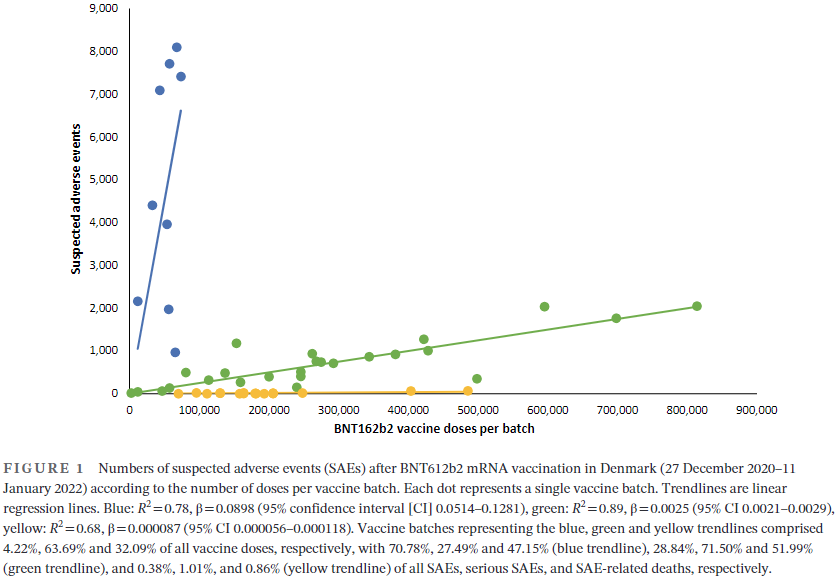
The graph shows that the batches can be grouped into harmfulness. Each ball represents a batch (see it as a barrel for the idea). The further to the right the sphere is, the more are made with it. The higher the bulb, the more side effects have been reported.
- The yellow batches have produced virtually no reports of side effects. There are batches of 200,000 jabs where no report has been found. This is what a placebo could look like.
- The rightmost green batch stands for approx. 800,000 injections with 2,000 notifications, which means 1 report per 400 injections. All spheres near the green line have approximately this ratio.
- The blue spheres are at a ratio of about 1 report to every 10 injections. We see that no more than 80,000 jabs were ever made of these batches.
How that is possible is unclear. One possible explanation is that these particularly bad batches have been quietly withdrawn from the market by public health authorities, keeping the public unaware of the willingness to vaccinate despite this reported harmfulness.
A second explanation could be that they tried to optimize the production process and that this did not always turn out well after they were put on the market. The most harmful batches have been quietly withdrawn from the market.
Other critics think that the explanation lies in a calculation error: that worldwide reports here are projected on only Danish deliveries so that they would be nonsense numbers. However, the Danish study is already a year and a half old. In the meantime, different scientists have come to similar findings independently of each other, which would mean that they would all make the same silly basic mistake. That is very unlikely. Or am I overestimating the state of science again?
By Dyker's calculation, the blue batches represent less than 5% of the total doses in the Danish study. Nevertheless, they are associated with almost 50% of the 579 deaths in the sample.
Similarly, scientists are guessing while it is Pfizer that should explain the discrepancies.
Het Duitse regelgevende agentschap, het Paul Ehrlich Institute (PEI), is volgens deze wetenschappers in principe verantwoordelijk voor de kwaliteitscontrole en "vrijgave" van alle Pfizer-BioNTech-vaccins in de EU.
Dyker en Matysik ontdekten dat het PEI alle zeer slechte 'blauwe' batches, de overgrote meerderheid van de niet zo slechte 'groene' batches, maar bijna géén van de onschadelijke 'gele' batches heeft getest en goedgekeurd voor vrijgave - alsof het PEI van tevoren wist dat deze batches geen problemen zouden opleveren. (zie de "ja/nein" kolom)
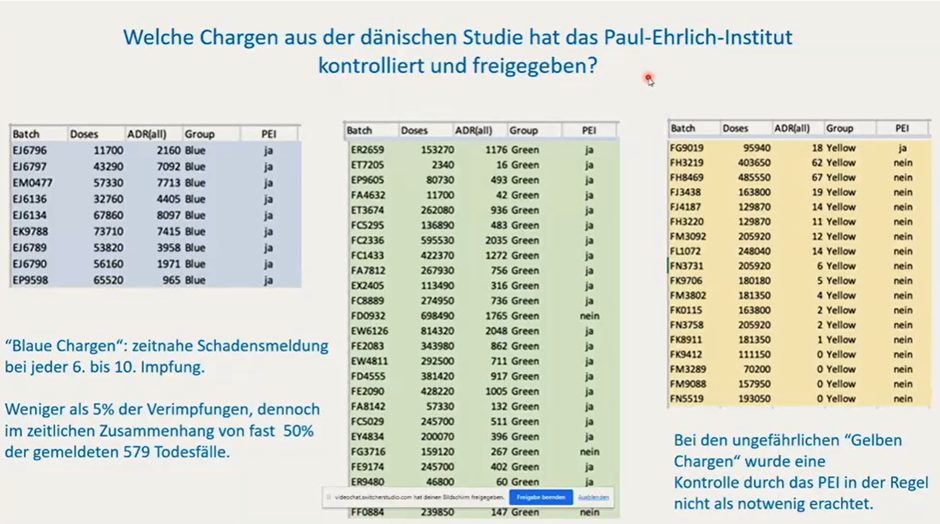
'Which batches from the Danish research has the Paul Ehrlich Institute tested and approved for release?'
Het bijschrift onder die tabel luidt "Het PEI vond het testen van de onschadelijke 'gele batches' over het algemeen niet nodig."
And what exactly are they testing for, the scientists are beginning to wonder.
Karl Lauterbach Tweette onlangs trots dat het PEI zowel de effectiviteit (Wirksamkeit) als de veiligheid (Sicherheit) test. Je zou denken: een foutje van de dienstdoende socmed-ambtenaar. Maar "Wirksamkeit" staat ook op een posterversie van het testprotocol, zoals die in het PEIU-lab hangt.

The scientists don't understand this at all. How can you test the efficacy without a clinical trial? (not to mention safety - but that's not mentioned on the poster)
"In Duitsland is het Paul Ehrlich Instituut verantwoordelijk voor de vergunningverlening van vaccins, d.w.z. de beoordeling van de kwaliteit, veiligheid en werkzaamheid en de farmacovigilantie (geneesmiddelenveiligheid) na de vergunningverlening."
Website Paul Ehrlich Institut
There are now several questions before the PEI. What does the testing process actually look like? Are the methods up-to-date? Does the PEI carry out random checks in the field or does the pharmaceutical company choose which test samples are sent to the PEI? What standards have been set? Why are the tolerance values so enormous when the quantities are so microscopically close? This also applies to additives that increase the risk of cancer. Requirements and features on websites and package leaflets are deleted and/or added; Where are the dates that justify these changes?
We'll see if anything remarkable comes out of that. They were able to force a response after a letter sent in the Berliner Zeitung. On other letters they were sent bad and outright false information, with the final announcement that no more information would be provided. The institutes there are still regarded as institutions that are there for the citizen. We in the Netherlands are already used to the fact that the State is going to lie down for everything.
Either way, it seems clear that not all vaccinations have the same quality.
From a previous post from April 2023:
The existence of 'bad batches' is certainly not imaginary. Leaked EMA documents talk about impure mRNA, damaged mRNA, too little or too much mRNA. RNA instability is one of the biggest hurdles for researchers developing nucleic acid-based vaccines. Specific regulatory guidance for mRNA-based vaccines has yet to be developed, according to an article inthe BMJ. There is therefore a lack of official quality requirements for mRNA vaccines: they simply do not yet exist. So there is no standard for how much they can differ from each other. Despite this, governments have enforced distribution with amounts reminiscent of bribery and conditions that opened the door to irresponsible production and distribution methods with inadequate output control.
Reason enough to take a closer look at the Dutch batch numbers in relation to the individual mortality rates. Oddly enough, those were not public, which led to a WOO request. The Ministry of Health, Welfare and Sport replied that this information is not available, while they have done so in other countries and WOB documents show that this is indeed also registered in the Netherlands.
(update July 6: Meanwhile, John Campbell has also picked up the Danish research.)

In other words, tests have been carried out by Pfizer. I speculate that they deliberately used three groups beforehand (placebo, low dose, high dose?) in order to have valuable information for future injections afterwards.
They literally tested on us (well, not on me).
https://www.foxnews.com/lifestyle/chimpanzee-sees-sky-the-first-time-nearly-30-years-reacts-amazement-video
Or would 'you' rather stay in the propaganda cage?
You ask yourself: Does the PEI do spot checks in the field or does the pharmaceutical company choose which test samples the PEI receives?
The answer is on the PEI's own FAQ list
(https://www.pei.de/EN/service/faq/coronavirus/faq-coronavirus-node.html):
"the manufacturer sends the Paul-Ehrlich-Institut samples of the relevant batches that are representative of the whole batch. "
And that's called quality control...
I had seen that FAQ page by now too, yes. There are more things to scratch behind your ears. It looks like a pseudoscientific pro-marketing money laundering there. Just as the Lareb is a pseudo-scientific after-sales money laundering (or at least behaves accordingly!).
Thanks for this article (and all the other articles) and the link to the video of the excellent interview.
Kim Iversen has discussed the batch variability study and the curious non-testing of the placebo batches very well (starts around 6:00 min):
https://rumble.com/v2wx3w0
I summarized her discussion from about 18 minutes to about 4 minutes:
"CRIMINAL": Study shows 1 in 3 Pfizer batches likely PLACEBO, regulators likely KNEW
https://rumble.com/v2x6le4
Thanks Frank! Good work!
Interesting!
If 30% placebos had been provided, the calculated effectiveness of vaccination in all kinds of studies would have been enormously inflated, and when corrected, not much remains of it!
That's because effectiveness depends on the RATIO of unvaccinated to vaccinated. After all, you can also write the formula for the relative risk (= 1-vaccination effectiveness) of vaccination in the following form:
RR = P x S
P is ratio of unvaccinated/vaccinated in the population
S is the ratio of cases (morbidity or mortality) among vaccinated and unvaccinated people in the sample (study group)
In the case of the mass use of placebos, the term P of multiplication not only has far too many vaccinated people been counted in the denominator, but also far too few unvaccinated people in the numerator: both numerator and denominator of the ratio must therefore be corrected.
In a population with a vaccination rate of 90%, the effectiveness is therefore a factor of 6 too high! Because instead of a ratio of 0.1/0.9 for P, you have to calculate with 0.4/0.6. And that difference is about a factor of 6!
So there is a very strong motive for providing the placebos to both the vaccine suppliers and the authorities: you can then "fake" a very high effectiveness of the vaccines.