


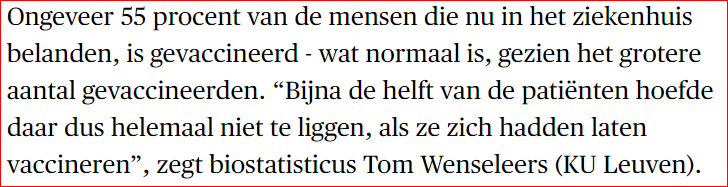
Een tussendoordenkertje van een 'biostatisticus' uit het Belgische Leuven. Lees het screenshotje even, het artikel voegt weinig toe al is daar vast nog meer fraais uit te halen. Van een (bio)statistiscus zou je toch niet verwachten dat hij bedoelt dat die 45% er niet had hoeven liggen... Maar wat bedoelt hij dan met "bijna de helft"? Wij rekenden het voor je uit.
Erratum: Calculation A was incorrect. It took me a while to understand the mistake so I left it as a puzzle challenge and to show how easy it is to cut corners. The adjusted -and hopefully definitively correct- calculation is Calculation B.
Who calculates
Calculation A
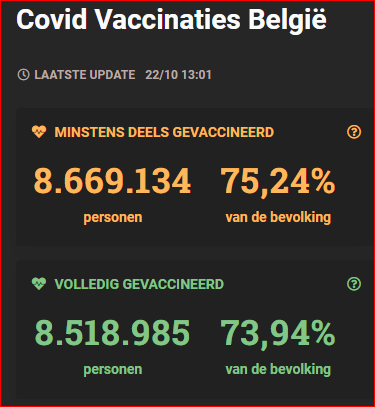
Let's see: 74% of Belgians have been vaccinated.
For ease of reading, we assume 100 patients.
If the vaccine is completely not 74 of those 100 patients would have been vaccinated.
However, there are only 55, thanks to the vaccines.
55 instead of 74: that is an effectiveness of 27%.
So if the 45 unvaccinated people had been vaccinated, there would have been 27% less: 12. So they didn't have to be there. We leave age differences between the unvaccinated and vaccinated out of the equation for a moment, because that would make it even worse.
The biostatistician calls those 12 out of 100: 'almost half of the patients'.
Het antwoord volgens berekening A is dus: Volgens de biostatistiek is 12% gelijk aan "bijna de helft".
Calculation B
Calculation A therefore turned out to be too short-sighted. Various calculators came to the rescue, which brings me to the following sum:
- Given: population of 1000, of which 73% vaccinated
- Given: 100 hospitalizations, of which 55% vaccinated
- 730 vaccinated people lead to 55 zkho = 8%
- 270 unvaccinated people lead to 45 zkho = 17%
If those 270 vaccinated people were to be vaccinated, they would only yield 8% admissions instead of 17%, which is 20 instead of the current 45.
So you save 45 – 20 = 25 shots out of 100. That is 25% fewer admissions.
Het goede antwoord volgens berekening B is dus: Volgens de biostatistiek is 25% gelijk aan "bijna de helft".
What does this mean?
First of all, it says something about the fact that math is sometimes more difficult than you think and that you have to adjust your model when feedback comes.
It says something about the 'journalist' (I would really choose a different profession if I were called that), who writes it down and the editors are happy with it.
It says something about the biostatistician, who will probably get pats on the back from the healthcare capos. The unvaccinated are blamed for a near doubling of ICU admissions.
Fact checkers are also often 'journalists'. Think about that the next time you encounter a fact check.
Medics and biostatisticians will carry out 'plausibility checks' on the CBS data. Where should CBS get its expertise from other than the RIVM? Not with straightforward data analysts...?
P.S.: In the meantime, shocking calculations are emerging from various sides about excess mortality and possible relationship to vaccinations, also in relation to what they have prevented. It is being worked on. As soon as there is a solid and plausibly substantiated story, a post about it follows. In any case, the reverse-engineered data are in, in the absence of CBS activity.
Stay tuned!
