

The media is already anticipating the 500,000th infection that is coming. That number is of a completely different order than what we can see at the RIVM.
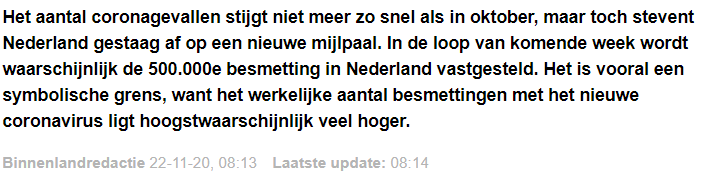
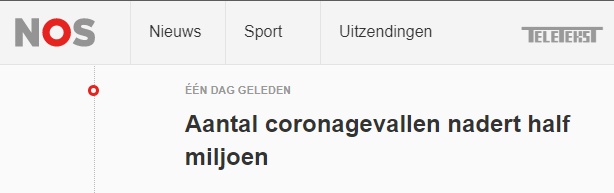
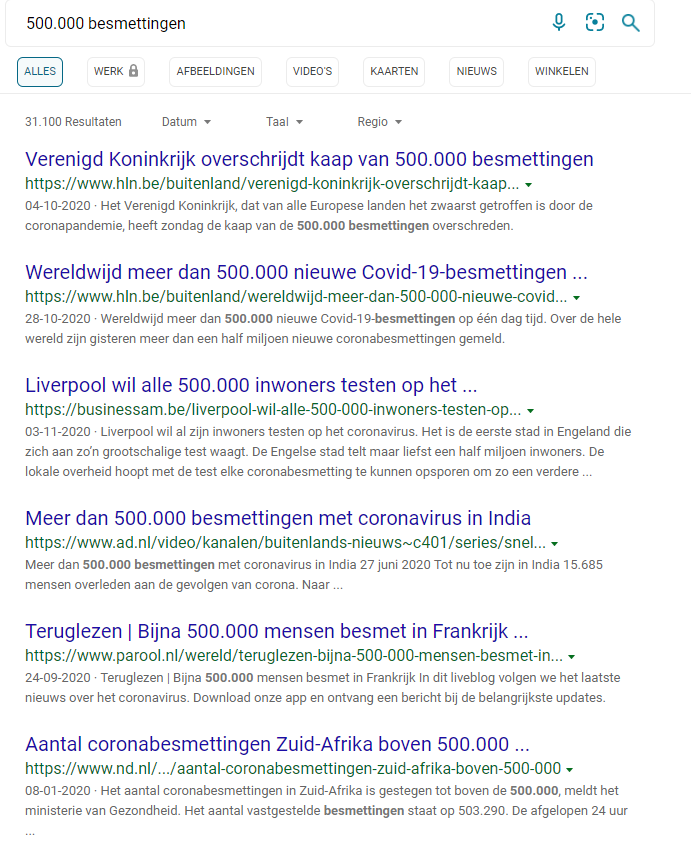
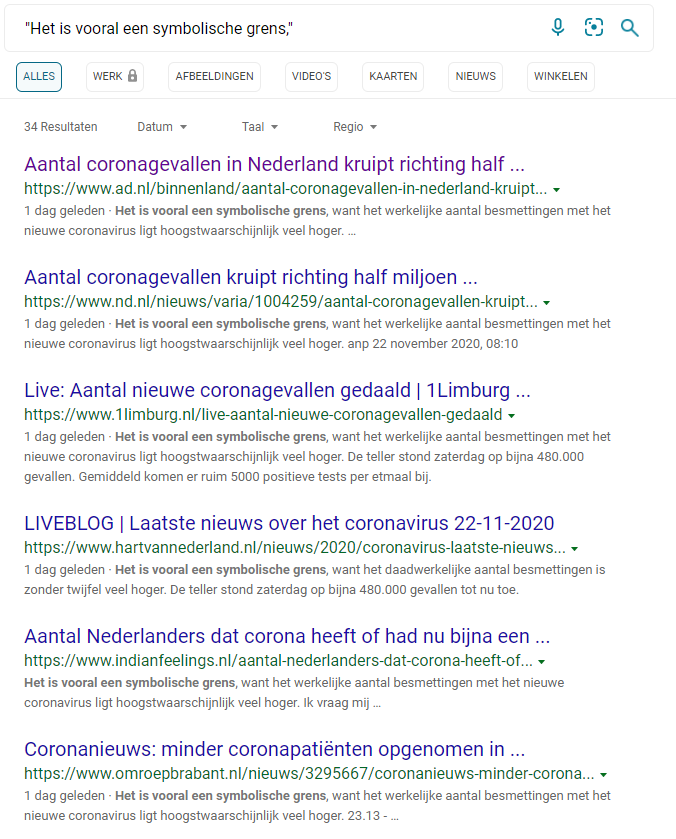
Je vraagt je misschien af waar dat getal van 500.000 vandaan komt. AD en NOS zijn niet de enige, getuige de zoekactie op "500.000 besmettingen".
You would almost think that the WHO's communication manual says something about the number 500,000.
Let's give it a try Fact-checking according to the best Dutch science journalism traditions: we compare the reporting with the figures on the RIVM website. After all, this is how every nationally publishing journalist approaches his or her truth-telling. They call it 'source research'.
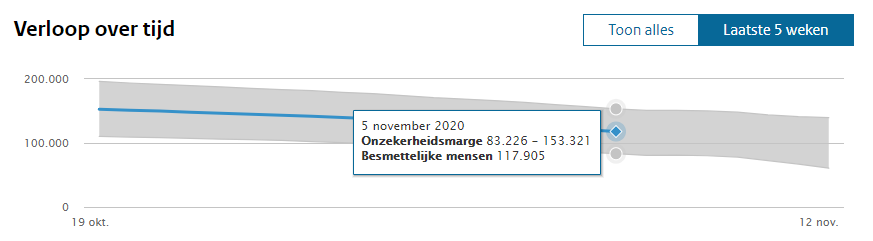
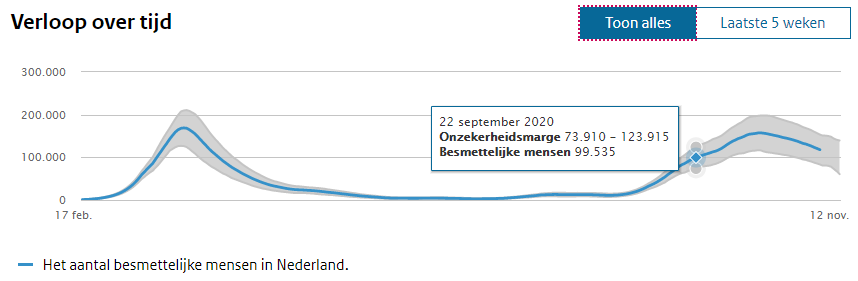

On September 22, we were at 100,000 active infections.
A month ago there were 155,000.
As a final estimate (it is now November 22), RIVM gives approximately 117,905 infections.
On average, certainly not contagious for more than 10 days
Laten we voor de laatste 8 weken rekenen met een gemiddelde van 125.000. Hoe lang duurt het voordat deze poule van mensen is vernieuwd? Op de vraag hoe lang een besmet persoon ook besmettelijk blijft antwoordt het RIVM: "dat verschilt per persoon".
After infection, you may not be contagious at all, or for a few days. If you are still not sick after 14 days, you are no longer contagious. If you are unlucky and you are one of the few who do get sick, you will remain contagious longer, at least as long as the infection is active and maybe even after that.
The vast majority of people do not develop any symptoms of disease and are therefore not contagious or are contagious for a maximum of a few days. Let's say the contagious term is 10 days on average. That is very broadly speaking.
Half a million reached after just six weeks
The 125,000 contagious people therefore account for 10 days of active infection. After four periods of ten days, you are at 4 x 125,000 = 500,000. So it takes 40 days to reach 500,000 infections. That's roughly six weeks.
Including March/April, we have now been above 100,000 infections for at least 12 weeks. We have just seen that you reach 500,000 infections in 6 weeks. In the 12 weeks around the peaks you are at 1 million - and that is a very economical calculation.
From February: easily over a million
In the other 20 weeks since February, the infection average has been rounded off to 10,000. That represents 140,000 people. (20 weeks = 140 days. Divided by the period of 10 days = 14 and that times the average of 10,000.). Added to the previous million: 1,140,000.
You only get to 500,000 infections if everyone who has been infected has actually been tested and that every person who tested positive has also become contagious. In that case, you would only have to count the -already debatable- positive tests.
Who can count like that...?
Maar hoe hebben al die journalisten het dan berekend? Of copy/pasten ze gewoon de kritiekloos de officiële persberichten? Het lijkt er wel op als je de zoekresultaten bekijkt. Sommigen wagen het er hun eigen draai aan te geven door bijvoorbeeld "werkelijk" te vervangen door "daadwerkelijk". Fijn toch, die gedifferentieerde nuances in ons bloemrijke medialandschap...
Chapeau Hart van Nederland for boldly sticking to its own signature!
Positive tests = infections...?
Achter elke positieve test staan misschien wel tientallen besmetten die zich niet hebben laten testen. Tegelijkertijd worden de meeste positief getesten niet ziek. Je kunt eigenlijk niks met die testen maar in de media en in de Tweede Kamer worden positieve testen gewoon als "besmettingen" en zelfs als "coronagevallen" behandeld. Daar klopt natuurlijk niets van maar dat is nu eenmaal Democratically decided. So we are talking about politically correct calculations.
Adapt statistics to political desirability. It is hard to imagine a greater poison for society. We are inundated with it.
