

In the Netherlands, the data are about reports of deaths after/due to vaccinations not just available. Still, I would like to be able to judge how worrisome those stories actually are. So I resorted to VAERS. VAERS stands for The CDC's Vaccine Adverse Event Reporting System: the system that tracks REPORTS of POSSIBLE side effects, for all of America. So those are certainly not always vaccine-induced side effects or deaths. They are only reports from the field, by general practitioners, etc. Let's see how it goes there.
You can turn any death into an antivax horror story and that's absolutely not my intention. However, I would like to have some sort of frame of reference for when possible (dis)information appears on TV or in the newspaper. Leaving matters undiscussed fuels imagination - and fear.
Searching in the VAERS database is not easy so I share a report here, then you can read the reports.
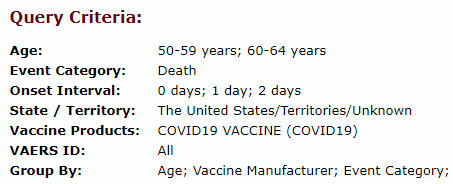
The selection I have made is as follows:
- Alone Deaths (so no serious side effects, etc.)
- Only from Americans aged 50-64. The next category is 65+, which includes a lot of hospice reports, etc., so that is even more difficult to interpret.
- Within two days of vaccination died (i.e. three days: the same day, 1 day or two days after.)
This yields 75 results. A number of them are explicitly reported as unlikely to be vaccine-related, but reported anyway just to be sure. So are there too many? On the contrary, there are far too few. Take a look at one of my famous beer mat calculations.
First get a feel for the averages:
- In that 50-65 age group, we are talking about a total of 43 million Americans. Source
- About 7.5 million of them die every 5 years. That is 1.5 million per year, about 4000 per day: 0.009% of the total 43 million. (A total of 7,700 Americans die every day, so that doesn't sound surprising.)
- Every three days, that is 0.028% of that population. Of course there are mortality peaks, etc., but they don't matter right now, we look at the averages of the average expected mortality.
Then the vaccinated:
- There are 14 million Americans in this age group vaccinated. Source So you should expect 0.028% to die within three days after that.
- So 3906 people between the ages of 50-64 would have to die within three (actually two) days after the jab.
- Of these, only 72 are registered as potentially vaccine-related.
So 72 is not much at all. But it does stimulate the imagination... Namely:
If it comes on top of normal mortality, that would mean an increase of 1.5%. That is a lot. But yes, is that true? If you don't register it properly, you will never find out.
So about 3,800 people died a few days after the vaccination and simply did not report. Isn't that strange?
Maybe those 3831 were already in really bad shape... Or they were traffic accidents or other obviously unrelated causes of death, who knows. Presumably a lot of heart failure, which is the first cause of death in America (23% of all deaths). Heart failure also regularly appears as the last symptom in the VAERS reports. If the body reacts violently, a weak heart will not help.
In any case, it seems that the vast majority of post-vaccination deaths are not reported. There is apparently no obligation to report whether or not someone has been vaccinated a few days before death. If that had been the case, you would have been able to compare that data with the normal values a bit better.
Another question: why did the 72 report and the other 3831 not?
Als je de beschrijvingen leest, zie je best wat "'s ochtends beroerd, 's middags dood"-achtige rapporten, ook van voorheen gezonde mensen die in het kwartier na de prik geen last hadden. Een enkeling zakt op de parkeerplaats alsnog in elkaar. Na twee dagen zie je vaak klachten over misselijkheid, kortademigheid, symptomen die wijzen op hartklachten (pijn in schouder/arm), diarree - en even later helpt niets meer. Overlijden mensen in deze leeftijdsgroep vaak op deze manier? Ik weet het oprecht niet maar nogmaals, echt gemakkelijk voel ik me er niet bij. Zou ik hierover deugdelijke informatie kunnen hebben s.v.p., in plaats van geruststellende beloftes of vreeswekkende dreigementen?
And if you know, then what?
In any case, this raises the question of what the accepted risk of vaccinations is and to what extent this outweighs the risk of dying from the disease against which vaccination is being given. I've read something about that but it never seems to be properly quantified. Last year I got the impression that this is being directed off the cuff on the basis of authority arguments.
Tel ik daarbij de verhalen op over sterke vermoedens van vaccin-geïnduceerd overlijden terwijl dat niet als zodanig wordt vermeld, op advies van een GGD-arts bijvoorbeeld, dan krijg ik daar opnieuw een ongemakkelijk gevoel bij. Het bekendste verhaal is dat van huisarts Bart van Tienen, die voorzichtig zijn zorgen uitte: "Ik geloof dat het vaccin een grote rol heeft gespeeld. De GGD-arts stelde telefonisch vast dat er sprake was van een natuurlijke dood. Het waren bekende bijwerkingen en de constitutie van die patiënt was kennelijk te zwak om die te kunnen doorstaan. Dat is dan een natuurlijke dood." Zie ook dit interview on youtube.
Informed Consent
A friend of mine in Amsterdam is currently at home with corona. Is ill (headache, etc.) and PCR positive. She asked a GGD employee whether a vaccination was still useful. The GGD employee said absolutely yes, because natural immunity only offers protection for 8 weeks and a vaccination much longer. Pierre Capel, Geert Vanden Bossche and many other top immunologists, virologists and epidemiologists strongly disagree... Immunity depends on the mutation rate of a virus; an illness experienced covers a much broader spectrum than a specific vaccine.
We have something to think about again.
Epilogue
A Harvard study commissioned by the CDC into VAERS (under) reporting showed, among other things, that "fewer than 1% of vaccine adverse events are reported. That corresponds with the missing reports. It could even rise to 7,000 actual cases, although you would say that mortality will not be as bad as with milder side effects... Right...? Oh oh oh, doctors and governments...
Electronic Support for Public Health–Vaccine Adverse Event Reporting System (ESP:VAERS) (ahrq.gov)
(Thanks to Muriel van Koppen )
Click on the Query Criteria image to view this selection from the VAERS DATABASE.
(same link as at the beginning of the article)