


I should actually delete this article. At the time, we had no idea that the vaccines would affect excess mortality and the method of calculating excess mortality has since been adjusted. This article could be seen as a prelude to the plea for 'norm mortality' Although I didn't know that at the time.
That is not two seasons added together, as is happening now with Covid-19, no, that will be the average per year. Sharp mortality, such as last year, especially among the elderly, will be seen every year in the next 20 years. Not only are there more and more people, there are also proportionally more and more elderly people during that process. The virus that is dominant at that time will then be pointed out as the culprit of excess mortality, especially when we start testing again. This year could just be the first year in that series.
[edit: there are now thorough analyses of a.o. Bo van der Rhee on LinkedIn en (n.a.v. de cijfers van het Belgische RIVM "Sciensano") een article by Els Ooms on her own blog.] What I write below is broadly in line with that.]
That doesn't look good in terms of peaks
Thanks to better life-prolonging care, hygiene and medication, we keep the elderly among us for longer and longer, like autumn leaves on the tree, when there is no wind. Until another nasty virus comes along. Those will be real hits of at least 8,000-12,000 flu deaths per season. You don't want to think about skipping a year or two (no significant virus for a while, little excess mortality). What will happen in the first subsequent serious flu season, I don't want to think about, in terms of healthcare capacity. Maybe I'll be among them myself. Hopefully we will be a bit better prepared by then, with an RIVM that does have foresight.
Judging by the population pyramid, those mortality peaks will only stabilize in 20 years, and then fall again at the current level and lower.
Flu peaks are important indicators of aging. Not just from a virus.
You would say: just scale up those hospitals and ICUs. And still ventilate. The numbers mentioned here are only rough estimates, but it is inevitable that something similar will happen. Now that I replay this in my mind's eye, I understand better that pension funds and insurers are also somewhat concerned.
And healthcare?
Healthcare is having a hard time. Currently, the largest part (80%!) of time and hospital budgets goes to the last years of life. Can you imagine how many last years of life will come at the same time? We should have been prepared for that a long time ago. Healthcare can wet the chest. The corona crisis is a dress rehearsal.
The only way to smooth out those future virus peaks is: prepare ourselves with the right ventilation/ionization/UV-C etc, nutrition, vitamin D+K, Zinc. Hopefully, there will also be a solution that virologists see potential in.

Addition based on a great analysis of the situation in Belgium by Els Ooms
In summary: Excess mortality is determined on the basis of the pre-estimated mortality. The amount of this estimate determines the exceedance. How that estimate is calculated is therefore decisive for the resulting excess mortality.
The piece by Els Ooms makes it clear that if this mortality estimate is made taking into account population size and structure (i.e. growth and ageing), the excess mortality of 2020 will all but evaporate. Keep in mind that excess mortality, together with the mismanagement of ICU capacity, is an important justification for the draconian measures.
Now the population pyramid of Belgium looks more even than that of the Netherlands. Her figures and percentages will therefore not apply one-to-one to the situation in the Netherlands, since she calculates the mortality rates per age category. The pyramid of the Netherlands is 'top heavier' than that of Belgium. I would not be surprised if this turns out to be an even greater underestimation of mortality in Belgium than in Belgium.
She also calculates what it looks like when calculating with QALY. A tough piece but worth reading!
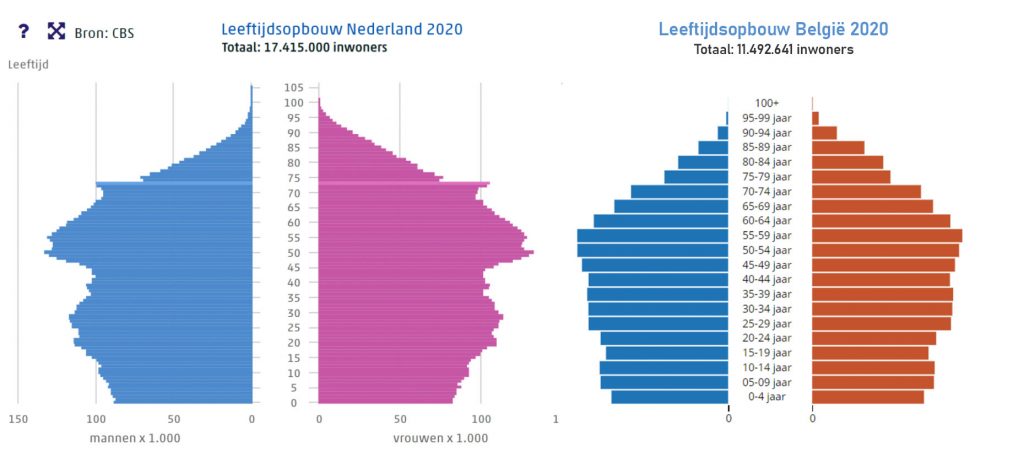
How do we actually get the huge hump between 45 and 60 years old, which Belgium is hardly visible?
