


Pfizer last week approval requested from the Food and Drug Administration (FDA) om gezonde kinderen van zes maanden tot en met vier jaar een startpakket aan te bieden van drie injecties. Ook is er op 28 juni een FDA-zitting waarin een nieuw plan wordt besproken van Moderna en Pfizer: het Future Framework. Als dit "Future Framework" wordt goedgekeurd, worden alle toekomstige Covid-19-injecties, ongeacht de formulering, automatisch als "veilig en effectief" beschouwd zonder aanvullende klinische onderzoeken, omdat ze worden beschouwd als "biologisch vergelijkbaar" met bestaande shots. Lees more about the Future Framework.
Wie eerder FDA-hearings heeft bekeken, weet hoe groot de kans is dat FDA, EMA en CBG ook in deze plannen mee zullen gaan ondanks alarmbellen van externe experts. Hierbij valt vaak de term "All Cause Mortality": totale sterftecijfers (dus niet alleen sterfte aan Covid). Die cijfers zijn verontrustend, zeker voor de jongere groepen, waar we de 40-49 jarigen in dit verband ook toe rekenen.
Bonten, Koopmans, Bruijning, Illy: they should all know these figures for a long time.
This article covers the 18-49 age group as reported by the UK. There are no complete figures (yet) for youth up to 18. Remember that in Flanders, 88% of 12-17 year olds have already been vaccinated. If it is up to the pharmaceutical companies, it will also be the turn of the 0-12 year olds.
And that while 18-49 year olds make up the majority of the Dutch population, while they only make up 1% of all Covid deaths.
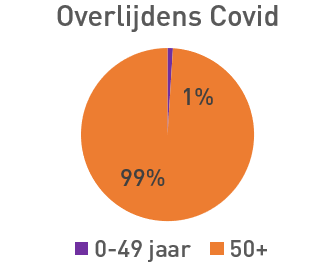
All Cause Mortality
How do you compare different group sizes that change over time? First, total mortality in the unvaccinated group was looked at, per month. For example, if that group was five times smaller than the vaccinated group in that month, the mortality was multiplied by 5 and then compared with the number of deaths in the vaccinated group. The difference between those two numbers is shown in the graphs.
Calculation example:
| 18-49 YEAR OLDS | Group size | Number of deaths |
| Unvaccinated | 3 million | 50 |
| Vaccinated | 15 million | 350 |
| Unvaccinated after arithmetic equalization (upscaling) | 15:3 = factor 5 5 x 3 million = 15 million | 5 x 50 = 250 |
De groep ongevaccineerden is 5 keer zo klein. Als de groep even groot wordt gemaakt, komt dat uit op 5x50=250 overlijdens.
The mortality risk is therefore higher among the vaccinated, resulting in 100 more deaths.
So it concerns all causes of death, including Covid. Positive values represent more deaths among vaccinated people. More explanation and links to the sources can be found here.

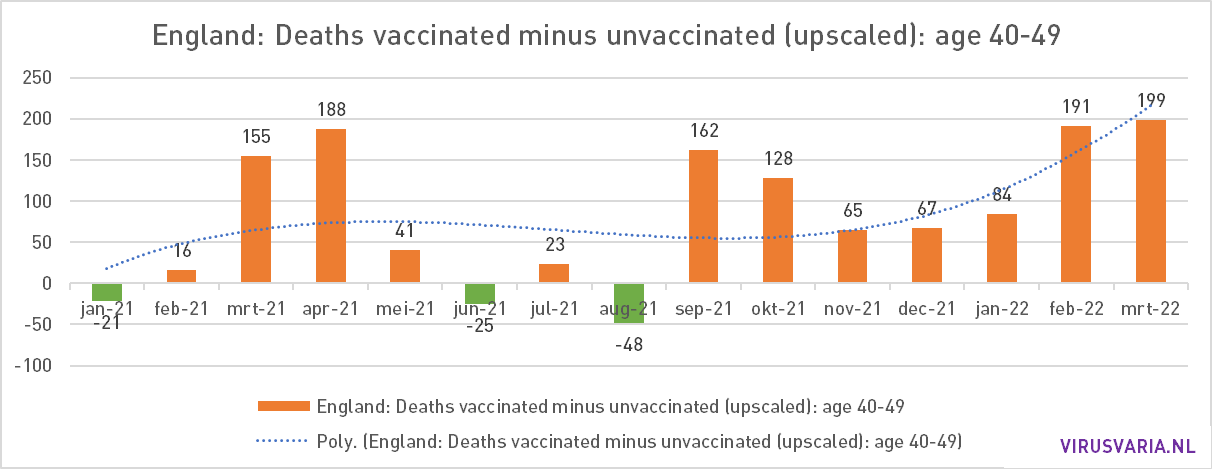
All bars added together, we see 2,346 more deaths in the vaccinated group. For both age groups, 1,121 and 1,225 respectively.
Translated to the Dutch situation
In the absence of Dutch data, we try to deduce a few things from the UK's reports. According to the ONS files, the English population is about 3.3 times as large as the Dutch population. If we divide the English figures by 3.3 (we then disregard any health differences between the two countries), this gives the following figures:
2021
If we take mortality among English unvaccinated people as a benchmark and compare it with the mortality of vaccinated people, then converted to the Dutch population size, there were deaths in 2021 an average of 41 more people every month in the group of vaccinated under-50s. That's 10 every week, between the ages of 18 and 49.
2022 to March
In the first three months, there were an average of 237 more deaths per month in the vaccinated 50-min group than in the unvaccinated. Dividing by 3.3 for NL (population size) would mean: 72 per month more among vaccinated people per month than among unvaccinated people in the Netherlands.
Een aansprekende kop in de Nederlandse dagbladen zou kunnen zijn: "Sterfte jonge gevaccineerden neemt schrikbarend toe, oorzaak onbekend".
More deaths among vaccinated people under 50: why?
What has been the cause of those extra deaths among vaccinated people? What else do those vaccinated people have in common that unvaccinated people do not have in common and/or vice versa?
And if the vaccinations are related to it, do we see this reflected in an increase in accidents (becoming unwell in the car, falling down the stairs), cerebral infarctions or hemorrhages, immunity problems, heart failure, clots and other thrombosis-related disorders?
The causes of death could give direction to this, but we do not find out, even the members of the sounding board group that investigates excess mortality are not allowed to see that data. That at least gives the appearance of self-protection of the policymakers. In particular, vaccine-related diseases that are already known would raise questions: about the role of the experts, the health authorities, policy and political control (and media) and of course the whole state of affairs in the pharma/medical chain.
Medisch-politieke ethiek: 'do no harm'
If a total of 700 people under fifty in the Netherlands have indeed died from the vaccine, is that acceptable? And is it also acceptable if we consider that those age groups had very little to fear from the Covid-19 disease, which only wreaked havoc among the elderly in the first months of the year (2021)?
"The benefits outweigh the risks", dat was immers de argumentatie.
A realistic calculation of years of life gained and lost may follow. Then there remains an ethical discussion about weighing up QALY among young and old, and whether you can use it as change among yourself.
I don't have the impression that the ethical effort has been taken to the limit. I have never seen the serious consideration (although hesitantly suggested here and there) to selectively offer vaccines, for example only people over fifty and vulnerable people under fifty. We do know of offering vaccines under the threat that otherwise you will not be allowed to go on holiday, to a concert or to the catering industry.
Een veel gehoord argument dat mensen wel eens ontglipt: "Achteraf is het makkelijk, dat zien we nu pas, dat konden we toen niet weten". Maar als je zoiets belangrijks niet weet, hoe haal je het dan in je hoofd om een wereldwijde massavaccinatie campagne uit te rollen? Bovendien was de kennis er wel degelijk, luister maar naar eerdere hearings of the FDA: even then, there were plenty of doctors who had delved into the Pfizer papers and warned again and again. There were even signs in January 2021 (see various articles on this blog around that time or the video in this post, from 32 minutes).
Ook de Pfizer-docs zijn onthutsend, net als de manier waarop FDA, EMA en CBG de goedkeuringen er met spoed doorheen hebben gejast. Medici hebben recentelijk nog hun jonge gezonde 'patiënten', zelfs kinderen en zwangere vrouwen klakkeloos aangemoedigd om zich te laten prikken, misleid door het label 'vaccin'. Dat is gezien de discutabele veiligheid en de korte werking eigenlijk niet op zijn plaats. Deze vaccins doen op geen stukken na wat er werd voorgespiegeld.
There are questions at ONS because we identified inconsistencies in the data and because external checks raised questions. If there is an answer or the data is corrected, we will of course report on it. For now, we will stick to the official report.
In conclusion
For pharmaceutical companies, for the entire vaccination chain and, in a way, for the entire medical world, the Covid crisis is a rare opportunity to strengthen their position and achieve growth in the sales market. The necessary counterforces have been absent or have become part of the pharmaceutical system. Who is going to argue that:
- It is highly unlikely that Covid will once again become a threat to public health
- We must face the finiteness of life
- The vaccines are an unprecedented failure, both in terms of safety and effectiveness
- We have a duty to protect children and young people
Pharmaceutical initiatives must be stopped. Vaccines first deserve thorough research with due regard for the target groups that actually need the vaccines.
In the meantime, a calculator, a statistician, a data analyst, an accountant and a graph builder looked at the data and the previous blog article about the UK figures. The graphs are a correct representation of the source data, the methodology followed is correct. So we fully rely on the data that governments, in this case ONS (Office for National Statistics of the United Kingdom Government), report. Reservations about this are beyond the scope of this article.
Enlightening dialogue
English data shows that hundreds of young people and young adults may have died in the Netherlands as a result of the vaccinations. Are you familiar with those figures?
"100 children or thereabouts, yes that could well be" explains Dr. Politicus VV-3902-CC97when asked. "In England, more than a thousand under-40s have been counted, but that population is much larger and of course vulnerable young people have also been injected who would otherwise have died anyway, so you actually have to take them off again. They did not necessarily die because of the vaccinations. But others may have, unfortunately, we can't rule that out yet. It may be difficult to understand, but medications always have side effects. All the time. Every medical procedure has risks. But in this way we have many thousands, what do I say: tens of thousands of patients, whom we could have seen in an epidemic like this, we have managed to keep them out of the care circuit. That's what it was all about."
The vaccinated under the age of 50 are all worse off, not just teenagers and twenty-somethings. So the slogan 'Vaccination protects against serious illness and death' does not apply to them.
"No, you have a point there – but those five hundred or so people under the age of fifty that we may have killed in this way, I emphasize 'maybe', do not outweigh the thousands or certainly tens of thousands of very old and elderly people that we have saved from death. It is more or less in that order of magnitude. Moreover, it is not certain whether they actually died "by" or simply "with" the vaccination, after all, you do not have the causes of death. We have been looking at this thoroughly for several months now, what we are going to do with it. You are now hammering on the young, and rightly so, but you must not forget that in our aging society, the elderly are by far the majority."
These younger age groups together make up half of the population. If you add the minors, it is about 60%. Soon that will have to be done: the minors have now also come into the sights of the pharmaceutical companies.
"OK. Can you ask the question again?"
Wouldn't it have been better, for example, to only have the elderly and vulnerableVaccinate people over 50? Shouldn't we have excluded those children and younger groups? Shouldn't we have informed the parents?Should we continue to vaccinate the very young?
"Those are a lot of questions, but very good questions and I understand your concern. You have to see it this way: something like what you propose poses major challenges in terms of administration. Such a campaign is a complex logistical operation. You can't do that on an individual level; Then you might have to put GPs in between again and that has all kinds of other disadvantages. Communication also becomes very complicated; People no longer understand: which one does and which one doesn't, that takes the momentum out of it. That is why we have opted for a clear strategy in modern one-size-fits-all medicine. This was not possible in the past, but now it is thanks to the mRNA technique. Very clever people have been working on that for a long time. Pfizer's studies show that this is really the most effective approach. So that means: vaccinate everyone. Otherwise, the disaster would have been incalculable"
For reasons of privacy,VV-3902-CC97 not the real name of the interviewee in this imaginary dialogue.

indeed, those figures from the ONS are not correct.
https://jdee.substack.com/p/age-standardised-annualised-all-cause?utm_source=email&s=r
Hello Jan,
Not everything is correct from ONS, but those are different figures. I didn't want to use those "person-years" and "age-standardization" figures for various reasons.
Therefore, no statements are made in the article that require that kind of calculation. For this article, I only used 'raw data': counts of deaths and specified sizes of age groups ("Count of Deaths" and "Population"). The age groups remain compartmentalized, the vaccination statuses are not divided into Doses 1, 2, 3, and 4. If you do, it suddenly becomes a lot more complicated.
The problem is that the sizes of age groups are not known.
of the vaccinated and count of deaths, but not of the unvaccinated and population.
in addition, the question is, as of when someone counts as vaccinated for the US, the date of the shot or any date, two weeks?, after?
Good questions Jan, that is spread over previous posts about the UK data, but in short: I used the data from data.gov.uk: https://coronavirus.data.gov.uk/details/vaccinations?areaType=nation&areaName=England At the bottom of the page, download button below the purple graph. It is what it is...
— The causes of death could give direction to this, but we do not find out, even the members of the sounding board group that investigates the excess mortality are not allowed to see that data. That at least gives the appearance of self-protection of the policymakers. —
I would like to turn it around... Without transparent data, I have to assume that vaccinations are the main cause of the excess mortality achieved. It is then up to the authorities to prove the opposite. And as long as that doesn't happen, I suspect our government of planned genocide.
I feel you, but "without transparent data I have to assume" – who should do that... Someone is innocent yoy the contrary has been proven. But I also feel that way, I have written it that way in an earlier article, hoping to provoke someone. Nothing. I only scare people off because of the tone. So I moderate it a bit, every now and then.
The result is that I have lost all confidence in our government, no confidence that it has our best interests at heart, no longer even feel the need to participate in this society. In a month we will move to Curaçao where it is actually not much better, but at least without a technocratic EU and with an even more corrupt government that does not make a dent in a packet of butter. We just go back 20 years in time and I like that prospect.
Today I heard from an emigration official that there are currently an exceptional number of Dutch people emigrating to Curaçao and Bonaire...
In my opinion, this is still a medical experimental treatment that is being forced on the population.
Proper monitoring and transparency about the data seems mandatory and punishable if this does not happen.
So I also assume that the vaccines are the cause of the excess mortality, especially because we see the same picture in other countries. So it is indeed up to the government to monitor everything properly and to make this data available to science in full transparency. I would rather not have the government interfere with the interpretation of the data. I would rather see a public scientific debate, then the population can make a better choice afterwards. This also prevents conspiracy thinking.
The calculations that Steven Kirsch shows again and again show that the argument that the vaccine saves more lives than it costs is very unlikely to hold water. Therefore, no justification can be found for the use of the experimental drug of, for example, Pfizer. Moreover, it also seems that Kreutzfeldt-Jacob-like phenomena are occurring, on a previously unknown scale, due to vaccination with that junk from Pfizer, Moderna and Johnson. How on earth can the thunder of the pharmaceutical companies pass for SCIENCE when there is a deluge of evidence that goes against their usual mantra
I don't know either. We'll just hang in there!
I just listened to the conversation between Dr Brett Weinstein and Dr Robert Malone (see Spotity, Dark horse podcast). Is largely about the effect and side effects of the injectable products, but also about the evolution of the virus.
Tough stuff, but very worthwhile.
The number of injection deaths is most likely much, much higher. For example, younger inoculations that were mostly around from summer 2021 onwards were noted as uninoculated well over half the time of the remaining 6.5 months if they were given two shots. With one shot, two weeks, also with the boosters at the beginning of this year. The figures are further polluted, because people who are known to die very soon do not get a shot. Even if they did get an injection and died shortly afterwards, they were considered unvaccinated. Furthermore, many seriously ill people who use certain medications and/or follow chemotherapy are not vaccinated. The same applies to people with certain serious diseases.
Everyone here is counted as vaccinated from the first injection. There are also vulnerable people who are now more vaccinated. All fairly marginal, it will not cause these differences easily, I guess. Try to calculate it if you think it is lamgrijk.
I thought they were counted from the jab, but that if they died within two weeks of a jab, they were still counted as unvaccinated.
The UK data also includes deaths within 21 days of the first shot. Whether that has happened the same in all countries is impossible to say. This article only shows the official data. I'm not going to correct it.
The conversation between Bret Weinstein and Geert van den Bossche is still going on in my opinion.
"What has been the cause of those extra deaths among vaccinated people? What else do those vaccinated people have in common that unvaccinated people don't have in common and/or vice versa?"
This is of course a good question. Could it be, for example, that healthy people are more likely to say: "I don't take a 'vaccine' because I don't need it" and that unhealthy people are more likely to take it. If that jab then does little, more jabbed people die than unjabbed.
Justified reservations. Some counter-questions:
1) Is the idea that people themselves have about their own health or resistance to the virus correct? Perhaps many imagine themselves to be strong.
2) Aren't many healthy people unjustly frightened, which in turn cancels out that effect?
3) If 90% of an age group has been vaccinated, does that still apply (to that extent)?
4) Would that explain the observed differences at all, do you quantitatively achieve those numbers and percentages with that?
Could it be that the people who died within three weeks of the first shot only received/needed to have one shot (Janssen) and they all died after two weeks?
Would like some substantiation why that would be the case... Coming up with scenarios is one thing, but making them plausible is part of it.
It was just a question. Only if it is clear to all those who died within three weeks that they had to get an extra shot within a few months and people have also died and noted within two weeks of the first shot, then my question does not need to be asked. If that is not clear, the argument says; The calculations also include people who died within three weeks, not all.
It is explicitly stated as such in the source files, so, well... Then I'll just take it.
"The causes of death could give direction to this, but we do not find out".
For this we can use another official source, the US army (Defense Medical Surveillance System DMED). Unfortunately, their data set was falsified (or accidentally reconstructed incorrectly after a convenient data crash?), but with the help of archive.org and other people like you, we can figure it out, as discussed in another blog:
https://roundingtheearth.substack.com/p/defining-away-vaccine-safety-signals-82f
I have my doubts about this approach with 2 datasets. The ONS dataset Table2 lists the person-years of the various vaccination statuses. These can easily be converted to population (for a total of 15 months of data, this is person-years/15*12, per month person-years/days-month*365). And then you come to a population of 11.17M on average for 18-39 year olds. Of these, 6.25M with status "ever vaccinated" and 4.92M "unvaccinated". With the number of deaths of 3000 and 2848 respectively, upscaled from "unvaccinated" would come to 3619, so 619 more died "unvaccinated" compared to "ever vaccinated".
Status Deaths sum person-years
First dose, at least 21 days ago 839 1420083
First dose, less than 21 days ago 166 523734
Second dose, at least 21 days ago 1476 3807614
Second dose, less than 21 days ago 97 498587
Third dose or booster, at least 21 days ago 368 1222889
Third dose or booster, less than 21 days ago 54 320204 Popavg Upscaled
Unvaccinated 2848 6132176 4919218 3619
Overall all statuses 5848 13925287 11170835
Ever (calculated Overall – Unvaccinated) 3000 7793111 6251617 3000
How do they know in England how many people have not been vaccinated?
they don't even know how many people there are in total.
This is indicated in table2 as person-years for the “unvaccinated” status. And all statuses added up are person-years of the population on which the data is based. Whether those are the correct numbers. I'm not about that. If you calculate the population per month as indicated, this is the population trend (all 18-39 years):
Month Pop
January 11214354
February 11207742
March 11200779
April 11193808
May 11186791
June 11179695
July 11173262
August 11167587
September 11161846
October 11157143
November 11153196
December 11148972
January 11143273
February 11139253
March 11135502
@Harry: That check is correct, I believe that immediately. But if I look at the actual (officially reported) vaccination percentages across the entire population, the picture looks different. So what goes wrong, those official vaccination percentages or the Person-year calculations? In addition, I only need those person-years if I want to add or average cohorts. I deliberately don't do that. The definition of "vaccinated" has also changed over time (1 or 2 shots, minimum number of weeks after the shot). That is why I have chosen "everyone with at least 1 shot = vaccinated". It may well be that you will achieve different results with this. Then the results with my definition of vaccinated/unvaccinated and the official percentages will still hold up, it seems to me.
De nieuwe sterftecijfers voor de week 22 van het CBS.
https://www.cbs.nl/nl-nl/maatwerk/2022/23/overledenen-per-week-provincie-en-gemeente-week-22-2022
De geen van de gebruikelijke gegevens voor week 22. Week 21 komt op 2881 sterfgevallen maar blijft onder de 2958 95% onzekerheidsmarge.