

Translation of a column of el gato malo. Original article is in English, subscription advised. In this striking parable with explanation, all kinds of things are discussed that you can put one-on-one on the situation in the Netherlands. Only the aerosols are not explicitly mentioned.
And also a look at the future of Science. The government should facilitate crowd-sourcing instead of putting together committees with static knowledge and then censor who wants to supplement or correct that knowledge.
What kung fu theatre can teach us about Public Health
A long time ago I was a wrestler. I was pretty good, won a few tournaments, captained a high school team, etc. Nothing earth-shattering, but not bad either. Later I picked up Muay Thai (Thai kickboxing). This was in the 90s, long before it was trendy and when gyms were still dirty, hard, fighters-only bases. Nobody came for thai-bo. You came because you full contact wanted to learn how to fight.
Ik was een best wel getalenteerde amateur met aardige resultaten in de ring tegen andere best wel getalenteerde amateurs, maar ik koesterde geen hoop om ooit naar het volgende level te klimmen. Als je me had aangeboden om tegen een professional te vechten, had ik "no way" gezegd. Mijn kop zou eraf zijn getrokken - en dat wist ik verdomd goed.
Zoiets luistert niet nauw. Je wist gewoon hoe "expert" je was. Je wist het omdat je gevochten had en je je nergens kon verstoppen tijdens training, sparring of vooral: in de ring met andere mensen die ook ambieerden om vechters te worden.
Everyone had plans. Everyone got a slap on the nose. This way you found out whether and if so to what extent your plan had a chance of survival in reality.
If you didn't know if you were better than someone else, there was a simple way to find out.
Er waren ook andere kunsten. De verheven Shaolin-mystici, karate-kiddos en taekwondozers zagen er allemaal verschrikkelijk prachtig uit met hun vliegende trappen en luchtstoten en wudan-wijsheid. Hemel, ik deed het meteen al in mijn broek voor ze. Hun exclusieve mystiek zorgde voor superieure marketing. Maar het was een slecht product, zo bleek al gauw. Veel zogenaamde "vechtexperts" waren absolute watjes en je kon menig "zwarte band" ontmantelen zonder één druppeltje zweet.
None of them wanted to fight us. (Well, maybe with me, but not with the intensely scary guys I trained with.) They didn't venture into our ring. Their masters and sifus were nowhere to be seen, carefully staying out of the sight of our instructors whenever anything resembling a fighting day approached. This allowed their delusions to continue.
Een vliegende driedubbele lotus trap kan het publiek verbazen, maar hoe zit dat op een "verdedig je tegen een getrainde tegenstander-dag?" Dan valt dat best tegen.
But if you've never tried it, how could you know?
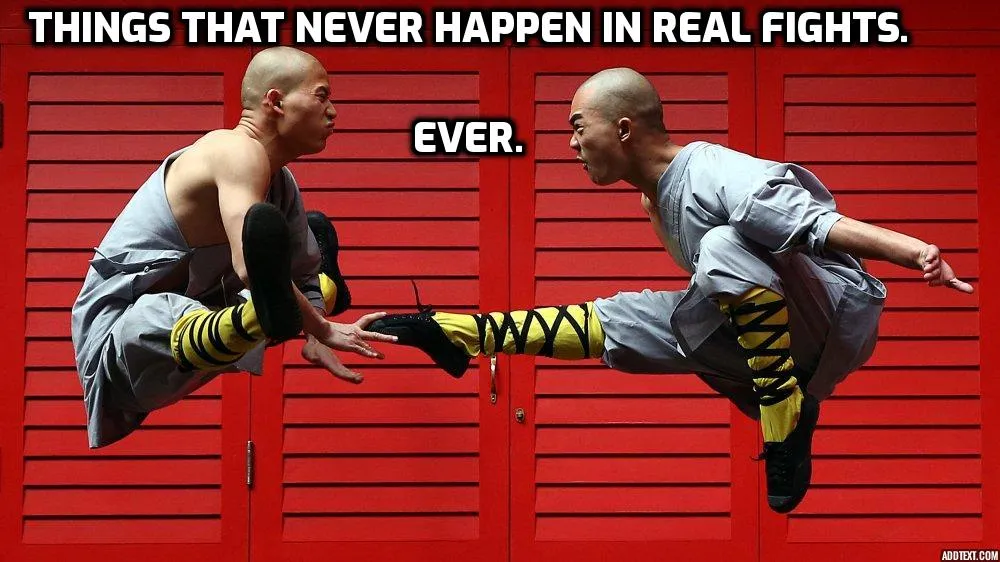
Our teachers and coaches came from Thailand. They called all these claims and flashy fights 'woo-woo'.
For example "als je die woo-woo in de ring probeert, ben je dood."
And they were right.
We zagen het toen de dappersten het probeerden of wanneer we een student oppikten van een of andere drakenacademie. En daarom was het zo belangrijk voor hen om te kunnen ontkennen dat onze ring bestond en geldig was. Zo werd de mystiek behouden van de "haal in 18 maanden je zwarte band in TKD" McDojo-fabrieken, met hun discipelen die alleen met elkaar omgingen in gecontroleerde, gekunstelde omstandigheden waar het veilig was.
The most astonishing thing was that many of those who did show up on a day of combat were absolutely certain that they would dominate.
None succeeded.
Lange tijd hield deze mythe stand. "Ik ken karate hoor!" bleef een angstaanjagende bewering. Toen gebeurde er iets grappigs: de waarheid begon los te komen. MMA kwam op en pikte alle technieken op die werkten van kickboksen en MT tot jiujitsu, worstelen en wat er nog meer bruikbaar uitzag. Dus niet in het rond dansen en er indrukwekkend uitzien. Gewoon toepassen van alle vechtstijlen.
It was easy for me to see that coming: it was things I had done myself. I had some experience, some kind of basic knowledge.
And MMA wiped the floor with woo-woo.
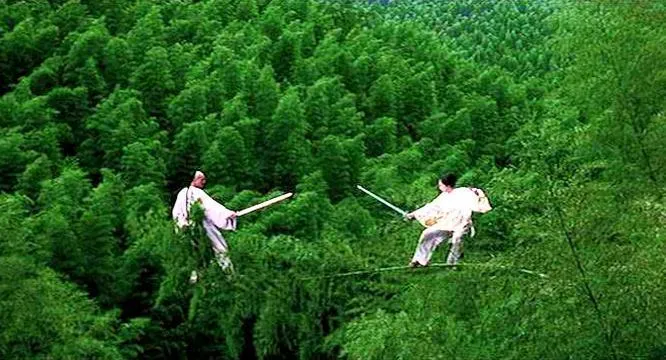
What people forget is that initially there was a great hope that the masters of woo-woo would come and silence these newcomers. Some saffron monk from the secret valley whose name might not be pronounced would float in and clean up the house. Instead, anyone who tried it was gutted. And very, very quickly, these disciples found all kinds of reasons to stay on their mountain tops.
The mismatch was far too obvious and nothing solves the mystique of the lifelong woo-woo practitioner when he is knocked out in 30 seconds by a 3rd year boxer from a good school.
The true power of woo-woo is that you no longer dare to challenge.
And much more than you think works like this in our world.
Because woo-woo is absolutely everywhere.
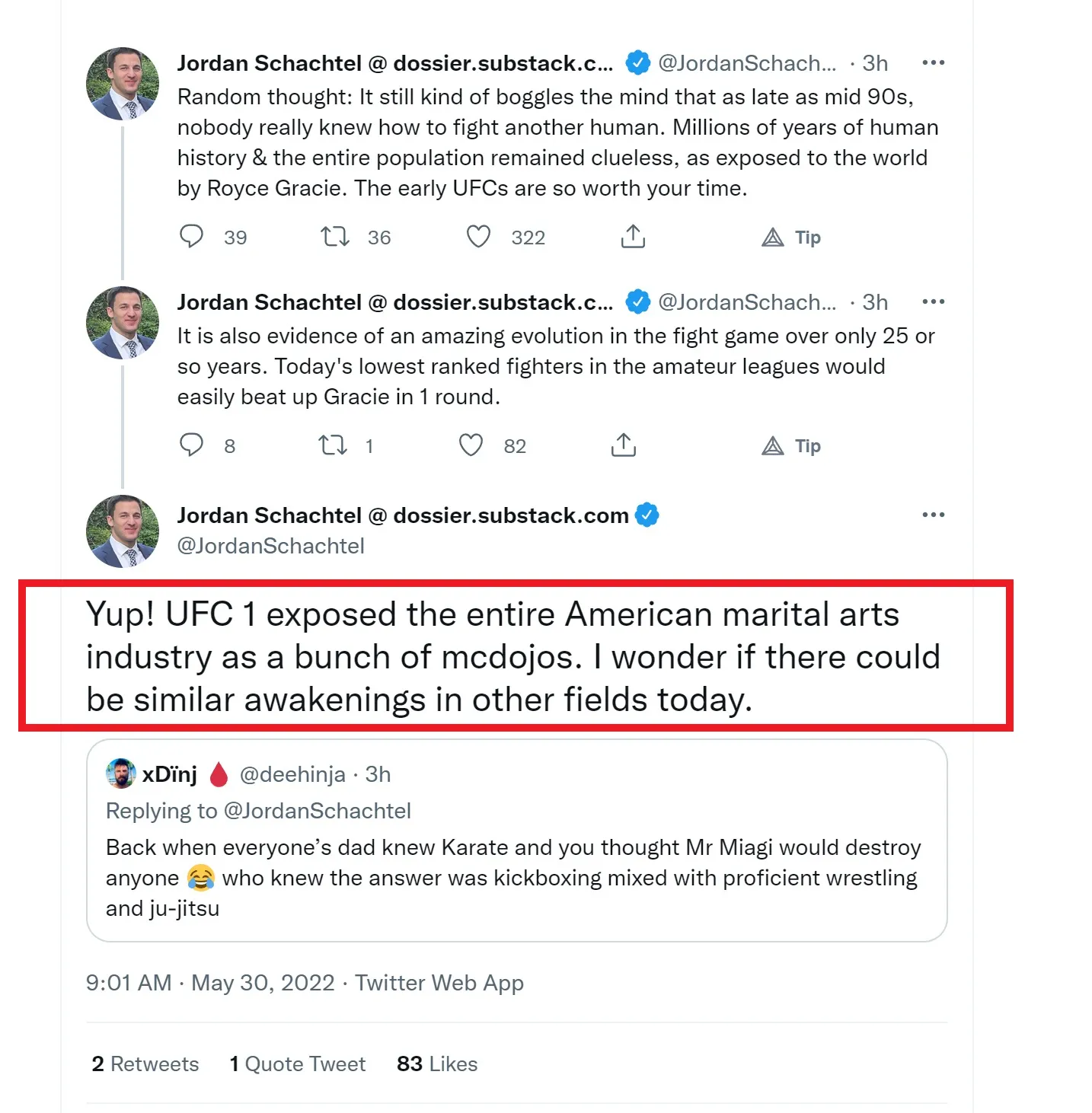
That's exactly what made gato-buddy's question jordan schachtel So wonderfully striking:
"Yup! UFC1 (Ultimate Fighting Championship) ontmaskerde de hele Amerikaanse martial arts industrie als een clubje mcdojo's. Ik vraag me af of er zich soortgelijk ontwaken voortdoet in andere vakgebieden, vandaag de dag."
Could anyone think of another field like this?
Oh wait a minute: you mean like the public health frauds of nonsense credential factories that have to compete in real-time with people who really master science, data, and statistics?
De afgelopen 2 jaar heb ik veel vermeende blackbelts en sifu's verslonden zien worden door "newbies".
It looked like this:
I'm not going to mince words here: almost the entire public health policy branch is woo-woo.
These alleged epidemiologists, modelers, and academics were a bunch of con artists who spread hocus pocus from the mountaintop temples. And they have learned nothing. They had misunderstood in March 2020 and 2 years later they were still wrong.
It's all woo-woo and fear-mongering.
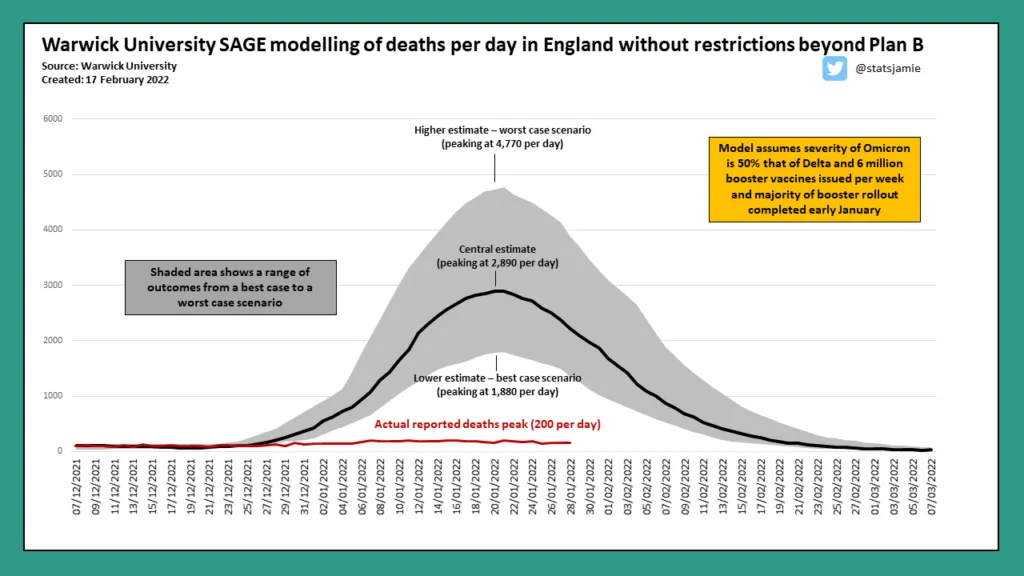
Their track record stinks. This field has been a laughing stock for a long time with a few bright spots that generally remained far removed from public policy, of which this ecosystem of mysticism was hardly a part.
From SAGE to the CDC, the UW to the NIH, [U.S. health agencies] it was complete and totally woo-woo. Not only did their models fail, they were so bad that they were non-deterministic and couldn't even replicate their own results.
They rode in on large white woo-woo horses, laden with credentials, and made bold claims about their ability and foresight. They really had no idea that they were certainly not top world champions-stone-cold-legendary killers. They had never been outside before. It was 15 years of puppy training in preparation for the gold medal round in Olympic boxing.
Totale missers op Mexicaanse griep, zika, dengue en "ebola komt naar amerika" werden grotendeels genegeerd.
They had no idea that they were actually mind-boggling, embarrassingly bad at this.
And all of a sudden, they were in the big leagues and were eliminated in the first round in front of everyone because they didn't know any better than to jump into a ring they weren't qualified for. All their predictions were wrong, their recommendations incorrect and unsubstantiated. It was just jumping around and throwing some jargon and mathematicalism around as if that implied that you knew how to fight a disease.
And we saw this kung fu theater go down in real time.
Het meest amusant was wat het teweegbracht bij degenen die wisten hoe ze moesten vechten. Eén blik en deze fraude was duidelijk. Het waren 7-jarigen die "hee-yah" schreeuwden en over hun voeten struikelden.
Velen (waarschijnlijk de meesten) van ons die bij dit debat werden betrokken, hadden geen epidemiologische achtergrond. Eerlijk gezegd, dat is waarschijnlijk de reden waarom we het probleem konden zien. Als je eenmaal precies wist hoe een klein onderdeel van het grote probleem werkte, kon je meteen zien dat de "experts" dat kleine stukje verkeerd deden.
So you grabbed the thread that caught your eye and you started pulling it. And it soon became clear that this was not as complicated or obscure as was made out to be. It was just jargon and authority, used to intimidate people and impress those who weren't familiar with what science should look like (unfortunately, most of the public).
But if you had an understanding of biology, drug or vaccine design, statistics, data transfer, and/or inferential and deductive reasoning, you could quickly catch up and surpass the mendacious monastic orders of public health. And so people came from all corners of finance, academia, physics, chemistry and the life sciences. Actuaries walked like bulldozers over PhD students in epidemiology. People who built trading algorithms or research apps looked at contagion models and laughed out loud for a week.
The battle against the experts was embarrassingly unfair.
De "experts" waren grootgebracht op woo-woo. Ze hadden nog nooit in een echte ring gestaan met echte technieken en echte mensen die uit werelden kwamen waar je gelijk moest hebben, geen vaste aanstelling had en waar niemand om je referenties of je glanzende functietitel gaf. Of met mensen die erop uit waren om een beurs te krijgen om jouw onderzoek te leiden en zo aan een carrière te bouwen. Nee, ze wilden weten of je orde in gegevens kon brengen, zinvolle voorspellingen kon doen en je beweringen kon staven in een open debat.
The first clashes were telling.
I was amazed time and time again when I came into contact with people who ran departments of universities and government agencies, and discovered that they had no basic knowledge of statistics and often also of science. Many had barely read the works of their own branch of science or did so so selectively that it came down to the same thing.
And the wizards of woo-woo did what they always do: as soon as they saw that they were being outdone, they did not try to overcome the opposition in the arena, but to keep others out of the arena, to intimidate them with credentials, to dismiss them with ad hominems and appeals to authority, and thus even to prevent their own class from speaking and publishing. Go against the teachings of the great woo-woo and you will never get any more money, a term of office or a mandate.
Do not trust anyone whom we have not anointed as trustworthy.
It is circular. Only those who provide credentials can be trusted, as you can only trust those with credentials.
This is basically how you recognize woo-woo.
Look for groups that validate their ability with credentials that they have provided themselves.
If you're really that good, get in the ring. Put your ideas, your data, and your process forward, make everything accessible. Let's fight over it and see what hypotheses emerge as validated.
Good fighters want to be tested. Those who only talk don't.
This is true in every area of human endeavor.
En as an indicator, it is almost foolproof.
In 2019, I was really unaware of what a sham public health largely is. I had never seen them step into the Octagon before. By mid-2020, it was already so obvious that no one with real data, statistical or scientific skills could miss it.

It cost Team Reality 3 maanden om van "nooit eerder naar gekeken" op gelijke voet te komen met de volksgezondheidsspecialisten en nog 3 maanden later had het die discipline overtroffen.
It was amazing to see biophysicist Michael Levitt demonstrate to an entire industry how to model epidemics. It took him a few months to make models that performed much better than any other I saw. Apparently, in his field, they don't just hand out Nobel Prizes for having a winning smile.
Het was een genot om te volgen hoe hilarische woo-woo zoals "de hamer en dans" in de houdgreep werd genomen door mensen die het 'ronddansen met veel misbaar' konden herkennen.
Ik bouwde een aantal modellen met de hand in Excel met behulp van Google-mobiliteitsgegevens die zonder enige twijfel aantoonden dat lockdowns de curves niet ombuigen en dat alle "werkzaamheid" eigenlijk gewoon bestaande immuniteit was van eerdere SARS-achtige virussen.
Ondertussen konden de "experts" op het gebied van volksgezondheid niet eens achterhalen dat de data wezen op seizoenseffecten [en aerosolen] en brachten ze zichzelf in verlegenheid door Peru te claimen als een geweldig voorbeeld van lockdowns die werkten. Vlak voordat het een paar minuten later de ergste covid-piek ter wereld onderging.
De "experts" hebben een BIJZONDER slechte 2 jaar gehad. Hun geloofsbrieven en hun gemakzuchtige beroep op autoriteit hielden geen stand in de arena. En toen wilden ze helemaal niet meer met ons praten en namen scheldwoorden in de mond als 'ontkenner' en namen standpunten in als 'de wetenschap is geregeld'.
We think again about
Je meent toch niet dat het ALLEEN deze discipline van "autoriteiten en experts" is die zo verrot is en ongeschikt voor de strijd? Want dat is niet zo. Het is niet eens een van de ergste.
En de prikkel om niet-ingewijden uit te sluiten van het debat zal alleen maar toenemen. Dit wordt de strijd van onze tijd, het achterhoedegevecht van ivoren torens die proberen onverdiende status en voorrechten als "de bewaarders van de wetenschap" te behouden, zodat de technocratie aan de macht blijft.
"Ik praat niet met jou omdat je het niet begrijpt" is een zwakke uitvlucht van hen die het herhaaldelijk en systematisch mis hebben.
The world is full of people who are very good at things. Good at seeing patterns, good at handling data, good at assessing evidence and drawing conclusions. That world is now strongly networked. And that segment is getting more and more access to the data.
For every problem there is someone who does not turn his hand to it. If you don't know an answer, the best step is to show the problem to many people. Someone from a totally unexpected corner will say: “Oh, we also had a problem like that in our field. We solved it this way....”
Dit is het duidelijke pad voor iemand die op zoek is naar daadwerkelijke antwoorden. Het pad dat niemand durft te bewandelen als hij een neppe poel van vermeende kennis overeind wil houden. Dus "open data en onderzoek", gekenmerkt door betrokkenheid in plaats van afkeuring, dat is de spil van degelijke wetenschap.
Zich verschuilen achter een proces van "peer review" door bevriende collega-woo-woo-liefhebbers om zodoende debat en kritiek van buitenstaanders uit te sluiten middels schijngevechten met pantomime-tegenstanders, dat is gewoon woo op woo. Het wekt de schijn van factchecking, maar is in werkelijkheid de antithese ervan. Alleen het gilde mag beslissen wat kan worden goedgekeurd en waarover kan worden gesproken en deze instanties bestaan om ideologie en carrières te verdedigen, niet om waarheden en paradigmaverschuivingen na te streven.
This is why the future will continue to be incredibly unfriendly to the silo orthodoxy of self-proclaimed expertise.
Because the future is interdisciplinary.
The future lies in cross-pollination, not in protecting the genetic purity of the fragile greenhouse flowers of academia. And that means the future is ours.
The speed with which the crowdsource public health and epidemiology movement coalesced from 20 different disciplines that found and continue to build on each other was nothing short of dazzling.
It was inspiring.
This field has made more progress in 2 years than in the previous 50 years [and that has passed the experts by]. An entirely new underpinning in reality was generated for a degenerate outdated discipline, in the blink of an eye, and its credibility has shifted drastically. We dropped the woo-woo and learned what really works.
Now imagine what this can do in any other discipline. And how beautiful that future could be. THAT is why we need to be absolutists when it comes to reclaiming the public domain and freewheeling and the contrarian discourse of progress. Collaborative media should be defended as an agora open to ALL ideas.
We are on the eve of something truly extraordinary and mere guilds and the government must not block the way to it.
The time for kung fu theatre is over.
This is our time.