


The benefits outweigh the risks. We hebben ruim aandacht besteed aan "the risks". Wat zijn dan de laatste bevindingen rond "the benefits"? Zijn de vaccinaties dan werkelijk zo effectief?
A common thread through last year's virus varia articles is the unexplained excess mortality, which already stood out in August 2021. That excess mortality has been going on for almost a year now. Structurally, more people are still dying than expected, also more than before and most of them without an official cause of death. CBS says that it is Covid while there is nothing to see in the hospitals and it is also not in line with the RIVM data. A sounding board committee does not get to see the data. No openness is given about causes of death. Maybe it will soon be my turn, or you, who will say. The government certainly doesn't.
Among the younger half of vaccinated Dutch people, about 40 lives of vaccinated people end every month without us knowing why. We deduced this from the data from the Office for National Statistics (the CBS of the UK, see article of 8 June). Nevertheless, we simply proceed to the order of the day. Just like in England itself, which sees about two extra funerals a day in this age group. Maybe without realizing it.
External checks
Specialists in the field of statistics, data and models have taken a critical look at these calculations. There was actually nothing to complain about, yet no one wanted to burn their fingers on it. After all: the risk that the figures from the ONS (Office for National Statistics) are not correct cannot be excluded. For example, these figures may not be representative. I don't consider that my problem but that of ONS and governments. Precisely if it turns out that incorrect figures are being sent, shouldn't action be taken? That doesn't happen either.
The benefits outweigh the risks
Those extra deaths in the younger groups are not something to worry about in relation to the total mortality in absolute terms: 240 out of 170,000, that is 0.14%. On the other hand, according to the same figures, in the first months of 2021 the lives of many tens of thousands of people in their eighties and nineties were saved. That would - according to medical logic - the collateral damage onder de jongeren rechtvaardigen: "The benefits outweigh the risks". Iets anders kunnen ze daarmee niet bedoelen want jongeren hebben alleen risks van de vaccinaties, de benefits moeten bij anderen vandaan worden gehaald.
It would be so easy to double the overall vaccine effectiveness and decimate the risks: only vaccinate the vulnerable! Stay away from our children!
Unfortunately, making a distinction based on vulnerability or age is not feasible in new vaccination programs, even if that would mean that young people would no longer have to be sacrificed. It seems like a necessary ritual... It can't be purely profit-seeking, can it? You wouldn't deliberately kill hundreds of people for that, would you?
In any case, there is no sign of reflection, in fact, children and babies are also involved in the vaccination campaigns. No one dares to use the word 'infanticide', while you should look at it carefully on its merits in relation to the decision taken by the FDA.
Recent studies on vaccine effectiveness
[There is now a pre-print in which the Pfizer and Moderna trials are being evaluated. In those trials, the benefits do NOT outweigh the risks.]
Last week, two studies appeared in the New England Journal of Medicine analyzing effectiveness with data from 2021 and 2022. One study with data from Qatar of 15 June and a study based on data from Israel, appeared on June 9.
Without posting a detailed analysis or a translation, below the take-aways which emerge from both studies:
- The vaccinations have a short-term positive effect. That positive effect is almost exclusively reserved for the higher age classes because the lower ones have little trouble with Covid. After that, the effect quickly subsides, in some cases even to a negative effect. It's too early to tell if this is a general trend or not.
- The group that has had 1 or even 2 vaccinations soon shows no difference in terms of protection with those who have not had it when it comes to severe Covid and worse.
- For symptomatic Covid, so the lighter infections, the effectiveness is a bit more positive.
- It also appears that with a vaccination you are better protected against re-infections [which, as a rule, do not lead to serious illness].
- The third jab still makes a positive difference. This is due to the fact that less time has passed. That effect also subsides quickly, even faster than the previous injections. It is only a matter of a few months that we will see to what extent protection falls back.
- Not only does it appear that natural immunity lasts much longer, but also offers a broader cross-immunity: more protection against later variants.
My idea: short-term profits should not be at the expense of structural losses. Exchanging young lives with those of the elderly cannot be justified, and certainly not because these young people hardly benefit from vaccination. The medical advisers have pushed for a sloppy, negligent, incompetent policy and politicians have proved incompetent, especially in their supervisory function.
The sacrifice of young lives is the price paid for refusing to bring ICU capacity to normal European level. Because pressure on healthcare, that's what it was all about. The dedain is downright shocking.
Qatar
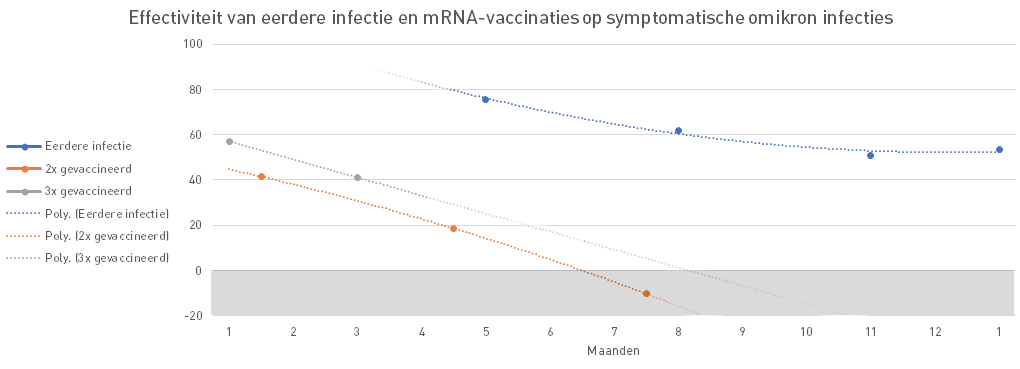
The graph below is from the Qatar study. The population in Qatar is relatively young (90% are under 50). About similar to our youngest half.


The protection against symptomatic Omikron decreases sharply over time in vaccinated people: the green cubes sink further and further down. Immunity due to natural infection (blue cubes) remains much better.
Below the same in one scale of duration in months, on the horizontal axis. The dotted lines are derived trend lines. (The dotted line of 3x vaccinated will deflect as soon as a third value is added.) Especially worrying is the negative effectiveness after 6 months, as it is already visible in the double-vaccinated. Hopefully it will not sink any further and that will not become a breach in the protection against other diseases.
Israel
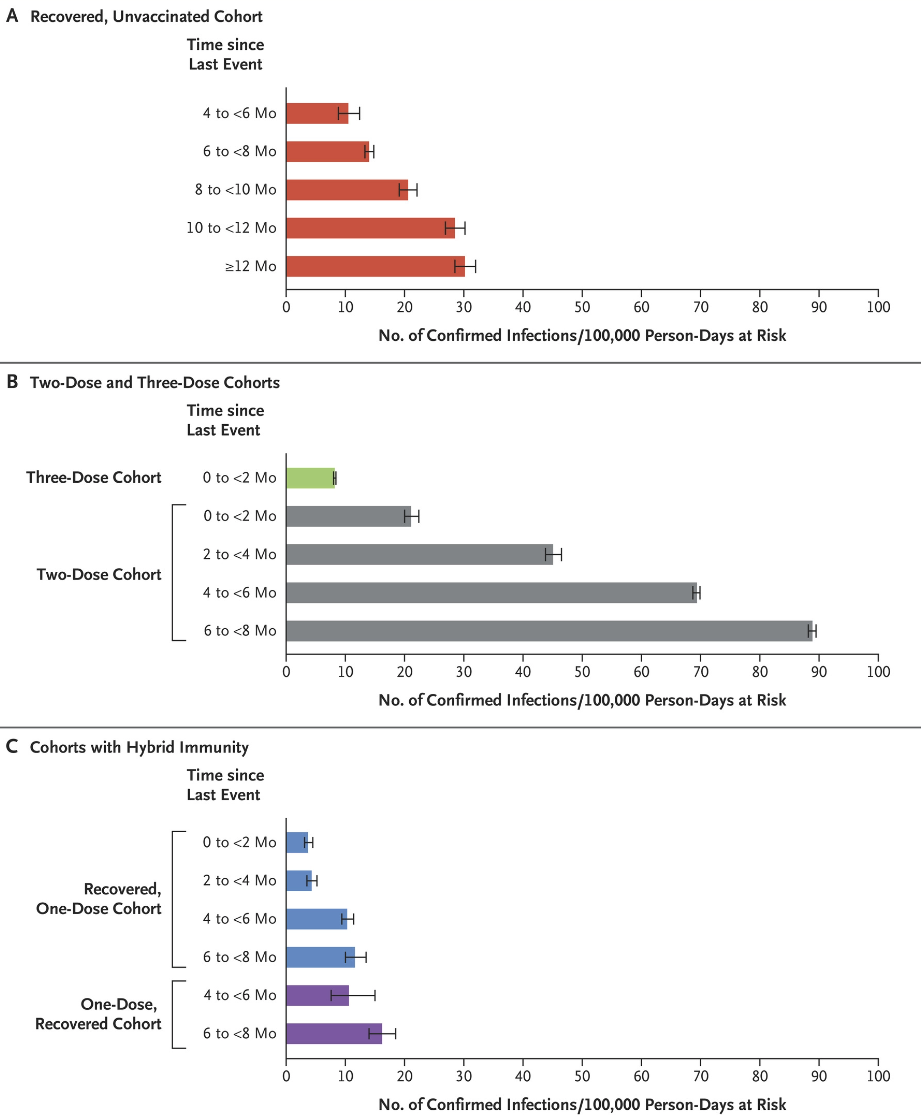
These bar graphs come directly from israeli research.
A - shows the number of infections among naturally immunized people
B - number of infections among the vaccinated. (Too bad that A only starts at 4 months after infection.)
C shows infected people who have been vaccinated and vaccinated people who have gone through the disease: double protection. And indeed: the best corona protection even after 6 months, but at what price...
At first glance, the hybrid rods at C indicate fewer infections. A closer look at the scale: there are really only two periods comparable: 4 to 6 months and 6 to 8 months. Let's put them together neatly.
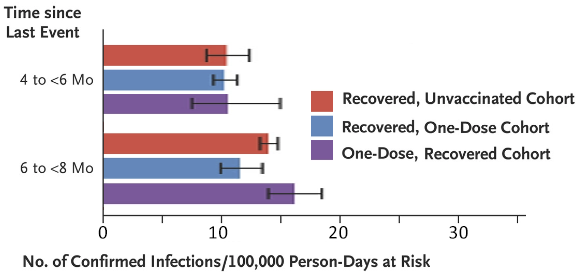
Minimal differences between unvaccinated and vaccinated. A difference of 1 per 100,000 is 0.001%. And then we are talking about infections, of which perhaps 3% become ill. It's not really about anything anymore...
The fact that the period shorter than 4 months is not shown in the graphs may have to do with the lowering of immunity in the first weeks after the injection, or because the natural immunity is still 100% in the beginning (after all, the disease has only just been completely conquered). The vaccines, of course, never make it. Admittedly, these are suspicions of an informed layman, based on the fact that government-unwelcome information is clouded and withheld by scientists wherever possible.
Other signals
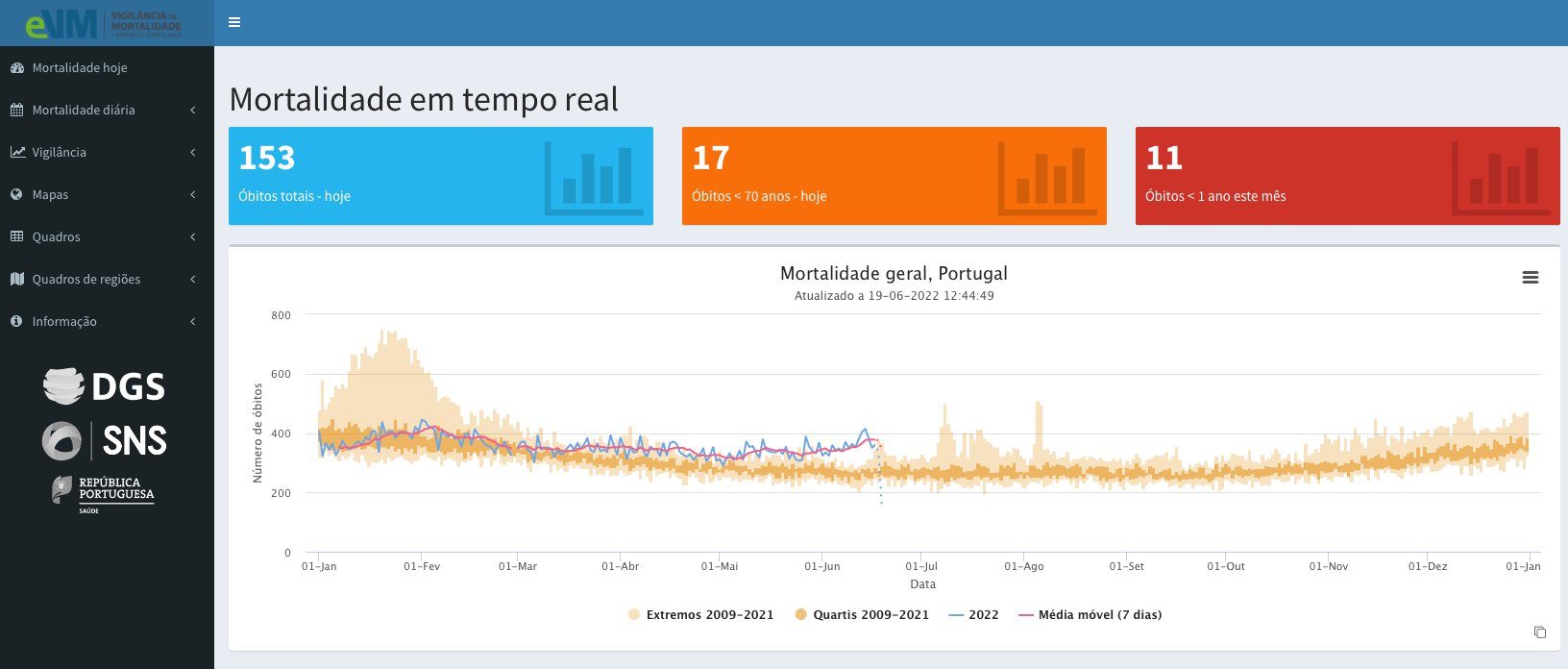
Portugal suffers from highest excess mortality
@Gefaell on Twitter: "PORTUGAL, the most vaccinated country in the world, continues to show large excess mortality rates [...] I don't know what is more alarming, this extraordinary out-of-season excess or the silence of the lambs."
Portugal was regularly cited as an example of vaccinated protection.

Even hotter from the press: Pfizer trials vetted.
A nurse speaks out
Omdat op data gebaseerde argumenten niet altijd worden opgepikt door de Ginny Mooys van deze wereld, tot slot ook maar een aangrijpend filmpje. Bij "benefits outweighing the risks" zouden de bijwerkingen die deze ER-medewerker herkende moeten opwegen tegen de hierboven getoonde effectiviteit van de injecties.
And just appeared in The Epoch Times, about the two studies discussed above...
Vaccination increases the risk of COVID-19 infection, but infection without vaccination gives immunity: research
By Marina Zhang
June 21, 2022 Updated: June 21, 2022
Being vaccinated twice with a COVID-19 vaccine has been linked to Negative protection against symptomatic infection of that disease, scientists say. In contrast, a previous infection without vaccination provides about 50 percent immunity. That's according to a study that the Omicron wave inQatarAnalyses.
The study, published in theNew England Journal of Medicineon June 15, examined the Omicron wave in Qatar that occurred from around December 2021 to February 2022, and compared vaccination coverage and immunity between more than 100,000 Omicron-infected and uninfected individuals.
The authors of the study found that those who had a previous infection but did not have vaccination had immunity of 46.1 and 50 percent to the two subvariants of the Omicron variant, even if the previous infection was more than 300 days ago.
In individuals receiving two doses of the Pfizer andModerna Vaccinehowever, negative immunity was found to both BA.1 and BA.2 Omicron subvariants, indicating a higher than average risk of contracting COVID-19.
More than six months after getting two doses of thePfizer Vaccine, immunity to each Omicron infection dropped to -3.4 percent.
But for two doses of the Moderna vaccine, immunity to each Omicron infection dropped to -10.3 percent after more than six months since the last injection.
Although the authors reported that a third dose of the Pfizer vaccine increased immunity to more than 50 percent, this was measured just over 40 days after the third vaccination, which is a very short period of time. In comparison, natural immunity remained at about 50 percent, measured more than 300 days after the previous infection, while immunity levels dropped to negative rates 270 days after the second dose of the vaccine.
These figures indicate a risk of decreasing immunity from the third vaccine dose as time goes on.
The findings are supported byanother recent study from Israelwhich also showed that natural immunity decreased significantly more slowly compared to artificial or vaccinated immunity.
The study found that both natural and artificial immunity decreased over time.
Individuals who were previously infected but not vaccinated had half the risk of re-infection compared to those who were vaccinated with two doses but were not infected.
"Natuurlijke immuniteit wint opnieuw", schreef Dr. Martin Adel Makary, onderzoeker op het gebied van openbaar beleid aan de Johns Hopkins University, op Twitter, verwijzend naar de Israëlische studie.
"Onder personen die eerder met SARS-CoV-2 waren geïnfecteerd, nam de bescherming tegen herinfectie af naarmate de tijd vorderde", concludeerden de auteurs, "deze bescherming was echter hoger" dan de bescherming die in hetzelfde tijdsinterval werd verleend door twee doses van de vaccin.
Enrico Trigoso contributed to this report.

And then today the comments in the MSM regarding excess mortality in the Netherlands: "Nothing wrong" !!!!!.
Waaaaaat ???????
On 8 June, based on the figures in the UK, you gave an estimate of 700 extra deaths from the vaccine among Dutch 50-year-olds. But when I look at the flat CBS mortality figures, I don't see it:
2017 – 5.526
2018 – 5.337
2019 – 5.216
2020 – 5.572
2021 – 5.401
Week 1 to week 21 (with 2022 added):
2017 – 2.303
2018 – 2.160
2019 – 2.133
2020 – 2.285
2021 – 2.137
2022 – 2.178
If it's really 700, then we should see that in the raw data, right?
Yes, once, that's curious. (Do you have a link to that age distribution?)

Covid has also meant little in 2020, it seems. Based on those figures, you would say that mortality is quite normal, also in 2021. I can't reconcile it well with the image at Euromomo, for example, although I don't know exactly how to make an absolute estimate of it. Maybe you? Or someone else? (too bad the categories don't exactly match of course). But if you just look at 15-44, there really has to be a higher number. And then a quarter of that 45+ is added...
Here I had the xls with data from: https://www.cbs.nl/nl-nl/maatwerk/2022/23/overledenen-per-week-provincie-en-gemeente-week-22-2022
As far as corona mortality is concerned, the point is of course that it is not about large numbers. The corona dashboard states that 1% of all corona mortality is in the 50-minus group. If I add up the figures on Nice, there are slightly more: about 320 (outcome death after admission to ICU or nursing ward).
At Euromomo you can download the raw figures for the 29 countries they follow from 2018. That gives (for 15-44):
2018 – 79.300
2019 – 77.139
2020 – 80.430
2021 – 81.422
Week 1 to 24
2018 – 37.164
2019 – 35.909
2020 – 36.677
2021 – 36.530
2022 – 36.300
Yes, in 2020 it already became clear that there was no reason to vaccinate 50-min. Combating contagiousness was never investigated and implausible, but vaccination was necessary. And then that very unfavorable mortality balance: much more red than green... I'm definitely going to look at that 700 again. Have you looked at how much Euromomo cumulatively comes out at 15-44 for example?