


Round table discussions must be held on May 16. To provide clarity for the government about future measures against the spread of the virus. It is commendable that various parties, including the physicists of TNO, are given a say in whether or not measures are effective, especially after two years of draconian regime from which it could be concluded that they had long since decided. Lockdowns, (almost mandatory) vaccinations and splitting society between certified and uncertified people are not something you do if you are not actually very, very sure of your case with international scientific substantiation in hand.
Well, it does. Anyway: on the way to a new autumn, people are now looking for ways to have the policy confirmed by external parties. That would be commendable if we could expect consequences in the event that things are undermined. But if Jaap van Dissel has co-selected the external parties, it is already certain in advance that the consensus will be: all measures have been adequate, excellent science! That not everyone agrees, that's just the way it is. In a democratic process (which science apparently is now) you can't please everyone.
For those who follow the science, there is no doubt that the dominant route of transmission for viruses that cause respiratory diseases is through the air. The virus hitches a ride with aerosols. There is a school of virology that stubbornly continues to deny this fact. This has historical grounds that have been referred to before. For decades, virologists have refused to accept that measles and tuberculosis went through the air with the arguments they are now using again to deny aerosol transmission. More about this in the box at the end of this article.
At the beginning of the pandemic, the wrong direction was taken by these aerosol-denying medics who happened to make up the entire OMT. Government and media have committed themselves to their empty assumptions with major negative consequences and now there is actually no decent way back without losing face.
OMT position 2020 summarised by TNO Senior Researcher
TNO, also invited to the roundtable discussion, presented a position paper ingediend om aan te geven waar ze staan. Ze maken daarin duidelijk dat ze de ontwikkelingen in ieder geval sinds begin 2020 niet meer gevolgd hebben; het paper geeft de stand van zaken, zoals die toen helaas was, correct weer. Het stuk bevat geen verwijzingen of andere wetenschappelijke onderbouwing, zoals het OMT dat ook nooit heeft gehad. Tot zover spot-on. Oh wacht - er wordt één onderzoek aangehaald: van het rivm. Dat gaat over aantallen virusdeeltjes in speeksel. Dat schiet lekker op.
Verreweg de belangrijkste besmettingsweg is volgende deze Senior Researcher toch echt (herhaaldelijk genoemd) dat mensen elkaar in het gezicht hoesten. Zo raakt driekwart bevolking dus in een paar maanden besmet - overigens ook als hoesten geen kenmerkend symptoom is, zoals bij omikron-21 dat als nog besmettelijker geldt dan het twee jaar oude COVID-19. Hij presteert bijvoorbeeld om het volgende te stellen:
"...directe transmissie is de belangrijkste besmettingsroute van het SARS‐CoV‐2 virus. [...] het virus wordt op korte afstand (minder dan 1,5 meter) overgedragen, o.a. door grotere deeltjes en een hoge concentratie kleine deeltjes (< 0,5 micrometer). Dit kan door bijvoorbeeld iemand in het gezicht te hoesten. Op deze directe transmissie heeft ventilatie nagenoeg geen effect. [...] We weten echter niet precies hoe groot de kans is dat mensen in een binnenruimte via de aerogene route een besmetting oplopen. Daar is extra onderzoek voor nodig."
For those who don't believe it: this is the piece.
A review can suffice to say that at the time of writing it was already outdated and drawn up without checking the current literature, apart from a feather between the buttocks of the RIVM (which is the only one cited).
Dat iemand van TNO de fout durft te maken dat kleine deeltjes gedefinieerd worden als < 0,5 micrometer is eigenlijk met geen pen te beschrijven. Juist natuurkundigen van het TNO zouden moeten weten dat zelfs druppels van 50 micrometer (100x zo groot!) blijven zweven en dus in de gewraakte categorie van "airborne" kleine deeltjes oftewel "aerosolen" vallen.
[edit: "De WHO definieert ‘aerosolen’ als: zeer kleine druppels of druppelkernen (≤ 5 µm)". ]
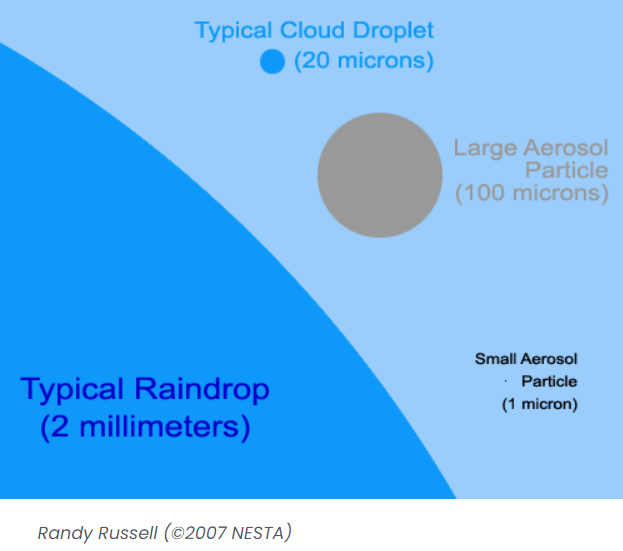
Mocht je het nog niet weten: dat de grens van 5 (dus niet 0,5) micrometer het maximum is om te kunnen blijven zweven, is een klassieke fout. Wolken bijvoorbeeld blijven ook zweven. Die zijn samengesteld uit talloze kleine waterdruppeltjes met typische diameter van meestal 5-50 micron. Een druppeltje van 1 micron wordt als "klein" beschouwd, 100 micron is een "grote" aerosol. [Nu hebben wolken ook zweefvermogen door opwaartse luchtbeweging dus eigenlijk was mist een beter voorbeeld geweest.]
The reverse of the proposition seems to be more scientifically based:
“…indirecte transmissie is de belangrijkste besmettingsroute van het SARS‐CoV‐2 virus. […] het virus wordt in besloten ruimtes ook op meer dan 1,5 meter) overgedragen, hoofdzakelijk door een hoge concentratie kleine deeltjes (< 5 micrometer). Kleinere deeltjes bevatten meer virusdeeltjes en komen dieper in de longen. Epidemieën worden aangedreven door besmetting in besloten ruimtes, door accumulatie van uitgeademde virusdeeltjes en vrijwel niet in de buitenlucht". source
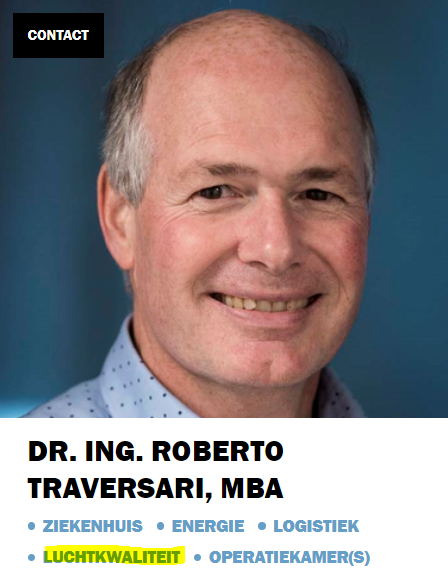
Iemand met met Luchtkwaliteit als specialisme zou toch mogen weten hoe druppelgrootte samenhangt met zweefvermogen! Dat doet me denken aan Marion Koopmans met haar "viroscience" in het Jeugdjournaal (posed beforeYou really wonder how people who have reached a position can stay there. Or rather: what they have to do to lose that position.
Video from July 2020: floating droplets of 50 microns so more than 100x as large as what TNO indicates).
Large aerosols, as shown in the blue illustration, can be 100 microns in size. That is 200 times as much as what Traversari must have memorized at school.
In short
It is an astonishingly ignorant piece that does not think sharply about the subject at hand. It therefore does not provide any additional insight into what was already known 10 years ago. TNO has not had a single advanced insight since the beginning of 2020, while from that moment on there was every reason for physicists to worry about something. For example, Jos de Laat of the KNMI: "The standard model used in virology and epidemiology is based on assumptions that are simply not physically correct.." Ik vermoed dat Jos de Laat niet is uitgenodigd bij het rondetafelgesprek. Een goed voorbeeld zijn de eerste twee zinnen van het antwoord op de afsluitende vraag:
Does it make sense to use ventilation as a measure?
Traversari: "The supply of fresh virus-poor outdoor air and a good distribution of it in a room generally leads to better indoor air quality (lower concentration of small particles with virus). For this reason, good ventilation is important."
Dus toch wel kleine deeltjes met virus... Maar dat wisten we toch niet? Ik proef wankelmoedigheid.
Heeft deze meneer eigenlijk wel in de gaten waar het om gaat, hoe "maatregelen" zijn ingezet? En dat een maatregel een specifiek doel heeft in de context van dit rondetafelgesprek? Is hij eigenlijk wel geïnteresseerd in het probleem dat levens heeft gekost en samenlevingen ontwricht?
Onvoorstelbaar. TNO... De ongeïnteresseerdheid is duidelijk niet alleen de politiek in geslopen. Het stuk van Traversari was voor mij het meest onthutsende. Het meest positief verrassende kwam van TU Delft.
Fortunately: not all Position Papers are bad
Prof.dr.ir Philomena M. Bluyssen (professor of Indoor Environment) delivers a paper at a high level, worthy of a TU Delft. It is the text of this 10-minute youtube video. Plus references. I would have found it a bit stronger if she had referred a little more to studies in which she herself did not participate, there are those too.
Haar tekst laat aan duidelijkheid niets te wensen over. Geen slagen om de arm, het belang van ventilatie staat buiten kijf. Een zin: "The corona pandemic shows the importance of ventilation in the fight against viruses. Even though more knowledge is needed about how potential pathogens spread in buildings, what the best conditions and ways are to combat them, ventilating them properly seems to be an important defense against the pandemic."
(OK, dat "lijkt" had eigenlijk "is gebleken" moeten zijn maar vooruit, het blijft wetenschap.)
Maurice de Hond (the only one not mentioned with his doctoral degree) recaps how things went wrong with the cherry-picking from Wells' studies and the mistakes that the King made in his Decree as a result. It is very nice that he becomes concrete: he indicates how far Belgium has already come with ventilation and concisely describes the basic idea behind his Delta Plan Ventilation.
The 16 position papers are download here.
Also read: Keywords and keywords from the other papers.
A red line in virus research: contamination through breath
Whenever a serious respiratory virus occurred, diligent research was done. Below are some examples: from 1944, 2004 and 2020. Time and again, the air turned out to be the dominant route of infection, as here in tuberculosis.
Robert Koch had already received the Nobel Prize in 1905 for his pioneering tuberculosis research. Excerpt about Koch from Sciencedirect: "Alle geïnoculeerde dieren vertoonden ziekte, maar geen van de niet-geïnoculeerde dieren vertoonden ziekte. Niet-geïnoculeerde cavia's raakten echter besmet wanneer ze in dezelfde kamer leefden als geïnoculeerde dieren. Dit toonde de luchtroute van overdracht van het infectieuze agens."
Nevertheless, 40 years later, we find: Whether the exposed individuals were in close proximity to tuberculous roommates or at a considerable distance from them, the incidence of tuberculosis was the same. The infectious agent was apparently evenly distributed throughout the room. Since the disease originated deep in the lung parenchyma through the inhaled air, it is it is clear that the contamination was transmitted by air."
Source: https://www.atsjournals.org/doi/pdf/10.1164/art.1947.55.2.124, study from 1944
A line of research that can be established via influenza (2000), rhinoviruses and other airborne viruses (2003) doortrekt naar het SARS-virus in 2003 "Airborne spread of the virus appears to explain this large outbreak of SARS in the community, and future prevention and control efforts should take into account the potential for airborne spread of this virus."
https://www.nejm.org/doi/10.1056/NEJMoa032867?url_ver=Z39.88-2003&rfr_id=ori:rid:crossref.org&rfr_dat=cr_pub%20%200www.ncbi.nlm.nih.gov, study from 2004
And, more recently, about SARS-CoV-2:
"Handen wassen en sociale afstand bewaren zijn de belangrijkste maatregelen die door de Wereldgezondheidsorganisatie (WHO) worden aanbevolen om te voorkomen dat u COVID-19 oploopt. Helaas voorkomen deze metingen geen infectie door inademing van kleine druppeltjes die worden uitgeademd door een geïnfecteerde persoon die een afstand van meters of tientallen meters in de lucht kan afleggen en hun virale inhoud kan dragen. De wetenschap verklaart de mechanismen van dergelijk transport en er zijn aanwijzingen dat dit een belangrijke infectieroute is in binnenomgevingen. [...] Het is daarom it is extremely important that the national authorities recognise that the virus spreads through the air, and recommend that adequate control measures be taken to prevent further spread of the SARS-CoV-2 virus, in particular the removal of the virus-laden droplets from indoor air through ventilation."
https://www.sciencedirect.com/science/article/pii/S016041202031254X?via%3DihubApril 2020
In short: a solid line of hundreds of studies confirms the transmission of respiratory viruses through the air. And now looking for a long-term strategy.
The virological basic assumption has proven to be unshakable: infection occurs through direct contact. Other routes are a side issue. Convincing evidence that it goes through the air is not taken seriously, even if that evidence is provided for each specific virus. There is no evidence for the basic assumption that contamination does NOT go through the air. That contamination of respiratory viruses mainly takes place through droplets and contact is no more than a lazy assumption that has been falsified many times.
