


How do you tell for the umpteenth time that at least 40 more people a day die per day than you had thought? You would say: by clearly naming that terrible fact, which has been occurring since April 2021. But what if it is your job to support the government in collecting and interpreting figures? Yes, then exactly! you might say. But what if that death could be a direct result of serious issues such as mismanagement, tunnel vision and possibly even violations of laws and regulations, up to corruption and treason? Well, then you are in a split. If you sound the alarm, you will no longer fit into the system and you will not be suitable for your government function. After all, then you no longer support the government, then you are undermining. Then you are a terrorist or fascist, or whatever other immorality stamp is up for grabs at the time.
I'm not going to fillet cbs messages again, that point has already been made repeatedly. It is about time that the CBS Monthly Bulletin writer received a prize, following in the footsteps of people like Diederik Gommers, Marion Koopmans, Jaap van Dissel and Maarten Keulemans. They have defended government policy through the consistent propagation of rabid nonsense and have been praised for it.
For example, look at journalist Merel Ek, who was recently very deservedly nominated for an award. Indeed: deserved because she has clearly shown that she is lying to the camera in the public interest. She lied about her sources, an eminently journalistic skill that she applied creatively. A huge journalistic talent and a pity that she just missed out on this prestigious journalistic prize. After all, it was no less than € 3500,-. That's quite a lot, a little journalist wants to commit a character assassination for that with the microphone of a public broadcaster in her hand.
De prijs is overigens gewonnen door Stephan Komduur. Ik heb zijn Twittertijdlijn van de laatste vijf maanden doorgescrolld, geen woord over oversterfte. Heel netjes. Bij de NPO propagandeer je de staatsvisie of je houdt je mond. En wegkijken mag ook wel eens gehonoreerd worden! "Ik behandel deze week bijna alle crises" schrijft hij begin september. Waarom die ene niet? Ik heb het juryverslag niet gelezen maar dat 'bijna' heeft vast de doorslag gegeven. Brilliant.
Back to CBS
The CBS editor has also sold his soul to a higher cause. He may have looked away from Ruben van Gaalen on Twitter, maybe he writes those messages too.
He often writes about 'just' or 'just not', which makes everything less bad because it is close to the limit value. And below that limit there is nothing wrong!
Or take the explanatory text with this graph. A drama is unfolding, this mortality is unprecedented and NEVER SHOWN BEFORE: so long and so many. The red lines indicate excess mortality. The black lines show a meager reduction in mortality, much less than you would expect immediately after such major epidemic peaks. What does Ruben write? (Apart from some missing verbs - it's just a Tweet)
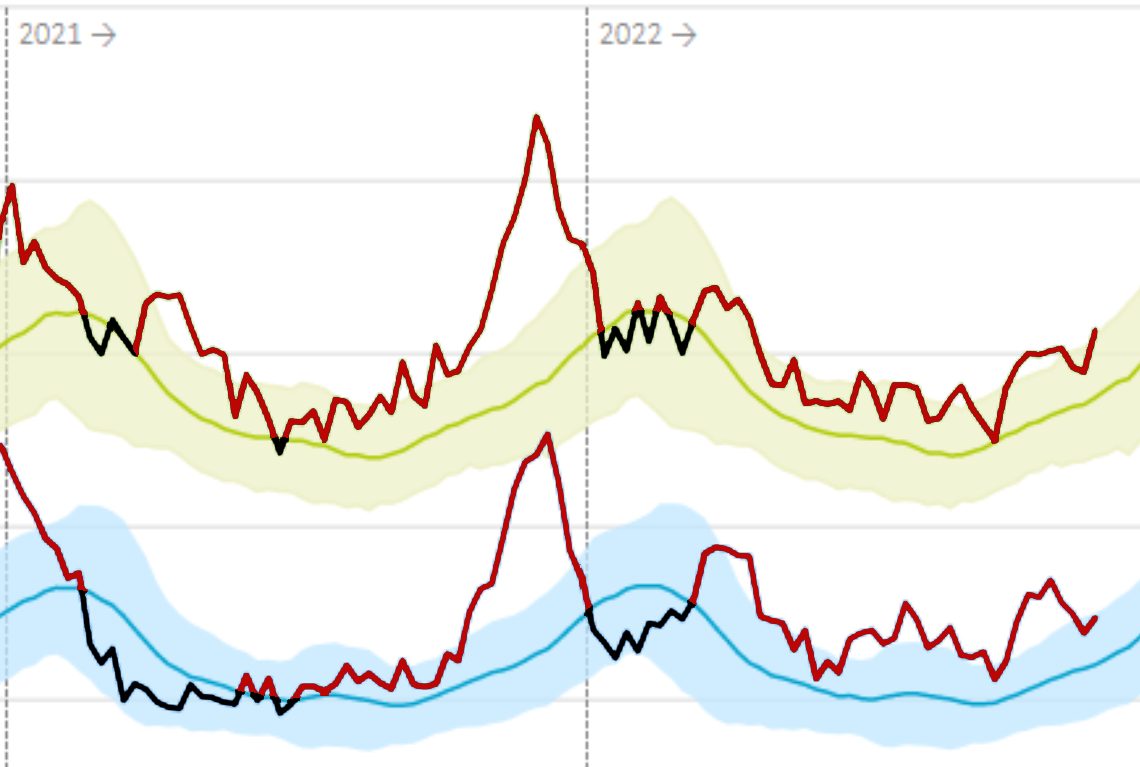
Zie je het opwippertje helemaal rechts aan het uiteinde van de onderste rode lijn? Ruben grijpt dat aan om een week eruit te lichten met "just no excess mortality." Want het ligt binnen de blauwe marge. Terwijl het net zo goed een nieuwe stijging kan inluiden. Ben ik nou de enige die dat opvalt?
Ook dat laatste zinnetje: "Among the rest of the population, there is just #oversterfte, de sterfte onder Wlz-zorggebruikers is wel hoger dan verwacht." How soothing can you make it sound...
Tegen critici zeggen de engelen uit de Alfa-hel: "Jullie hebben er geen verstand van" of "Jullie laten de bandbreedte gemakshalve weg". Met name die bandbreedte is een terugkerend rookgordijn om niet te zeggen struikelblok voor wetenschapsjournalisten van faam. Ik heb er samen met Herman Steigstra al twee artikelen aan gewijd maar zal het hier bondig opnieuw duidelijk proberen te maken. Als je het begrijpt, leg het uit aan anderen!
The dice
Every time you roll a dice, you have a 1 in 6 chance of throwing a six. On the second throw another six throw is 1/6 x 1/6 = 1/36. That goes up quickly: the chance of throwing a six 10 times in a row is 1 in 60,466,176 (so 1 in more than 60 million).
What CBS continually does is to assess each roll separately ('nothing special, you have just as much chance of getting a six as any other number') while they have to see that an impossible series is going on. Indeed: impossible, because for example throwing a six 20 times in a row, not throwing it a few times and then again 20 times in a row? Then something is going on, perhaps with the dice or with the person who makes the rolls. But the man at the scoreboard simply judges every point relentlessly, and every point is clearly made real.
If the numbers guy who makes the rolls is hired by the person who paid a fortune for that dice and no one is allowed to watch... How do you get out of the game? I know people who have put their house up for sale. They are going to emigrate to Portugal. That's besides the point.
The coin
We now simplify the complexity around excess and less mortality to tossing a coin. With a correct coin, we estimate that 50 out of 100 throws become heads. That means 0.5 chance in the lead: the same as 1/2 or 1 chance from two possibilities. The prediction will not be correct with any throw. After all, we had said: a chance of 0.5. You never throw that because you can only throw 1 or 0, head or tail. So the predictor will not have a single throw right. That will also remain the case if you assess per throw because of course you do not look well. In that case, the predictor will defend himself by saying that you should of course look at longer series! Just throw a hundred times, and you'll see that the prediction is close to 1/2!
The margin
De kans dat je exact "om en om" kop en munt blijft gooien is net zo klein als de kans dat je alleen maar kop gooit. Afwisselend kop en munt kan niet, dus je zult ook wat reeksen toe moeten staan. Daarvoor moet je dan een marge bepalen: hoe lang mogen die reeksen zijn en binnen welk tijdsbestek? Uit praktische overwegingen is gekozen voor een weekmarge. Er wordt nooit gesproken over een maandmarge, kwartaalmarge of seizoensmarge. Die langere termijnmarges zijn wel af te leiden uit de weekmarges maar worden nooit toegepast. Waarom niet? Om dezelfde reden dat de voorspeller je eerder heeft gewezen op de reeksen. Maar nu met de tegenovergestelde bedoeling: hij zal je nu blijven wijzen op de weekmarge omdat anders de voorspelling uit de pas blijkt te lopen.
That is what happens in the CBS reports. Monthly reports are therefore not monthly reports, they are four weekly reports in a row, assessed per week as separate events. Totals are occasionally mentioned, but only if they are lower than a previous period - even though the long-term trend is upward.
Good news show from CBS

The gist of the CBS monthly report is that excess mortality is doing well: in October we still had excess mortality in all weeks, in November we see excess mortality in only four weeks.
Also note that the report is reviewed on a weekly basis. No weeks are added up, there is no question of a monthly margin.


The message should have been for a year that since mid-2021 there has been persistent unexplained excess mortality, even in the short periods of under-mortality. It is chilling how the population is being abandoned by healthcare institutions, the medical profession and governments, with a leading role for the EU.
Do you want to arm yourself against misinformation regarding excess mortality? This site alone contains several articles that can help with this. Also read it with suspicion and, if in doubt, look for why it is incorrect - and then also why it is correct.
Relevant links
The very first excess mortality article, which started it all:

Week 45 did not give any excess mortality in 1st instance but is now 8 in the plus.
Week 46 is only 6 below the excess mortality limit. So next week that will also be above the limit with the follow-up notifications.
Week 47 immediately stands at an excess mortality of 122.
It seems that the decline of the past few weeks is turning into an increase again.
The excess mortality tm week 47 is 10309. (This includes the lower than expected mortality of the 1st 12 weeks)
The official (cbs) excess mortality until week 47 is 4384.
If you roll a dice several times, the chance is always 1/6 that you roll 6. The chance of a 6 if you also threw a 6 before that is 1/36 (nl 1/6 x 1/6). This is called a conditioned probability. Therein lies the difference.
The same applies to the weekly reports. The excess mortality in a week may be within the bandwidth for that one week, but if the week before was also seen excess mortality, that bandwidth for those two weeks together should be smaller, because it is a conditioned probability. Then the chance of excess mortality in week 2 is smaller than in week 1, just like with the dice (the chance of throwing 6 the second time is smaller than the first time).
If you look at the weeks separately, separately, you miss that fact, and that is methodologically incorrect.
Precise! See Bandwidths for dummies and Excess mortality breaks all records