

To my dismay, monkeypox has been given A-Status. This is bad news for the Dutch: in the case of SARS-CoV-2, the A-Status has turned out to be the license to institute law-violating draconian measures, even when the virus caused less damage than the flu. On the page of the central government staat "It is very much about dealing with individual cases. No general collective measures are to be expected." Laten we de uitspraken van begin 2020 er maar niet bij pakken om te kijken in hoeverre we op zo'n belofte kunnen vertrouwen. Maar apenpokken - wat is dat nu weer?
We don't have to consult our media. Take nu.nl. That reported this week dat 18 mei de warmste 18 mei ooit was! Dat is weer spektakelnieuws, inspelend op de "opwarming" retoriek. We moeten kennelijk weer op de kast gejaagd.
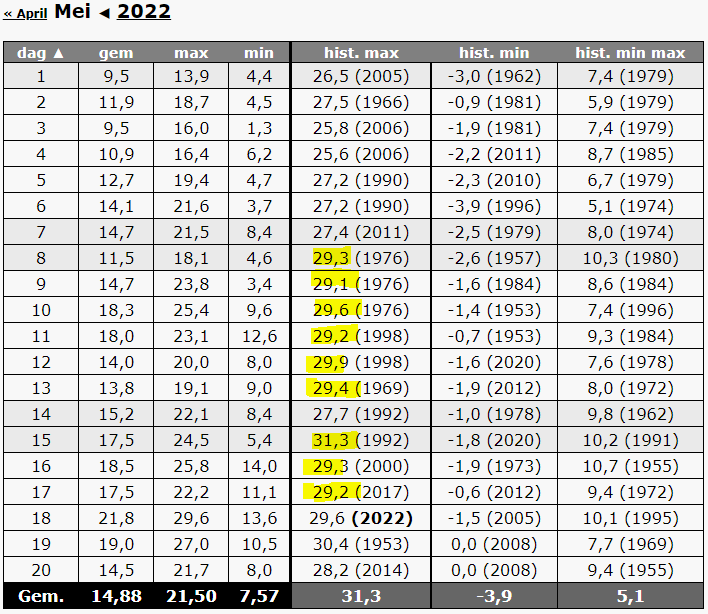
A journalist who had been paying a little attention could have seen that that record is not so much due to a super hot day as to the fact that May 18 was an outlier. The previous 10 warmest days have an average temperature of 29.4 degrees. That's a full degree higher than the 28.4 nu.nl reported! May 19, 1 day later: 30.4 degrees! And no, not really warming related, that was 70 years ago.
So the striking thing was that May 18 lagged behind for so long with its warmest day. That strange situation has now been rectified.
Furthermore, 28.4 turns out not to be even correct. It was 29.6.


Er zal wel gejankt worden: "ja maar we waren te vroeg, we wisten dat nog niet." Waarom dan Twente nemen met 28,4? Als je het nog niet kan weten, hou dan je mond.
In Ell werd 28,8 graden gemeten. In Hupsel 29,2. Nieuw-Beerta: ook 29,2. In Arcen was het zelfs 30,2 graden! Er waren maar liefst vier meetstations warmer dan die in Twente! En in Maastricht was het een dag later 31,3 dus wat moet zo'n bericht nou, met zijn 28,4? De claim deugt niet en het getal klopt niet eens. Het is wat je noemt "DESINFORMATIE". Het artikel staat inmiddels niet meer online, het is vervangen met betere informatie. Maar de toon is gezet, het vuurtje weer even aangeblazen.
In short: pathetic crap journalism. It is an example that is not about anything and that is precisely why it is so striking. That's how they write about everything, including Covid. Just as sloppy, uninformed and in step with a supporting narrative, without any substantiation or thorough check. And that should provide us with information... About a monkeypox virus that suddenly appears after a vaccination campaign. By the way, you must be crazy if you assume that a conditionally approved, strictly monitored vaccine is closely monitored. The opposite is the case. Anyway, about excess mortality next time. What are those monkeypox?
Het is voor het eerst bij apen gevonden en wordt nu vooral verspreid onder homoseksuele mannen. Het woord dat bij mij opkwam was "banaal" 🙂
Fortunately, we can now look for our own sources for reliable information. In the absence of good science reporters, we do just that. The newsreel can go to the pot. This brings me back to Robert Malone. He wrote a useful article today. He shares on its substack about monkeypox zijn kennis, als antwoord op de hem veel gestelde vraag: "Is deze uitbraak van apenpokken een reële bedreiging, of is dit weer een geval van overdreven en dreigende berichten over de volksgezondheid?".
For those who prefer to read (somewhat edited) Dutch, below is the translation of his piece. I've left out a few sections (technical or anecdotal) that don't add much to the encyclopedic line of the story. If you still want to read everything, just read his article.
Robert Malone on monkeypox
The monkeypox virus, which originates in several regions of Africa,isrelated to Smallpox (Variola), both of which are members of the genusOrthopoxvirus. However, it is important to understand that Variola (large or small) is the type of virus responsible for the worst human disease caused by theOrthopox viruses. For example, cowpox, horsepopped and camelpox are also members of this genus, none of which pose a major threat to human health, and one of which (cowpox) has even been (historically) used as a smallpox vaccine. My point is that just because monkeypox is related to smallpox, it in no way means that it poses a similar public health threat. Anyone who claims otherwise is in fact engaged in or otherwise supporting weaponized public health-related propaganda. In other words, spreading public health fear.
History
Apenpokken werden voor het eerst geïdentificeerd in 1958 in kolonies van apen, en het eerste menselijke geval van het virus werd geïdentificeerd in 1970 in de Democratische Republiek Congo. Hoogstwaarschijnlijk was dit slechts het eerste geval dat werd geïdentificeerd, omdat mensen die in Afrika wonen al duizenden jaren in contact staan met apen en de andere apenpokkendiergastheren. De "West-Afrikaanse" apenpokken clade (clade = tak van varianten) die op dit moment buiten Afrika circuleert, veroorzaakt een mildere ziekte in vergelijking met het nauw verwante virus dat in andere regio's van Afrika wordt aangetroffen (Congo clade).
Symptoms
The symptoms of monkeypox are somewhat similar to, but much milder than, smallpox disease. The general clinical presentation of the disease caused by the West African monkeypox clade virus includes influenza-like symptoms - fever, body aches, chills - along with swollen lymph nodes. A rash on the palm of the hand is often observed. In the final stages of the disease, which in some cases can last up to a month or more, small lesions may occur that develop a scab and may result in a small depigmented scar. There is no evidence of asymptomatic transmission. In other words, current medical knowledge indicates that it is only spread through personal contact between an uninfected person and someone who already has symptoms of the disease. Therefore, the spread of disease can be easily controlled by classic public health interventions such as contact tracing, temporary quarantine of those who have had physical contact with someone who is infected, and long-term quarantine of those who develop symptoms.
Endemic and zoonotic
In wezen zijn alle huidige gevallen in het westen die we in het nieuws zien onder mannen die seks hebben met mannen en lijken te wijten te zijn aan nauw fysiek contact. Apenpokken zijn endemisch in veel delen van Afrika en is een "zoönotisch" virus, wat betekent dat het kan worden overgedragen van een verscheidenheid aan dieren (niet alleen apen) op mensen. Initiële overdracht van dier op mens gevolgd door beperkte overdracht van mens op mens is waarschijnlijk de oorzaak van de sporadische gevallen die typisch in Afrika worden waargenomen.
Chickenpox, which is highly transmissible, is not part of the genusOrthopoxvirus, despite the name 'smallpox'. Again for emphasis, Cowpox and Camelpox also belong to the genusOrthopoxvirus,and they are not particularly pathogenic when contracted by humans;alleen omdat Monkeypox een "pokkenvirus" is in het geslachtOrthopoxvirus, does not mean that it is particularly deadly.
Contagiousness
[...] The different Orthopox viruses are often cross-protective from an immunological point of view. In other words, if you have been vaccinated with a smallpox vaccine or previously infected with cowpox, camelpox or monkeypox, there is a good chance that you are quite resistant to diseases caused by the monkeypox virus which is now being reported (quite rarely) in non-African countries.
Huidige gegevens geven aan dat apenpokken niet erg besmettelijk is bij mensen - het heeft een lage Ro (misschien onder 1), wat de term is die wordt gebruikt om te beschrijven hoe efficiënt een infectieziekte zich van mens op mens kan verspreiden. Nogmaals, dit is super goed nieuws voor het bedwingen van verspreiding. Een Ro van <1 betekent over het algemeen dat (zelfs bij afwezigheid van social distancing van andere inperkingsmaatregelen), voor elke persoon die al besmet is, gemiddeld minder dan één andere persoon besmet zal raken. Ter vergelijking: de Omicron-varianten van SARS-CoV-2 hebben een Ro in het bereik van 7 tot 10. Een virus met een Ro van minder dan één kan gemakkelijk worden ingedamd met de hierboven besproken standaardmethoden voor de volksgezondheid. Een virus met een Ro van 7-10 is in wezen niet in te dammen en zal zich snel over de hele wereld verspreiden, zoals we hebben gezien met de Omicron-varianten. In het geval van een virus met een Ro rond 1 of minder, kunnen traditionele methoden voor het indammen van infectieziekten zoals contactopsporing, identificatie en isolatie van geïnfecteerde personen alles zijn wat nodig is om het virus onder controle te houden. [...] Het gebruik van een vaccin om die inperking te helpen via "ring" -vaccinatie of wijdverspreide vaccinatiestrategieën is over het algemeen onnodig en kan zelfs contraproductief zijn, afhankelijk van de veiligheid van het vaccin - rekening houdend met het feit dat geen enkel medicijn of vaccin volkomen veilig is.
Ik kreeg [ooit] de opdracht van het Ministerie van Defensie om te kijken naar historische DoD-pokkenvaccincampagnerecords met betrekking tot "bijwerkingen" in het leger, naar aanleiding van vermeend bioterrorisme na de aanslag van 9-11. In sommige gevallen had een kleine subgroep van jonge strijders en rekruten een eerder onopgemerkt immunologisch defect dat ertoe leidde dat ze een voortdurende infectie ontwikkelden door het levende verzwakte vaccinvirus dat op dat moment werd gebruikt. De andere groep ontwikkelde subtielere symptomen, waaronder wat nu vaccinatie-geassocieerde myo- en pericarditis lijkt te zijn geweest - meestal toegeschreven aan een auto-immuunproces. Deze problemen waren bekende risico's toen pokkenvaccinatie gebruikelijk was. Maar de pokken waren uitgeroeid en het ergste scenario van Cheney is nooit uitgekomen. Degenen die zijn gevaccineerd en beschadigd werden om zich te beschermen tegen een niet-bestaande dreiging, vormen een goed voorbeeld van een volledig omgekeerde risico-batenverhouding. Alle risico's, geen voordeel. En, toepasselijk, werd de pokkenvaccinatiecampagne stopgezet.
To remember
This is not influenza or COVID - this virus mutates slowly, it is not very contagious, naturally acquired immunity is powerful and long-lasting, and Orthopox vaccines are usually cross-protective. The risk of immunological escape is very, very low. And the spread of this virus can easily be stopped by simple, inexpensive classic public health measures. If things were different, we would have experienced a monkeypox pandemic decades ago.
The severity of monkeypox disease can vary with different variants (found in different regions of Africa, which also suggests that the virus has been around for a long time). Fortunately, this particular variant is less severe and appears to be endemic in Africa. Unfortunately, it has rarely been studied and thus relatively little is known about the virus and associated human disease, largely because the infectious threat to the general population is so low. STAT news' journalist Helen Branswell recently interviewed CDC experts and published an excellent summary of the clinical presentation:
"Met één tot drie dagen na het begin van koorts verschijnt een opvallende uitslag, vaak beginnend op het gezicht. Veel aandoeningen kunnen huiduitslag veroorzaken, maar de apenpokkenuitslag heeft enkele ongewone kenmerken, met name het feit dat blaasjes zich op de handpalmen kunnen vormen. In landen waar het endemisch is, wordt aangenomen dat het virus zich voornamelijk verspreidt naar mensen van geïnfecteerde dieren wanneer mensen bushmeat doden of bereiden voor consumptie.
Once the virus jumps to humans, human-to-human transmission can occur through respiratory droplets — virus-laced saliva that can infect the mucous membranes of the eyes, nose and throat — or through contact with monkeypox lesions or bodily fluids, where the virus enters through small cuts in the skin. It can also be transmitted through contact with clothing or linen contaminated with material from monkeypox lesions. (STAT News).
Outbreaks and vaccines
There was a previous outbreak of Monkeypox in the United States in 2003. That particular outbreak, the first reported outside Africa, was traced to the importation of small mammals from Ghana. As shown in this outbreak, multiple animals can contract the disease — during that outbreak, large possums and squirrels tested positive for the virus and eventually spread it to prairie dogs sold as pets in multiple Midwestern states (according to the CDC). Forty-seven people contracted prairie dog disease. This is an important and relevant history, as the current outbreak appears to be of human-to-human transmission, with no individual being traced as case zero. There have been a few other outbreaks outside Africa over the years from travelers from Nigeria. The Monkeypox virus is currently thought to be much more common in Nigeria than previously reported.
There is a vaccine that was approved in the U.S. in 2019 for people 18 and older to protect against smallpox and monkeypox; Bavarian Nordic Jynneos. A second vaccine, ACAM2000 made by Emergent Product Development, protects against smallpox and is also believed to provide some protection against monkeypox. Both vaccines are only licensed for people who are at high risk of contracting the disease because they are not completely safe. In the 2003 Monkeypox outbreak in the U.S., the smallpox vaccine was used in individuals who were considered high-risk.
De VS hebben al voorraden van de vaccins in de Strategic National Stockpile, een hedge tegen noodsituaties op het gebied van de volksgezondheid. "Om een pokkennoodtoestand te bestrijden, heeft de SNS voldoende pokkenvaccin om de hele Amerikaanse bevolking te vaccineren. Bovendien heeft de SNS antivirale geneesmiddelen die kunnen worden ingezet om pokkeninfecties te behandelen, indien nodig," zei een woordvoerder van het ministerie van Volksgezondheid en Human Services via e-mail. Naar mijn mening vertegenwoordigt de aankoop van 119 miljoen dollar pokkenvaccins die zojuist is goedgekeurd door de Amerikaanse HHS- en Biden-administratie een onnodige en ongerechtvaardigde uitgave, tenzij er gegevens zijn waaruit blijkt dat de huidige stam aanzienlijk verschilt van de historische voorgangerstammen binnen deze variantentak.
The WHO's Van Kerkhove noted that some of these products are licensed using what is known as the Animal Rule, where animal efficacy data is used as a surrogate because the lack of circulating smallpox means the vaccines or drugs cannot be tested for efficacy in humans. As a result, such a product could only be used in the context of a clinical trial, she said.
"Er zijn opties. We moeten er alleen voor zorgen dat ze op de juiste manier worden gebruikt. Een van de dingen met betrekking tot vaccins is dat we ervoor willen zorgen dat als de vaccins nodig zijn en worden gebruikt, ze worden gebruikt door bevolkingsgroepen die ze het meest nodig hebben. Er is op dit moment niet voldoende aanbod van iets," zei ze.
Still, she expressed confidence that the outbreak can be contained.
"Wat we nu moeten doen, is ons richten op het stoppen van de verspreiding. En dat kunnen we. Dat kunnen we doen met de juiste berichtgeving, met de juiste testen ... met ondersteunende isolatie en klinische zorg waar nodig, met bescherming van gezondheidswerkers," zei Van Kerkhove. (STAT News).
Bill Gates-funded organization GAVI has given their assessment of the medical threat of Monkeypox, whichcan be found here. Many readers of this substack will not be surprised by my assessment that this GAVI threat analysis is highly biased towards exaggeration. For example, the article tries to create parallels between Monkeypox and Ebola:
As with viruses such as Ebola, transmission occurs only in close proximity through contact with lesions, bodily fluids, respiratory droplets, or contaminated materials such as bedding or clothing.
The article also states the following pants-on-fire disinformation:
Although symptoms often subside within a month,one in ten cases can be fatal. Children are particularly susceptible.
This claim represents a highly biased interpretation of a World Health Organization data report:
In 2020, theWorld Health Organization (WHO)4,594 suspected cases of monkeypox, including 171 deaths (mortality ratio 3.7%). They are described as suspicious because confirmation requires PCR testing, which is not readily available in endemic areas.
Readers who have become alert to this kind of information manipulation and the implementation of measures will immediately notice two important things. First, the reported mortality rate of 3.7% (NOT 10%) of the cases originating from suspected, unconfirmed cases. Second, this estimate is strongly focused on the seriously ill: countries will rarely detect cases of mild illness and thus will not report it to the WHO.
In conclusion
Dus, is de biodreiging echt? Is het aanstaande? Rechtvaardigt het de wereldwijde mediahype? Terwijl ik twee dagen geleden in een luchthavenlounge wachtte om van de VS naar het VK te reizen, zag ik een journaal van CNN dat klakkeloos verslag deed van deze "dreiging" terwijl historische beelden van patiënten met pokkenziekte werden getoond. Dit is naar mijn mening een klassiek voorbeeld van angstfor public health and CNN should be reprimanded for broadcasting irresponsible propaganda - misinformation and disinformation - under the guise of journalism.
In my opinion, based on the information currently available: monkeypox is a virus and disease that is endemic in Africa, appears sporadically after transmission to humans from animal hosts, and is usually spread through close human contact. It is easily controlled by classic public health measures. It does not have a high mortality rate. Unless there has been some genetic change, either through evolution or deliberate genetic engineering, it is not a significant biothreat and has never been considered a high-threat pathogen in the past.
SoStop sowing fear, disinformation and disinformation.
Now also a 10-minute video of Pierre Capel
Two perhaps somewhat conspiratorial options, but we should not rule them out:
- Could the virus have been artificially mutated, which we don't know but the virologists do?
- Are the immune systems still as functional today as they were in the days when the virus could do little harm?

It's only called monkeypox virus because it was first identified in an app and not because it came from monkeys.
The actual host is small mammals such as rodents.
a disease, endemic to the whole of central Africa, with a negligible number of cases, with a low mortality risk, is given A status.
And the USA already happens to have 200 million doses of "vaccine" in stock.
developed against "true" smallpox but it also helps 85% against monkeypox.
developed AFTER the true smallpox had been eradicated.
if there is anyone else who doubted the real interests of the WHO and its sponsors big pharma and bill gates...
Yes that's right, I've adjusted it. Thanks!
Who are the monkeys? Could this disease have been developed by people who don't like people very much? The monkey will still come out of the sleeve....
Just a derived response / question
Here is a link to a sermon by JD Faraq from May 29th. My point now is not to draw attention to the Christian content of this sermon, but to the reference of JD Faraq to a pandemic exercise in New York (still available online) from October 2019 (hosted by WEF / Gates foundation / J. Hopkins university) about a 'global outbreak modding a covictional corona virus', and also a reference to a document from March 2021 that talks about monkeypox and that it would break out worldwide on May 15, 2022 (and so it happened). From approx. minute 8:45 (until about minute 15).
My request is if Virusvaria wants to do some research on this and write about this soon? I'm not inclined to conspiracy thinking (although that's becoming less and less), but this is very coincidental!
https://www.jdfarag.org/bible-prophecy?sapurl=LytkNmtjL2xiL21pLys3bjV3aDY0P2VtYmVkPXRydWUmcmVjZW50Um91dGU9YXBwLndlYi1hcHAubGlicmFyeS5tZWRpYS1zZXJpZXMmcmVjZW50Um91dGVTbHVnPSUyQjgyeXhwOGY=
This subject does not appeal to me very much. Said parties consider a pandemic as the possible eradicator of humanity and warn against it. The boy who shouted 'wolf' wasn't blamed for sending the wolf to the village, was he?
If they had planned to spread the virus intentionally, they wouldn't have reported on it. Just look at Wuhan, what they did there was also not allowed and the finer points of it are expertly covered up, according to FOIA (WOB) documents. By the way, the date of 15 May is not exactly correct. The first British traveller with monkeypox came back from Africa infected on 4 May. Also, in the exercise, the place of origin is a different one (I think the Seychelles?). There are more things like that. There are many scenarios.
If there really was a plan to drastically reduce the world's population, they would have been better off doing it by the autumn: "this year everyone should get a flu shot", referring to the smallpox virus against which only the elderly are protected. And then with that jab cause a fatal condition that only comes to the surface after a year or even better: shortens life by about 10 years.
How I think it went pretty much like I did here< beschreef/a>. I still have to incorporate the Omicron line: A romance between Bat Lady and a charming and brilliant intern (formerly a dance teacher). They have the audacious plan to take the original, unmodified virus out of the freezer and make it more contagious than the variant they have spiked on. They do this during various nocturnal escapades, but when the tension wears off a bit, it becomes a parallel trajectory in the lab. They are almost caught by the rendering company for used laboratory animals when they come to pick up another load of monkeys (he trades the still living ones on the nearby 'wet market'). All's well that ends well: they release the virus during their honeymoon in South Africa, which they spend sniffling.