


There are two routes through which a disease can end up in Group A. Hugo de Jonge writes in response to a parliamentary question that "de indeling van een infectieziekte in groep A, in de Wet publieke gezondheid (hierna: Wpg) is gerelateerd aan de vraag of landelijke regie door de Minister van Volksgezondheid, Welzijn en Sport (hierna: VWS) noodzakelijk wordt geacht. Als dat het geval is, dan wordt de ziekte in groep A ingedeeld."
Dit is een onvolledige beschrijving. Allereerst is het goed om te weten dat de ministerraad wettelijk een infectie tijdelijk op de A-Lijst kan plaatsen, als "the feeling of the Council of Ministers" dat ingeeft. Bijvoorbeeld als de ministerraad een groot gevaar voor de volksgezondheid ziet, op zeer korte termijn ingrijpende maatregelen verwacht te moeten doorvoeren, het gebruik van een digitale pas wil stimuleren of gewoon volkomen in paniek is (mijn vrije vertaling van de term "gevoelen van de ministerraad"). Hier hoeft wettelijk geen medicus aan te pas te komen.
However, this route can only be followed under the following legal conditions:
- a cause of the disease unknown according to the state of science
- a well-founded suspicion of contagiousness
- serious danger to public health
At a glance, including that of an MP, you can see that Omikron now only scores on point 2. Omikron is contagious - but so are colds and herpes. There are viruses for which the entire population tests positive (140,000 viruses live in our intestines alone).
The 'feeling of the Council of Ministers' can no longer be that all measures, including the QR pass, are permitted because of the disease. Maybe there is another reason but it is not communicated. You don't hear about it from the Council of Ministers, they leave it to the medical advisors. This disproportionality has caused confidence in the government to sink to an all-time low.
Let ook op het gebruik van "gerelateerd". Daarbij laat de Jonge bewust in het midden of het oorzaak of gevolg is. Je zou bijna denken dat het een afdoende argument is om te zeggen: "landelijke regie is gewenst", terwijl dat de beleidsreactie moet zijn op de constatering dat we met een ernstige ziekte te maken hebben.
De experts hebben Omikron nooit aan bovenstaande drie wettelijke punten getoetst, waarvan alleen punt 3 van belang is. De experts lopen de beslisboom (zie verderop) ook niet door. Ook de Eerste Kamer heeft niet naar deze voorwaarden gekeken. Iedereen neemt genoegen met het instinctieve "gevoelen van de ministerraad" destijds, in begin 2020: doe maar op lijst A. Er is dus nooit onderscheid gemaakt tussen de situatie met het 'nieuwe, onbekende' virus van destijds en omikron, waar we inmiddels veel meer van weten dan wat toen bekend was van de Wuhan-variant. (zie de bullets in the previous post)
(Re)evaluation of a disease
1) Don't just follow procedures
In order to make such a temporary situation proportionate again once the initial panic has subsided, the law provides for subsequent mandatory extension procedures. The intention is that testing will then take place.
These tests do not appear to be functional for determining severity. Neither the virologists involved, nor the ministers (the kongsi OMT/cabinet) will be eager to give up the newly acquired attention and power, so the signals do not jump green quickly. Moreover, they are born risk averse, so it is easy to point out enormous potential dangers with every speck of risk.
Who should then test whether that risk is still real? The doctor can say so much... Where is the second opinion?
Van de Tweede Kamer is niet veel te verwachten, die stemt met het kabinet mee. De Eerste Kamer is daarna vooral een procedurele formaliteit: "Kan het allemaal wel?" en niet: "Waar zijn we nu eigenlijk mee bezig?". (Dat dacht ik altijd, dat er ook wat reflectie plaatsvond.) Maar de ziekte zelf wordt gewoon niet meer getoetst en zo kunnen ondemocratische regelingen tot het einde der dagen worden volgehouden. Ze kunnen worden verankerd in spoedwetten, in de gezondheidswet - zolang de artsenij maar niet in de weg zit. Maar waarom zouden ze.
It was also evident from Ernst Kuipers's explanation in the Senate: he pointed to the past, how bad it had been, that virus from 2019. No one said: 'It is now 2022, you act as if we have the same flu every year'.
What was especially important in his argument: the uncertain future, how bad things could get. But he could also have told that story in 2018 or 2019. Just like that. Or because we had just finished the horrible flu epidemic '17-'18, with no fewer than 9,500 deaths in 1 year, considerably more than in the average SARS-CoV-2 year.
No one in the Senate said: 'It is now 2022, you act as if we have the same flu every year'.
Would we have wanted to live under a technocratic regime in 2018 and 2019 and give up our fundamental rights, just because a group of 'experts' warned that a terrible new wave of influenza could emerge after 2017-2018? Worse than ever? (And then you will just see: it turns out not to be influenza in 2020 but something else...)
2) The decision tree: when the dust has settled a bit
Unfortunately, what Kuipers did not do was point to the current Omicron situation in February 2022: a virus that approaches the innocence of a cold.
"Het kan alle kanten op gaan" dreigt Kuipers en hij lichtte de Eerste Kamer verkeerd voor met desinformatie over een mortaliteit van 0,9%. Onze virologen relativeren dat niet door deze MDL-arts te informeren. De mortaliteit ligt momenteel tussen de 0,003 en 0,03 (bron: Herman Steigstra).
A virus usually mutates into increasingly mild and contagious forms (as I just encountered again in this Nature article). Zouden OMT-artsen dat goede nieuws bevestigen, dan zijn ze meteen hun bevoorrechte positie kwijt want dan is het duidelijk dat er van het huidige "SARS-CoV-2" weinig meer te duchten valt - in elk geval niet de ziekte Covid-19.
"Omikron-21" zou een correcte benaming kunnen zijn voor het huidige ziektebeeld. Of kortweg "Omikron", net als het virus. De ziekte SARS heet immers ook hetzelfde als het virus. Terwijl het bij Ebola weer omgekeerd is, dat kan worden veroorzaakt door maar liefst vijf verschillende Ebolavirussen, een virusgroep die is vernoemd naar de ziekte die zij veroorzaakt. Hoe dan ook: Omikron is geen "Covid-19".
An independent OMT would want to test a mutating epidemic virus every quarter against the legal powers, but that is not in their interest now. While it is in the spirit of the law; After all, that's why those extensions were invented. That is to look at again and again: are we going to extend or not and why, what is the situation now? There is a decision tree for that, see below.
As long as you close your eyes to the differences between diseases, you can continue to fill your toolbox. Whoops, another 30 million for an app update. Why on earth!? What exactly has that app contributed, Dancing at Jansen? Now I have also made an app and I must say, this seems quite heavily budgeted to me - but hey, I am not a virologist.
Group A, B1, B2, C: groups of diseases with a notifiable obligation and their own measure ceiling
Experts dienen over de ernst van een ziekte te adviseren aan de hand van onderstaande beslisboom, aldus het rivm. Voor wie de voorgaande Open Brief heeft gelezen zal het duidelijk zijn dat er voor Omikron geen route is naar het vakje "Adviseer meldingsplicht", anders dan misschien via de International Health Regulations which only says something about the obligation to report so that it is signaled when a disease rears its head somewhere and monitoring of the reports.
Nothing about an A-status, only Covid-19-specific Temporary Recommendations zoals "ga risico-gebaseerd te werk" (dus geen universele mandaten en verplichtingen) en "gebruik vaccinaties niet als verplichting voor internationaal reizen" (waarmee een 2G toepassing voor de QR-pas wordt afgeraden).
Below is the decision tree of the experts. Walk through it with Omicron in mind. Start at Start. You will not receive two hundred euros.
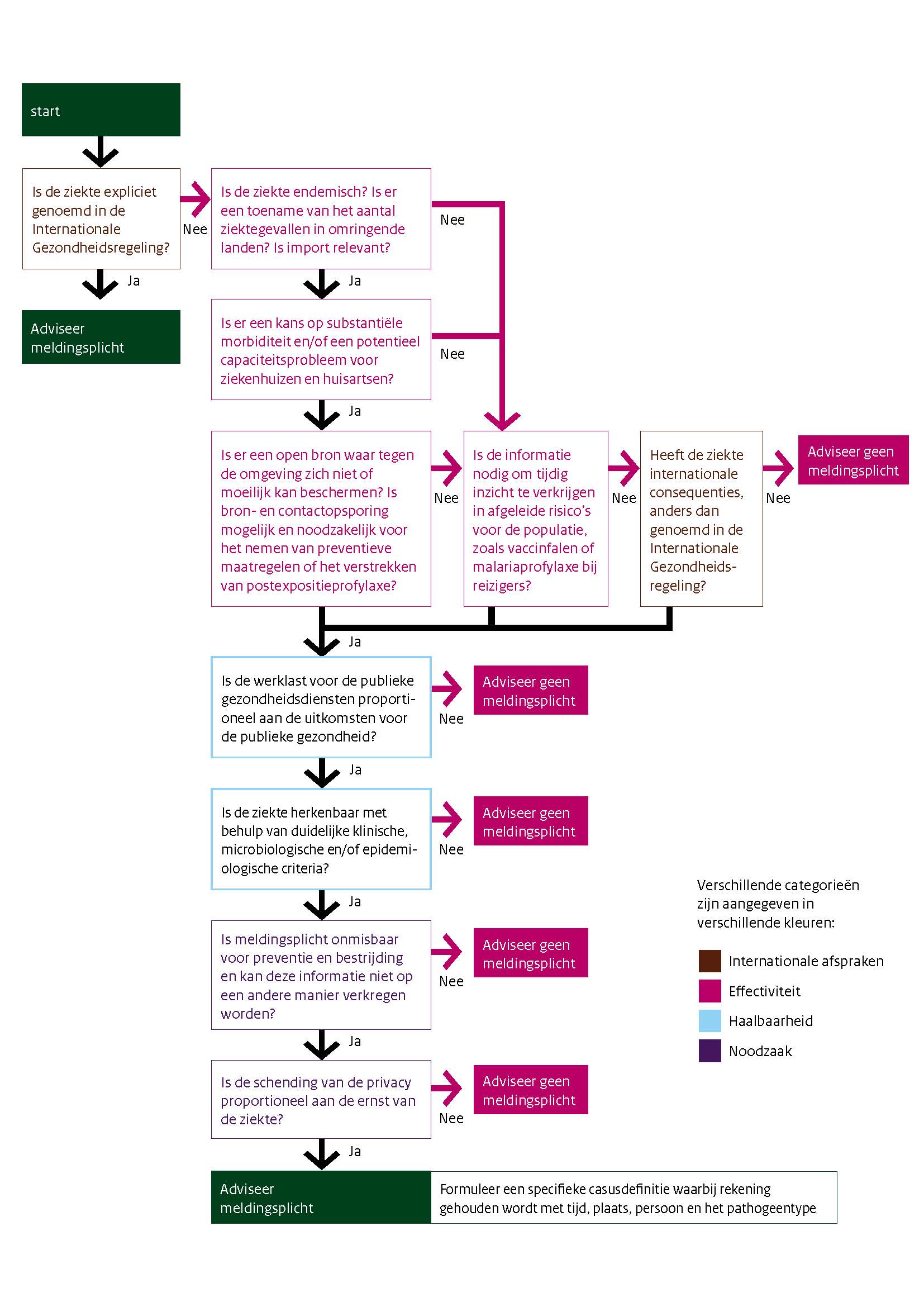
To pick a few: there is no increase in the number of cases in surrounding countries, imports are irrelevant. Endemic? Kuipers said yesterday that he did not, but that doesn't say much, after all, he is not a virologist and works with bizarre percentages that are manipulated graphs to rival.
Kans op substantiële morbiditeit is er ook niet. Ga zo maar door; geen schijn van kans. Van de onderste vier beslispunten leidt er geeneen tot "Adviseer meldingsplicht". Omikron is echt een zacht ei onder de pandemieën.
But yes, this is apparently no longer tested. That is also an explainable habit: after all, we have never had such a rapidly changing disease on the A-List. That makes no sense at all: the usefulness of the list is that you immediately know what to do if a certain disease (re)appears. But a virus whose disease changes character almost every six months is now no longer a shadow of what it was in 2019, when it came fresh from the lab - or from that one pangolin, of course. So what else should you put on that list? The Spanish Flu? This requires a draft motion.
Covid-19 has been declared a pandemic in the International Health Regulations, that would make the obligation to report unavoidable. After all, that means that we are dealing with a worrisome disease. The experts then advise on which Group the disease must be placed. A suitable package of measures has been devised for each Group. But as argued: we no longer have Covid-19 and the Omicron disease has still not been declared a pandemic after more than two months.
The government does not distinguish between viruses that hardly mutate and viruses that can change within a month in such a way that they cause a completely different clinical picture (such as from lungs to throat). Doctors should be on top of that, it is essential.
Oh dear, the future...!
Referring to a possible future catastrophe is a recurring trope that actually suits the powers that be a little too well. They are never held accountable because the catastrophe is invariably averted, of course through decisive action. However, never before has so much misery been caused based on such an uncertain threat out of the blue, in ways that are contrary to the principles of a democratic constitutional state. And that is precisely why a new law is needed: to legally violate fundamental rights.
Now we each house hundreds of thousands of viruses in our bodies (with bacteria together accounting for one and a half kilos), but has that ever been a reason for a toolbox with fundamental rights restrictions? By the way, don't tell Kuipers, who will have a heart attack when he realizes what can happen if even one of all those microorganisms were to mutate malignantly.
Toolbox or App drawer?
What good are we all using tools that restrict fundamental rights: face masks, which have long been clear that they do not stop a pandemic. That can't be it. Lockdowns, which at most spread out the number of deaths over a longer period of time at enormous public health loss and costs... That can't be it.
So why the drive to keep fundamental rights restrictions in the toolbox? The curfew that the incoming Minister of Health, Welfare and Sport determined did not work at all? Is it the flattering positions of advisers and the unbridled room for manoeuvre of the minister? To be important, to join talk shows? Or the preparation for a more technocratically directed society?
So then we have arrived at the CTB, the stepping stone to the EU pass, but would the government really want to be the best child in the EU/WEF class? At the expense of freedom and democracy? Has the Netherlands been put forward as a pilot country, the ideal digital testing ground on top of Europe's most important internet hub? After all, we have the best infrastructure! And you know, technology can't be stopped. And how else are you supposed to distinguish yourself, as a cool little country...
Motion Theunissen on Spanish Flu in group A
The Chamber,
after hearing the debate; whereas Covid-19 has been included in Group A in order to be able to immediately resort to unconstitutional measures in the event of a predetermined coronavirus outbreak, unhindered by parliamentary intervention or other delaying formalities;
Whereas, that this essential protection of public health is lacking in the event of suspicions of other virus outbreaks;
noting, that it is currently not possible to intervene quickly in the event that a vaccine or virus expert foresees an influenza virus outbreak;
calls on the Government to place the Spanish Flu in Group A in order to close this gap;
and expresses as her wish, that in the event of possible imminent flu outbreaks, unconstitutional measures can and will be taken immediately to offer the people the legally prescribed protection.
and proceeds to the order of the day.
Relevant attachments are listed under the previous post
